
A Framework Built From Experience, Now Reaching The World
My impact begins in my classroom, where I teach multilingual learners with disabilities using my A.C.C.E.S.S. Literacy Framework. Every lesson, scaffold, and instructional routine has been refined through classroom implementation and analysis of student growth. Using beginning-of-year and end-of-year data, I continuously adjust instruction to help students strengthen reading comprehension, written expression, vocabulary, and academic confidence. The framework was developed from authentic classroom challenges and remains grounded in evidence-based reflection rather than theory alone. Looking at outcomes in aggregate across all documented years tells a consistent story: most students meet or exceed growth expectations.
How do we know it was the teaching?
This is the hardest question — and the right one. Student growth in a single classroom can’t be attributed to one cause with certainty. But several factors increase the likelihood that these results reflect instructional quality rather than chance.
Consistency Across Schools
The same growth patterns — 70%+ meeting goals, average gains well above expected, a small cohort not responding. Different schools, different student cohorts, same teacher, same results. That’s the strongest signal.
Third-Party Assessments
Every data point here comes from Reading Inventory (Houghton Mifflin), InSight Reading Plus, Read 180, or EBWR rubrics. No teacher-generated test. No grading inflation. The Lexile scale is normed nationally and not influenced by the assessing teacher.
Magnitude of Gains
When a student grows 11 grade-level years in one semester, or a class averages 128 Lexile points when the standard is 50–85, the gap between expected and actual is too large to dismiss as background noise or test variance.
A population most systems stop investing in
What I think gets lost when people look at a single year’s Student Achievement Data score is the population underneath it. The caseloads behind these numbers were never a single, easy-to-serve group. They included 6th graders with documented learning disabilities being assessed on decoding and spelling; 9th-through-12th graders reading multiple years below grade level in a dedicated intervention program; English learners newly arrived in the country being assessed on WIDA ACCESS for both speaking and writing proficiency; and, most recently, a Newcomer population – students who arrived in the school system with little or no prior schooling in English – being scored on the same rigorous, district-approved instruments as everyone else. I did not lower the bar for any of them, and Student Achievement Data does not allow it: the assessments still had to be approved in advance and validated after the fact, regardless of which population sat in front of me that year.
What the +11.2 Years Actually Means: A 9th-grade student began the year at BR (Beginning Reader). By mid-year, the same student was reading independently at 560 Lexile, solidly within 5th-grade range. The expected growth for a Beginning Reader is 220–340 Lexile points per year. This student gained 560 in one semester. That kind of jump doesn’t happen from curriculum alone, it comes from a student who has finally been taught in a way that makes sense to how their brain processes language.
Beyond my own students, I have expanded this work by supporting educators worldwide. Through the A.C.C.E.S.S. Gives initiative, more than 205 teachers have voluntarily joined the professional learning community, collectively reaching over 4,150 students with classroom-ready strategies and resources. My classroom-tested materials have also been adopted by educators across all 50 U.S. states, generating 3,455 resource downloads/sales while maintaining a 0.13% refund rate, demonstrating sustained educator trust and practical classroom value.
Why I believe this is replicable, not just personal
The instructional core underneath these numbers – what I now call the A.C.C.E.S.S. Literacy Framework (Activate, Clarify, Chunk, Engage, Support, Synthesize) – did not exist as a named framework in 2009. It crystallized over years of watching the same pattern repeat: students who had been told, explicitly or through years of low expectations, that grade-level text was not for them, could in fact access it, once someone broke it into the right sequence of steps and refused to lower the bar while doing so. The framework is my attempt to make that sequence teachable to other adults, not just performable by me. I have since introduced this framework with teachers and school leaders in four countries outside my own classroom, in contexts as different as a public high school reading intervention program in Washington, D.C. and multilingual classrooms in the Philippines, Malaysia, India and Myanmar – not because I believe every context is identical, but because I wanted to find out, whether the sequence held up outside of me. That is ongoing work, and I would not claim it is proven at the scale this data represents.
Where The Work Is Going
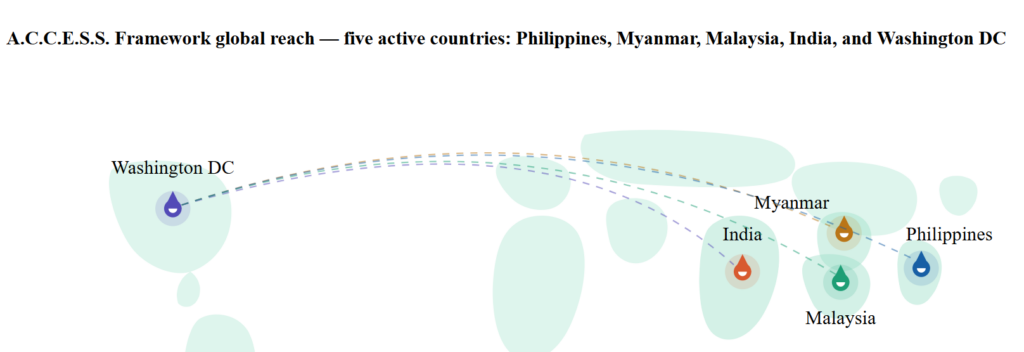
There’s a certain kind of quiet in the dashed lines on that map — the kind that doesn’t show up in a headline, but tells the real story if you look closely enough. Washington, DC sits on the far left, a single point of origin. Everything else on this map exists because of what happened in one bilingual special education classroom over twenty-two years, long before anyone called it a framework.
The line stretches first to Myanmar, where the Gift of Education team took a six-session masterclass and turned it into something measurable — teachers walking away with real, documented gains in confidence, not just goodwill. Then to the Philippines, back to where this all started in some sense, where a school in Iloilo picked up the framework not as an import from a foreign expert, but as something recognizable, something that spoke the same language of bayanihan the framework was always built on. Malaysia followed with a virtual keynote at UPSI — a room full of more than a hundred educators hearing, maybe for the first time, that the gap between “language learner” and “student with a disability” doesn’t have to be a gap at all. And then India, a school visit in Mumbai, teachers and students meeting A.C.C.E.S.S. face to face for the very first time in that hall, on that day.
What this map doesn’t show — what no map can show — is how slow and unglamorous this kind of growth actually is. It isn’t a social media viral moment. It’s real relationship building and nurturing, as what real, strong, education should look like. It’s a virtual masterclass here, an in-person school visit and a presentation, a school pilot there, or a keynote that plants a seed that might not bloom for another year. It’s showing up in person, again and again, in classrooms that don’t look anything alike except in the one way that matters most: they’re full of students the system wasn’t quite built for.
That’s the through-line connecting every dot on this map. A student in Yangon and a student in Mumbai and a student in Iloilo may never meet each other, may never know the others exist. But they’re being taught by teachers who are, in their own classrooms, wrestling with the exact same question — how do you teach a child who needs language support and disability support, when most systems were only ever built to offer one or the other?
The framework didn’t travel because someone marketed it well. It traveled because that question doesn’t have a country. Every dashed line on this map represents someone who recognized their own classroom in someone else’s story, halfway around the world, and reached out anyway.
This is what growing slowly and honestly looks like. Not a tracking chart. Not a press release. Just one more country, one more classroom, one more teacher deciding that the gap their students fall into deserves a real answer — and finding one, carried across an ocean, by someone who built it out of the exact same need.
Five years from now, Maria’s goal is for A.C.C.E.S.S. to be part of a policy, not just a pilot, and to have impacted at least 5,000 teachers and 250,000 students in Southeast Asia. Ten years— she wants herself unnecessary. Because “the best thing I can build is a system strong enough that it doesn’t need me anymore.” This is what makes something genuinely sustainable.
That’s what bayanihan actually means. You build together so no one person has to carry it alone forever.

I further extend my impact through professional development, conference presentations, workshops, and collaborations with schools and education organizations. By sharing practical strategies for inclusive literacy, bilingual special education, AI-supported instruction, and teacher capacity building, I help educators create more equitable learning opportunities for multilingual learners and students with disabilities. My goal is to ensure that effective, classroom-tested practices improve outcomes not only for the students I teach directly, but also for thousands of learners reached through empowered teachers and sustainable instructional leadership.
✅ White Paper: A.C.C.E.S.S. Literacy Framework™
(Page added July 2026)