From One Classroom to a Global Framework
Angala is the teacher who built a bridge where the system built walls.
It isn’t just one wall. It’s that the same bridge — literally the same six-word A.C.C.E.S.S. framework — worked against a pandemic tech gap in Quezon Philippines, a language barrier in Myanmar, a disability-equity gap in Washington D.C., a legal ban on girls’ schooling in Afghanistan, and a bilingual special education-access disparity globally.
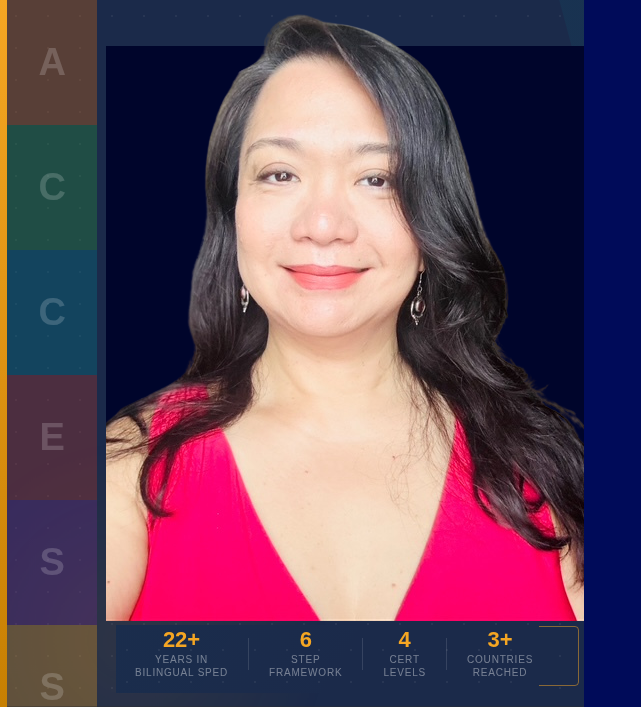
Maria (“Teacher Sol“) is a National Board Certified Teacher with 22+ years of experience in bilingual special education in the inner city schools of Washington DC. She is the founder of BilingualSPED.com, creator of the A.C.C.E.S.S. Literacy Framework™ and The Human Centered AI Teaching Continuum, a NASET Outstanding Special Education Teacher award recipient, UN Representative for DKG International Society for Women Educators, and the first Filipina Fellow of the DC Area Writing Project.
Evidence of Student Growth


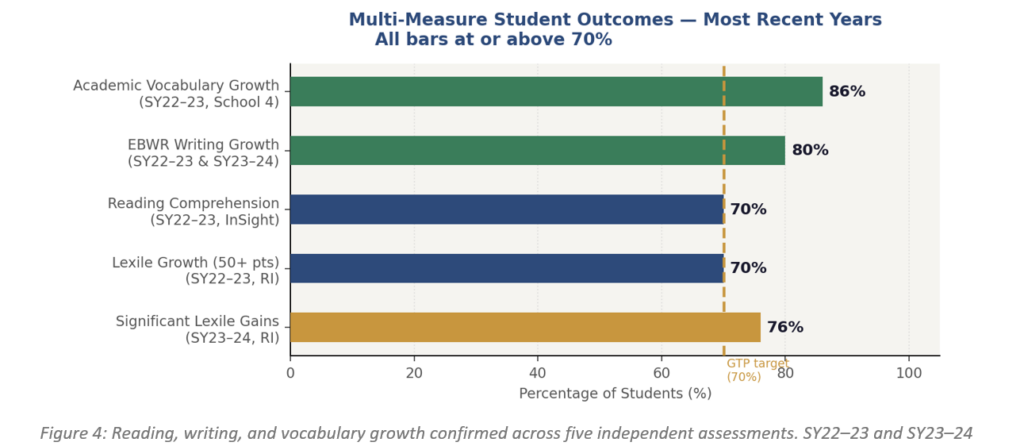
This isn’t a one-good-year story. Three things make that clear.
First, it’s lasted sixteen years, across three different schools, with different administrators, different colleagues, different kids. That rules out the easy explanations — one great class, one easy evaluator. It kept happening no matter who was watching.
Second, it’s not resting on one test. At least seven different assessment systems have picked up the same growth — some vendor-run, some district-run, none of them Maria’s to control.
Third, the students weren’t the same kind of student. Kids with significant learning disabilities. English learners at every level. Newcomers who’d had little or no schooling before they walked into her room. Different populations, same result.
That’s why Maria believes this can travel beyond her. She’s since put a name to the instructional approach underneath all of it — the A.C.C.E.S.S. Literacy Framework — and has started introducing it to teachers and school leaders outside her own classroom, including in multilingual settings across South and Southeast Asia. She’s not claiming that proves it works everywhere. She’s saying sixteen years of validated data gives us a real foundation to go find out.
Across sixteen years, three schools, and at least seven independent assessment systems, the pattern holds: real, measured growth in reading and writing, in students who are statistically the least likely to show it in a single year. That consistency — through every change in school, staff, and student population — shows this isn’t luck. It’s a framework.
The A.C.C.E.S.S. Literacy Framework™ is a research-based instructional system she developed to help teachers make rigorous literacy instruction accessible for diverse learners—especially students receiving Special Education services and English Language Learners. The framework guides teachers through a clear instructional sequence that activates background knowledge, supports vocabulary development, breaks complex texts into manageable steps, and builds students’ ability to analyze and respond with evidence.
At its core, A.C.C.E.S.S. was created by a classroom teacher for real classrooms. The goal is not to simplify academic expectations but to provide intentional scaffolds that help students meet them. Teachers who use the framework report stronger reading comprehension, more confident writers, and greater engagement from students who previously struggled to access grade-level texts.
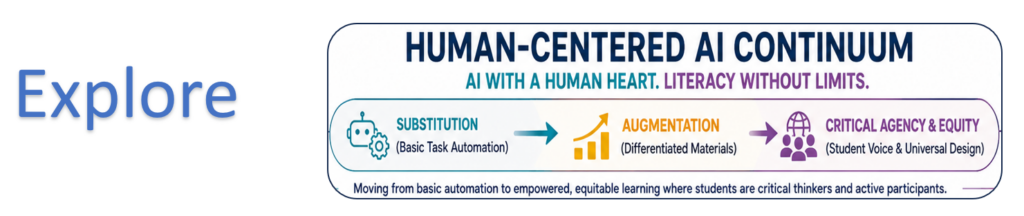
As a recognized Exceptional Needs Specialist and publisher of AI-assisted systems, Angala also developed the Human Centered AI Teaching Continuum to prevent marginalized, neurodivergent, and multilingual learners from falling through the cracks of the digital divide. The continuum functions as a guide for moving teachers away from standard tech substitution toward full, equity-driven AI integration. Angala brings a boots-on-the-ground, intersectional approach, and represents the bridge between theoretical HCAI standards and frontline equity. Through her innovative work, she provides the specific instructional methodology ensuring these technologies are accessible to neurodiverse and multilingual populations. A core issue in HCAI is preventing students from completely outsourcing their thinking to an LLM. Angala tackles this by training special educators on how to “prime” AI prompts specifically for neurodiverse learners. Instead of letting the AI write the essay for a struggling student, her frameworks use A.C.C.E.S.S. AI Instructional Systems she built to generate highly customized, granular scaffolds (like customized graphic organizers or chunked reading interventions) that reduce formatting friction while keeping the actual cognitive heavy lifting entirely on the student.
Her international work, made possible by A.C.C.E.S.S. Gives, includes a keynote at UPSI Malaysia, introducing the A.C.C.E.S.S. Framework in Iloilo and Mulanay, Quezon in the Philippines, advising Gift of Education Myanmar, and a recent visit in Mumbai. Her memoir, Teacher Sol: A Memoir of Leaving, Surviving, and Coming Back to Help Change Everything, was published in June 30, 2026.
✅ White Paper: A.C.C.E.S.S. Literacy Framework™
👉 Explore Classroom-Tested Resources

Collaborative Systems Work. It’s called “Bayanihan”.
Long before BilingualSPED.com existed, Maria established a tutoring center (Funshine) for children with special needs in Quezon City, Philippines — the direct root of the classroom-grants program and of the organization’s broader philosophy of “bayanihan”, the Filipino tradition of communal support in which a community lifts a house together, no one carrying a corner alone.
Maria believes that teaching is “bayanihan”. She has worked on collaborative learning teams where teachers plan together, problem-solve together, and hold each other accountable — not in a punitive way, but in a “we’re all trying to get better” way.
Maria has supported cross-role collaboration — general educators, special educators, ESL specialists, counselors, all teachers pulling in the same direction for the same kids. She has pushed for data-informed decision-making that’s useful, not just compliance paperwork.
And she has fought for equitable access. Not just in theory, but in practice — making sure students with disabilities and English learners get the same rigorous content, the same high expectations, and the same shot at success as everyone else.
This is bayanihan — the Filipino tradition of a community lifting a house together, so no one carries a corner of it alone. And it’s the Origin of A.C.C.E.S.S Gives – our Giving Mission.
We have many promising initiatives underway.
Whether you’re a humanitarian, a potential partner, an advocate, a superintendent, a school leader, a SPED teacher, an ELL specialist, an instructional coach, or a general ed teacher suddenly supporting students with diverse needs—you’re in the right place.
Work with us: solangala@yahoo.com
(Last updated: July 2026)