Meta description: The “AI is coming for teaching jobs” narrative gets the whole thing backwards. This post breaks down why the strongest AI tools in education are built to strengthen planning, assessment, differentiation, and instructional decision-making — not replace the professional judgment only a trained teacher brings. Written from 22+ years in bilingual special education, not a tech company’s roadmap.
The Question I Get Asked at Every Single PD Session
Somebody always asks it, usually in the first ten minutes: “Is this eventually going to replace us?” And I get why. It’s a fair question, and honestly, kind of an exhausting one to keep answering, because the framing itself is off from the start.
Here’s my honest answer, the same one I give every time: no. Not because I’m trying to make anyone feel better. Because the actual research keeps landing in the same place. A 2024 World Economic Forum report found that 78% of education experts believe AI will augment teachers’ work, not replace it. Not a slim majority. Not a coin flip. Nearly four out of five people whose job it is to study this professionally.
And in special education specifically? The idea of AI replacing us gets even less plausible, fast. My job on any given day includes reading a kid’s body language before a meltdown, adjusting a lesson mid-sentence because I can tell the visual support I planned isn’t landing, and knowing which family needs a phone call instead of an email because of history I’ve built with them over years. None of that is something a model trained on text can do. It’s not even close.

So let’s dig into what AI actually amplifies in good teaching, what it definitely does not touch, and how you can start using it in a way that makes you sharper at your job instead of quietly outsourcing the parts that make you good at it.
Why Does the “AI Will Replace Teachers” Narrative Keep Showing Up Anyway?
Honestly? Because it’s a better headline than the boring, accurate version. “AI augments teacher expertise” doesn’t generate the same clicks as “Will Robots Replace Your Teacher?” But the actual consensus among researchers is remarkably consistent — a 2026 industry trends report pointed to both McKinsey’s 2025 research and the OECD’s Education 2030 framework as landing squarely on the same conclusion: AI will augment, not replace, teachers.
It’s also worth naming the flip side of this fear, because it matters: adoption is climbing fast whether the narrative catches up or not. The share of K-12 teachers using AI tools in their classrooms nearly doubled between 2023 and 2025, jumping from 34% to 61%. And professional development is finally starting to keep pace — teachers receiving formal AI training jumped from just 13% in 2023 to 50% by fall 2025. That’s still not universal, and that gap matters (I’ve written about it elsewhere), but the direction is right.
Quick Win: Next time someone brings up “AI replacing teachers” in a staff meeting, redirect the conversation to a more useful question: what specifically will this tool take off my plate, and what stays entirely mine? That framing gets you further than the fear does.
What Does AI Actually Strengthen in Good Teaching?
1. Planning — Faster Drafts, Not Finished Decisions
AI can generate a first-pass lesson plan, a differentiated version of a text, or a set of discussion questions in minutes. What it can’t do is know that your student with a specific learning disability needs the reading chunked into smaller pieces than the AI defaulted to, or that another student needs the whole thing translated and paired with a photograph-based visual support instead of an icon. That adjustment is yours. Every time.
I built a full toolkit specifically around this workflow — AI-assisted drafting paired with the specific adjustments special education requires, sensory accommodations, multilingual visual supports, and social stories included — because starting from scratch every time was eating hours I didn’t have. If you want the ready-made version of what I’m describing here, grab the AI-Supported IEP Writing Toolkit on TpT.

2. Assessment — Faster Feedback, Human Interpretation
AI does well with instant feedback on objective assessment items — think multiple choice, fill-in-the-blank, basic comprehension checks. What it doesn’t do well, and shouldn’t be trusted to do alone, is interpret why a student is struggling. A wrong answer could mean a skill gap, a language barrier, a sensory overload moment during the test, or something entirely unrelated to content knowledge. That interpretation takes a teacher who knows the kid.
Tools worth trying for this piece:
- Diffit for generating leveled comprehension questions you then interpret against what you know about each student
- Otter.ai for transcribing verbal assessments or check-ins so you can review responses more carefully afterward, instead of relying on memory
3. Differentiation — Scale Without Losing Specificity
This is where AI genuinely shines, and I don’t say that about much ed-tech. Generating three or four leveled versions of the same text, in multiple languages, used to eat an entire planning period. Now it takes minutes. But — and this matters — the AI-generated version is a draft, not a finished differentiated resource. You’re still the one deciding whether the vocabulary support is enough, whether a social story needs to accompany the lesson for a student who struggles with transitions, whether the visual schedule needs photographs instead of drawings for a particular kid.
4. Instructional Decision-Making — Where Human Judgment Stays Fully in Charge
AI can surface a pattern — this student’s engagement dropped during this unit, this group is struggling with this specific skill. It cannot decide what to do about it. That decision requires knowing the whole kid, not just the data point. Researchers studying this exact augmentation-versus-replacement question found that professionals who use AI well treat it as an accelerant to their own knowledge and judgment, not a replacement for it — verifying outputs rather than trusting them blindly. That’s the posture that matters here, in a cybersecurity training context and in a classroom, honestly, for the exact same reasons.
Quick Win: Before accepting any AI-generated instructional recommendation, ask: does this match what I already know about this specific student? If it doesn’t, trust what you know. The AI doesn’t have your history with this kid.
A Lesson Where AI Sharpened My Decisions Instead of Making Them For Me
Classroom context: A small group working through a reading comprehension unit — one student who’s an emergent bilingual, one student with a specific learning disability who also needed sensory regulation support built into the lesson structure.
The instructional challenge: I needed differentiated texts fast, in two languages, with comprehension questions pitched at the right level for each student — plus a plan for the sensory-sensitive student that didn’t just bolt a break onto the end of the lesson as an afterthought.
The lesson approach: I used an AI tool to generate three leveled versions of the reading passage and translate one into the student’s home language. Then I did the actual teaching decision-making myself: I added a photo-based visual schedule showing exactly when breaks would happen, built a short social story about the reading routine since transitions were the real trigger point (not the reading itself), and adjusted the AI-generated comprehension questions because two of them assumed background knowledge neither student actually had yet.
Student response: The emergent bilingual student engaged with the passage far more confidently reading it first in her home language, then cross-referencing the English version — something I’ve noticed works consistently well, and something no AI tool suggested on its own; that came from watching how she’d approached other bilingual texts all year. The student needing sensory support got through the full lesson without a meltdown, largely because the break schedule was visible and predictable, not because the reading itself got easier.
Teacher reflection: I’ll admit the AI-generated comprehension questions looked totally reasonable at first glance — polished, grammatically clean, the whole thing. But two of them assumed cultural or background knowledge I knew these specific students didn’t have yet, and I almost didn’t catch it because the questions read so confidently. That’s the trap with AI output in general — it sounds sure of itself even when it’s missing something important.
What I’d refine next time: I’d build a quick pre-check habit — reviewing any AI-generated question set specifically against “would this assume something my current students don’t yet know” — instead of trusting polish as a proxy for accuracy. Small habit, but it would’ve caught the issue faster.
Want a starting structure for exactly this kind of AI-assisted-but-teacher-finalized planning? The AI-Supported IEP Writing Toolkit is built around that same principle — check it out on TpT here.
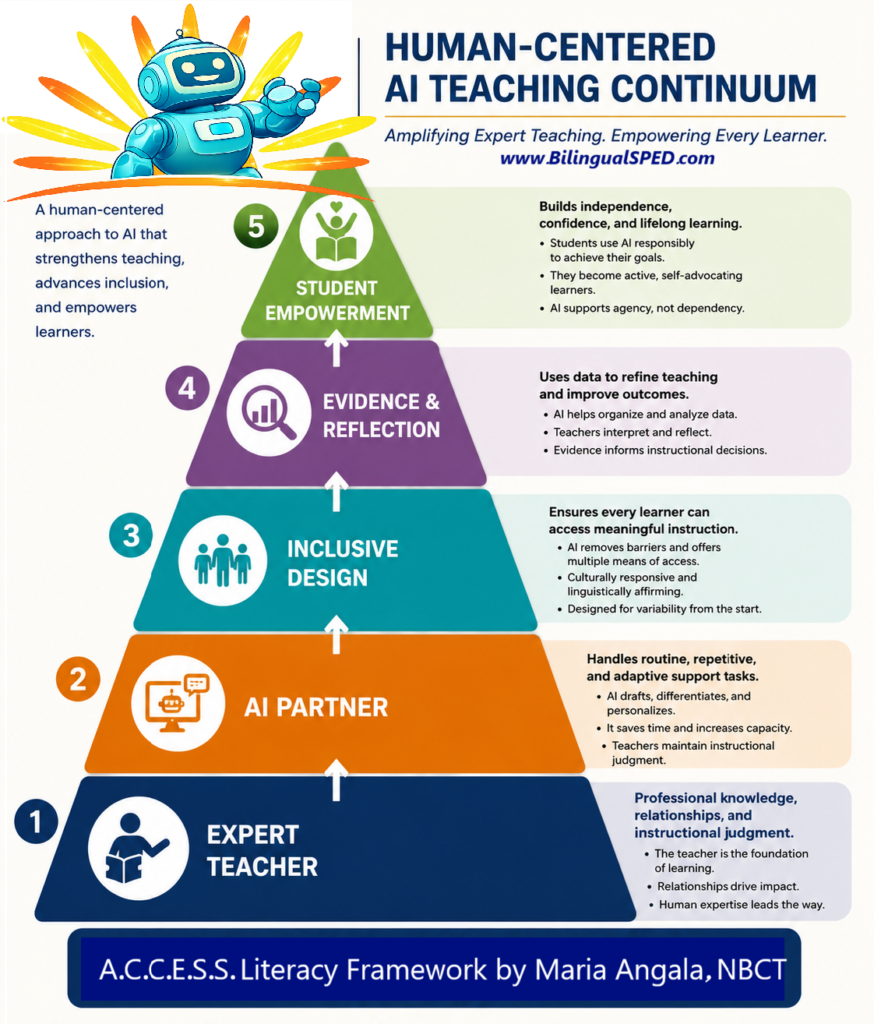
I developed a Human-Centered AI Teaching Continuum embedded within the A.C.C.E.S.S. Literacy Framework to guide educators in using AI ethically and effectively to amplify expert teaching for multilingual learners and students with disabilities.
What AI Still Cannot Do — And Why That’s the Whole Point
Researchers who study why teachers remain irreplaceable describe us, somewhat beautifully I think, as “wisdom workers” — people who apply knowledge ethically to benefit many, who build authentic relationships, read nonverbal cues, and offer comfort during hard moments. No algorithm replicates that. Not because the technology isn’t advanced enough yet, but because that work was never a data problem to begin with.
One researcher framed it with a question I’ve started using myself when evaluating any new tool: what will this replace, what will it augment, and how might it go wrong? Applied honestly, that question keeps you from either rejecting AI out of fear or handing it more trust than it’s earned.
Quick Win: Run every new AI tool through that three-part question before adopting it in your classroom: what does it replace, what does it augment, and where could it go wrong for your specific students? Takes five minutes and saves you from both extremes.
Frequently Asked Questions
Will AI eventually replace special education teachers?
No — the research consensus, including McKinsey and OECD analysis, consistently finds AI augments teacher work rather than replacing it. This holds especially true in special education, where relationship-building, behavioral interpretation, and individualized decision-making require human judgment AI cannot replicate.
What’s the difference between AI that amplifies teaching and AI that undermines it?
Amplifying AI speeds up drafting, generates first-pass differentiation, and surfaces patterns — while leaving every actual instructional decision with the teacher. Undermining AI gets treated as a final answer instead of a draft, skipping the human review step that catches errors, bias, or missed context.
How can new teachers start using AI without over-relying on it?
Start with low-stakes tasks — first-draft lesson differentiation, generating discussion questions — and always build in a review step where you check the output against what you actually know about your specific students. Treat AI as a fast intern, not a decision-maker.
References
- World Economic Forum data cited via HTL International School, “Can AI Replace Teachers? The Truth About Learning in 2026” (2026)
- X-Pilot, “AI in Education 2026: 7 Trends Reshaping Teaching” (2026)
- Forbes, “Will AI Replace Teachers? What Experts Say Is Changing” (2026)
- University of Rochester Newscenter, “How AI Is Reshaping Teaching and Learning in Schools” (2026)
- arXiv preprint, “Automated but Atrophied? Student Over-Reliance vs Expert Augmentation of AI in Learning and Cybersecurity” (2025)
Where to Go From Here
The teachers who’ll do best in this next stretch of AI adoption aren’t the ones who reject it, and they’re not the ones who hand over every decision to a chatbot either. They’re the ones who stay firmly the expert in the room — using AI to draft faster, differentiate at scale, and surface patterns worth noticing, while every actual judgment call about a real kid stays exactly where it belongs. With you.
If you want a framework that already balances that trade-off — AI-assisted drafting, teacher-finalized decisions — the AI-Supported IEP Writing Toolkit is available on TpT here.
Want more honest, classroom-tested thinking on where AI actually helps and where your expertise still leads? Sign up for my email newsletter and I’ll send new strategies straight to your inbox.
Reflection question: Think of one instructional decision you made this week that no AI tool could have made for you. What did you draw on to make that call — and how might naming that help you trust your own expertise a little more the next time a shiny new tool shows up?
You Might Also Like
More strategy and tools like this over at the BilingualSPED.com blog — including posts on the A.C.C.E.S.S. Literacy Framework, instructional decision-making, and building teacher confidence in an AI-integrated classroom.