Look, I’m going to be honest with you. When I first started teaching special education, I thought the curriculum would be all about academics. Reading comprehension. Math facts. Writing paragraphs.
I was so wrong.
The real game-changer? Teaching a student how to brush their teeth independently. How to sort laundry. How to ask for help at a grocery store. These weren’t “extras”—they were everything.
And here’s the thing most teacher prep programs won’t tell you: if your students can’t navigate daily living tasks, all those academic gains mean a whole lot less in the real world. I learned this the hard way during my first IEP meeting when a parent asked me, “But will he be able to live on his own someday?”
I didn’t have an answer. Not a good one, anyway.
That moment changed how I teach.
Why February (Dental Health Month) Matters More Than You Think
February is Dental Health Month, which honestly used to feel like just another theme month to me. Until I realized that dental hygiene is one of those critical life skills that directly impacts employment, social relationships, and overall health for our neurodivergent learners.
Think about it. A student who can’t maintain personal hygiene independently faces real barriers to job success, community inclusion, and relationship building. The stakes are genuinely high.
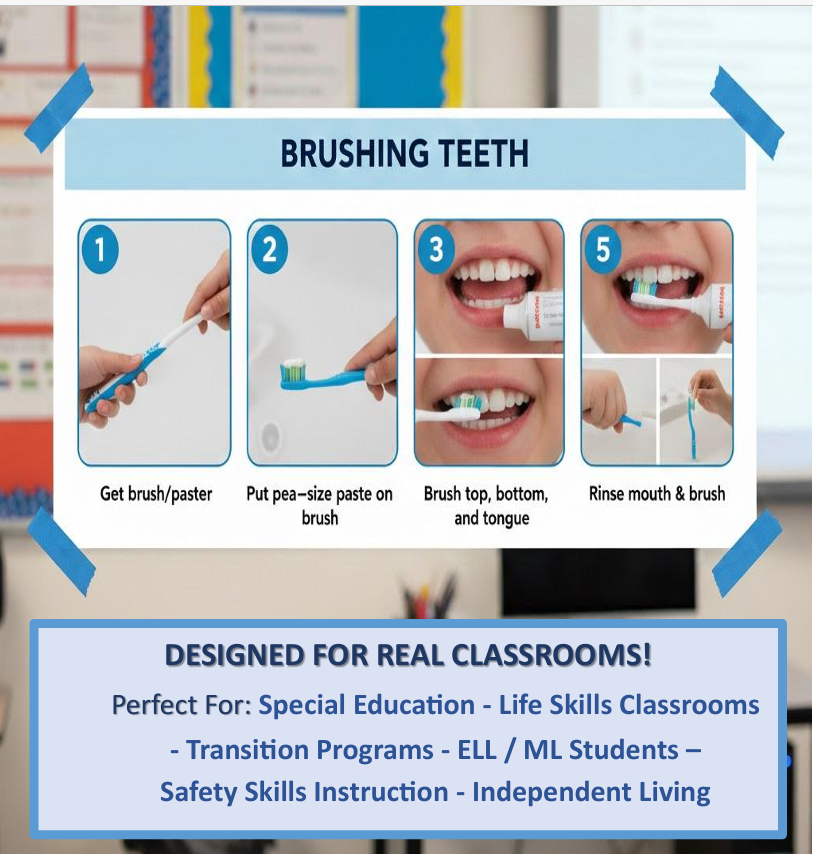
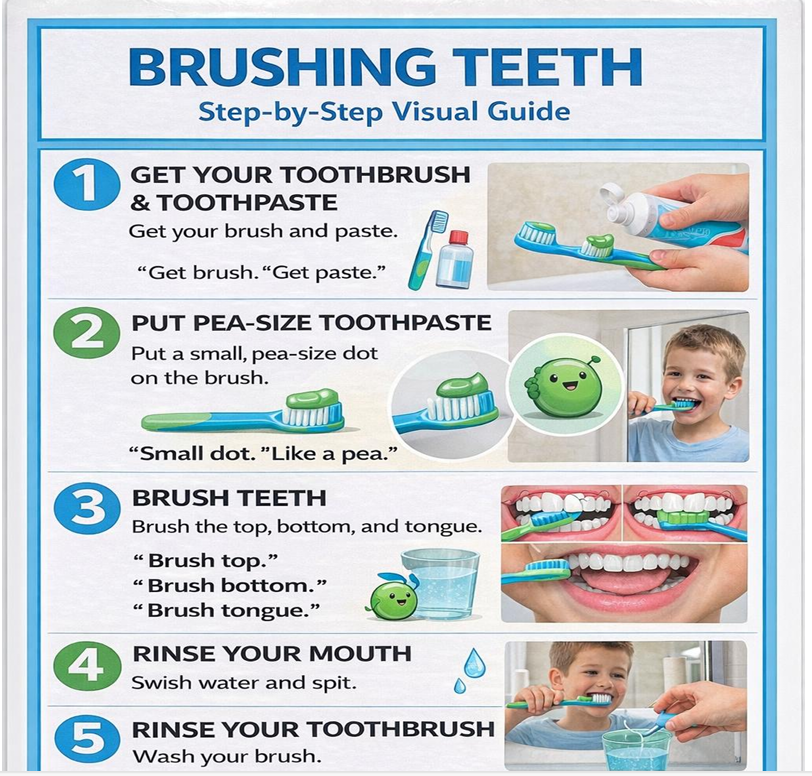
That’s why I created this step-by-step visual guide for brushing teeth. Not because I’m obsessed with dentistry, but because I watched too many students struggle with something that seems “simple” to neurotypical people but is actually incredibly complex when you break it down.
The guide uses task analysis—breaking the skill into tiny, manageable steps with visual supports. Because our students deserve tools that actually work, not just worksheets that look pretty.
The Problem Nobody Talks About
We’re graduating students from special education programs who can identify shapes and colors but can’t pack a lunch. Who can recite multiplication tables but panic when ordering at a restaurant. Who have amazing artistic talents but don’t know how to do laundry.
And whose fault is that? Ours. The system. The obsession with standardized testing and academic benchmarks that completely miss the point of what education should be for students with significant support needs.
I’ve noticed this gap is especially painful for families. Parents tell me all the time: “I won’t be around forever. Who’s going to help them when I’m gone?” It keeps them up at night. And it should keep us up at night too.
Building a Transition-Focused Classroom: Where to Start
Here’s what worked for me, and I promise I’m not trying to sell you some perfect Instagram-worthy classroom fantasy. This is messy, real-world stuff.
Start with a Skills Assessment (The Real One)
Forget the standardized assessments for a minute. I’m talking about actually watching your students navigate real tasks. Can they:
- Wash their hands properly?
- Make a simple snack?
- Tell time well enough to know when lunch happens?
- Cross a street safely?
- Use a phone to call for help?
Make a list. Be specific. And prepare to feel overwhelmed because the list will be long.
But here’s the thing—you don’t have to tackle everything at once. Pick one domain to start. For me, it was personal hygiene because it had the biggest immediate impact on my students’ social inclusion.
Create Visual Supports That Actually Work
Visual supports are everywhere in special education. Most of them suck. Sorry, but it’s true.
They’re too cluttered. Too many words. Colors that are distracting rather than helpful. Clip art that looks like it’s from 1997.
What works instead:
- Clear, high-contrast photos of the actual steps
- Minimal text (or text in multiple languages for ELL students)
- Sequential numbering that’s obvious
- Real objects when possible, not cartoon versions
The brushing teeth visual guide I use follows this format exactly. Real photos. Clear steps. Available in multiple languages because our ELL students with disabilities need support too, and they’re often underserved in this space.
I’ve also found success with apps like Choiceworks for creating visual schedules and Model Me Going Places for social stories about community experiences. Both have free trial versions you can test before committing.
Embed Skills into Your Daily Routine
You don’t need a separate “life skills block” if you’re creative about it. Actually, separate blocks can make generalization harder because students learn the skill in one isolated context.
Instead, try this:
- Snack time = cooking skills, following recipes, measuring
- Arrival routine = personal hygiene check, clothing management
- Classroom jobs = vocational skills, following multi-step directions
- Transitions = time management, following schedules
In my experience, students learn way better when skills are embedded naturally. Plus it makes your job easier because you’re not creating tons of separate lesson plans.
The Sensory Piece You Can’t Ignore
Okay, real talk. I used to think sensory accommodations were optional. Like, “Oh, if we have time, we’ll address sensory needs.”
Wrong. So wrong.
For many neurodivergent learners, sensory challenges are the barrier preventing skill acquisition. A student can’t learn to brush their teeth if the toothbrush texture makes them gag. They can’t practice crossing the street if the sound of traffic sends them into sensory overload.
Practical Sensory Accommodations for Life Skills
For tooth brushing specifically:
- Try different toothbrush types (soft bristles, electric vs manual, different handle grips)
- Experiment with toothpaste flavors (unflavored exists!)
- Use a visual timer so students know how long to brush
- Practice with just water first, no toothpaste
- Consider playing preferred music during brushing to create positive associations
I use Time Timer constantly—both the physical version and the app. Visual timers are game-changers for students who struggle with time concepts or need to see how long an uncomfortable sensory experience will last.
For other hygiene and daily living tasks:
- Tagless clothing for dressing practice
- Unscented soap options
- Noise-canceling headphones for community outings
- Weighted lap pads during seated tasks like meal prep
- Dimmer lighting options if fluorescents are overwhelming
The Zones of Regulation framework is super helpful here. It gives students language to communicate their sensory state and strategies to regulate. There’s a great app version too that makes it more interactive.
Social Stories: Your Secret Weapon
Social stories get a bad rap sometimes because people create these long, wordy narratives that students zone out on. But when done right? They’re incredibly powerful.
A good social story:
- Describes a situation from the student’s perspective
- Explains what will happen and why
- Suggests appropriate responses
- Includes visuals that match the text
- Is SHORT (seriously, keep it brief)
For hygiene tasks like tooth brushing, a social story might explain why we brush teeth, what will happen during brushing, and how the student might feel afterward. It normalizes the sensory experience and provides a script for what to expect.
I create most of mine using Book Creator because students can record themselves reading the story, which helps with both literacy and self-advocacy skills. Plus you can embed videos and interactive elements.
The visual hygiene guide works beautifully alongside social stories because you’re hitting the skill from multiple angles—the why (social story) and the how (task analysis).
Multilingual Supports for ELL Students with Disabilities

Can we talk about how ELL students with disabilities are often left out of life skills instruction? It’s honestly one of the most frustrating gaps I see.
These students need visual supports in their home language. They need social stories that reflect their cultural context. They need vocabulary instruction that includes daily living terms, not just academic language.
Some strategies that work:
- Collaborate with ESL teachers to get translations of key vocabulary
- Use universal symbols when possible (like the international symbols for restroom, no smoking, etc.)
- Include family members in creating cultural relevant examples
- Provide take-home versions of visual supports in home language
- Use photo-based visuals that transcend language barriers
The Google Translate app has a camera feature that’s surprisingly useful for quick translations of signs and labels during community-based instruction. Not perfect, but helpful.
Apps like Proloquo2Go offer AAC supports in multiple languages, which is critical for students who need communication devices and are learning English.
Building Toward Independence: The Long Game
Independence doesn’t mean doing everything alone. Let’s kill that myth right now.
Independence means:
- Knowing when you need help
- Being able to ask for help appropriately
- Having strategies to solve problems
- Understanding your own needs and preferences
For some students, independence looks like completing a full morning routine without prompts. For others, it looks like using a visual checklist to get through part of the routine and asking for help with the rest.
Both are wins.
Creating a Task Analysis for Any Skill
Here’s my process, and you can use this for literally any life skill:
- Do the task yourself while noting every single micro-step
- Break it down further than seems reasonable (you can always combine steps later)
- Test it with a student and see where they get stuck
- Revise based on what you observe
- Create visuals for each step
- Practice, practice, practice with fading prompts over time
When I created the tooth brushing guide, I literally stood in my bathroom and brushed my teeth while counting each action. Wet toothbrush. Apply toothpaste. Brush front teeth. Brush back teeth. And so on. It felt ridiculous, but it works.
Data Collection Without Losing Your Mind
I know, I know. Data collection is the worst part of special education. But for life skills, you actually need good data to show progress and justify why you’re spending instructional time on these tasks.
Keep it simple:
- Use a basic checklist of steps from your task analysis
- Note the prompt level needed for each step (independent, verbal, gesture, model, physical)
- Track once or twice a week consistently rather than sporadically
- Graph it visually so progress is obvious to families and administrators
I use Google Forms for quick data collection on my phone. Create a form with your task analysis steps, note prompt levels, and the data automatically goes into a spreadsheet. Takes literally 30 seconds per student.
Workforce Skills: Connecting to Real Employment
Life skills instruction isn’t just about self-care. It’s about preparing students for actual employment, which requires a whole different skill set.
Some students I’ve worked with have gone on to:
- Stock shelves at grocery stores
- Work in restaurant kitchens
- Provide janitorial services
- Assist in daycare centers
- Do data entry
- Work in landscaping
Every single one of these jobs requires task initiation, following multi-step directions, asking for help when needed, and managing personal hygiene. See how it all connects?
Building Pre-Vocational Skills
Start early with classroom jobs that mirror real work:
- Attendance helper (data entry, following a list)
- Lunch count (math, recording information)
- Recycling manager (sorting, following routes)
- Supply organizer (categorizing, inventory)
- Tech support (troubleshooting, assisting others)
According to the National Center on Disability and Journalism, employment rates for adults with disabilities remain significantly lower than the general population. We can change that by prioritizing functional skill instruction starting in elementary school.
Use apps like First Then Visual Schedule to help students follow work-based routines independently. It’s simple but effective.
Common Pitfalls (That I’ve Definitely Fallen Into)
Pitfall #1: Assuming students will generalize skills automatically.
They won’t. You have to explicitly teach the skill in multiple settings with different materials and people. That tooth brushing routine you practiced at school? Practice it at home, at grandma’s house, on vacation. Otherwise students learn “I brush my teeth in the school bathroom with Ms. Teacher” rather than “I brush my teeth.”
Pitfall #2: Making supports too complicated.
If you need a 10-minute explanation to use the visual support, it’s not going to work. Keep it stupid simple. One of the reasons the step-by-step hygiene guide is effective is because it’s dead simple to use.
Pitfall #3: Forgetting to celebrate small wins.
Learning to put toothpaste on a toothbrush independently might not seem like a huge deal to you. To a student who’s never done it? It’s massive. Celebrate it. Document it. Share it with families.
Pitfall #4: Not involving families enough.
Parents and caregivers are your partners in this. They know their kids better than anyone. Plus, skills need to be practiced at home for true independence. Send visuals home. Make videos. Host training sessions. Whatever it takes.
The Research Backs This Up
Don’t just take my word for it. Research consistently shows that functional life skills instruction leads to better post-school outcomes for students with disabilities.
The National Technical Assistance Center on Transition (NTACT) provides evidence-based practices showing that teaching daily living skills significantly improves independent living outcomes. Their research is gold if you need to justify your approach to administrators or IEP teams.
Plus, the Council for Exceptional Children has published multiple studies demonstrating that task analysis with visual supports is one of the most effective instructional strategies for students with intellectual disabilities and autism.
This isn’t fluffy feel-good teaching. It’s evidence-based practice that changes lives.
Frequently Asked Questions
Q: How do I balance academics with life skills instruction when there’s already not enough time in the day?
A: Stop thinking of them as separate. Embed academic skills into life skills instruction. Following a recipe teaches reading and math. Creating a shopping list teaches writing and planning. Telling time is necessary for catching the bus. It all connects. Also, have honest conversations with your IEP team about priorities. For some students, functional skills will and should take priority over traditional academics.
Q: What if parents don’t see the value in life skills instruction and just want academics?
A: This is tough. I usually ask parents to envision their child at age 25. What does independence look like? What skills will matter most? Sometimes showing data on employment outcomes and independent living statistics helps. Also, framing life skills as “applied academics” can help parents see the connection. And honestly? Some parents need time to process and grieve expectations before they can embrace a more functional approach. Be patient and keep communicating.
Q: How do I teach hygiene skills without embarrassing students or violating their dignity?
A: Great question. Privacy is critical. Teach hygiene skills in small groups or one-on-one, never in front of the whole class. Use neutral, clinical language rather than making it personal. Focus on the routine and steps rather than pointing out when a student smells or looks unkempt. And always, always give students choices and control within the routine whenever possible. Their dignity matters more than perfect technique.
Your Action Plan for Tomorrow
Okay, you made it this far. Now what?
Here’s what I want you to do:
This week:
- Pick ONE life skill to focus on
- Create or find a task analysis for that skill (or grab the tooth brushing guide if hygiene is your starting point)
- Try it with one student
- Take notes on what works and what doesn’t
This month:
- Embed that skill into your daily routine
- Collect some basic data
- Share the visual support with families
- Adjust based on what you’re seeing
This year:
- Expand to multiple life skills across domains
- Build a resource library of task analyses
- Train paraprofessionals and family members
- Document student growth for IEP meetings
You’ve got this. And on the days when it feels overwhelming (which will be most days, let’s be real), remember why this matters. You’re not just teaching skills. You’re opening doors to independence, employment, and quality of life that might otherwise stay closed.
Let’s Stay Connected
Teaching students with significant support needs can feel isolating. You’re working on skills that don’t show up on standardized tests. You’re celebrating victories that other people might not understand. You’re fighting battles that exhaust you.
But you’re not alone.
I share resources, real-talk reflections, and practical strategies for special educators through my email newsletter. No fluff. No toxic positivity. Just honest support from someone who gets it.
Before You Go: A Question to Sit With
Think about your students. Really picture them in 10 years.
What skill—if they mastered it—would have the biggest impact on their independence and quality of life?
Not what the curriculum says. Not what the standardized test measures. What actually matters for their life?
Drop a comment and let me know. I read every single one, and I’d love to hear what you’re working on.
Because this work? It matters more than we sometimes realize. Every visual support you create, every task analysis you teach, every moment you spend celebrating a student’s growing independence—it’s building toward something real.
Keep going. Your students are lucky to have you.
Looking for ready-made visual supports to get started? Check out this comprehensive tooth brushing task analysis guide that includes multilingual supports and sensory accommodations. It’s a perfect example of how life skills instruction can be both effective and accessible for diverse learners.