Every field has that one image.
The one that shows up in conference slides, gets pinned to classroom walls, and becomes so familiar that people recognize it before they even read the label. Scarborough’s Reading Rope. The UDL Guidelines wheel. Simple visuals that carry enormous weight because they make something complicated feel true in a way that words alone can’t quite do.
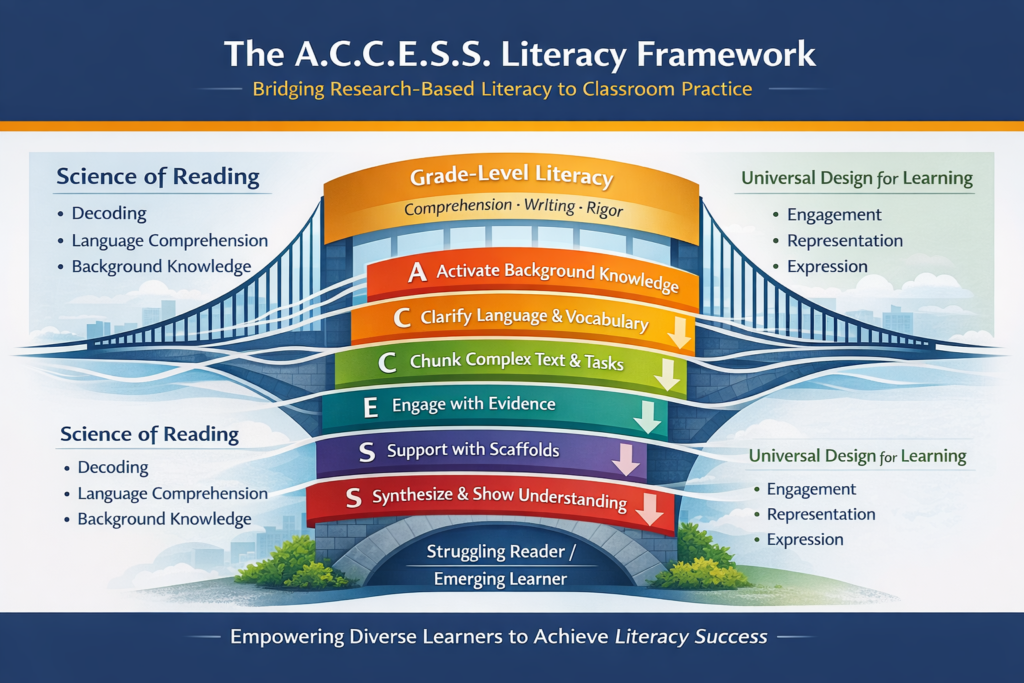
That’s what I set out to build with the A.C.C.E.S.S. Literacy Framework™ signature image. Not just a diagram. A visual that teachers, coaches, and literacy leaders look at once—and immediately understand where every struggling reader lives, and exactly what it takes to get them somewhere better.
So let’s talk about why this image is a bridge. Not just metaphorically. Structurally.
The Bridge Isn’t Decoration. It’s the Argument.
Here’s what strikes me every time I look at this image: the bridge isn’t background art. It is the framework.
Think about what a bridge actually does. It connects two places that can’t reach each other on their own. It bears weight—real weight, distributed across its entire structure. And the stronger the foundation underneath, the more load it can carry. Remove one support and the whole thing becomes unreliable. That’s not poetic. That’s engineering.
The A.C.C.E.S.S. Literacy Framework™ works the same way.
At the top of the bridge: Grade-Level Literacy—comprehension, writing, rigor. That’s where we’re going. That’s the destination every student deserves to reach, regardless of their reading level, their language background, or the label in their IEP.
At the foundation of the arch: Struggling Readers and Emerging Learners. That’s where so many of our students currently are—not because they lack intelligence or effort, but because the bridge between where they are and where they need to be hasn’t been built for them yet.

The six colored layers of the bridge? Those are the spans. The intentional instructional sequence that holds everything up.
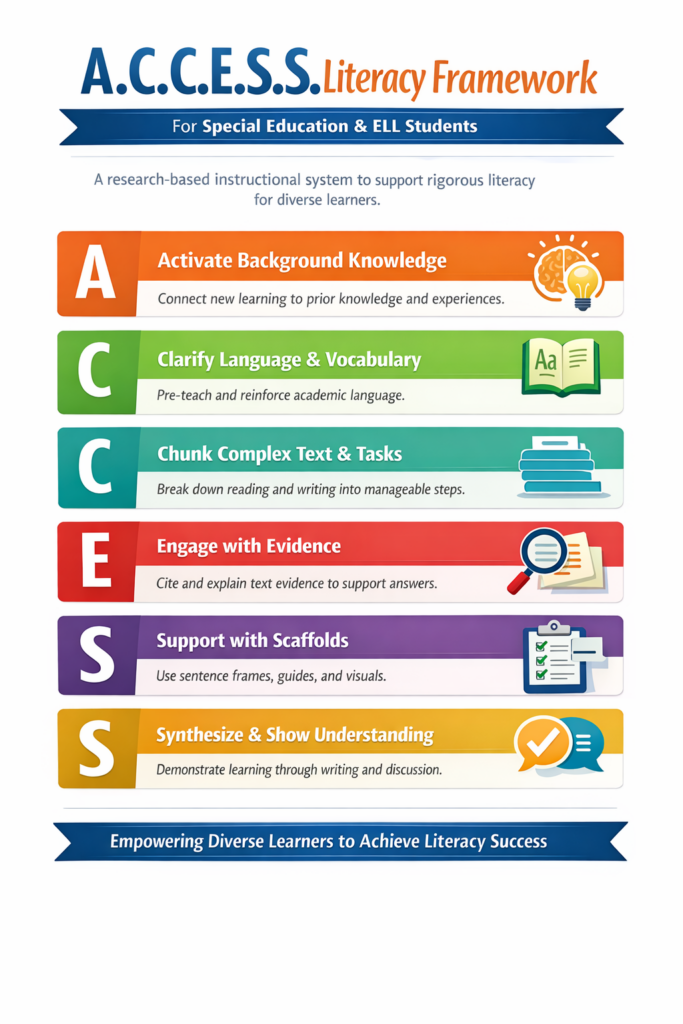
A — Activate Background Knowledge. You can’t build comprehension on nothing. Every reader needs a hook, a connection, a reason for the text to matter. When I skip this step—even on a rushed Monday morning—my students struggle more. Every time.
C — Clarify Language & Vocabulary. This is where so many multilingual learners and students with language-based learning disabilities fall through the cracks. Not because the content is too hard, but because the words are strangers. Pre-teaching vocabulary isn’t dumbing things down. It’s opening the door.
C — Chunk Complex Text & Tasks. Complex texts are complex on purpose. But “complex” doesn’t have to mean “overwhelming.” Breaking a dense paragraph into meaningful sections, giving students a stopping point to process before moving on—this is the difference between a student who disengages and one who leans in.
E — Engage with Evidence. This is the step that separates surface-level reading from real comprehension. Students don’t just read the text—they go back to it. They cite it. They build arguments from it. This is where academic literacy actually develops.
S — Support with Scaffolds. And here’s something I want to say clearly: scaffolds are not modifications. They’re not a watered-down version of the lesson. A scaffold is temporary support that allows a student to do something rigorous that they couldn’t do alone yet. There’s a huge difference. I’ve written about this distinction on the blog—it matters enormously, especially for students with IEPs and English Language Learners.
S — Synthesize & Show Understanding. The final layer. The capstone of the bridge. Students don’t just absorb—they produce. They write. They explain. They demonstrate that the reading meant something and went somewhere.
Six layers. Six spans. One bridge.
This Is What Scarborough’s Rope Always Needed a Partner For
Scarborough’s Reading Rope is one of the most cited visuals in literacy education—and for good reason. It shows us, beautifully, that skilled reading is the integration of language comprehension and word recognition, each made up of multiple interwoven strands. Phonological awareness, decoding, background knowledge, vocabulary, verbal reasoning, literacy knowledge. Woven together over time into fluency.
But here’s what I’ve noticed after years in the classroom: the Rope tells us what skilled reading is made of. It doesn’t always tell teachers how to build it, step by step, for a student who is currently unraveling.
That’s where A.C.C.E.S.S. lives.
The Science of Reading pillars on the left side of the bridge image—Decoding, Language Comprehension, Background Knowledge—aren’t placed there by accident. They’re the research foundation the bridge rests on. The A.C.C.E.S.S. framework doesn’t contradict phonics instruction or decoding work. It builds on it. It says: once a student can decode, here’s how you make sure they can also comprehend, analyze, and produce at grade level. Because decoding alone is never the finish line.
If you’re implementing structured literacy in your school and wondering where comprehension instruction fits—the A.C.C.E.S.S. bridge is your answer. Read more about the full framework here.
And Then There’s UDL. On Both Sides. Intentionally.
Notice something about the bridge image: the Universal Design for Learning pillars—Engagement, Representation, Expression—appear on both sides of the bridge. Not once. Twice.
That’s not a layout mistake. That’s a design principle.
UDL isn’t a strategy you apply at the end of a lesson plan to make sure you’ve “covered” accessibility. It’s a lens you bring to the entire instructional experience—before, during, and after. It frames how students are engaged in the first place, how content is represented to them, and how they’re given options to show what they know.
CAST’s UDL framework has always been clear on this: the goal isn’t compliance with guidelines. It’s reducing barriers by design, not by afterthought. And every single layer of the A.C.C.E.S.S. bridge reflects that philosophy.
Activate Background Knowledge? That’s UDL’s Engagement principle—recruiting interest, connecting to what students already know and care about.
Clarify Language & Vocabulary? That’s Representation—offering multiple means of making content accessible, especially for students who are navigating English as an additional language or processing language differently.
Synthesize & Show Understanding? That’s Expression—giving students real options for how they demonstrate what they’ve learned, not locking everyone into the same product.
UDL doesn’t sit outside this framework. It runs through it like rebar through concrete. That’s why it shows up on both sides.
Why a Signature Image Matters — Really Matters
I want to be honest about something.
When I first started developing the A.C.C.E.S.S. framework, I wasn’t thinking about a signature image. I was thinking about my students. Specifically, about the ones who’d been labeled “non-readers” and “non-writers” but who—when I looked closely—were neither. They were students who’d never had instruction designed around how they learned. Students for whom the bridge had never been built.
The framework grew out of that. From PLUSS to A.C.C.E.S.S., from lesson plans to a full instructional sequence—it evolved the way real things evolve, through years of iteration and honest reflection.
But here’s what I’ve learned: a framework without a visual doesn’t travel. It doesn’t stick. It doesn’t get shared in faculty meetings or explained quickly to a new teacher on a Thursday afternoon. Scarborough’s Rope became iconic because you can see how reading works. The UDL wheel became a reference point because you can point to exactly where your lesson plan needs more options.
The A.C.C.E.S.S. bridge image needs to do the same work.
When someone looks at it—whether they’re a classroom teacher, a literacy coach, a special education specialist, or a district curriculum director—I want them to immediately understand three things:
- There is a gap. And it is our responsibility to close it.
- The path from struggling reader to grade-level literacy is not magic. It’s a sequence. Six specific, intentional steps.
- Research grounds this. The Science of Reading and UDL aren’t decorations on the image—they’re the ground it stands on.
Who This Bridge Is For
Honestly? It’s for every teacher who has ever stood in front of a student who “doesn’t get it” and asked themselves what they’re missing.
It’s for bilingual teachers whose students understand so much more in their home language than they can express in English—and who need an instructional sequence that meets that student where they actually are.
It’s for special education teachers writing IEPs who know their students can reach grade-level content if the lesson design stops working against them.
It’s for literacy coaches who need a common language—a shared visual—that helps their whole team get on the same page about what good instruction actually looks like.
It’s for students in Myanmar and the Philippines and communities that have been told their learners are too far behind—when what they actually lack is a bridge. That work is happening now, and it’s some of the most meaningful work I’ve done.
And it’s for the students at the bottom of the arch. The struggling readers. The emerging learners. The ones who’ve been told—explicitly or through the quiet message of inaccessible instruction—that grade-level literacy isn’t for them.
It is for them. That’s why the bridge was built.
The Image Is a Claim. A Big One.
Here’s the thing about placing your framework inside a bridge: you’re making a promise.
You’re saying: this connects something. You’re saying: there is a gap, and this spans it. You’re saying: the foundation matters as much as the destination.
The A.C.C.E.S.S. Literacy Framework™ is that bridge—between what research tells us about how students learn to read and what teachers are actually able to do in classrooms on a Tuesday morning with 28 kids and a stack of ungraded papers and three different reading levels in the same group.
That gap is real. The research-to-practice divide in literacy education is well-documented and, honestly, a little maddening. We have decades of cognitive science, neuroscience, and classroom research telling us what works. And yet too many students—especially multilingual learners, students with disabilities, and kids from under-resourced communities—still don’t have access to instruction built on that knowledge.
A.C.C.E.S.S. is my answer to that gap. Not a perfect answer—I’m still building and refining this, which is the point of the Founding Cohort professional development program—but an honest, research-grounded, classroom-tested one.
The A.C.C.E.S.S. Literacy Framework is still in its early stages in Southeast Asia. Educators and students from places like the Philippines, Myanmar and Malaysia have already begun exploring how this framework can support multilingual learners and inclusive classrooms.
But the most exciting part is this: the community is just beginning.
That means the people who join now will not simply be members—they will be founding members who help shape how this framework grows across countries and cultures.
If you believe education should be inclusive, innovative, and globally connected, I invite you to be part of that founding group.
Take a moment to add your name to the community.
Years from now, when this work expands to more classrooms and more teachers, I hope some of you will be able to say:
‘I was there at the beginning.’
I’m very hopeful about what’s ahead. Together, we have an opportunity to make a real difference in classrooms and in students’ lives.
Looking forward to working with this incredible community of educators.
Want to Go Deeper?
If this framework resonates with you, here’s where to start:
- 📄 Read the full A.C.C.E.S.S. White Paper — the research foundation, full framework description, and implementation guidance
- 🔁 How My Thinking Evolved: From PLUSS to A.C.C.E.S.S. — the behind-the-scenes origin story
- 🌏 Why We’re Bringing A.C.C.E.S.S. to Myanmar — what equity-driven literacy work looks like globally
- 🇵🇭 A Direct Conversation With Filipino Educators — why the Philippines needs this framework now
- 💡 Join the Founding Cohort — become an early implementer and help shape the future of this work
The bridge in this image isn’t just a metaphor. It’s a commitment—to every learner who’s been left on the wrong side of a gap that good instruction can close.
Let’s build it together.