
Why the most imaginative teachers eventually run dry — and exactly how to fill the well back up.
I used to be the teacher who made things.
Handmade anchor charts with color-coding systems that actually worked. Unit projects that surprised even me when they came together. Transitions that were genuinely engaging instead of just functional. Some nights I’d lie awake not because I was stressed but because an idea was forming and I wanted to catch it before it disappeared. The creative energy felt almost embarrassing in its abundance. I couldn’t not make things.
Then somewhere around year five, I noticed it had gotten quiet. The ideas weren’t arriving the way they used to. Lesson planning felt more like maintenance than invention. I’d open a blank document and sit there staring at it, waiting for something that didn’t come. I told myself I was just tired, that it would pass, that summer would fix it.
It didn’t. Because the problem wasn’t that I was tired. The problem was that I had been pouring creativity out, professionally, every single day — and I had never once thought to pour anything back in.
That’s creative depletion. And for special educators specifically — who are required to be among the most adaptive, inventive, resourceful professionals in any building — it is both universal and almost completely ignored.
If you are a teacher, you’re constantly dealing with other people’s emotions and personalities, pulling from your creative energy all day. And according to Dr. Saundra Dalton-Smith, a board-certified internal medicine physician and author of Sacred Rest, a deficiency in creative rest — one of seven essential types of rest — can have unfavorable effects on your health, happiness, relationships, creativity, and productivity.
This post is about recognizing what’s happening and doing something about it.
What Creative Rest Actually Is (And What It Isn’t)
Let me start with the distinction that changes everything.
Creative rest is not making things. It’s receiving things — beauty, inspiration, wonder, novelty — without any pressure or obligation to produce anything from what you take in.
Dr. Dalton-Smith describes creative rest as surrounding yourself with beauty and inspiration while simultaneously taking the pressure off having to “do” something with it. That phrase — taking the pressure off — is the entire key.
Most teachers, when they think about creative rest, think about making something different: a new craft, a Pinterest project, an art journal. And while those activities can be enjoyable, they’re not creative rest if you bring your professional perfectionism into them. They’re just a different flavor of output.
Genuine creative rest is receptive. You go to a gallery and look at art without analyzing it. You sit in a park and watch the light change without taking photos to post. You read a novel that has no professional application whatsoever, purely because the writing is beautiful. You listen to a piece of music all the way through, doing nothing else, just listening.
For special educators who adapt curriculum in real time, problem-solve behavior without a manual, and generate novel approaches to reaching kids who haven’t responded to anything else — the creative demands are extraordinary. The creative rest needs to match.
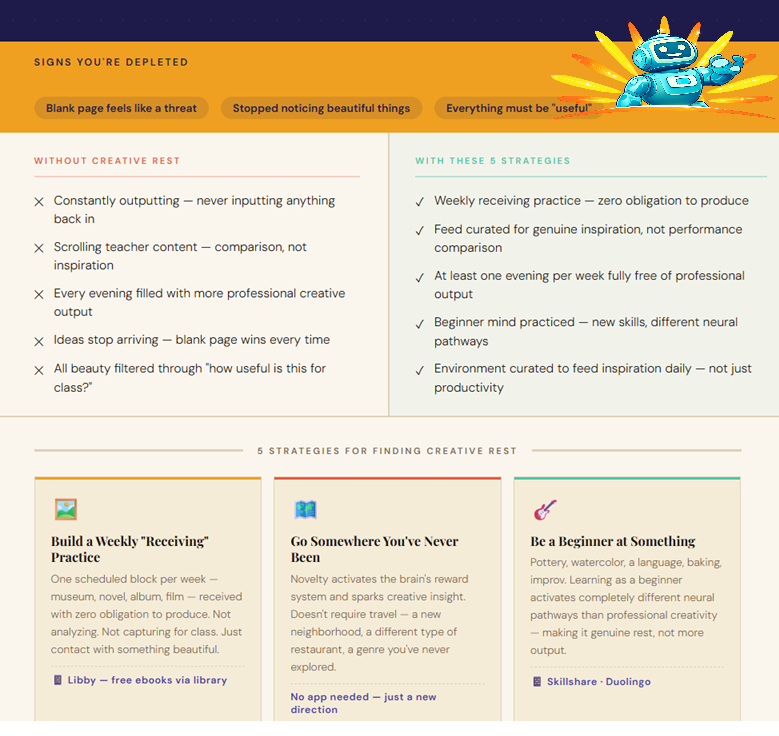
Sign #1 You’re Creatively Depleted: The Blank Page Feels Like a Threat

You know you’re running creatively empty when the act of beginning feels impossible. Not hard — impossible. When you open a lesson plan and feel a kind of internal blankness you can’t push through with more coffee or more time.
This is different from procrastination. Procrastination has an avoidance quality — you’re resisting the task. Creative depletion has an emptiness quality — there’s genuinely nothing there to resist or start from. The well isn’t just low. It’s dry.
If you’ve been feeling this way consistently for more than a few weeks, that’s your creative system telling you it has nothing left to give until you give something to it first.
Sign #2: You’ve Stopped Noticing Beautiful Things
This one is subtler — and in some ways, sadder.
Creative people tend to be people who notice. The particular way light hits a classroom in late afternoon. The unexpected metaphor that perfectly captures something complex. The design of a thing. The texture of an experience. This noticing is not incidental to creativity. It is the raw material of it.
When creative depletion sets in, the noticing goes quiet first. You walk past things that would have stopped you before and feel nothing in particular. The world becomes functional rather than alive with interest and beauty.
If you can’t remember the last time something stopped you — a piece of music, a view, a sentence in a book, a design that was simply well-made — that’s worth paying attention to. Or more precisely: it’s worth noticing that you’ve stopped noticing.
Sign #3: Everything Has to Be Useful
Here’s the particular trap that catches most teachers. We’ve been trained to evaluate everything through the lens of usefulness. Will this serve a student? Does this have an application? Can this translate into a lesson?
That training is valuable — it’s part of what makes great teachers great. But when it colonizes every creative impulse, you stop being able to receive beauty for its own sake. You go to a bookstore and only pick up education-related titles. You watch a documentary and immediately think about how to use it with students. You can’t just enjoy a piece of art without assessing its grade-level appropriateness.
Creative rest requires disabling the usefulness filter. Reading a novel just because you love it is not a waste of time. Listening to an album because it moves you is not indulgent. Going to an art museum with zero professional agenda is not unproductive. These acts of pure aesthetic reception are what fill the creative well — and without them, the well goes dry.
Strategy #1: Build a Weekly “Receiving” Practice
The most foundational creative rest strategy is this: schedule one block per week that is exclusively for receiving beauty, with zero obligation to produce anything.
I’m deliberate about the word schedule because if you’re anything like the teachers I’ve coached, it will not happen organically. There will always be something more urgent, more demonstrably useful to fill the time with. You have to treat this appointment with the same respect you’d give a parent meeting.
What it might look like:
- A 45-minute visit to a museum or gallery
- Reading two chapters of a novel you chose purely because the premise excited you
- Listening to an entire album, start to finish, while doing nothing else
- Watching a film recommended for its beauty, not its professional utility
- Sitting somewhere naturally beautiful with no devices and no agenda
The rule is simple: receive. Don’t produce. Don’t analyze. Don’t capture anything for classroom use. Just be in contact with something made by another person or by the world — and let it land.
Libby connects your local library card to a massive digital library of ebooks and audiobooks, completely free. This is my top recommendation for teachers who want to read for pleasure but struggle with cost or logistics. The friction between you and a beautiful novel should be as low as possible.
Strategy #2: Go Somewhere You’ve Never Been — Even Locally
One of the most reliable sources of creative restoration is novelty — encountering an environment, context, or set of stimuli your brain has never processed before. Novelty activates the brain’s reward circuitry and is directly associated with creative insight generation.
You don’t need to travel internationally. You need to go somewhere new. A neighborhood in your own city you’ve never walked through. A style of restaurant you haven’t tried. A type of music you’ve always been vaguely curious about. A craft store with no purchase agenda, just wandering.
The point is exposure to the unfamiliar — because creative depletion is partly the exhaustion of encountering the same contexts in the same ways. Novelty doesn’t just restore creativity; it is creativity in its earliest form. You’re giving your brain genuinely new material to work with.
Strategy #3: Let Yourself Be a Beginner at Something
This one is surprisingly powerful — especially for teachers who spend all day being the expert in the room.
When you learn something new as a complete beginner — pottery, watercolor, a new language, a musical instrument, bread baking, improv — something crucial happens. You experience the creative process from the receiving end. You feel what it’s like to encounter something unfamiliar, to struggle, to gradually find a foothold, to make something imperfect and feel okay about it.
This is restorative on multiple levels. It reconnects you with the vulnerability and courage required to be a genuine learner — which tends to make you a more empathetic teacher. And it activates completely different neural pathways than the professional creativity you use all day, which means it functions as genuine rest rather than more output.
Skillshare offers thousands of creative courses — photography, illustration, ceramics, design, music production, writing — with a free trial long enough to explore several different directions. Duolingo makes language learning genuinely enjoyable and game-like, free, and works in short daily sessions that fit a teaching schedule.
The beginner thing doesn’t have to be perfect. It doesn’t have to become a side business or a teaching tool. It just has to be yours — uncertain, exploratory, without stakes.
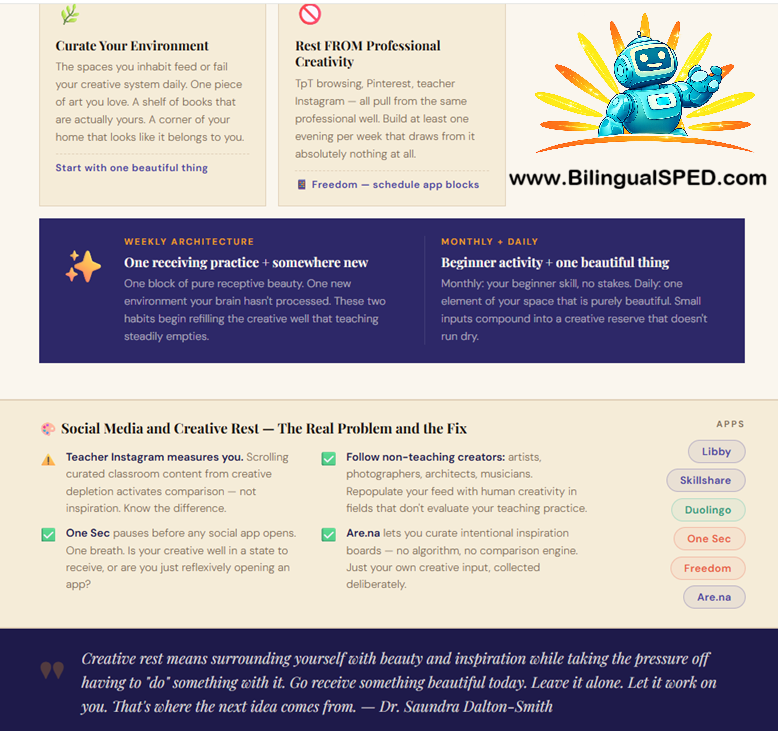
Strategy #4: Curate Your Environment for Inspiration
The environments we inhabit constantly feed — or fail to feed — our creative systems. A space full of professional materials but nothing beautiful is not creatively nourishing. It just isn’t.
This can be as simple as rotating the art on your walls. Choosing different music for the background of your planning sessions. Buying one small print from an artist whose work genuinely moves you. Rearranging a shelf to display books you actually love rather than books that look impressive.
And while you may not be able to redesign your classroom (though I’d encourage you to try), you can absolutely curate the spaces where you spend your non-teaching hours with more intentionality. One piece of art. One plant. One corner of your home that belongs to you and looks like it.
Strategy #5: Rest From Professional Creativity Deliberately
This is the strategy nobody mentions — and it might be the most important one.
If you spend your working hours doing creative work — adapting curriculum, designing learning experiences, problem-solving with students, creating visual supports — then your evenings and weekends should not also be filled with professional creative output. The Pinterest board of classroom ideas. The TpT store you’re building. The teacher Instagram content you’re generating.
None of those things are inherently bad. But they are additional creative output pulled from the same professional well. If you never stop pulling from that well, it never refills.
Build a deliberate rest from professional creativity into your weekly rhythm. At least one evening where you consume nothing education-related. At least one day where you don’t open a design tool, browse classroom resources, or generate professional content. Let the well close for a day. Give it time to fill.
Social Media and Creative Rest: The Real Problem and the Fix
Here’s the honest thing nobody in the teacher-influencer space wants to say out loud: teacher social media is both a source of creative inspiration and one of the most reliable drains on it.
When you scroll through beautifully curated classroom photos and teachers who appear to have unlimited creative supply — without being in a genuinely receptive state yourself — you’re not being inspired. You’re being measured. The comparison instinct kicks in immediately. Why don’t my ideas look like that? Why can’t I make something that polished? And instead of filling your creative well, the scroll leaves it more depleted than before.
Dr. Dalton-Smith is clear that there are specific restorative activities you do to pour back in the energy you’re pouring out — because that’s how rest deficits form in the first place. When you’re consuming content that activates comparison instead of inspiration, you’re withdrawing from the creative account, not depositing.
The fix isn’t leaving social media. It’s using it with intention.
Follow for genuine inspiration, not comparison. Artists, photographers, naturalists, architects, musicians, illustrators — people creating in fields that have nothing to do with your job. Your feed should feel like a window into human creativity, not a performance review of your teaching practice.
Use One Sec to pause before opening any social platform. One conscious breath before the feed loads. That moment of interruption is often enough to ask: am I in a state to receive something beautiful right now, or am I just reflexively opening an app?
Use Freedom to block specific apps during your designated creative rest windows — your receiving practice, your beginner activity, your nature time. When the block is in place, the choice has already been made for you.
Use Are.na as an intentional curation tool — a place where you collect images, ideas, and references that genuinely inspire you, without the algorithm, the notifications, or the comparison engine. It’s a container for your creative input that actually feeds the process rather than measuring you against someone else’s highlight reel.
Optimizing Creative Rest: Your Weekly Architecture

Here’s the practical framework I coach teachers to build — one layer at a time, not all at once:
Once per week: One receiving practice — museum, novel, film, music, nature. Zero obligation to produce anything from it.
Once per week: Somewhere new — a neighborhood, a restaurant, a genre, an environment your brain hasn’t processed before.
At least once per month: Your beginner activity. Something you can’t do yet but are learning. No stakes, no performance.
Daily: One element of your environment that is purely beautiful. One moment of noticing something made well.
Weekly: At least one evening free of professional creative consumption — no Pinterest, no TpT browsing, no teacher content feeds.
The Closing Truth
Over 250,000 people have discovered their personal rest deficits using Dr. Dalton-Smith’s free assessment at RestQuiz.com — and if you’re a teacher who’s been running creatively empty, it’s worth taking. But you don’t need a quiz to recognize the blank-page feeling, the stopped-noticing feeling, the everything-must-be-useful feeling. You know them. You’re probably living them.
The answer to running dry is never more output. It’s input. Beauty received without pressure. Novelty encountered without agenda. Beginner-mind practiced without shame.
Your students need your creativity at its most alive — not the depleted version that shows up when you’ve been pulling from an empty well for months. The solution isn’t to care less or produce less. It’s to replenish more, more deliberately, more often.
Go receive something beautiful today. Leave it alone. Let it work on you. That’s where the next idea comes from.
📬 Join the Weekly Newsletter
Every week I send one practical, no-fluff email built for special educators — classroom strategies, wellness tools, and honest conversation about what keeps us doing this work well.
No spam. No sales. Just real support, weekly.
💬 Reflection Question
When did your creative well last feel genuinely full — and what were you doing differently then that you’ve stopped doing now? What’s one small act of receiving beauty you could schedule into this week?
Leave your answer in the comments. I read every single one — and your reflection might be exactly what another teacher needed to hear today.
❓ Frequently Asked Questions
Q: What’s the difference between creative rest and having a creative hobby?
Creative hobbies involve making something — and can be wonderful. But they’re still output, not input. Creative rest is specifically about receiving — beauty, art, nature, novelty — without obligation to produce. You can have creative hobbies and still be creatively depleted if you bring the same perfectionism and output pressure from professional work into your hobby time.
Q: How do I find creative rest if I genuinely don’t know what I find beautiful anymore?
That numbness — not knowing what you find beautiful — is itself a symptom of creative depletion. Start extremely simply: go outside and look at the sky for five minutes. Visit one room of one museum with no agenda. Pick up one book in a bookstore because the cover or the first sentence drew you. Let the signals be small. They’ll get louder as you practice receiving.
Q: Is watching TV creative rest?
It can be. Low-stimulation, beautifully made visual storytelling — received without multitasking, fully present — can function as creative rest, especially when the content offers beauty, craft, or genuine emotional resonance. Reality TV watched out of habit while also scrolling your phone is not creative rest. That’s distraction with noise. Know the difference.
Q: How much creative rest do teachers need per week?
There’s no universal prescription. But practically: if you’re in a creative profession (and teachers are), you likely need at least as much creative input as you generate output. For most special educators, that means at least one meaningful receiving practice per week as a minimum — more during heavy planning and project-design periods when the professional creative draw is highest.
Q: Can I practice creative rest with my students?
Not in the same way — teaching always carries the output obligation. But incorporating receptive beauty into your classroom — great literature read aloud purely for its beauty, access to art that isn’t a project, music during independent work — can reduce the overall creative demand on students and on you. It builds the kind of classroom culture where creativity feels like living rather than performing.
📚 References
- Dalton-Smith, S. (2019). Sacred Rest: Recover Your Life, Renew Your Energy, Restore Your Sanity. FaithWords. https://www.drdaltonsmith.com
- Interfaith America. (2025). “You desperately need rest:” Author Dalton-Smith on Sacred Rest. https://www.interfaithamerica.org/article/dalton-smith-on-sacred-rest/
- Caring Magazine. (2023). 78: Seven types of rest you need and how to find them with Dr. Saundra Dalton-Smith. https://caringmagazine.org/78-seven-types-of-rest-you-need-and-how-to-find-them-with-dr-saundra-dalton-smith/
- Nike TRAINED Podcast. (2022). Saundra Dalton-Smith, MD: The 7 types of rest. https://www.nike.com/a/dr-saundra-dalton-smith-on-what-rest-really-is
- Breathe For Change. (2025). The 7 types of rest every educator needs. https://breatheforchange.com/resources/rest-every-educator-needs
- RAND Corporation. (2024). State of the American Teacher Survey 2024. https://www.rand.org/education-and-labor/projects/state-of-the-american-teacher.html
- Beaty, R. E., et al. (2016). Creativity and the default network: A functional connectivity analysis of the creative thinking brain. Social Cognitive and Affective Neuroscience, 11(8), 1243–1252. https://doi.org/10.1093/scan/nsw029
- LCT eLearning. (2025). Beating burnout: Reclaim your energy and passion this summer with targeted rest strategies for teachers. https://www.lctelearning.com/post/beatteacherburnoutthissummer
- Kaplan, R., & Kaplan, S. (1989). The Experience of Nature: A Psychological Perspective. Cambridge University Press.
- Marken, S., & Agrawal, S. (2023). K-12 workers have highest burnout rates in U.S. Gallup. https://news.gallup.com/poll/393500/workers-highest-burnout-rate.aspx
- Psychology Today. (2022). The 7 kinds of rest you actually need. https://www.psychologytoday.com/us/blog/a-different-kind-of-therapy/202212/the-7-kinds-of-rest-you-need-to-actually-feel-rejuvenated