
This isn’t about religion. It’s about the thing that made you choose this work — and what happens when you lose contact with it.
I want to start by saying something important before we go a single word further.
When I use the word spiritual in this post, I’m not talking exclusively about faith, religion, or any particular belief system. I want to be clear about that because too many educators have clicked away from articles like this one before they were able to get what they needed — assuming the content wasn’t for them.
Spiritual rest, as Dr. Saundra Dalton-Smith defines it in her research framework, is the restoration that comes from connecting to meaning — to something larger than the daily grind of your to-do list, your caseload, your IEP deadlines. It’s the kind of rest that answers the question your soul keeps whispering underneath all the noise: Does what I do actually matter?
For some teachers, that connection comes through faith. For others, it comes through nature, art, community, service, or the quiet practice of sitting with a student in a hard moment and feeling the weight and gift of being exactly where you’re supposed to be. Whatever your version of meaning looks like — spiritual rest is about finding it, tending it, and protecting it from the relentless forward momentum that teaching demands.
And here’s the hard truth: without it, even the most dedicated, most competent, most loving teacher eventually empties out. Not because they stopped caring. Because they never stopped long enough to refill.
What Spiritual Depletion Actually Looks Like in a Teacher
Let me describe something and see if it sounds familiar.
You chose special education — or teaching more broadly — on purpose. Maybe you remember the exact moment you knew. A class you took, a student who got through to you, a clear sense that this was where your energy belonged. There was something in the work that felt like more than a job. Like a calling.
And now you’re in year three or seven or twelve, and when you try to locate that feeling — the one that made you choose this — it’s like reaching for something that used to be right there and finding empty space. You still show up. You still do the work. But something that used to make the hard days bearable has gone quiet.
Finding meaning and purpose beyond your daily routines is known as spiritual rest. It can be achieved through activities that connect you to something greater than yourself, like meditation, prayer, or community involvement.
That loss of felt meaning is spiritual depletion. And it’s one of the least-discussed dimensions of teacher burnout, possibly because it’s the hardest to quantify on a survey. But it’s devastatingly real — and for special educators who often carry the weight of being the most consistent, caring presence in a student’s life, losing contact with that sense of purpose is particularly destabilizing.
Spiritual rest connects you to a deeper sense of meaning and belonging. It might come through faith, community, or purpose-driven work.
So how do we find it again? Here’s where I’d start.
Strategy #1: Name Your “Why” — In Writing, Not Just in Your Head
This first strategy is the one most people skip because it sounds too simple. Don’t skip it.
When did you choose this work? Not the official answer you give in interviews — the real one. What was happening in your life, and what made you think this is where I belong? Write it down. Actually put it on paper, or in a notes app, in enough detail that a stranger could read it and understand why it mattered.
I did this exercise during what I now recognize as a period of deep spiritual depletion in my own career. I sat down expecting to write two sentences and ended up writing three pages. Things I hadn’t thought about in years came back — specific students, specific moments, a conversation that changed how I understood what education could be. And something loosened in my chest that I hadn’t realized was tight.
Your “why” is not a motivational poster. It’s a living document that needs to be revisited, especially during the seasons when the work feels most mechanical and least meaningful. Keep it somewhere you’ll actually see it. Update it when something happens that reminds you why you stayed.
Reconnect with your values and what gives your work meaning. Whether it’s through prayer, meditation, or community service, spiritual rest can provide a profound sense of peace and purpose, anchoring your educational philosophy and personal well-being.
Strategy #2: Protect One “Meaning-Full” Moment Per Week

Spiritual rest doesn’t require grand gestures. It requires consistent contact with the things that make you feel like what you do matters — and in a job that can reduce everything to output and compliance documentation, that contact has to be deliberate.
I started keeping what I call a “meaning journal” — not a gratitude journal, which I find can slip into forced positivity — but a specific record of moments in any given week where I felt the work was real. A student breakthrough I witnessed. A conversation with a family that went beyond transactional. A moment of connection in the middle of a hard day that nobody else saw but that I know was significant.
What you look for, you find. And what you record, you remember — especially during the February weeks when every day feels identical and the work feels bottomless.
Day One is perfect for this. It’s a beautiful, private journaling app that can hold these moments with the weight they deserve — much better than a Google Doc or a notes app. You can add photos, location, even music you were listening to. Over time, it builds into a record of your professional meaning that you can return to when you need it most.
Strategy #3: Find or Build a Purpose Community
One of the most consistent findings in burnout research is that isolation accelerates spiritual depletion — and connection, particularly with people who share your values and sense of purpose, restores it.
God didn’t create us to walk through life alone. “Two are better than one, because they have a good return for their labor: If either of them falls down, one can help the other up. But pity anyone who falls and has no one to help them up.”
Whether you draw that wisdom from scripture or from evolutionary biology, the point is the same: humans are not meant to carry meaning alone. We generate and sustain it in community. And for special educators, whose professional community is often fragmented by the isolating nature of the classroom, building that community requires intentionality.
This might look like a faith community if that’s part of your life. It might look like a teacher wellness group, a PLC that goes deeper than lesson planning, a monthly dinner with people who do similar work and speak the same language, or a mentorship relationship with someone further along in the career you’re building.
What it shouldn’t look like is isolation dressed up as self-sufficiency. If you’ve been carrying this work alone for more than a year, that’s not strength. That’s spiritual depletion with nowhere to go.
Strategy #4: Practice Sabbath — Whatever That Means for You
I want to use this word carefully and inclusively, because Sabbath is a concept that transcends any single religious tradition and points to something universally human: the radical practice of full, non-negotiable rest.
The Sabbath is like a governor on the speed of life. All week long we work, we play, we cook, we clean, we shop, we exercise, we answer text messages, we inhabit the modern world, but finally we hit a limit.
Research specifically among teachers found a significant inverse relationship between Sabbath-keeping practices and burnout — across teachers from different cultural and religious backgrounds. The common element wasn’t religious observance. It was the practice of one full day per week that was genuinely different. Not a lighter workday. Not a Sunday afternoon of planning followed by a few hours of TV. A day where the frame of reference shifted entirely — away from production and toward being.
For me, that practice looks like no school-related work on Sundays. Not checking my email, not looking at the plans for Monday, not mentally rehearsing the week. On Sundays I cook something I enjoy cooking, I spend time with people I love, and I do at least one thing that has nothing to do with being productive. It took me years to build this habit. And without it, I lose my spiritual footing within about three weeks.
Your version will look different. But if you don’t have some version of it, I’d argue it’s the highest-leverage single habit you could build for your long-term sustainability in this work.
Strategy #5: Spend Time in Nature — Seriously
This one might seem too simple to include in a conversation about spiritual rest. It isn’t.
There is a reason that virtually every spiritual tradition on earth uses nature as a site of encounter with something larger than the self. There is a reason that the research on Attention Restoration Theory consistently shows that time in natural environments restores not just cognitive function but emotional and meaning-making capacity. Something shifts when you step outside human-built systems of pressure and performance and into a world that doesn’t need anything from you.
Spiritual rest means connecting with something bigger than ourselves, through nature, meditation, or faith.
You don’t need a mountain or an ocean. A park works. A garden. The sky above your backyard. Even sitting by a window with actual daylight coming through. The goal is contact with something that is not a screen, not a task, not a relationship that requires anything from you — something that simply exists, indifferent to your performance, and beautiful anyway.
Commit to 20 minutes outside per week that are specifically not for exercise or errands. Just being outdoors. Start there.
Strategy #6: Return to Beauty — In Whatever Form It Takes for You
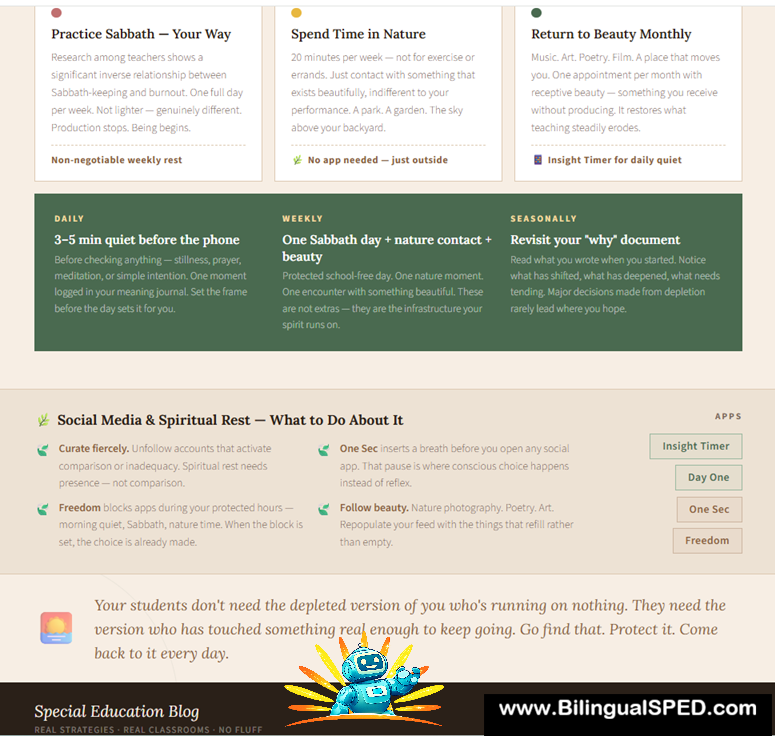
Spiritual rest is also restored through what I call receptive beauty — encountering something made by another human or by the natural world that moves you, with no obligation to respond, produce, or evaluate it.
Music that breaks something open in your chest. A poem that names something you couldn’t name. A piece of visual art that stops you in a gallery. A film that leaves you quiet for twenty minutes afterward. A piece of architecture. A garden in a particular light.
These encounters restore something in us that the functional demands of teaching steadily erode. They remind us that there is more to human experience than output — and that we participate in something larger than our classroom’s four walls.
Make one appointment per month with beauty. A museum, a concert, a used bookstore with a good poetry section, a particular place in your neighborhood that you find inexplicably moving. Put it in your calendar. Show up.
Optimizing Social Media for Spiritual Rest — What Nobody Says
Here’s the honest and uncomfortable truth about social media and spiritual rest: most of what we encounter on our feeds is specifically designed to produce the opposite of spiritual connection. Comparison. Anxiety. The performance of meaning rather than the experience of it.
Spiritual burnout often arises from overconsumption of spiritual content — when we absorb too many teachings, modalities, or “shoulds,” it can be overwhelming, especially without integration.
This applies directly to the teacher Instagram and TikTok ecosystem. Scroll for twenty minutes through teacher content — the perfect classroom setups, the elaborate bulletin boards, the “day in my life” videos of teachers who somehow do everything well and still have time to exercise and journal — and tell me honestly whether you feel more connected to your purpose or less. For most teachers I’ve worked with, the honest answer is: less.
Spiritual rest requires presence — the felt sense of being here, now, in your actual life. Social media is almost exclusively future-oriented (what you should do, who you should be) or past-comparative (what others have already done, how your classroom measures up). Neither orientation generates spiritual rest.
What to do about it:
Curate fiercely. Unfollow any account — educator or otherwise — that consistently activates comparison, inadequacy, or pressure to perform. Follow accounts that genuinely inspire, connect, or offer beauty. There’s a real difference and you know it immediately when you look at your feed and notice what you feel.
Use One Sec to insert a breath between impulse and action. The moment before you open Instagram or TikTok is a moment where you can choose. One Sec creates that moment.
Use Freedom to block social media during the hours you’ve protected for spiritual practices — your morning quiet time, your Sabbath day, your Tuesday evening walk. When those hours are blocked, the choice is already made.
Follow accounts that offer genuine beauty or meaning — photography of natural landscapes, poetry accounts, art accounts, music that moves you. Repopulate your feed with the stuff that refills rather than empties.
Use Insight Timer as your phone’s first morning reach — rather than social media. It has hundreds of free guided meditations and contemplative practices that take as little as five minutes and set a completely different tone for the day than news and notification-checking.
Optimizing Spiritual Rest: A Practical Framework

Here’s the architecture I’d suggest building — not all at once, but one layer at a time:
Daily: Three to five minutes of intentional quiet — meditation, prayer, stillness, whatever resonates — before picking up your phone. One moment in the day logged in your meaning journal.
Weekly: One full Sabbath-style day, protected from school work. One nature contact moment. One appointment with beauty.
Monthly: One deeper community connection — a conversation that goes below the surface with someone who shares your values and understands your work.
Seasonally: Revisit your “why” document. Read what you wrote and update it. Notice what has shifted.
None of this is dramatic. All of it is sustainable. And sustained, it adds up to a teaching career that lasts — and that feels like a life worth living rather than a sentence to serve.
The Honest Closing
You chose this work for reasons that mattered. That mattering hasn’t gone away — it’s just buried under the accumulated weight of a profession that moves too fast and stops too rarely.
Spiritual rest is how you find it again. Not once, in a retreat or a vacation or a dramatic reawakening moment, but daily, in the small deliberate choices to reconnect with what makes this work — and your life inside it — worth showing up for.
Your students don’t need the depleted version of you who’s running on nothing. They need the version who has touched something real enough to keep going. Go find that. Protect it. Come back to it every day.
📬 Join the Weekly Newsletter
Every week I send one email built specifically for special educators — wellness strategies, classroom tools, and honest conversation about what keeps us in this work.
No spam. No sales. Just real support, weekly.
💬 Reflection Question
When did you last feel genuinely connected to the reason you chose teaching — that felt sense that what you do actually matters? And what’s one small thing you could do this week to create contact with that feeling again?
Leave your answer in the comments. I read every single one — and your answer might be exactly what another teacher needed to hear today.
❓ Frequently Asked Questions
Q: Does spiritual rest require a religious practice or belief in God?
Not at all. Dr. Saundra Dalton-Smith’s definition of spiritual rest is explicitly inclusive — it’s about connecting with meaning and something larger than daily routine, which can happen through nature, art, community, service, purposeful work, or contemplative practice of any kind. You don’t need a faith tradition to experience or practice it. You need genuine contact with what makes your life feel meaningful.
Q: How is spiritual rest different from emotional rest?
Emotional rest is about processing and recovering from the emotional labor of the job — releasing what you’ve been managing and held. Spiritual rest is about reconnecting with meaning — the deeper “why” behind the work. You can be emotionally restored but spiritually depleted if you’re technically functional but have lost contact with why the work matters. Both are necessary; neither substitutes for the other.
Q: What if I’m in a season where I genuinely don’t know if teaching is still my calling?
That’s a question worth sitting with rather than rushing to answer. Spiritual depletion can feel like a loss of calling when it may actually be a loss of sustainability in the current conditions. Before drawing conclusions about whether to leave the profession, give yourself a genuine season of intentional spiritual rest — three to four months of the practices described in this post. Then reassess from a fuller place. Major life decisions made from depletion rarely lead where we hope they will.
Q: Can social media be part of spiritual rest, or is it always harmful?
It depends entirely on how it’s used. Passive, comparison-heavy scrolling through teacher content that activates inadequacy is antithetical to spiritual rest. But actively connecting with communities that share your values, encountering beautiful images of nature or art, or following accounts that consistently generate genuine inspiration can be aligned with spiritual restoration. The key question is always: how do I feel after? Lighter and more connected, or heavier and more depleted?
Q: What if I’ve tried these practices and still feel spiritually empty?
If sustained effort at the practices above doesn’t produce meaningful improvement, it may be worth speaking with a therapist — particularly one who works at the intersection of occupational burnout and meaning — or with a spiritual director, mentor, or trusted advisor. There are forms of spiritual depletion that require more than self-directed practice to address, particularly those that involve grief, moral injury, or systemic experiences of injustice in the workplace.
📚 References
- Dalton-Smith, S. (2019). Sacred Rest: Recover Your Life, Renew Your Energy, Restore Your Sanity. FaithWords. https://www.drdaltonsmith.com
- Breathe For Change. (2025). The 7 types of rest every educator needs. https://breatheforchange.com/resources/rest-every-educator-needs
- Calm Blog. (2025). The 7 types of rest that can help you feel fully renewed. https://www.calm.com/blog/7-types-of-rest
- Marken, S., & Agrawal, S. (2023). K-12 workers have highest burnout rates in U.S. Gallup Education. https://news.gallup.com/poll/393500/workers-highest-burnout-rate.aspx
- Cheng, S., et al. (2021). Sabbath-keeping and teacher burnout: An international study. Journal of Psychology and Theology.
- RAND Corporation. (2024). State of the American Teacher Survey 2024. https://www.rand.org/education-and-labor/projects/state-of-the-american-teacher.html
- Christian Scholar’s Review. (2023). Striving for spiritual wellness in 2023–2024. https://christianscholars.com/striving-for-spiritual-wellness-in-the-2023-2024/
- LCT eLearning. (2025). Beating burnout: Reclaim your energy and passion this summer with targeted rest strategies for teachers. https://www.lctelearning.com/post/beatteacherburnoutthissummer
- Root Grow Thrive. (2025). Burnout healing: Mind, body, heart, and soul. https://www.rootgrowthrive.com/blog/burnout-healing-mind-body-heart-and-soul
- Kaplan, R., & Kaplan, S. (1989). The Experience of Nature: A Psychological Perspective. Cambridge University Press.
- Maslach, C., & Leiter, M. P. (2016). Understanding the burnout experience: Recent research and its implications for psychiatry. World Psychiatry, 15(2), 103–111. https://doi.org/10.1002/wps.20311