

A growing number of Filipino teachers are asking the same question: how do we deliver rigorous literacy instruction when classrooms are large, multilingual, and deeply under-resourced? This post is a direct answer — grounded in real classroom experience, decades of literacy research, and an honest look at what isn’t working in Philippine education right now. The A.C.C.E.S.S. Literacy Framework isn’t a program imported from America and dropped on Filipino classrooms. It’s a research-grounded instructional system built for exactly the kind of complexity Filipino teachers face every single day. Here’s why it works — and why the time to adopt it is now.
Let me start with something uncomfortable.
According to the OECD PISA 2018 results, the Philippines ranked last among 79 participating countries in reading comprehension. Last. In a field of 79. And when the Department of Education’s own report came out, there was a lot of hand-wringing about what to do — new programs announced, new reading initiatives launched, new frameworks proposed.
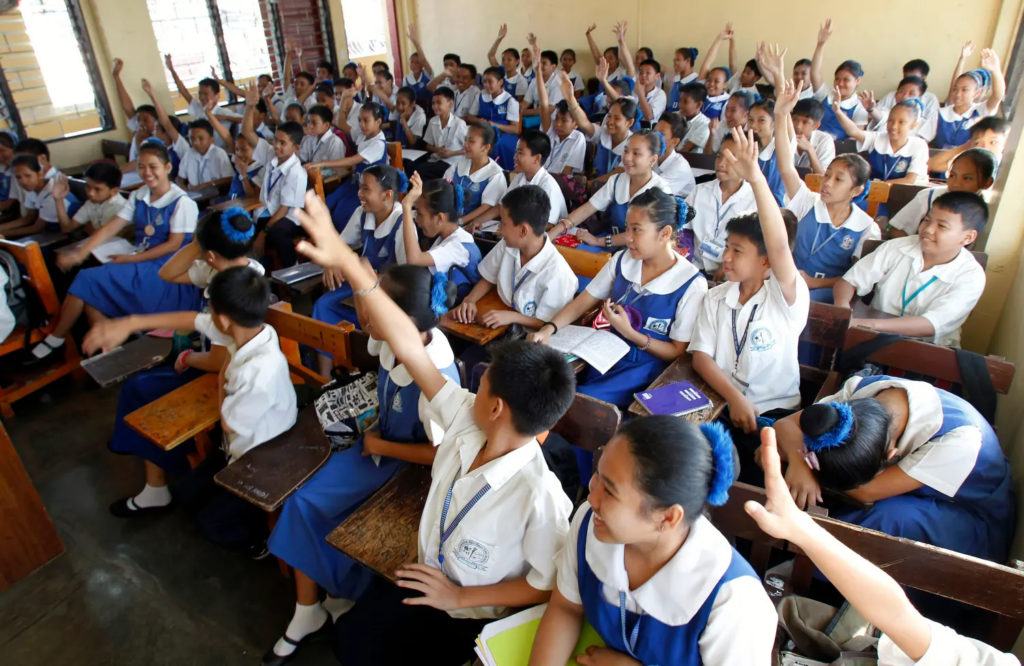
And yet. Walk into a typical Grade 5 or Grade 6 classroom in any province today, and you’ll still find students who can decode words fluently but cannot tell you what the paragraph means. Students who write one sentence when three paragraphs are needed. Students who have been in school for six years and still can’t engage with a grade-level text.
That is not a teacher problem. I want to be absolutely clear about that. Filipino teachers are among the most resourceful, most caring, most genuinely committed educators I have ever encountered — anywhere in the world. The problem is that we keep giving them strategies without giving them a system. And strategies without a system is just chaos with good intentions.
The A.C.C.E.S.S. Literacy Framework is that system. And it’s time for the Philippines to take it seriously.
What Is the Real Literacy Problem in Philippine Classrooms — and Why Has It Been So Hard to Fix?
Here’s what I know from experience working with multilingual learners in complex classroom contexts: the literacy gap in the Philippines is not a single problem. It’s three overlapping problems that most reform efforts treat as one.
Problem 1: Multilingual complexity without multilingual support. Filipino classrooms often operate in two, three, sometimes four languages simultaneously — English, Filipino, and regional mother tongues. The Mother Tongue-Based Multilingual Education (MTB-MLE) policy was a step in the right direction, but implementation gaps remain significant. Teachers are expected to support academic language development across multiple language systems without explicit instruction in how to do that. So they do their best. Which is impressive. But it’s not sustainable and it’s not consistent.
Problem 2: Cognitive overload in large-class instruction. The average Philippine public school classroom has 40 to 60 students. Maybe more. And the typical instructional approach — teacher-led, text-heavy, limited differentiation — is almost perfectly designed to create cognitive overload for struggling readers. Long passages assigned without preparation. Complex vocabulary presented without pre-teaching. Questions posed without scaffolded response structures. Students who could access the content with the right support instead check out. And the teacher, managing 55 students, doesn’t always have the bandwidth to notice who’s lost and who isn’t.
Problem 3: Writing instruction that doesn’t teach writing. Across grade levels and content areas, I’ve noticed a pattern: students are asked to write without being taught how to write in academic contexts. They copy from textbooks. They produce one-line answers. They avoid the question entirely because there’s no structure for responding. And the frustrating part is — when you give them a structure, when you say “start with this sentence frame and follow these steps,” something unlocks. They had the ideas all along. They just needed the pathway.
These three problems require a coherent instructional response. Not three separate programs. One integrated system.
The Data That Should Alarm Every School Leader PISA 2018: Philippines ranked 79th out of 79 countries in reading comprehension (OECD, 2019). PISA 2022 showed marginal improvement but still among the lowest globally. UNESCO estimates that as many as 90% of children in low- and middle-income countries cannot read and understand a simple text by age 10 — and the Philippines was cited as a country of concern. This is not a projection. This is the current reality in classrooms across the archipelago.
What Is the A.C.C.E.S.S. Framework — and How Is It Different From Everything That’s Come Before?
The A.C.C.E.S.S. Literacy Framework is a research-grounded instructional system with six stages designed to make rigorous literacy instruction genuinely accessible — not watered down, not simplified, but accessible — for multilingual learners and students with diverse learning needs. I built it from years of classroom practice, and everything in it is grounded in research I’ll name explicitly below.
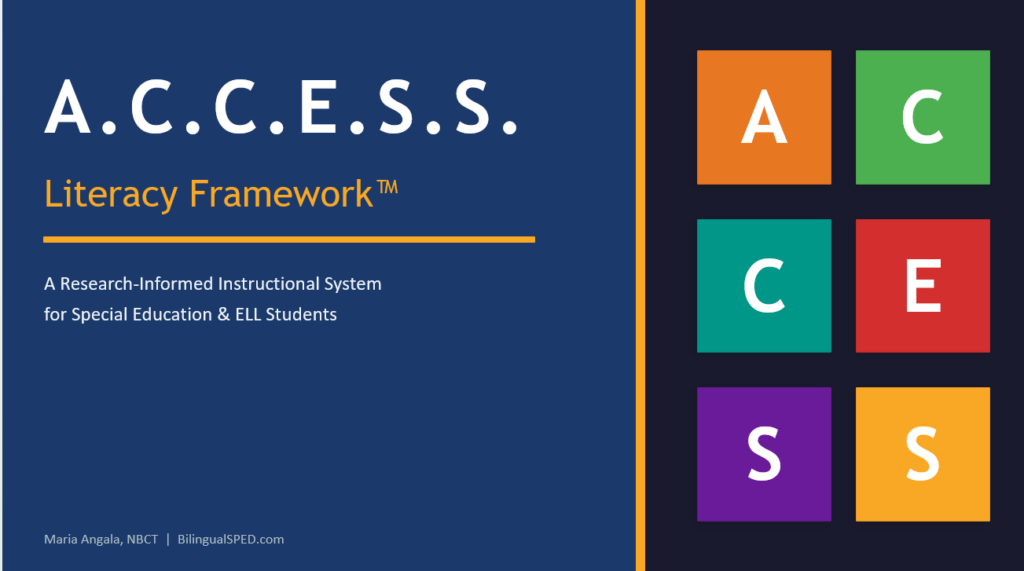
Here’s what each stage does and why it matters for Filipino classrooms specifically:
A
Activate Background Knowledge
Every lesson begins by connecting new content to what students already know. For multilingual learners, this step is often skipped — which is exactly why comprehension breaks down before reading even begins. You cannot understand new information in a vacuum. You need to connect it to something already in your schema.
🇵🇭 Philippines application: “Pwede muna sa inyong sariling wika — then let’s bridge together.” Allow students to surface prior knowledge in their dominant language first. That’s not a shortcut. That’s how the brain actually works.
C
Clarify Language & Vocabulary
Pre-teach 5–8 high-leverage academic words before students encounter the text. Not definitions on a handout — visual word maps, sentence frames using the target vocabulary, cognate instruction for students bridging Filipino/English. Research by Jim Cummins on BICS and CALP is definitive here: students need explicit support to move from conversational fluency to academic language proficiency. Without it, the gap widens every year.
🇵🇭 Philippines application: Prioritize Tier 2 words — the academic vocabulary that appears across content areas, not just in one subject. These are the words that unlock access to everything else.
C
Chunk Complex Text & Tasks
Long passages assigned without structure create cognitive overload — and Cognitive Load Theory (Sweller, 1988) explains exactly why. Break the text into labeled sections. Stop and process after each chunk. Ask one focused question per section before moving on. Students who used to stare at a page and go blank start engaging when the text is delivered in manageable pieces.
🇵🇭 Philippines application: In a class of 55 students, numbered annotation protocols and stop-and-jot checkpoints keep every student accountable and on pace — without requiring 55 individual interventions.
E
Engage With Evidence
Teach students to find and use textual evidence to support their answers — using the RACE structure: Restate the question, Answer it, Cite evidence from the text, Explain why the evidence supports the answer. This is the stage that transforms one-word answers into paragraphs. Not because students didn’t have the understanding. Because now they have the structure to express it.
🇵🇭 Philippines application: RACE anchor charts posted in both English and Filipino give students a visible scaffold they can use independently — even in a crowded classroom where individual support isn’t always possible.
S
Support With Scaffolds
Sentence frames. Guided response templates. Graphic organizers. Visual supports. These are not training wheels — they are instructional bridges that make complex thinking reachable while the student builds the underlying skill. The critical piece: scaffolds are designed to be faded. The goal is always independence. But you can’t fade a scaffold that was never there to begin with.
🇵🇭 Philippines application: A well-designed graphic organizer works across language backgrounds. A student who processes in Cebuano, Ilocano, or Tagalog can still use a visual scaffold to organize thinking before writing in English.
S
Synthesize & Show Understanding
Every lesson ends with students constructing meaning — connecting what they read to what they knew, expressing it in a structured format, and demonstrating comprehension in a way that goes beyond recall. Oral discussion, written summary, peer teaching, visual representation — the channel varies. The expectation of deep thinking does not.
🇵🇭 Philippines application: Peer discussion protocols in pairs or triads allow students to synthesize in their strongest language first, then translate key ideas together. This isn’t code-switching as a crutch — it’s bilingual thinking as a bridge.
⚡ Quick Win — Start Tomorrow, Not Next SemesterPick ONE lesson this week. Add these three things: (1) pre-teach 5 vocabulary words with visuals before reading begins, (2) break the main text into two chunks with a “stop and write one sentence” pause between them, (3) end with a RACE question. That’s it. You don’t need a new program or a new textbook. You need a new sequence. This is that sequence — and you can start it tomorrow.
What Does A.C.C.E.S.S. Look Like in a Real Filipino Classroom?

Let me walk you through it the way I’d describe it to a new teacher sitting across from me at a planning table.
Picture a Grade 6 class. Mixed reading levels — some students fluent in English, others still developing academic proficiency, a few who speak primarily a regional language at home. The lesson is on a social studies text about Philippine history.
The teacher doesn’t just hand out the text and say “read pages 12 to 14.” She starts by showing a photo related to the content and asking: “What do you notice? What do you already know about this?” Students talk in pairs — some in Filipino, some in English, some switching between. Already, the class is engaged before a single sentence of the text has been read.
Then she puts five words on the board with visual definitions. She says each one, has students repeat, uses them in a sentence, and asks students to use them in a sentence with a partner. Five minutes. That’s it. But those five words are the five words that matter most for understanding the passage.
She breaks the text into two sections. First section — students read, annotate, and respond to one question. Check. Second section — same process. Now students have read the whole text, processed it in chunks, and responded in writing to two focused questions.
At the end, she asks a RACE question: “Based on the text, how did geography influence early Filipino communities? Restate, answer, cite, explain.” Students write. Some write more than she’s seen them write all year. Not because the content changed. Because the path to the content finally made sense.
After the lesson she told me: “I didn’t change what I was teaching. I changed how I gave them access to it.”
That’s A.C.C.E.S.S. in one sentence.
💚 For School Leaders and Policymakers — This Is a Systems QuestionA framework only transforms outcomes when it’s implemented consistently across classrooms, grade levels, and schools. The most powerful shift happens when teachers share a common instructional language, when professional development is ongoing rather than one-time, and when teacher-leaders are certified to train their peers. That’s the Teachers Teaching Teachers model embedded in the A.C.C.E.S.S. certification pathway — and it’s exactly how sustainable literacy reform happens at scale.
What Does the Research Actually Say — and Why Should Filipino Educators Trust This?
I want to name the research explicitly because Filipino school leaders and policymakers deserve evidence, not just enthusiasm.
The Gradual Release of Responsibility model (Pearson & Gallagher, 1983) — the principle that learning moves from “I do” to “we do” to “you do” — is the backbone of the A.C.C.E.S.S. instructional sequence. Every stage is designed to move students progressively toward independence through explicitly scaffolded instruction.
Jim Cummins’ BICS/CALP distinction — the difference between basic interpersonal communicative skills and cognitive academic language proficiency — explains why Filipino students who speak English in conversation still struggle with grade-level academic texts. The Clarify stage directly addresses CALP development, which is where most multilingual learners get left behind.
Cognitive Load Theory (Sweller, 1988), cited in the CAST Universal Design for Learning framework, explains why chunking works: working memory has limits, and instruction that overloads those limits produces the appearance of inability when the actual problem is instructional design.
And the National Academies of Sciences (2017) report on educating English learners is unambiguous: multilingual students benefit most from instruction that maintains high cognitive demand while providing explicit language support. Lowering the rigor is not an evidence-based strategy. Building the access pathway is.
What Technology Tools Support A.C.C.E.S.S. Implementation in Philippine Schools?
Technology doesn’t replace good teaching. But in a classroom of 55 students, it saves time — and that matters. Here are tools I use and recommend for A.C.C.E.S.S. implementation that work in Philippine connectivity realities:
- Canva for Education — completely free for teachers; use it to create vocabulary anchor charts, RACE writing scaffolds, and bilingual graphic organizers that can be printed and laminated for offline use. Surprisingly effective for visual vocabulary instruction even in classrooms with zero devices.
- Diffit — generates leveled reading texts from any topic or standard in minutes. Invaluable for the Chunk stage when you need two or three access levels of the same content for different readers in the same room.
- MagicSchool AI — creates scaffolded lesson plans, differentiated assessments, and vocabulary activities in seconds. Teachers in under-resourced settings tell me this tool alone cuts their planning time in half.
- Google Classroom — free, works in low-bandwidth conditions, and allows teachers to distribute RACE writing templates, collect responses, and track student progress without physical paper when connectivity permits.
- DeepL Translator — for creating bilingual vocabulary supports and sentence frames in Filipino and English. Significantly more accurate than generic translation tools for academic language.
And remember — every anchor chart in the A.C.C.E.S.S. framework can be printed and posted. The framework runs beautifully with a whiteboard and a room full of students who deserve a real pathway to rigorous learning. Technology amplifies it. The system works without it.
🇵🇭 Bring A.C.C.E.S.S. to Your School or District
If you’re a school leader or policymaker in the Philippines thinking “this is exactly what our teachers need” — I want to hear from you. The A.C.C.E.S.S. Teachers Teaching Teachers Professional Development Certification Program is designed for exactly this kind of school-wide and district-wide adoption. Explore the framework, the certification pathway, and training options at BilingualSPED.com.→ Explore the A.C.C.E.S.S. Literacy Framework
And for classroom-ready bilingual anchor charts, RACE writing scaffolds, and vocabulary supports you can use this week — grab the full SPED & ELL classroom toolkit on TpT.
Why Now — and What Happens If We Keep Waiting?

Honestly? I’ve been asking this question for years. And the answer keeps getting more urgent.
Every year that passes without a coherent instructional system is another cohort of Filipino students who can decode words but not construct meaning. Another group of teachers who work harder than anyone should have to work without a clear structure to work within. Another generation of school leaders who care deeply but don’t have the professional development architecture to move classrooms at scale.
The A.C.C.E.S.S. framework is not a magic fix. I’ll never claim that. It’s a starting point — a strong one, grounded in decades of research and real classroom experience — that gives teachers something they’ve rarely been given: a system instead of a set of scattered strategies.
When teachers have a system, they feel more confident. When they feel more confident, they take more instructional risks. When they take more risks, students get more access to complex thinking. And when students get more access to complex thinking — especially the students who’ve historically been left out of that conversation — that’s when outcomes start to change.
Not immediately. Not overnight. But consistently. Predictably. In the direction of equity rather than away from it.
That’s worth starting today. Hindi bukas. Today.
3 FAQs From Filipino Educators and School Leaders
❓ Is the A.C.C.E.S.S. framework only for English teachers?
Not at all — and this is one of the most common misconceptions. Literacy is not an English-class problem. It’s a school-wide challenge. The A.C.C.E.S.S. framework works across content areas — science, social studies, MAPEH, even mathematics when word problems and content texts are involved. The six stages are about how students access and process complex academic content, regardless of the subject. In fact, some of the most powerful implementations I’ve seen have been in science classrooms where teachers chunked a complex informational text, pre-taught tier 2 vocabulary, and watched students who “never participate” suddenly have something to say because the access barriers were removed.
❓ Can this actually work in a class of 45 or 55 students?
Yes. And in some ways, the framework works better in large classes because the structure benefits everyone rather than just the struggling readers. When every student has a vocabulary word map, when every student reads the same chunked passage with the same annotation protocol, when every student uses the same RACE structure — the teacher isn’t managing 55 individual instructional paths. They’re leading one well-designed path that serves the full range of learners. I’ve seen this work in Philippine classrooms. The structure is what makes the scale manageable. Without structure, 55 students is chaos. With A.C.C.E.S.S., 55 students is a learning community.
❓ What does professional development look like for schools adopting A.C.C.E.S.S.?
The Teachers Teaching Teachers A.C.C.E.S.S. Certification Program has three levels: Certified Practitioner (complete all six framework modules and submit an annotated lesson plan), Certified Instructor (submit a unit portfolio and complete peer coaching), and Certified Trainer (deliver a pilot training session and become eligible to train others at the school or district level). The model is explicitly designed so that your strongest teachers become your internal trainers — which means the professional learning continues long after any external facilitator has left the room. That’s what makes this sustainable for a system as large and geographically distributed as the Philippines.
References
- OECD. (2019). PISA 2018 Results: What Students Know and Can Do. oecd.org
- Department of Education, Philippines. (2019). PISA 2018 Philippine Report. deped.gov.ph
- Cummins, J. (1979). Cognitive/Academic Language Proficiency, Linguistic Interdependence, the Optimum Age Question and Some Other Matters. Working Papers on Bilingualism.
- CAST. (2018). Universal Design for Learning Guidelines Version 2.2. cast.org
- National Academies of Sciences, Engineering, and Medicine. (2017). Promoting the Educational Success of Children and Youth Learning English: Promising Futures. nap.edu
💜 Stay Connected — Get A.C.C.E.S.S. Resources, Updates, and Teaching Tools in Your Inbox
Join thousands of bilingual special educators and multilingual literacy advocates getting practical, research-backed classroom strategies delivered straight to their inbox. I share framework updates, free tools, bilingual teaching resources, and honest coaching about what actually works in real classrooms — in the Philippines, Myanmar, the United States, and beyond.
👉 Sumali na — sign me up for the BilingualSPED newsletter →
📘 Ready to Bring A.C.C.E.S.S. to Your Philippine Classroom or School System?
Explore the full framework, certification pathway, and professional development options at BilingualSPED.com. And for bilingual anchor charts, RACE writing scaffolds, vocabulary supports, and classroom-ready tools you can use this week — grab the complete SPED & ELL toolkit on TpT.→ Explore the Full A.C.C.E.S.S. Framework | → Get the Classroom Toolkit on TpT
💬 Reflection Question
Think about the teachers in your school — the ones showing up every day in crowded classrooms with limited resources and genuine care for their students. If they had a clear, repeatable instructional system instead of a collection of disconnected strategies, what would change in their classrooms? And what would change for the students who right now are falling through the cracks — not because they can’t think, but because the pathway to rigorous thinking has never been designed for them?
Leave your answer in the comments. Especially if you’re a teacher or school leader in the Philippines — your voice in this conversation is exactly what this framework needs to grow roots here.
📌 You Might Also Like
- The A.C.C.E.S.S. Literacy Framework — Full Overview and Certification Pathway
- Why We’re Bringing A.C.C.E.S.S. to Myanmar — And What It Means for Southeast Asian Education
- How Linda Darling-Hammond’s Equity Principles Shaped the A.C.C.E.S.S. Framework
- Speech and Language Impairment: What Teachers Need to Know for Multilingual Learners
- Intellectual Disability: High Expectations and Real Instruction for Bilingual Special Education Students