
What decision fatigue is really costing you — and the small, daily practices that actually give your mind a chance to recover.
Here’s a confession that took me years to admit.
I used to think I was resting when I was scrolling. End of a brutal teaching day, students gone, classroom quiet. I’d collapse into a chair and spend 40 minutes on my phone — videos, news, social media — telling myself I was unwinding. Decompressing. Resting.
I wasn’t. I was feeding my already-depleted brain a continuous stream of new information and emotional triggers. I was the mental equivalent of someone who just ran a marathon deciding to jog home because it’s “easier than running.” The input was lighter. The drain was real.
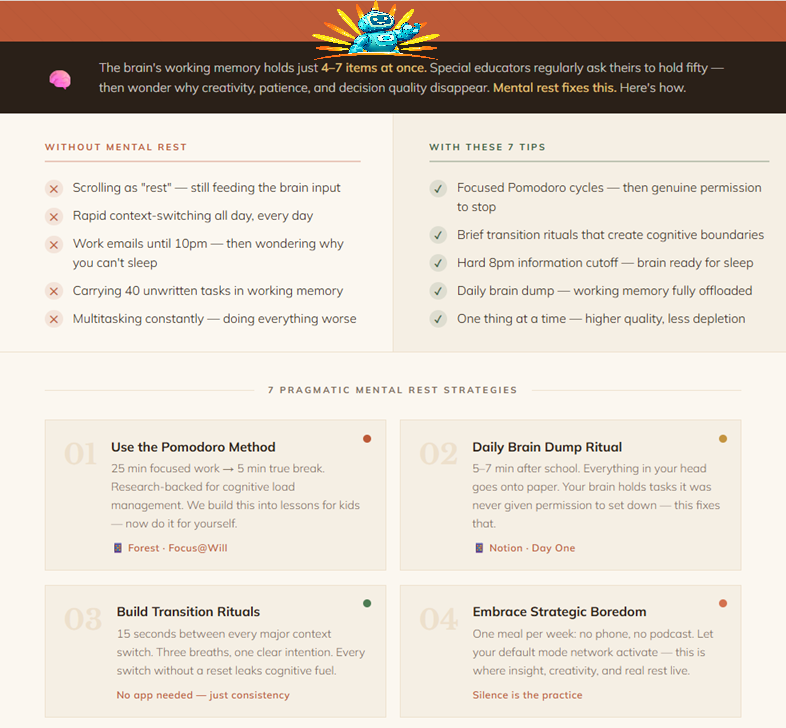
Mental rest is one of the most misunderstood types of recovery for teachers — and it’s the one we desperately need. We operate in what researchers call a high-cognitive-load environment every single day. We’re managing behavior, differentiating instruction in real time, tracking IEP goals mentally, monitoring student affect, making compliance decisions, fielding emails, and navigating staff dynamics — all simultaneously, all day. The human brain’s working memory can typically only handle 4 to 7 pieces of information at once. We’re regularly asking ours to hold fifty.
So this post is for you if you’ve been saying you’re tired but can’t sleep. If your brain won’t quiet down even when you want it to. If you’re running on the cognitive equivalent of fumes and wondering why your creativity, patience, and decision-making quality have all quietly disappeared.
What you need is mental rest. Not a vacation. Not more willpower. Not to work slower. Here’s exactly how to start.
What Mental Rest Actually Is (And Why It’s Not Scrolling)
Before we can practice mental rest, we have to be honest about what counts — and what doesn’t.
Mental rest is the deliberate reduction of cognitive input and demand. It’s giving your working memory white space. It means time where you are not absorbing new information, making decisions, tracking tasks, or processing emotional content. The brain isn’t designed to operate at peak output continuously. It needs what neuroscientists call default mode network activation — the mental state that kicks in during genuine downtime, associated with consolidating memories, processing emotions, sparking creativity, and restoring executive function.
Scrolling social media, watching a emotionally charged show, reading work emails “just to check,” or mentally rehearsing tomorrow’s schedule — none of these activate the default mode network. They suppress it. They keep the brain in input mode when it desperately needs output to stop.
This distinction is everything. Because once you understand it, you stop feeling guilty for resting and you start resting correctly.

Tip #1: Use the Pomodoro Method — For Yourself, Not Just Your Students
Here’s something I find quietly ironic: most special educators know exactly how to chunk information and build in breaks for their students. We build those structures deliberately into every lesson. And then we turn around and work for three hours straight without stopping.
The Pomodoro Technique — working in focused 25-minute intervals followed by 5-minute breaks, with longer breaks after four sessions — is one of the most research-supported strategies for managing cognitive load and preventing mental fatigue. It’s not just for students. It’s for anyone whose brain needs structure to actually stop.
What I love about this method is the permission it gives. You’re not abandoning the task. You’re working with your biology instead of against it. When you know a break is five minutes away, your brain sustains focus better. And when the break comes, you actually take it — because the system tells you to.
For implementation, Forest is one of the most satisfying focus apps I’ve recommended to teachers. You plant a virtual tree that grows while you work and dies if you touch your phone. Five-minute break? The tree is saved. It sounds silly until you realize you haven’t checked your phone mid-IEP documentation in three weeks. Focus@Will pairs Pomodoro timing with scientifically designed music that reduces cognitive interference — it’s genuinely different from playing a lo-fi playlist and hoping for the best.
Start with just one Pomodoro session per day. Your planning period. Your documentation time. See what it changes.
Tip #2: Build a Daily Brain Dump Ritual
This one is the single most underrated mental rest practice for teachers. And it costs you seven minutes.
Here’s the problem: teachers carry an enormous amount in working memory that never gets written down. Tomorrow’s schedule adjustments. The parent you need to call. The IEP goal you noticed wasn’t addressed this week. The concern about a student’s change in behavior. The form you almost forgot. All of it sits in your head, quietly consuming cognitive resources — even when you’re not actively thinking about it — because your brain is using energy to hold it so you won’t forget.
Using external storage systems like note-taking apps, digital calendars, and task management tools as “external hard drives” for your brain directly reduces cognitive load, freeing up working memory for tasks that actually require it.
A daily brain dump is simple: at the end of each workday, spend five to seven minutes writing down everything currently living in your head. Tasks, worries, ideas, things you almost forgot, things you’re anxious about. Get it out of your brain and onto paper or a screen. Then close the document. Your brain can let go of the items it was storing because they’re externally saved now.
Notion is exceptional for this — you can create a daily brain dump template that takes literally 30 seconds to open each afternoon. Day One (which I’ve mentioned before, and for good reason) works beautifully for the more reflective version of this — less task list, more mental offloading. Try both and see which feels more like relief.
The test for a good brain dump: you should feel your shoulders drop slightly as you do it. That’s the physical sensation of cognitive load releasing. It’s real, and it’s glorious.
Tip #3: Practice Intentional Transition Rituals
Special educators move from context to context at a speed that would give most people whiplash. A small group reading session flows into a behavior intervention, which flows into an IEP meeting prep, which flows into co-teaching, which flows into documentation. Each context demands a different cognitive gear. And most of us shift between them with zero transition time — just a rapid context switch and the hope that our brain caught up.
Here’s what cognitive science tells us about that: rapid context switching is one of the most expensive things the brain does. It increases errors, reduces performance quality, and accelerates mental fatigue. Allowing the brain even a brief cognitive reset between tasks dramatically improves focus and retention for the subsequent work.
A transition ritual doesn’t need to be elaborate. It needs to be consistent and genuinely signal to your brain that one context is closing and another is opening. My version: before switching tasks, I take three slow, deliberate breaths, put one hand on my desk, and say (silently, usually) “That’s done. Now this.” Fifteen seconds. Total. It creates a neural boundary between contexts that makes the new task more accessible.
Other teachers I’ve coached use: stepping outside the room for 60 seconds, splashing cold water on their face between classes, or doing a 90-second progressive muscle release of their shoulders and neck. None of these are productivity hacks. They’re cognitive hygiene — and they work.
Tip #4: Embrace Strategic Boredom
This one is the hardest sell. Bear with me.
We’ve conditioned ourselves to fill every gap with input. Waiting for a meeting to start? Phone. Walking to the copier? Earbuds. Eating lunch? Podcast. And I understand why — the podcast is interesting, the phone is engaging, the silence feels wasteful. But silence is exactly what the default mode network needs to activate.
Research using fMRI scanners found that during the brain’s state of rest — referred to as the “default mode” — despite appearing inactive, the brain is actually highly active, consolidating memories, processing emotions, and engaging in the creative and connective thinking that supports executive functioning.
Strategic boredom means deliberately choosing moments of zero input. Not meditation (which is its own practice). Just doing nothing. Sitting with your lunch without screens. Walking to your car without headphones. Letting your mind wander on purpose, without direction or agenda.
This is where insight lives. This is where good ideas come from. This is where your brain does its best integration work. And most teachers are systematically eliminating every opportunity for it by keeping input constant from 6am to 10pm.
Start with one meal per week eaten in genuine silence. No phone, no podcast, no conversation-heavy environment. Just food and whatever your brain wants to do without instructions. Notice what shows up.
Tip #5: Set a Hard Information Cutoff at Night
If you do nothing else from this post, do this one.
Pick a time — I’d suggest 8:00 or 8:30pm — and after that point, you consume no new information that requires cognitive processing. No work emails. No news. No social media doomscrolling. No researching strategies for tomorrow’s lesson. Nothing that makes your brain generate new thoughts, concerns, or decisions.
Following task-rest cycles and prioritizing sleep and recovery is essential because the brain processes and consolidates information during sleep — and skimping on genuine pre-sleep downtime increases cognitive overload the next day.
The science behind this is straightforward: your brain needs approximately 60-90 minutes of low-stimulation time before sleep to shift from information-processing mode to consolidation mode. When we feed it new information right up until we close our eyes, we’re essentially asking it to sprint to the starting line of a rest that requires a walking warm-up.
After your cutoff: read fiction (not educational or professional nonfiction), take a bath, do gentle stretching, have a low-stakes conversation, or use a meditation app. Headspace (still free for U.S. educators — please use this if you haven’t) has a “Nighttime SOS” and “Wind Down” series specifically designed for this transition window. Calm has an equally strong sleep collection with stories, music, and guided relaxation.
One month of consistent information cutoffs will change your sleep quality more than almost any other single habit. I’ve seen it in my own life and in every teacher I’ve coached through this. It’s that reliable.
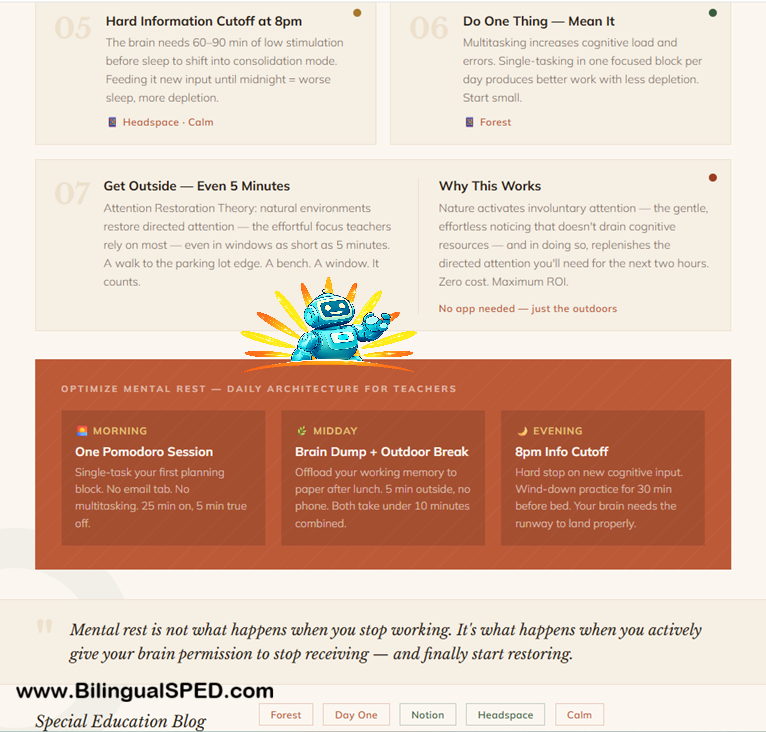
Tip #6: Do One Thing at a Time — And Mean It
Multitasking is the nemesis of mental rest. And teaching culture practically enshrines it as a virtue.
“Multitasking” doesn’t actually exist in the way we think it does. What we’re doing is rapid task-switching — and every switch carries a cognitive cost called the switching penalty. Your brain takes time to fully disengage from task A, reorient to task B, and reload the relevant context. Do this constantly and you’re essentially leaking cognitive fuel all day without noticing.
Multitasking is especially misleading — it feels productive but actually increases cognitive load by forcing the brain to reset between tasks, making errors more likely and quality of work lower.
The fix isn’t heroic: for one focused block per day, do one thing. Close everything else. One task, one window, full attention. No email tab open “just in case.” No mental tracking of the next thing. Just the one thing. Use Forest or a simple timer to hold the boundary.
The quality of work that comes from single-tasking compared to multitasking is genuinely surprising until you experience it. Documentation gets done faster. Planning gets done better. And afterward — crucially — you feel less depleted than you would have after the same amount of time spent juggling.

Tip #7: Get Outside — Even for Five Minutes
Research framed by Attention Restoration Theory demonstrates that even brief exposure to natural environments restores directed attention — the type of sustained, effortful focus that teachers rely on most — and reduces cognitive fatigue measurably even in short windows.
Five minutes outside — not on your phone, not running an errand — is a legitimate mental rest strategy supported by peer-reviewed research. A brief walk to the edge of the parking lot and back. Sitting on a bench with your face to the sky for four minutes. Standing near a window with natural light during your prep.
Nature doesn’t require your directed attention. It activates involuntary attention — the gentle, effortless noticing that doesn’t drain cognitive resources. And in doing so, it restores the directed attention you’ll need for the next two hours. This is Attention Restoration Theory in action, and it’s one of the most low-cost, high-impact things you can do for your mental recovery.
Teachers who prioritized restorative activities including brief outdoor time reported fewer instances of mental fog and fatigue during the school year — which, if you’ve experienced the February brain fog phenomenon, sounds like exactly what you need.
Make it a habit: lunch break outside, even if it’s cold. A five-minute end-of-day outdoor walk before you drive home. The barrier is almost zero. The payoff is real.
Optimizing Mental Rest: The Non-Negotiable Framework
All seven tips above work. But here’s the framework that ties them together — what I call the Mental Rest Architecture for teachers:
Morning: One Pomodoro session during your first planning task. No multitasking. One thing.
Midday: Brain dump after lunch. Everything currently in working memory, offloaded to a document. A five-minute outdoor walk.
Afternoon transitions: One 15-second transition ritual between every major context switch.
Evening: Hard information cutoff at 8:00pm. Wind-down app. One meal per week in silence.
Weekly: One genuine boredom window. No input. Let the default mode network do its job.
None of this requires more time in your day. It requires using the time you already have differently. That’s the whole point.
The Honest Conclusion
Teachers are not struggling because they don’t care enough. They’re struggling because nobody built mental recovery structures into a job that demands extraordinary cognitive output every day.
That’s not your fault. But it is your responsibility to fix for yourself — because the system isn’t going to do it, and your students need you in this work long-term, not burned out by March.
Start with one tip. The brain dump, the information cutoff, the Pomodoro. Whichever one felt most urgent as you read this. Do it for two weeks before adding another. Build slowly. That’s how sustainable change actually works.
Your brain is not the enemy. It’s just exhausted. Give it a little grace — and a little white space — and watch what comes back.
📬 Join the Weekly Newsletter
Every week I write one email built specifically for special educators: practical tools, honest conversation, strategies that actually fit inside a teaching life. No fluff. No sales. Just real support from someone who’s been in your classroom.
💬 Reflection Question
Which of these mental rest tips felt most like something you’ve been unconsciously avoiding — and what’s one small version of it you could try this week?
Leave your answer in the comments. I read every response, and your honesty might be exactly what another teacher needed today.
❓ Frequently Asked Questions
Q: How is mental rest different from physical rest?
Physical rest addresses the body — muscles, nervous system, sleep. Mental rest addresses cognitive capacity: working memory, decision-making, focus, and creativity. You can get a full night of physical sleep and still wake up mentally depleted if your cognitive load never properly offloaded. Both types are needed and neither substitutes for the other.
Q: Is watching TV a form of mental rest?
It depends on what you’re watching and how you’re engaging with it. Emotionally intense drama, news, or anything requiring sustained attention is not mental rest — it’s lower-stakes cognitive input that still keeps the brain in processing mode. Low-stimulation content (calm, predictable shows you’ve seen before) can approach rest-adjacent territory. Genuinely nothing — darkness, quiet, stillness — is the most effective for activating the default mode network.
Q: How long does it take to feel the effects of better mental rest practices?
Most teachers report noticeable improvement in mental clarity and sleep quality within 1-2 weeks of consistent information cutoffs and daily brain dumps. The deeper cognitive benefits — improved creativity, better decision-making, restored patience — typically emerge over 3-4 weeks of consistent practice.
Q: Can I practice mental rest during the school day?
Yes — and this is essential. Transition rituals, micro-breaks, and single-tasking during a focused Pomodoro block are all in-school practices. Outdoor time during lunch is in-school. You don’t need to wait until 5pm to begin recovering. In fact, in-day micro-restoration prevents the deep depletion that requires hours to recover from at home.
Q: What if I genuinely can’t turn my brain off at night?
This is extremely common in chronically cognitively overloaded teachers and is often related to unresolved working memory load — your brain keeps rehearsing tasks it hasn’t been given permission to set down. A brain dump before bed, combined with a consistent information cutoff and a guided wind-down practice, addresses all three contributing factors. If it persists beyond 3-4 weeks of consistent practice, speaking with a doctor about cortisol dysregulation or an anxiety assessment is worth considering.
📚 References
- Sweller, J. (1988). Cognitive load during problem solving: Effects on learning. Cognitive Science, 12(2), 257–285. https://doi.org/10.1207/s15516709cog1202_4
- Kaplan, R., & Kaplan, S. (1989). The Experience of Nature: A Psychological Perspective. Cambridge University Press.
- Mrazek, M. D., Franklin, M. S., Phillips, D. T., Baird, B., & Schooler, J. W. (2013). Mindfulness training improves working memory capacity and GRE performance while reducing mind wandering. Psychological Science, 24(5), 776–781. https://doi.org/10.1177/0956797612459659
- Mason, M. F., et al. (2007). Wandering minds: The default network and stimulus-independent thought. Science, 315(5810), 393–395. https://doi.org/10.1126/science.1131295
- Balance Health Systems. (2025). The overwhelmed mind: Understanding cognitive overload and effective coping strategies. https://balancehealthsystems.com/2025/04/14/the-overwhelmed-mind-understanding-cognitive-overload-through-kappasinian-theory-and-effective-coping-strategies/
- Parallel Learning. (2024). 10 restorative activities for educators to try on your next break. https://www.parallellearning.com/post/10-restorative-activities-for-educators-to-try-on-your-next-break
- Taylor & Francis. (2023). Rest breaks aid directed attention and learning. https://www.tandfonline.com/doi/full/10.1080/20590776.2023.2225700
- The Mind Company. (2025). Cognitive overload theory: Understanding and mitigating mental overload. https://themindcompany.com/blog/cognitive-overload-theory
- RAND Corporation. (2024). State of the American Teacher Survey 2024. https://www.rand.org/education-and-labor/projects/state-of-the-american-teacher.html
- Dalton-Smith, S. (2019). Sacred Rest: Recover Your Life, Renew Your Energy, Restore Your Sanity. FaithWords.