
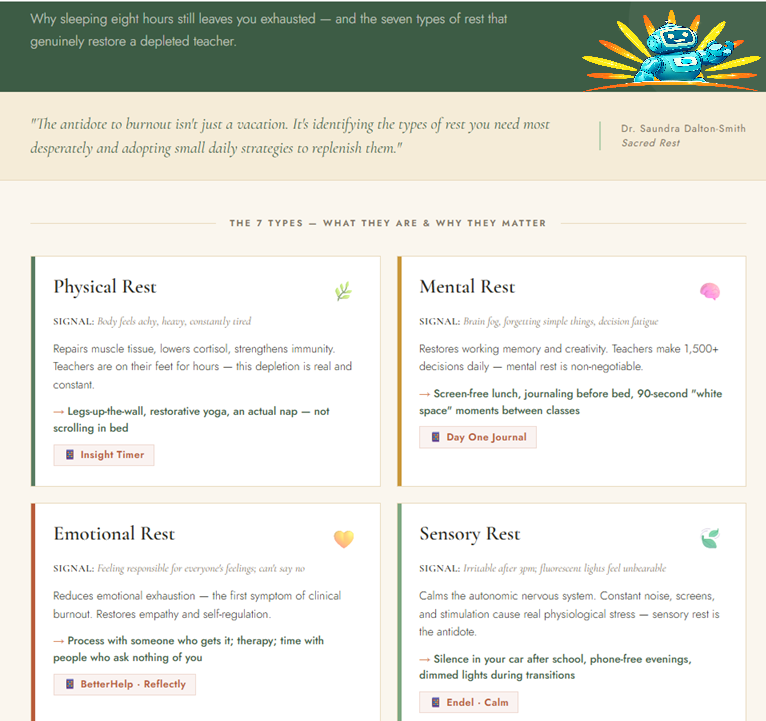
Why sleeping eight hours still leaves you exhausted — and what to do about it.
A few years into teaching, I started noticing something strange.
I wasn’t sleeping poorly. I was getting to bed at a reasonable hour. I wasn’t sick. And yet every single morning I woke up already tired. Not a little groggy — bone tired. The kind of tired that makes you do the math in your head on your drive in: how many years until I can retire?
I thought I was broken. Or weak. Or maybe just not built for this work.
Then I found Dr. Saundra Dalton-Smith’s framework on rest — and honestly? It rearranged how I understand exhaustion entirely. Because here’s the thing nobody tells teachers: sleep is only one type of rest. And if you’re only restoring one type while depleting seven, you’re going to wake up exhausted no matter how many hours you logged.
This post is about the full picture. All seven types. What they look like for someone doing our specific job — which is, if we’re being real, one of the most emotionally and cognitively demanding jobs that exists. And how to actually start replenishing each one without overhauling your entire life.
Let’s go.

First — Why Sleep Alone Will Never Be Enough
Dr. Saundra Dalton-Smith is a board-certified physician and the author of Sacred Rest: Recover Your Life, Renew Your Energy, Restore Your Sanity. Her research identified something that explains why so many high-performing, caring, dedicated teachers are running on empty: we’re deficient in multiple types of rest simultaneously, and we keep trying to fix all of them with sleep.
The antidote to burnout isn’t just a vacation—it’s identifying the types of rest you need most desperately and adopting small daily strategies to replenish them.
That’s the frame. Not a week off. Not a long weekend. Daily strategies. Small ones. Ones that fit inside the life you already have. That’s what I want to give you today.
Rest can have profound effects on our overall health — it can help repair our body, calm our brain, and restore our energy. Sometimes taking time to rest can seem unproductive or even lazy. But it’s vital to remember that rest isn’t a luxury, it’s a necessity.
When I first read that, I printed it out and stuck it inside my plan book. Because every teacher I’ve ever coached has needed to hear it — and believe it — before anything else could change.
Type 1: Physical Rest
This is the one we think we’re getting. And sometimes we are. But physical rest isn’t just sleep — it includes both passive forms like sleep and active forms like yoga or stretching. If your body feels achy or heavy, this might be what you need.
For teachers, physical depletion is almost universal. We’re on our feet for six or seven hours. We’re lifting, redirecting, moving furniture, crouching down to student level. Our bodies absorb the physical toll of the job in ways desk workers genuinely can’t relate to.
What it does for you: Physical rest restores muscular tissue, lowers cortisol levels, improves immune function, and resets your nervous system. Without it, everything else suffers. Cognitive sharpness, emotional regulation, patience — all of it degrades when your body is chronically under-recovered.
What it looks like in practice: Legs-up-the-wall for 10 minutes after school. A restorative yoga video (YouTube has thousands of free ones, 15 minutes or less). A genuine nap on Saturdays — not scrolling in bed, an actual nap. A walk that’s slow enough to actually decompress, not just exercise.
The app Insight Timer has free guided body scans and yoga nidra sessions that are genuinely excellent for physical rest — especially the sleep-focused ones if you struggle to wind down at night.
Type 2: Mental Rest
Here’s the one most special educators desperately need and never get.
If your brain feels foggy or overwhelmed, you may be mentally exhausted — finding it hard to focus or remember simple things. Mental rest involves breaks from decision-making, white space in your day, and practices that give your mind a pause.
Think about the number of decisions you make in a single teaching day. Behavior redirections. Instructional pivots. IEP accommodations applied in real time. Parent communication. Scheduling. Data interpretation. Staff coordination. I’ve read that teachers make upward of 1,500 educational decisions every single day. That’s not hyperbole — that’s cognitive load that would exhaust anyone.
What it does for you: Mental rest restores working memory capacity, improves problem-solving and creativity, reduces decision fatigue, and makes you more patient — because irritability is almost always a sign of mental depletion before it’s a personality issue.
What it looks like in practice: A true screen-free lunch break. Journaling before bed to offload the mental to-do list that otherwise replays at 2am. Short “white space” moments between classes — even 90 seconds of doing absolutely nothing is genuinely restorative.
Dalton-Smith encourages short breaks throughout the workday, or journaling before bedtime — to assist with mental chatter.
Day One is a beautiful, private journaling app I’ve recommended to teachers for years. The prompts are gentle, it syncs across devices, and there’s something about getting thoughts out of your head and onto a page that genuinely frees up cognitive space for the next day.
Type 3: Emotional Rest
This one hits different if you’re in special education. Because emotional labor — the kind where you hold space for a dysregulated child, manage a tense parent meeting, support a colleague having a hard week, and then drive home without processing any of it — is relentless.
When we rest emotionally, we give ourselves time to process our feelings, which helps us maintain our emotional balance and avoid burnout. Emotional rest can be especially challenging because we often feel guilty for taking time for ourselves.
The guilt piece is real. Special educators especially carry a deep sense of responsibility that makes rest feel like abandonment. But here’s what I know from watching too many good teachers burn out: you cannot pour from a vessel that’s been cracked from the bottom. The feelings you don’t process don’t disappear — they leak into your classroom, your relationships, your health.
What it does for you: Emotional rest reduces emotional exhaustion (the first and most defining symptom of clinical burnout), restores empathy, improves your ability to regulate your own responses, and quite literally makes you a better teacher.
What it looks like in practice: Giving yourself permission to say “I don’t have the bandwidth for that right now.” One honest conversation with a person who gets it — not venting, processing. Therapy. Time with someone who asks nothing of you emotionally. Crying in your car if you need to (no judgment — I’ve been there).
BetterHelp offers flexible, affordable online therapy that fits into a teacher’s schedule far better than in-person appointments. And if formal therapy feels like too big a step right now, Reflectly is a guided emotional journaling app that uses AI-driven prompts to help you name and process what you’re actually feeling — which, it turns out, is half the work.
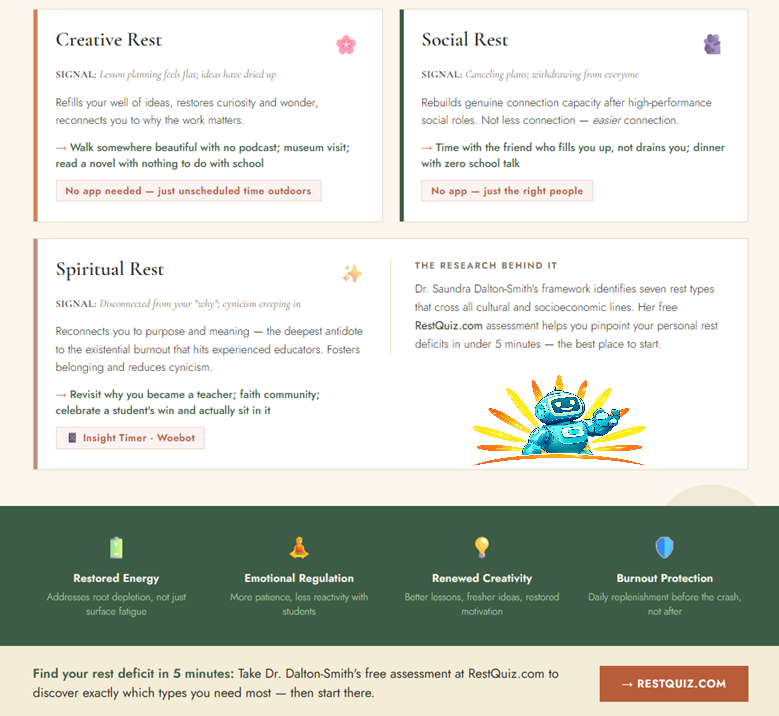
Type 4: Sensory Rest
Nobody talks about this one enough. And for teachers — especially those in classrooms with fluorescent lighting, constant noise, 25 different conversations happening at once, and a phone that won’t stop buzzing — it’s critical.
Whether or not you are consciously aware of the sensory input around you, your body and your subconscious self are going to respond. All of these sensory inputs over time can cause you to develop sensory overload syndrome. The number one way most of us respond to sensory overload is irritation, agitation, rage, or anger.
Does that sound familiar? That short fuse at the end of a long teaching day isn’t always stress in the traditional sense. Sometimes it’s your nervous system completely maxed out on sensory input, desperately reaching for quiet.
What it does for you: Sensory rest calms the autonomic nervous system, reduces physiological stress markers, lowers blood pressure, improves sleep quality, and — honestly — makes you a much more pleasant person to be around after 4pm.
What it looks like in practice: Sitting in your car in silence for five minutes before going inside after school. Eating lunch without screens, without talking, without input. Closing your eyes for 60 seconds between classes. Dimming your classroom lights during a calm transition. Putting your phone in a drawer for two hours on a weekday evening.
Endel creates personalized soundscapes based on your circadian rhythm — it’s scientifically designed to reduce stimulation and is genuinely different from just playing lo-fi beats. For total silence support, Calm has a “body scan” and “sleep” collection that eases your nervous system down from its peak-stimulation state.
Type 5: Creative Rest
This one sneaks up on special educators because we are constantly being creative — and we don’t realize that creativity without replenishment is still a drain.
For those of us working in creative fields, creative rest is an absolute must. One way to achieve creative rest is to surround yourself with inspiration while simultaneously taking the pressure off having to “do” something with it.
The key phrase there: without the pressure to do something with it. Creative rest isn’t making something. It’s receiving something — beauty, inspiration, art, nature — with zero output expected of you.
What it does for you: Creative rest refills your well of ideas, restores your sense of wonder and curiosity, combats the flatness and monotony that accompany advanced burnout, and reconnects you to why this work matters to you.
What it looks like in practice: A walk somewhere beautiful with no podcast, no music — just looking. Visiting an art museum or botanical garden. Sitting outside and watching something grow. Reading a novel that has nothing to do with education. Cooking something new. Going to a live performance. Letting yourself be moved by something you had no hand in making.
This one doesn’t need an app. It needs unscheduled time outdoors, or somewhere that reminds you the world is bigger and more beautiful than your classroom’s four walls.
Type 6: Social Rest
Teachers are people people. Which is why this one is counterintuitive: social rest doesn’t mean isolation. Social rest means being with people who don’t require anything from you — when you feel fully accepted and safe to just be.
The distinction matters enormously. There are people in your life who fill you up — conversations that end with you feeling energized. And there are people (and professional roles) that drain you, where you’re always performing, always “on,” always managing someone else’s needs or emotions.
Teaching is, by its nature, a high-performance social role. You’re on for six to seven hours. For our students with special needs, this requires an extraordinary level of presence and attunement. By 3pm, most of us have given socially more than most people give in a full week.
What it does for you: Social rest rebuilds your capacity for genuine connection, reduces emotional withdrawal (the pulling-back-from-everyone pattern that shows up in burnout), restores your sense of belonging, and refills the social energy you need to actually enjoy the people you love.
What it looks like in practice: Time with the friend who doesn’t need you to manage anything. A dinner where nobody talks about school. Permission to cancel a social obligation when your tank is genuinely empty. Spending time with a pet. Sitting on the porch alone. The goal isn’t more connection — it’s easier connection.

Type 7: Spiritual Rest
Last — and I say this as someone who works with people across every background and belief system — spiritual rest is about meaning, not necessarily religion.
If you don’t feel like your work has meaning, you will experience burnout. Find a way to connect to a desire for meaning, whether that’s through community, a work culture where you feel like what you do matters, or a faith-based culture. We all have that need to feel like we belong and that we are contributing.
This one is the most quietly urgent for special educators. Because we chose this work on purpose. We showed up for the kids nobody else figured out how to reach. And when systems failures, administrative friction, or sheer exhaustion disconnect us from why we started — that’s when burnout becomes existential.
What it does for you: Spiritual rest reconnects you to your purpose, reduces nihilism and cynicism (which are classic late-stage burnout symptoms), fosters belonging and community, and gives your work a larger context than the stack of ungraded work on your desk.
What it looks like in practice: Journaling about why you became a teacher and revisiting it when things are hard. Connecting with a faith community if that resonates. Volunteering for something outside of school that reminds you of your values. Meditation. A long conversation with a mentor. Celebrating a student’s milestone — really sitting in it instead of rushing to the next thing.
Insight Timer again earns its place here — it has the world’s largest library of free guided meditations, many focused specifically on meaning, purpose, and grounding. Woebot can help when existential spiraling is part of what’s depleting you — its CBT-based tools are surprisingly effective at interrupting the thought loops that strip meaning from work you once loved.
The Real Takeaway
You can’t continue to show up for yourself — or anyone else — with zero rest. Rest is vital for your mental health and overall wellbeing.
I want you to do one thing after reading this. Just one.
Go through the seven types — physical, mental, emotional, sensory, creative, social, spiritual — and ask yourself honestly: which two am I most starved for right now? Not all seven. Just two. Because you don’t need to take a three-month sabbatical or some kind of big carved-out period of time — you need a strategy of small things you can do today to start feeling better.
Start there. Build slowly. The goal isn’t a perfect rest practice. It’s staying in this work long enough to do it well — for the students who need you, and for the version of yourself who chose this profession on purpose.
You deserve to be rested. All seven ways.
📬 Want More? Join the Weekly Newsletter.
Every week I send one email — practical, real, no-fluff — built specifically for special educators navigating the real work. Classroom strategies, IEP tips, honest conversations about sustainability in this profession, and tools that actually fit inside a teaching schedule.
No spam. No sales. Just one educator in your corner.
💬 Reflection Question
Which of the seven types of rest resonated most with you — the one you realized you’ve been missing — and what’s one small thing you could do this week to start restoring it?
Drop it in the comments below. I read every response. And your answer might be exactly what another teacher needed to read today.
❓ Frequently Asked Questions
Q: Is it really possible to practice all seven types of rest as a working teacher?
Not all at once — and nobody’s saying you need to. The point of naming all seven is so you can identify which ones you’re most deficient in. Start with one or two. Build gradually. Small, consistent restoration beats zero restoration every time.
Q: Does the type of rest I need change throughout the year?
Absolutely. September burnout usually looks different from February burnout. September tends to deplete mental and physical rest the most. February — the longest month of the school year, emotionally — typically depletes emotional and spiritual rest. Check in with yourself at the start of each month and adjust accordingly.
Q: I feel guilty resting when there’s so much to do. What do I do with that?
This is the most common thing I hear from teachers, and it’s worth naming directly: the guilt is real, but the logic behind it is flawed. Resting doesn’t make you a less dedicated teacher. Chronic depletion does. The best thing you can do for your students is remain a sustainable, present, regulated version of yourself for the long haul.
Q: Can the wrong type of rest actually make burnout worse?
Yes — and this is why the framework matters. If you’re mentally exhausted, scrolling social media for two hours isn’t rest. It’s more cognitive input. If you’re sensorially overloaded, going to a loud party isn’t social rest. Matching the right type of rest to the right type of depletion is the whole point.
Q: What’s the fastest way to figure out which types of rest I need most?
Dr. Dalton-Smith offers a free rest assessment at RestQuiz.com — it takes about 5 minutes and gives you a personalized rest deficit profile. Worth doing before anything else.
📚 References
- Dalton-Smith, S. (2019). Sacred Rest: Recover Your Life, Renew Your Energy, Restore Your Sanity. FaithWords. https://www.drdaltonsmith.com
- Dalton-Smith, S. (2021). The 7 types of rest that every person needs. TED Ideas. https://ideas.ted.com/the-7-types-of-rest-that-every-person-needs
- Breathe For Change. (2025). The 7 types of rest every educator needs. https://breatheforchange.com/resources/rest-every-educator-needs
- Calm Blog. (2025). The 7 types of rest that can help you feel fully renewed. https://www.calm.com/blog/7-types-of-rest
- Psychology Today. (2022). The 7 kinds of rest you actually need. https://www.psychologytoday.com/us/blog/a-different-kind-of-therapy/202212/the-7-kinds-of-rest-you-need-to-actually-feel-rejuvenated
- Mindful Health Solutions. (2023). 7 types of rest and why they’re important. https://mindfulhealthsolutions.com/embrace-these-7-types-of-rest
- RAND Corporation. (2024). State of the American Teacher Survey. https://www.rand.org/education-and-labor/projects/state-of-the-american-teacher.html
- Maslach, C., & Leiter, M. P. (2016). Understanding the burnout experience: Recent research and its implications for psychiatry. World Psychiatry, 15(2), 103–111. https://doi.org/10.1002/wps.20311