
A special education coach’s perspective for teachers who want to get it right
I still remember my early years in special education—sitting in team meetings, staring at data sheets, and quietly wondering, Is this student struggling because they are still learning English, or is something deeper going on?
That question never really goes away. It just becomes more urgent, because the decisions we make carry real consequences. They affect how students see themselves, the services they receive, and whether they are celebrated for their strengths or misunderstood for their challenges.
If you are a new teacher, a bilingual educator, or a service provider supporting multilingual learners, this post is for you. Think of this as me pulling up a chair next to you, coaching you through one of the most important distinctions you’ll ever make in your career.
Why This Distinction Matters More Than We Admit
Language acquisition and learning disabilities can look similar on the surface. Both may involve slow reading progress, limited written expression, difficulty following academic language, or frustration during independent work.
But they are not the same thing.
When we confuse them, one of two harmful things happens:
- Students are misidentified as having disabilities when they are actually doing exactly what second-language learners do.
- Students with genuine learning disabilities are told to “just wait” or “get more exposure,” delaying critical intervention.
Neither outcome is acceptable.
Language Acquisition: A Normal, Predictable Journey
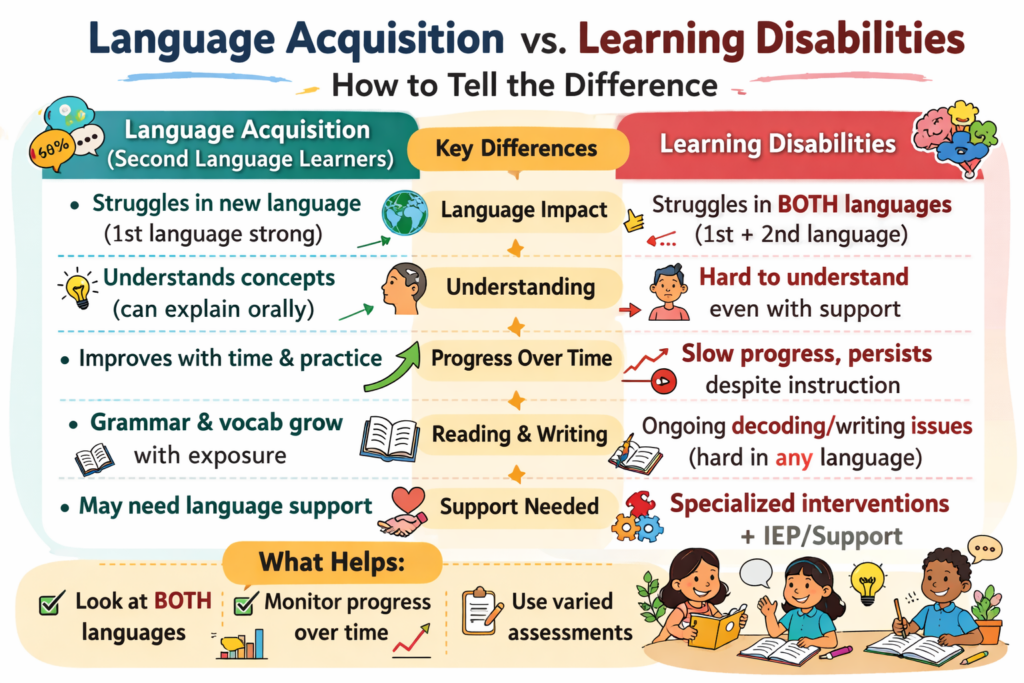
Language acquisition is the natural process of learning a new language. It is developmental, nonlinear, and deeply influenced by context, exposure, and opportunity.
Multilingual learners often:
- Understand concepts before they can express them
- Show stronger oral language than reading or writing
- Translate from their home language
- Use simplified grammar or sentence structures
- Appear quiet or hesitant in academic discussions
These are not red flags. These are signs of a brain doing exactly what it’s supposed to do—building a new linguistic system.
One of the most important coaching questions I ask teachers is:
“What does this student know when language is removed as a barrier?”
When students can explain ideas verbally, solve problems using visuals, or demonstrate understanding through their home language, that is language acquisition—not a disability.
Learning Disabilities: Persistent, Cross-Linguistic Challenges
Learning disabilities are neurologically based and affect how information is processed, stored, or retrieved. They are not caused by limited English exposure, cultural background, or interrupted schooling.
A key distinction is this:
Learning disabilities show up across languages.
A student with a learning disability may:
- Struggle with decoding or spelling in any language
- Have difficulty organizing thoughts even when speaking
- Show slow progress despite high-quality, targeted instruction
- Require repeated, explicit teaching to retain skills
Time alone does not resolve these challenges. Exposure alone does not resolve these challenges. Instructional quality matters—but so does specialized intervention.
The Coaching Lens: Patterns, Not Snapshots
One worksheet, one test score, or one observation will never tell the full story.
As a coach, I urge teachers to stop looking for proof and start looking for patterns.
Ask yourself:
- Is progress happening over time with appropriate language supports?
- Does the student show strength in their home language?
- Are struggles consistent across settings and subjects?
- How does the student respond to targeted interventions?
Language acquisition typically shows growth with support.
Learning disabilities show persistence despite support.
That difference is subtle—but powerful.
Practical Tools That Help You See More Clearly
Technology can be a powerful ally when used intentionally.
For language learners:
- TalkingPoints helps bridge home–school communication in families’ preferred languages.
- Read&Write provides text-to-speech, translation, and vocabulary support without lowering cognitive demand.
- Flip (formerly Flipgrid) allows students to demonstrate understanding orally, reducing language production pressure.
For suspected learning disabilities:
- Lexia and i-Ready offer diagnostic insights into foundational literacy skills.
- Speech-to-text tools can help determine whether the barrier is language output or idea generation.
- Seesaw allows for multimodal responses, revealing hidden strengths.
These tools don’t replace professional judgment—but they sharpen it.
What I Tell New Teachers (Every Single Time)
Here’s the coaching advice I wish someone had given me early on:
- Do not rush to label difference as deficit.
- Do not delay support while “waiting it out.”
- Do not rely on English-only data.
- Do not ignore family insights—they know the child across contexts.
And most importantly:
You can hold two truths at once.
A student can be learning English and have a disability. These are not mutually exclusive.
Assessment Must Be Thoughtful, Not Convenient
True differentiation requires:
- Multiple data points
- Observations over time
- Input from families
- Consideration of language proficiency
- Assessments in both languages when appropriate
Quick conclusions feel efficient—but they are often costly.
For Parents Reading This
If you are a parent, know this: questions are not resistance. Advocacy is not denial. Wanting clarity is not the same as rejecting support.
You deserve explanations that honor your child’s language, culture, and potential.
The Bigger Picture
When educators get this distinction right, students experience something transformative:
- They are seen accurately.
- They are supported appropriately.
- They are protected from unnecessary labels.
- They are empowered to learn with dignity.
That is the heart of special education done well.
Frequently Asked Questions
Can a student be both a multilingual learner and have a learning disability?
Yes. Dual identification requires careful, ongoing analysis and should never be assumed—or dismissed.
How long should language acquisition take?
Conversational fluency may develop in 1–2 years. Academic language can take 5–7 years or more.
What’s the biggest red flag for a learning disability?
Persistent difficulty across languages and contexts, despite targeted, research-based instruction.
Should students be assessed in their home language?
When feasible and appropriate, yes. It provides critical insight into whether challenges are language-based or neurological.
Credible References
- American Speech-Language-Hearing Association (ASHA)
- National Center on Intensive Intervention (NCII)
- WIDA Consortium Research Briefs
- Individuals with Disabilities Education Act (IDEA)
- Ortiz, A. A. (2002). Disproportionate Representation of Minority Students in Special Education
Call to Action
If this post resonated with you, I invite you to continue the conversation. I share practical strategies, visuals, and coaching insights for educators and families navigating bilingual special education.
Reflection Question for You
The next time a student struggles, will you pause long enough to ask:
“Is this a language difference, a learning difference, or both—and what evidence do I truly have?”
That question alone can change a child’s trajectory.