
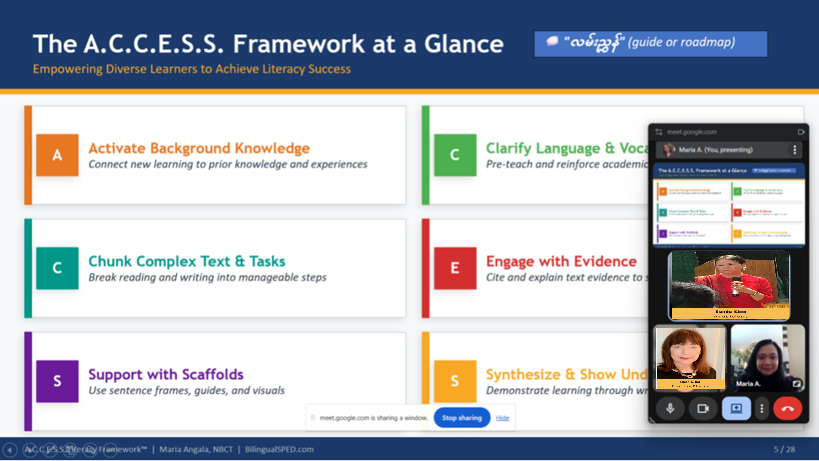
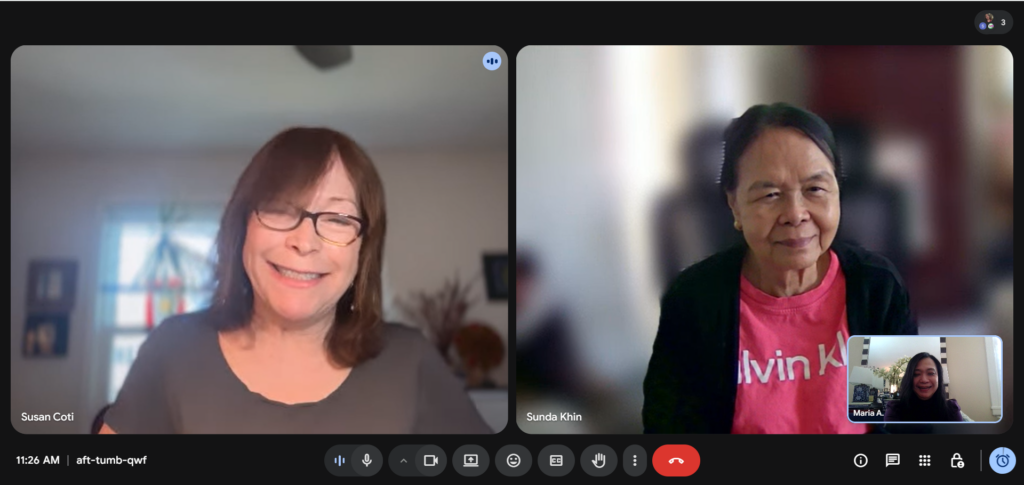
Two hours. That’s how long I spent on a call with Susan and Sunda from Gift of Education Myanmar — and by the end of it, something had shifted in me. I’d been invited onto their Advisory team to help develop standards-based curriculum and launch the A.C.C.E.S.S. Literacy Framework in Southeast Asia. Teacher training begins in May through the Teachers Teaching Teachers Professional Development Certification Program. This post is about why that moment matters — why the A.C.C.E.S.S. framework belongs in Myanmar’s classrooms, what the literacy challenges look like on the ground, and what I hope this collaboration builds for teachers and diverse learners across the region and beyond.
I didn’t expect to feel emotional on a Google Meet.
But there I was, two hours into a conversation with Susan and Sunda from Gift of Education Myanmar, and something about the way they talked about their students — about the teachers who are showing up in incredibly challenging conditions and trying to give children access to real learning — just got to me. Because that’s exactly why I built the A.C.C.E.S.S. Framework in the first place. Not for a perfect classroom in a well-resourced school. For the classrooms that don’t have everything — but have teachers who refuse to let that be the end of the story.
So when they asked me to join their Advisory team, I said yes immediately. Without hesitation.
And honestly? I’ve been buzzing ever since.
We’re going to develop a standards-based curriculum that Myanmar’s teachers can actually use and sustain. Teacher training begins in May through the Teachers Teaching Teachers A.C.C.E.S.S. Professional Development Certification Program — a model I designed specifically so that teachers can become certified practitioners, then certified instructors, and then train others in their own communities. Because the most powerful professional development isn’t what I give to teachers. It’s what teachers eventually give to each other.
What Does Literacy Look Like in Myanmar — and Why Does This Framework Fit?
Let me give you some context, because the numbers matter here.
According to UNICEF Myanmar, years of political instability and the disruption of the education system have left millions of children with severely interrupted schooling. Teachers are working in conditions that most Western educators can’t imagine — large multilingual classrooms, limited materials, minimal formal training in inclusive or differentiated instruction, and students whose home languages vary enormously from the language of instruction.
Research from the Global Partnership for Education shows that Myanmar faces compounding literacy challenges: high classroom sizes (averaging 40+ students in many regions), significant gaps in teacher professional development specifically around language learning and disability inclusion, and a student population that brings extraordinary linguistic diversity to every lesson.
And here’s what I know from years of classroom experience: when teachers don’t have a clear, repeatable instructional system, they default to what’s fastest and most manageable. Which is usually teacher-centered, low-interaction, and ultimately low-growth for the students who need the most support. Not because teachers don’t care — they care enormously. But caring without a system is exhausting and often ineffective.
That’s the gap the A.C.C.E.S.S. framework was designed to fill.
🇲🇲 The Myanmar Context — Why A.C.C.E.S.S. Fits
Myanmar classrooms often have 40–60 students, multiple home languages, minimal SPED-trained teachers, and students whose schooling has been interrupted by conflict and displacement. The A.C.C.E.S.S. framework’s chunking and visual scaffolding strategies work in large classes. Its background knowledge activation honors rich cultural contexts. And its vocabulary clarification stage is designed for exactly the kind of linguistic diversity Myanmar teachers face every single day.
Why the A.C.C.E.S.S. Framework — and Not Something Else?
Fair question. There are plenty of literacy frameworks out there. So why this one for Myanmar?
Because A.C.C.E.S.S. was built from the classroom out — not from a theory down. Every component was designed because I saw a specific barrier preventing specific students from accessing rigorous literacy learning. And those barriers — cognitive overload, vocabulary gaps, lack of background knowledge activation, missing scaffolds for writing — are not unique to the U.S. They’re universal. They show up in Manila. They show up in Yangon. They show up wherever teachers are trying to reach diverse learners without enough support.
The six stages of the framework map directly onto the challenges Myanmar teachers face:
A
Activate Background Knowledge
Connect new learning to what students already understand. “Every learner arrives with experience. Honor it.” For students whose schooling has been interrupted, this stage is especially critical — it builds the bridge between what they know from life experience and what the text is asking them to understand.
🇲🇲 Myanmar application: Allow students to share in their home language first, then bridge to the language of instruction. This reduces anxiety dramatically and opens cognitive access to the lesson.
C
Clarify Language & Vocabulary
Pre-teach and reinforce academic language before students encounter it in text. Academic vocabulary is the single greatest predictor of reading comprehension — and for multilingual learners, explicit vocabulary instruction is non-negotiable, not optional.
🇲🇲 Myanmar application: Prioritize Tier 2 words that appear across content areas. Cognate instruction where applicable. Visual word maps that work across language barriers.
C
Chunk Complex Text & Tasks
Break reading and writing into manageable steps. Rigor is not removed — it is made accessible. Long unbroken texts overwhelm working memory, especially for students with learning differences or limited language proficiency. Chunking is how we preserve the rigor while removing the overload.
🇲🇲 Myanmar application: In classes of 40–60 students, numbered annotation protocols and stop-and-jot checkpoints after each chunk keep all learners engaged and on pace simultaneously.
E
Engage with Evidence
Cite and explain text evidence to support answers. The RACE/RACES writing structure (Restate, Answer, Cite, Explain, Summarize) gives students a consistent scaffold for evidence-based writing that they can use every single day — until it becomes habit rather than task.
🇲🇲 Myanmar application: RACE anchor charts in both the language of instruction and students’ home languages make the structure visible and accessible regardless of language proficiency level.
S
Support with Scaffolds
Use sentence frames, guides, and visuals — then gradually fade them as students build independence. The scaffold is not the goal. Independence is. But independence built without scaffolding is just struggle without support. We build the bridge and then we dismantle it piece by piece as the student demonstrates they don’t need it anymore.
🇲🇲 Myanmar application: Visual scaffolds transcend language barriers. A well-designed graphic organizer works for a student whether their home language is Burmese, Karen, Kachin, or Shan.
S
Synthesize & Show Understanding
Demonstrate learning through writing and structured discussion. This is where students move beyond recall into real comprehension — constructing their own understanding from the text, connecting it to what they knew before, and communicating it in a way others can understand.
🇲🇲 Myanmar application: Oral synthesis options, drawing responses, and peer discussion protocols allow students to demonstrate understanding through multiple channels — not just written English.
None of these stages lower the thinking required. Not one. They make that thinking reachable for students who’ve been told, implicitly or explicitly, that certain kinds of learning aren’t for them.
⚡ Quick Win — The A.C.C.E.S.S. Classroom Check
Before your next lesson, ask: Does my plan include a way to activate what students already know? Does it pre-teach the vocabulary they’ll need? Have I chunked the reading into sections with pause points? Is there a structure for written responses? And does the lesson end with students synthesizing — not just answering? If you can check all six boxes, you’re implementing A.C.C.E.S.S. And your diverse learners will feel the difference.
What Is the Teachers Teaching Teachers Model — and Why Is It the Right Approach for Myanmar?
Here’s what I’ve learned after years of professional development work: a single training session doesn’t change instruction. It can inspire. It can open a door. But lasting change in classroom practice happens when teachers have a system, have time to practice it, have a community of peers also implementing it, and eventually become the ones teaching it to others.
That’s the whole design of the Teachers Teaching Teachers A.C.C.E.S.S. Professional Development Certification Program. It’s not a one-day workshop. It’s a pathway.
- Level 1 — Certified Practitioner: Complete all six A.C.C.E.S.S. framework modules, demonstrate classroom application, submit one annotated lesson plan. Earn a digital certificate and badge.
- Level 2 — Certified Instructor: Build on Level 1 with advanced modules, submit a scaffolded unit portfolio, complete a peer coaching session. Earn an advanced certificate and priority resource access.
- Level 3 — Certified Trainer: Complete Levels 1 and 2, deliver a pilot training session, submit a full trainer portfolio. Earn the right to deliver A.C.C.E.S.S. workshops and become eligible for district-level licensing.
By May, I’ll be delivering the first training cohort with Gift of Education Myanmar’s teachers. And my goal isn’t just for them to understand the framework. My goal is for the strongest participants in that cohort to become Level 2 and Level 3 trainers — so that when I’m not in the room, the training continues. That’s what makes this sustainable. That’s what makes it real.
💚 Why Certification Matters for Teachers in Myanmar
In contexts where teachers often have limited access to formal professional recognition, digital certificates and badges are genuinely meaningful. They give teachers a credential they can display, share, and point to as evidence of professional growth. I’m designing the certificates, badges, and certification portal with that weight in mind — because these teachers deserve to be recognized for the serious work they’re doing.
If you’re an educator outside Myanmar who wants to understand this certification pathway — or if you’re a school leader wondering whether the A.C.C.E.S.S. framework might fit your context — the full framework and certification information is on BilingualSPED.com. And for the classroom-ready anchor charts, RACE writing scaffolds, and vocabulary supports that bring each stage to life, grab the bilingual classroom toolkit on TpT — it’s the foundation I’ll be adapting for Myanmar’s context.
What Technology Will Support This Work — and How Do We Use It in Low-Resource Contexts?
Look — I’m not going to pretend every classroom in Myanmar has a device for every student and reliable broadband. That’s not the reality. So when I think about technology supports for this rollout, I think in tiers: what works when you have full connectivity, what works with limited access, and what works completely offline.
Tools I’ll be building into the training program:
- Canva for Education — free for teachers, works beautifully for creating visual anchor charts, vocabulary cards, and bilingual materials that can be printed and used offline
- Newsela — leveled texts on real-world topics, downloadable for offline use, with built-in vocabulary support that aligns directly with the Clarify stage
- Google Workspace for Education — free suite including Docs, Slides, and Forms that supports collaborative lesson planning and student portfolio development even in low-bandwidth conditions
- DeepL — far more accurate than generic translation tools for multilingual vocabulary instruction, especially for complex academic language
- Seesaw — multimodal response platform that lets students demonstrate synthesis through voice recording, drawing, and video — critically important when written English is not yet accessible
And for the offline contexts — printed anchor charts, laminated sentence frames, physical graphic organizers, and the structured routines of the A.C.C.E.S.S. framework itself. Because the framework doesn’t require technology to work. Technology amplifies it. But the system functions beautifully with a teacher, a whiteboard, and a room full of students who deserve a real shot at literacy.
⚡ Quick Win — Low-Tech A.C.C.E.S.S. Implementation
You don’t need devices to run A.C.C.E.S.S. You need: a printed vocabulary word wall (5–8 words per unit), a chunked text with stop-and-jot boxes drawn in margins, a RACE anchor chart on the wall, and sentence frames on index cards at each desk. That’s it. I’ve seen this work in classrooms with 55 students and no electricity. The framework is the system. Everything else is support.
What Does This Mean for the Future — and What Am I Most Excited About?
Honestly? I’m most excited about the teachers.
Not the framework. Not the certification badges, as fun as they are to design. Not even the curriculum documents we’ll produce. The thing that genuinely lights me up is the image of a teacher in Yangon, six months from now, standing in front of a room full of students and running an A.C.C.E.S.S. lesson — and then turning around and training the teacher in the classroom next to hers.
That’s the vision. Teachers teaching teachers. Communities building capacity from within. A system that doesn’t depend on an American educator flying in to refresh everyone — because it’s been internalized, adapted, and owned by the people closest to Myanmar’s students.
The work I’m beginning with Gift of Education Myanmar is grounded in the same belief that shaped everything I’ve built at BilingualSPED.com: that teachers are not the problem. Teachers are the solution. They just need a clear system, genuine professional recognition, and a community that believes in the work as much as they do.
Susan and Sunda gave me that belief in two hours on a Google Meet. I hope the training we build together gives their teachers something that lasts much longer than two hours.
We are making things happen. And I am so grateful to be part of it.
🌏 Want to Learn More About the A.C.C.E.S.S. Framework?
Whether you’re a teacher in Myanmar, the Philippines, the United States, or anywhere in between — the A.C.C.E.S.S. Literacy Framework is designed for your classroom. Explore the full framework, the certification pathway, and the classroom tools on BilingualSPED.com.→ Explore the A.C.C.E.S.S. Literacy Framework
And for the ready-to-use bilingual classroom toolkit — RACE anchor charts, vocabulary scaffolds, reading and writing supports — grab the complete bundle on TpT.
3 FAQs About the A.C.C.E.S.S. Framework in Myanmar and Globally
❓ Is the A.C.C.E.S.S. framework designed for U.S. classrooms only — or does it work internationally?
The framework was built in the United States but designed around universal principles of literacy instruction and language learning. The six stages — activating background knowledge, clarifying vocabulary, chunking text, engaging with evidence, scaffolding writing, and synthesizing learning — address barriers that appear in every multilingual, high-diversity classroom context regardless of geography. The slide deck that anchors our Myanmar training explicitly maps the framework to Southeast Asia contexts: large class sizes, multilingual learner populations, limited SPED teacher preparation, and students with interrupted schooling. These are not uniquely American challenges. And the A.C.C.E.S.S. framework is not a uniquely American solution.
❓ How does the Teachers Teaching Teachers certification model work — and can teachers outside Myanmar participate?
The certification pathway has three levels: Certified Practitioner (completing all six framework modules and submitting an annotated lesson plan), Certified Instructor (building on Level 1 with a unit portfolio and peer coaching), and Certified Trainer (completing Levels 1 and 2 and delivering a pilot training session). Each level earns a digital certificate and badge. The model is specifically designed so that Level 3 Certified Trainers can deliver A.C.C.E.S.S. workshops in their own communities — meaning the knowledge travels without requiring me to be in the room. Teachers globally can explore the certification pathway and access training modules through BilingualSPED.com.
❓ What role does Gift of Education Myanmar play — and how can educators support their work?
Gift of Education Myanmar is an organization committed to rebuilding and strengthening education access for students and teachers in Myanmar — a context shaped by political disruption, displacement, and significant resource gaps. Susan and Sunda are the kind of educators who keep showing up regardless of the conditions, and the work they’re doing is genuinely important. I’m honored to serve on their Advisory team as we develop standards-based curriculum and launch teacher training together. If you’re interested in supporting education in Myanmar, I’d encourage you to look into Gift of Education Myanmar directly — and to watch this space as we document what we build together.
References
- UNICEF Myanmar. Education in Myanmar. unicef.org/myanmar/education
- Global Partnership for Education. Myanmar Country Overview. globalpartnership.org
- National Academies of Sciences, Engineering, and Medicine. (2017). Promoting the Educational Success of Children and Youth Learning English. nap.edu
- CAST. (2018). Universal Design for Learning Guidelines Version 2.2. cast.org
- Marzano, R. J. (2004). Building Background Knowledge for Academic Achievement. ASCD. Research on prior knowledge activation as among the highest-effect instructional strategies globally.
💜 Follow This Journey — Get Updates on the Myanmar Launch in Your Inbox
I’ll be sharing curriculum development updates, training stories, and resources from the Myanmar launch as we build. If you want to follow along — and get practical A.C.C.E.S.S. framework tools, IEP resources, and bilingual teaching strategies along the way — join the BilingualSPED community.
👉 Yes — sign me up for the BilingualSPED newsletter →
🌏 Ready to Bring A.C.C.E.S.S. to Your Classroom or School?
Whether you’re in Myanmar, the Philippines, the United States, or anywhere students need better access to rigorous literacy learning — the A.C.C.E.S.S. framework is here. Explore the full framework at BilingualSPED.com, and grab the classroom-ready bilingual toolkit on TpT.→ Explore the A.C.C.E.S.S. Framework | → Get the Classroom Toolkit on TpT
💬 Reflection Question
Think about a teacher in your life — in your building, your community, or your memory — who changed a student’s trajectory not because they had everything, but because they refused to let resource constraints become the ceiling on their students’ learning. What did they do? And what would it mean for that teacher to have a system like A.C.C.E.S.S. behind them?
Tell me in the comments. I read every single one — and right now, hearing about passionate teachers from around the world is exactly what’s fueling this work.
📌 You Might Also Like
- The A.C.C.E.S.S. Literacy Framework — Full Overview & Certification Pathway
- How Linda Darling-Hammond’s Equity Principles Inspired the A.C.C.E.S.S. Framework
- Speech and Language Impairment: What Every Teacher Needs to Know for Multilingual Learners
- ELL Students in Special Education: Avoiding Misidentification Across Contexts
- Intellectual Disability and High Expectations: A Bilingual Educator’s Framework for Real Instruction