I’ll never forget my first “total classroom meltdown.” I was a green teacher, armed with a color-coded behavior chart and a lot of optimism. Within twenty minutes, the chart was on the floor, a student was in crisis, and I was standing there feeling like a failure. I realized in that moment that behavior isn’t a problem to be “fixed”—it’s a message to be decoded.
If you’re a new teacher navigating the complex world of students with significant cognitive disabilities, I want to pull up a chair and tell you: The chaos you feel right now is not a reflection of your worth as an educator. It is simply a sign that the communication loop between you and your students isn’t closed yet.
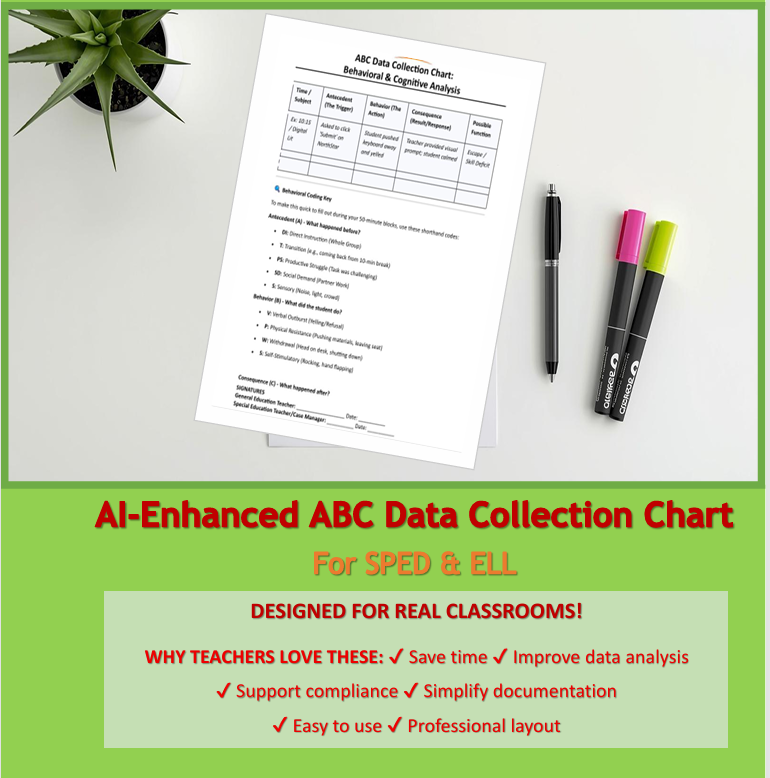
In my years leading the Digital Literacy Academy, I’ve learned that the most effective behavior management isn’t about control; it’s about dignity. It’s about creating a “productive struggle” where the student feels safe enough to try, fail, and try again. To manage this without losing your mind, you need a way to track the “why” behind the “what.” I’ve spent years perfecting the Special Ed ABC Behavior Data Chart & Productive Struggle Tracker, and it’s the first thing I hand to every teacher I mentor. It helps you see the patterns before the fire starts.
1. Behavior is Communication (The “Golden Rule”)
When a student with limited verbal communication swipes a laptop off a desk during a Digital Literacy lesson, our instinct is to think, “They’re being non-compliant.”
The Coaching Shift: Stop and ask, “What are they saying?”
- Are they saying, “This NorthStar module is too hard and I’m embarrassed”?
- Are they saying, “The fluorescent lights are humming and my head hurts”?
- Are they saying, “I haven’t had a break in 40 minutes and I need to move”?
When we view behavior as a message, we stop taking it personally. We move from being “the boss” to being “the investigator.”
2. The Power of the Predictable Routine
For our students, the world can feel like a chaotic, unpredictable place. Our classrooms should be the opposite. I advocate for a strict, visual agenda: First Five, Do Now, Standards, Whole Group, Practice, Partner Work, and Individual Work.
When a student knows that a 10-minute break always follows the 50-minute Financial Literacy block, their anxiety drops. Behavior incidents often happen in the “white space” between activities.
- The Tip: Use “First/Then” boards. “First, we do 5 minutes of typing practice. Then, we listen to 2 minutes of music.” This respects their dignity by giving them a clear roadmap of expectations.
3. Redefining “Productive Struggle”
We often try to remove every obstacle for our students to prevent a meltdown. But if we do that, they never learn resilience. The goal is to find the “Sweet Spot” of challenge.
- Too Easy: The student gets bored and seeks stimulation (poking peers, wandering).
- Too Hard: The student gets overwhelmed and seeks escape (crying, aggression).
- Just Right: The student is challenged but has the tools (assistive tech, visual prompts) to push through.
Using a tool like the Special Ed ABC Behavior Data Chart allows you to document these moments. Did the behavior happen during the “Individual Work” segment? If so, the struggle might not have been productive—it might have been purely frustrating. That data tells you to adjust the level of support tomorrow.

4. De-Escalation: The Art of Quiet
When a student’s volume goes up, yours must go down.
I see new teachers try to “talk a student out” of a meltdown. “Why are you doing this? You know the rules! You want your reward, right?” Stop. In a state of crisis, the brain’s language center often shuts down. You are just adding noise to an already overloaded system.
The Strategy:
- Limit Language: Use one-word prompts or visual icons.
- Respect Space: Unless there is a safety risk, give the student a “perimeter of dignity.”
- Wait: Time feels different during a crisis. Wait longer than you think you need to.
5. ABC Data: The Investigator’s Best Friend
You cannot change a behavior you haven’t mapped. This is where the Antecedent-Behavior-Consequence (ABC) model comes in.
- Antecedent: What happened right before? (e.g., The transition chime rang).
- Behavior: What did the student do? (e.g., Put their head on the desk).
- Consequence: What happened after? (e.g., They were allowed to skip the task).
If the consequence is “skipping the task,” the student has learned that putting their head down is a great way to avoid work. By tracking this on your Special Ed ABC Behavior Data Chart, you’ll see the trend. You can then change the Antecedent (give a 2-minute warning) or the Consequence (provide a modified, easier version of the task).
6. Workforce Readiness and Soft Skills
In our Financial Literacy and Digital Literacy blocks, we aren’t just teaching content; we’re teaching “Job Survival Skills.” In the real world, you can’t throw a stapler when you’re frustrated.
We teach our students Replacement Behaviors. * Instead of hitting, we teach the “I need a break” icon.
- Instead of screaming, we teach the “Help, please” button on their AAC device.
We treat these social-emotional skills with the same academic rigor as reading or math. We practice them when the student is calm, so they can access them when they are stressed.
A Coaching Note on Your Own Mental Health
You cannot pour from an empty cup. Behavior-heavy days are exhausting. They leave you feeling physically drained and emotionally spent.
When you have a hard day, look at your data. You’ll likely see that while today felt like “chaos,” the student actually had 40% fewer incidents than they did last month. Data is the antidote to the feeling of failure. Using a professional tracker like the Special Ed ABC Behavior Data Chart & IEP Progress Tracker gives you the objective proof that your strategies are working, even when it doesn’t “feel” like it in the moment.
Ready to Move from Chaos to Calm?
You have the heart for this work, and now you’re building the toolkit. Behavior management is a journey of a thousand tiny adjustments.
Your Next Steps:
- Identify the “Why”: Tomorrow, pick one recurring behavior and track the Antecedent. What triggered it?
- Equip Your Classroom: Get your data systems in order with the Special Ed ABC Behavior Data Chart & Productive Struggle Tracker to start seeing the “why” behind the “what.”
- Join the Newsletter:
You are the calm in their storm. Keep showing up, keep tracking the data, and keep respecting their dignity. You’ve got this.