
A medical autism diagnosis from a private provider does NOT automatically qualify a student for special education services under IDEA. Schools must conduct their own independent evaluation, and the student must show that autism adversely affects their educational performance. This post unpacks why that distinction matters, how the school process actually works, and what evidence-based classroom support for autistic students — including bilingual learners — really looks like.
Here’s a scenario I’ve watched play out more times than I can count.

A family comes in for an IEP meeting. Mom is holding a thick folder — developmental pediatrician’s report, neuropsychological evaluation, a private diagnosis of Autism Spectrum Disorder. She’s been fighting for this diagnosis for two years. She’s relieved. She’s exhausted. And she’s absolutely certain that now, finally, her child will get the services he needs at school.
And then someone on the team — sometimes gently, sometimes not — explains that the school still needs to do its own evaluation.
Her face. I’ve seen that face. The disbelief, the hurt, the flash of anger. What do you mean you need to evaluate him again? I have a diagnosis right here.
Honestly? That moment is one of the hardest in special education. Because she’s not wrong to feel confused. Nobody explained this to her. And in a lot of schools, nobody explains it clearly to new teachers either — which means the person sitting across from her at that table might not fully understand it themselves.
So let’s fix that. Right now. In plain language.
And before we dig in — if you’re building your classroom supports as you read, I put together a complete set of AI-Enhanced Anchor Charts for SPED & ELL students on TpT that covers reading, math, and writing with bilingual visual scaffolds. ASD students need consistent visual supports, and I reference this resource throughout the post because it genuinely fills the gap when you need something multilingual and immediately usable.
What Is Autism Spectrum Disorder Under IDEA — And Why Does the Definition Actually Matter?
Under IDEA 34 CFR §300.8(c)(1), Autism is defined as “a developmental disability significantly affecting verbal and nonverbal communication and social interaction, generally evident before age 3, that adversely affects a child’s educational performance.”
Two things jump out. First: generally evident before age 3. Not always — because late identification is real, especially for girls and for bilingual learners whose differences are masked by the complexity of second language acquisition. Second, and this is the critical one: adversely affects educational performance. That phrase is doing enormous work in that sentence. It’s the reason a private diagnosis alone doesn’t open the door to services.
Because the school’s question isn’t just “does this child have autism?” The school’s question is “does this child’s autism make learning significantly harder in ways that require specialized instruction or related services?” Those are different questions. A student can receive a clinical ASD diagnosis and still not qualify for special education if the team determines — after evaluation — that the condition isn’t significantly impacting their educational performance.
Which sounds bureaucratic and cold when you say it out loud. But it’s also the framework we have to work within. And understanding it is the first step toward advocating powerfully inside it.
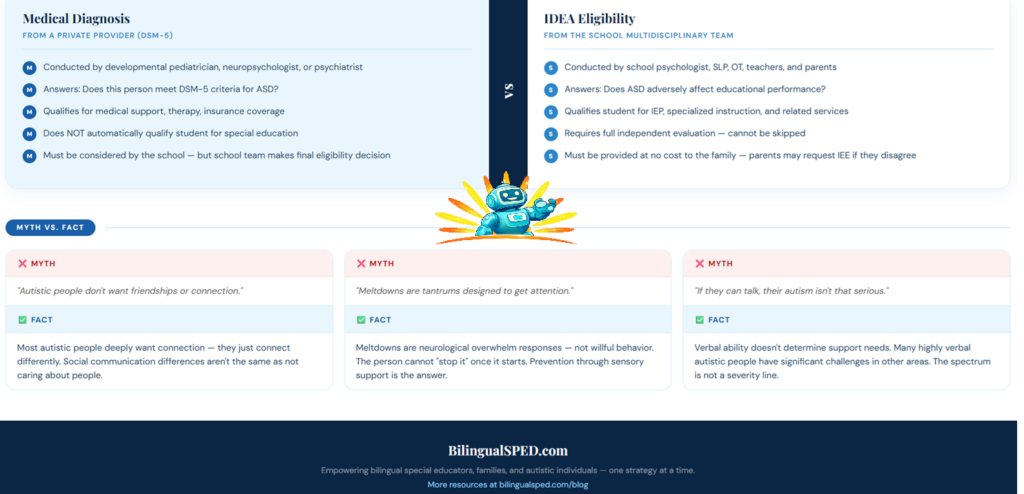
⚡ Quick Win — For Explaining This to Families Try this script: “The diagnosis from your doctor tells us what your child has. Our evaluation tells us how it’s affecting their school experience and what support they need to succeed here. We have to do our own evaluation — not because we don’t trust the diagnosis, but because IDEA requires us to understand the educational impact specifically. Both pieces matter.”
Medical Diagnosis vs. IDEA Eligibility — What’s Actually the Difference?
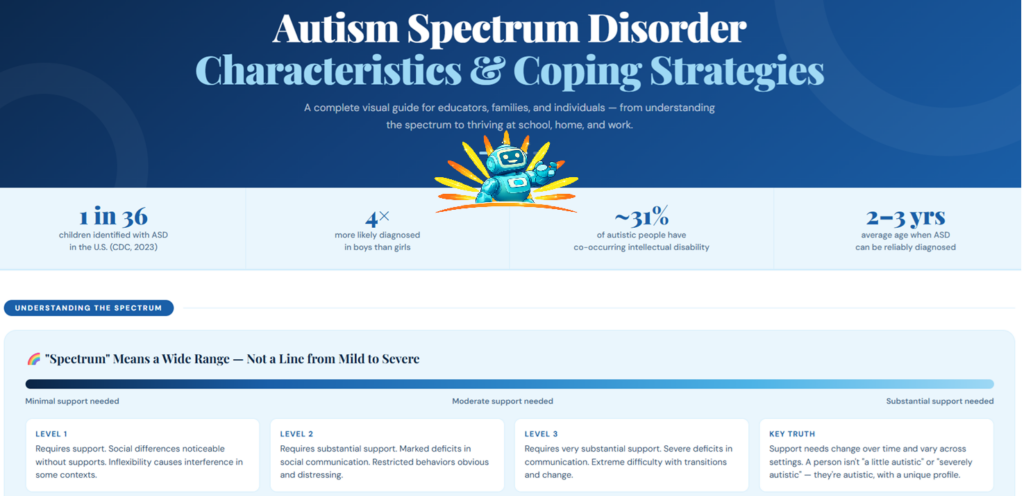
This is the section I wish existed when I was a first-year teacher. Because I genuinely didn’t understand this distinction clearly enough to explain it to families. I knew it intellectually but I couldn’t translate it into plain human words on the spot, which is when it really counts.
So here it is, as clearly as I can make it:
| Medical Diagnosis (Private Provider) | IDEA Eligibility (School Evaluation) |
|---|---|
| Conducted by a developmental pediatrician, neuropsychologist, or psychiatrist | Conducted by the school’s multidisciplinary evaluation team (MET) |
| Based on DSM-5 criteria — behavioral and developmental markers | Based on IDEA definitions and educational impact criteria |
| Answers: Does this person have ASD? | Answers: Does ASD adversely affect this student’s educational performance? |
| Qualifies the person for medical support, therapy, insurance coverage | Qualifies the student for special education services, IEP, related services |
| May or may not include academic or functional performance data | Must include educational performance data, observations, academic records |
| Conducted by one or two specialists | Must involve a team: school psych, general ed teacher, special ed teacher, parents, and others as needed |
| Not sufficient on its own for special education eligibility | Required for IEP development — cannot be skipped or shortcut |
And here’s the thing that makes this especially tricky: the school must consider the private evaluation results. They can’t just ignore the diagnosis. But they also don’t have to agree with it. Under IDEA regulations, the school team reviews the existing data — including private evaluations — but conducts their own independent assessment to determine educational eligibility.
This is where families get hurt. And honestly, sometimes rightfully so — because some schools use this process to delay or deny services when the private evaluation is thorough and the educational impact is obvious. That’s not what the law intends. But it happens.
⚠️ Know Your Rights — For Teachers AND FamiliesParents have the right to request an Independent Educational Evaluation (IEE) at school expense if they disagree with the school’s evaluation. And families cannot be charged for the school’s evaluation — it must be provided at no cost. If a family comes to you frustrated about the evaluation process, these are two key pieces of information worth knowing. The Parent Training and Information Center (PTI) in every state is a free resource to direct families to.
What Does the School Evaluation for ASD Actually Look Like?

Let me walk you through what a thorough school ASD evaluation typically includes — because if you’re a new special ed teacher, you may be part of this team before you feel fully ready for it.
A comprehensive school evaluation for autism should include:
- Developmental and social history gathered from parents — including language milestones, play patterns, early behavioral observations
- Standardized behavioral rating scales like the Autism Spectrum Rating Scales (ASRS) or the Gilliam Autism Rating Scale (GARS), completed by both parents and teachers
- Classroom observations across multiple settings — not just one visit, not just when things are going well
- Speech-language evaluation — including pragmatic language, which is the social use of language (this is where many ASD students have their most significant challenges)
- Cognitive and academic assessments to determine current performance levels and identify discrepancies
- Adaptive behavior assessment — how is the student functioning in daily life activities? The Vineland Adaptive Behavior Scales are commonly used here
- Occupational therapy screening if sensory processing or fine motor concerns are present
For bilingual students — this whole process needs to happen with language background at the center. An autistic child who is also an English Language Learner presents a genuinely complex picture, and a monolingual evaluation is not appropriate. According to Autism Speaks, bilingual students with ASD are frequently either misidentified (language differences mistaken for autism) or under-identified (autism missed because it’s attributed to language acquisition). The evaluation must account for both realities.
⚡ Quick Win — Bilingual ASD EvaluationsAsk these three questions before any ASD evaluation of a bilingual student: (1) Will assessments be conducted in the student’s dominant language? (2) Does the evaluator have experience with bilingual learners and ASD? (3) Are the rating scales being completed by someone who knows the student well AND understands the student’s cultural and linguistic background? If the answer to any of these is “no,” advocate for a different approach.
What Does ASD Actually Look Like in Your Classroom? (Because the Textbook Version Doesn’t Prepare You)
I want to be real with you here. Nothing in my graduate coursework fully prepared me for the range of presentations I’ve encountered in students with ASD. The spectrum is genuinely that — a spectrum. And the way autism shows up in a classroom setting is shaped by a student’s individual profile, their language background, their sensory sensitivities, their communication style, and a dozen other factors.
But here’s what I’ve consistently seen, and what I think every new teacher should know going in:
Social Communication Differences
Not deficits. Differences. Autistic students often communicate in ways that are direct, literal, and honest — which can be misread as rude or disrespectful in a classroom context that expects implicit social rules. The student who says “that’s wrong” instead of “I think that might be different” isn’t being disrespectful. They’re being precise. That’s a reframe worth holding onto.
In my experience, the biggest challenge isn’t that autistic students can’t learn social communication conventions — it’s that nobody takes the time to make those conventions explicit. We teach reading with phonics. We teach math with procedures. But we assume social rules are absorbed by osmosis, which is insane when you think about it.
Sensory Processing Differences
This one is huge and chronically underaddressed in school settings. Fluorescent lighting. The hum of the HVAC system. The smell of the cafeteria three hallways away. The texture of a pencil grip. The sound of chairs scraping. For many autistic students, these aren’t minor annoyances — they’re active barriers to learning that are present every single minute of the school day.
And then we wonder why the student is dysregulated by 10am.
Restricted Interests and Repetitive Behaviors
Here’s the instructional insight that took me a while to land on: restricted interests are not obstacles to learning. They’re entry points to learning. The student who will only talk about trains? Teach reading with train-themed texts. Teach math with train schedules. Teach writing with “design your own train route” prompts. I’ve watched students who wouldn’t produce a single sentence about a given topic write three paragraphs about their special interest — with genuine engagement and craft.
Use what you’re given. Don’t fight the interest. Channel it.
🛠️ Ready-Made Visual Supports for ASD Students
If you want the ready-made version of the task analysis tools and bilingual visual supports I’m describing — including anchor charts for reading, writing, and math processes — I built a complete classroom toolkit specifically for SPED and ELL students. Don’t spend your Sunday night creating from scratch.→ Grab the AI-Enhanced Anchor Chart Bundle on TpT
What Actually Works? Evidence-Based Strategies for Autistic Students
Visual Supports — In Multiple Languages

Visual supports are the single most consistently effective classroom accommodation for autistic students across the research base. According to the AFIRM Modules (Autism Focused Intervention Resources and Modules) at UNC, visual supports — including schedules, task strips, and graphic organizers — are classified as an evidence-based practice for ASD with strong empirical support.
But here’s what gets missed: for bilingual autistic students, visual supports need to be in the home language too. Not because the student can’t read English, but because when a student is dysregulated, they process information better in the language they’re most fluent in. A visual schedule in Spanish for a Spanish-dominant student isn’t a crutch — it’s a neurological accommodation.
Practically, this means:
- First-Then boards in both languages (“Primero trabajo, después descanso”)
- Visual daily schedules with icons and text in both English and home language
- Emotion check-in charts with facial expressions and multilingual labels
- Task analysis anchor charts posted at eye level — showing exactly what each step of an activity looks like
My SPED and ELL anchor chart bundle was built with this specific student population in mind — because finding bilingual visual supports that are also SPED-appropriate is genuinely hard, and I got tired of making them from scratch.
Sensory Accommodations That Make a Real Difference
Look — you don’t need a full sensory room to make a meaningful sensory difference for an autistic student. You need intentionality and a few targeted tools.
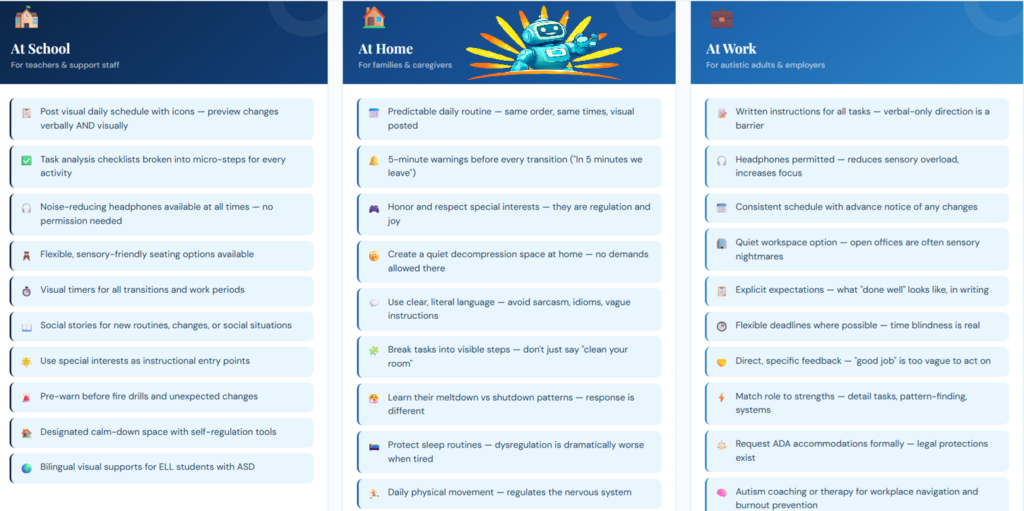
- Lighting: Swap fluorescent bulbs for warm LED where possible. Allow the student to sit away from overhead lights. A small lamp in a corner can make a significant difference for a light-sensitive student.
- Sound: Noise-reducing headphones during independent work. A visual “quiet signal” instead of a verbal one. Warning students before a fire drill — because unexpected loud sounds can be genuinely traumatic, not just startling.
- Movement and proprioception: Wiggle cushions. A resistance band across chair legs. A standing desk option. Scheduled heavy work breaks — carrying books, pushing the door, anything that provides deep pressure input.
- A calm-down corner: Not a punishment space. A proactive regulation space with visual choices — a squeeze ball, a weighted lap pad, a feelings chart, a visual breathing card. And the student needs to practice using it when they’re calm before it becomes useful when they’re not.
Social Stories — The Tool That Actually Prepares Students for Real Situations
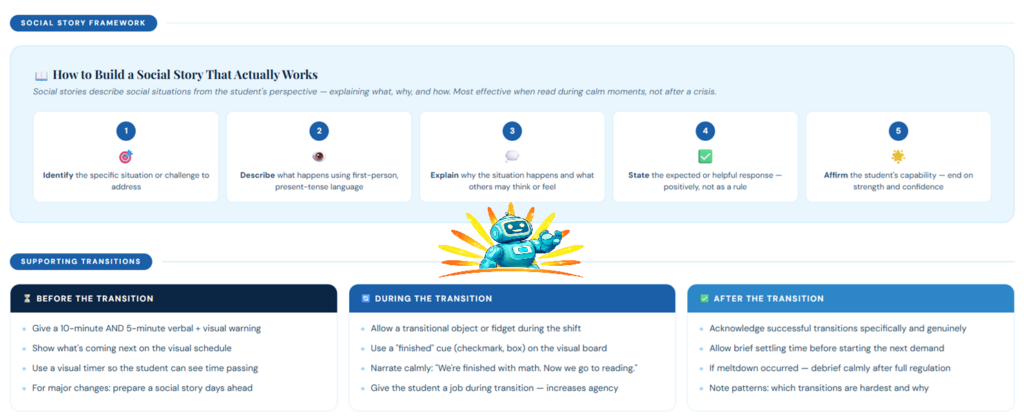
Social stories, developed by Carol Gray, are short narratives that describe a specific social situation from the student’s perspective — explaining what happens, why it happens, and what the expected response looks like. They’re surprisingly effective, and I’ve found them especially powerful for transitions, unexpected changes, and new school routines.
Here’s an example for a common school situation:
“Sometimes my teacher changes the schedule. When the schedule changes, it can feel surprising or uncomfortable. That’s okay. My teacher changes the schedule to help the class. I can take a deep breath and look at the new schedule. I can ask my teacher what is happening next. Changes don’t last forever. I can handle schedule changes.”
Translate into the student’s home language. Read it together during calm moments — not after a meltdown. Keep a copy in the student’s visual support binder and send a copy home so families can preview upcoming changes. Consistency between school and home is everything.
Technology Tools Worth Using
- TouchChat HD — a high-quality AAC (Augmentative and Alternative Communication) app for students with limited or emerging verbal communication
- Cluis — a visual schedule app designed specifically for autistic students, with customizable icons and transition supports
- Boardmaker Online — the gold standard for creating picture communication symbols, visual schedules, and social stories with multilingual support
- Choiceworks — visual schedule, waiting, and feelings management app that’s particularly effective for elementary-age autistic students
- Social Story Creator — for building custom social stories with photos from the student’s actual environment, which increases relevance and generalization
What Would I Refine? (Honest Teacher Reflection)
Here’s what I would do differently if I were starting over with my first autistic student.
I would have built the visual supports before the first day. Not during the first week. Before. Because the first days set the expectation for what the environment feels like — and for an autistic student, a predictable visual environment from day one communicates safety in a way that no verbal reassurance ever fully can.
I also would have had a much earlier and more explicit conversation with the family about what to expect from the school evaluation process — before they arrived at a meeting surprised by it. That conversation, had early and clearly, prevents so much pain downstream.
And I would have asked the student directly — in whatever communication modality worked for them — what makes learning hard and what makes it easier. Because the insight autistic students have about their own experience, when you create the conditions for them to share it, is remarkable. We just don’t ask often enough.
3 FAQs About ASD and Special Education Eligibility
❓ My child has a private autism diagnosis. Why is the school saying they need to do their own evaluation?
Because IDEA requires it. Under federal law, a school must conduct its own independent evaluation to determine whether a student qualifies for special education services — even if a private diagnosis already exists. The school is evaluating for educational impact, not just diagnostic criteria. The private diagnosis must be considered as part of the evaluation process, but it doesn’t automatically establish eligibility. This isn’t the school dismissing the diagnosis. It’s the law requiring a separate determination of educational need. If you disagree with the school’s evaluation, you have the right to request an Independent Educational Evaluation (IEE) at school expense.
❓ Can a student with autism have an IEP in one state but not qualify in another?
Yes — and this is one of the most frustrating realities in special education. While IDEA sets the federal framework, states have some flexibility in how they implement eligibility criteria and evaluation standards. A student who qualified for services in one state may not automatically qualify when the family moves. The new school district is required to conduct its own evaluation within the timelines set by their state. This is a known gap in the system, and it can create real disruption for military families and others who move frequently. Advocates recommend keeping thorough records of all evaluations, IEPs, and service documentation to support continuity.
❓ What’s the difference between autism eligibility under IDEA and a 504 Plan for an autistic student?
An IEP under IDEA provides specialized instruction and related services — it changes how the student is taught. A 504 Plan under the Rehabilitation Act provides accommodations within the general education environment — it changes the conditions under which the student is taught. A student with autism who needs a fundamentally different instructional approach, speech therapy, OT, or behavioral support generally needs an IEP. A student with autism who is performing adequately in general education but needs accommodations like sensory supports, extended time, or preferential seating may be better served by a 504. Both are valid. The decision should be driven entirely by what the student actually needs — not by what’s easier to write or manage administratively.
References
- U.S. Department of Education. IDEA Regulations, 34 CFR §300.8(c)(1): Autism. sites.ed.gov/idea
- AFIRM Modules, Frank Porter Graham Child Development Institute, UNC Chapel Hill. Visual Supports: Evidence-Based Practice for Autism Spectrum Disorder. afirm.fpg.unc.edu
- Autism Speaks. Autism and English Language Learners Tool Kit. autismspeaks.org
- Center for Parent Information and Resources. Evaluations in Special Education. parentcenterhub.org
- Maenner, M.J. et al. (2023). Prevalence and Characteristics of Autism Spectrum Disorder Among Children Aged 8 Years. CDC MMWR. cdc.gov/mmwr
💜 Want More Like This in Your Inbox?
Join the BilingualSPED community — practical, research-backed strategies for bilingual special educators delivered straight to you. IEP frameworks, classroom tools, freebies, and the kind of honest, experience-first conversation that actually helps you show up better for your students.
📚 Get the Ready-Made Classroom Toolkit
Everything I described — bilingual visual supports, task analysis anchor charts, and SPED-ready classroom tools for reading, math, and writing — it’s all in one downloadable bundle. Built specifically for SPED and ELL teachers who are doing the real work every day and don’t have three hours to build resources from scratch.→ Grab the AI-Enhanced Anchor Chart Bundle on TpT
💬 Reflection Question
Think about the last time a family came to you confused or frustrated about the difference between their child’s private diagnosis and what the school was telling them. Did you feel equipped to explain it clearly? What’s one thing in this post that you’d add to how you handle that conversation going forward?
Drop your answer in the comments below. This community learns best when we share honestly — so I want to hear from you.
📌 You Might Also Like
- Other Health Impairment (OHI) & ADHD: What Teachers and Families Need to Know
- Specific Learning Disabilities: A Teacher’s Real Guide to Dyslexia, Dyscalculia & Dysgraphia
- How to Write IEP Goals That Actually Work for Bilingual Special Education Students
- ELL Students in Special Education: Avoiding Misidentification and Building Real Support
- Visual Supports and Anchor Charts That Work for SPED and ELL Classrooms