
That end-of-day irritability isn’t a personality problem. Your nervous system is trying to tell you something.
Here’s a question I want you to sit with for a moment.
After a full day in your classroom — the fluorescent hum overhead, twenty-something different voices at various volumes, the sensory chaos of transitions and movement and PE class down the hall and that one student who taps their pencil through every independent work period — do you come home and feel like your skin is still somehow buzzing? Like even the sound of the refrigerator is too much? Like you need to sit in a dark, quiet room and just… stop?
I used to think that was just tiredness. Normal teacher exhaustion. The price of admission for a job that demands this much.
Then I started learning about sensory overload — and I realized I’d been misreading my own nervous system for years.
Teaching, especially in special education, is one of the most sensorially intense occupational environments that exists. You are operating inside a space full of competing visual stimulation, unpredictable sounds, physical contact, strong smells, constant movement, and emotional volatility — for six or seven hours, with almost no opportunity to lower the volume on any of it. And for many of us, we’ve been so conditioned to push through that we don’t recognize what our body is actually communicating when it finally breaks through the noise at 4pm.
This post is about learning that language. Understanding the signs of sensory overload — in yourself and in your students — so you can recognize them, name them, and actually do something about them before they compound into something bigger.
What Sensory Overload Actually Is
Let’s start with the science, because it reframes everything.
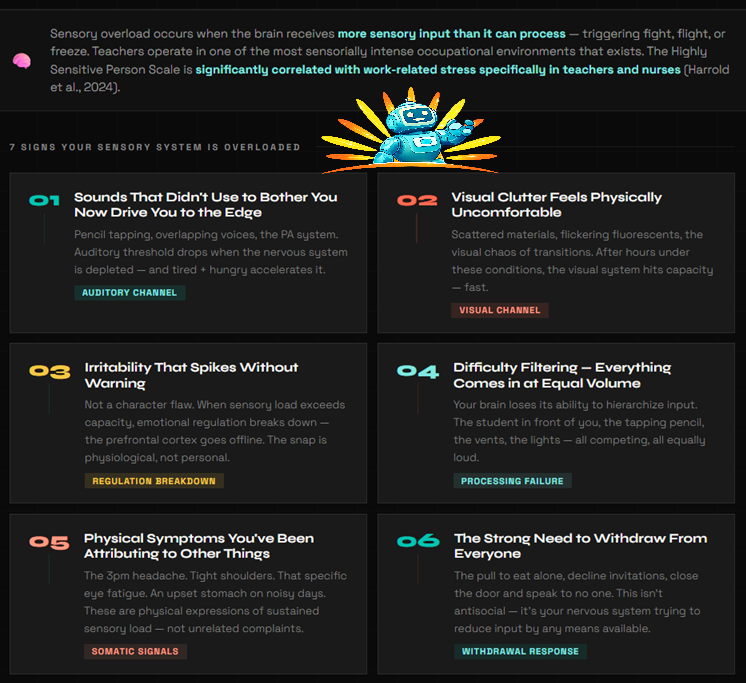
Sensory overload occurs when at least one of the body’s senses is overstimulated — in other words, when the incoming information exceeds the brain’s capacity to process and store it. It’s a lot like having too many browser tabs open at once. The computer slows down, freezes, drops processing capacity across all windows. Your brain does something similar — and the effects reach far beyond just feeling overwhelmed.
When the brain is overwhelmed by something, it enters the fight, flight, or freeze mode in response. Situations, sights, sounds, textures and smells can trigger sensory overload — and sometimes more than one sense is overwhelmed simultaneously.
This isn’t a condition that belongs only to students with autism or sensory processing disorder, though it is more common and intense in those populations. It happens to anyone whose sensory input exceeds their brain’s current processing capacity. And that category — anyone — includes teachers. Especially at the end of a long, loud, stimulation-heavy week.
Research has found that the Highly Sensitive Person Scale is significantly positively correlated with work-related stress specifically in teachers and nurses — two professions that involve sustained, intensive sensory environments without meaningful relief built into the day. That correlation matters. It means the environment you work in isn’t neutral. It’s actively loading your sensory system — and without deliberate recovery strategies, that load accumulates.

Sign #1: The Sounds That Didn’t Used to Bother You Now Drive You to the Edge
This is usually the first sign teachers notice — and the first one we dismiss.
The pencil tapping that sent you into a quiet rage. The hallway PA system that made your jaw clench. The overlapping conversations in the staff room that you couldn’t filter into anything coherent. The sound of someone’s crunching chips during a meeting that made you want to leave the building.
None of those reactions mean you’re unreasonable. They mean your auditory system has hit its threshold.
Hearing-based sensory overload is triggered by loud noise or sound from multiple sources — such as several people talking at once. In a classroom, that’s Tuesday. And when the threshold is already depleted from yesterday and the day before, Tuesday’s sounds hit differently than they would on a rested nervous system.
The clinical psychologist Dr. Eddie Taylor explains it simply: in adults, sensory overload occurs when their senses can’t process all of the sensations the brain is experiencing — and this can also occur simply when you are tired or hungry. Which means sleep deprivation and skipped lunches — both extremely common in teachers — directly lower your sensory threshold. The overlap between teacher habits and sensory vulnerability is not a coincidence.
Sign #2: Visual Clutter Feels Physically Uncomfortable
Walk into your classroom after a chaotic afternoon and pay attention to what you feel in your body when you see the scattered materials, the chairs not quite pushed in, the whiteboard still half-covered from the morning.
For many teachers experiencing sensory load accumulation, the visual environment doesn’t feel neutral. It feels assaultive. Sight-based sensory overload is triggered by crowded or cluttered spaces, bright lights, strobing lights, or environments with much movement such as crowds or frequent scene changes.
Fluorescent lighting deserves its own paragraph here. Most school buildings are lit by overhead fluorescents that flicker at a frequency most people can’t consciously detect — but that the nervous system absolutely registers. After hours under those lights, many teachers experience a specific type of eye fatigue and visual sensitivity that goes beyond just tired eyes. That sensitivity is sensory overload presenting through the visual channel.
If you’ve started dreading the drive home because the visual stimulation of traffic feels like too much — that’s your visual system telling you it’s at capacity.
Sign #3: Irritability That Spikes Without Warning
This is the sign that causes the most professional self-criticism — and the least professional self-compassion.
You snap at a student over something minor. A colleague makes a benign comment and you feel a disproportionate flash of frustration. You hear a familiar phrase for the hundredth time that day and something in you goes tight.
The interpretation we default to: something is wrong with me. I’m losing patience. I’m getting burned out.
What’s actually happening: your nervous system is overwhelmed and your brain’s capacity for emotional regulation — which requires cognitive resources your depleted processor doesn’t currently have — is compromised.
In crowded spaces, some people may experience heightened sensory sensitivity, feeling overwhelmed by even subtle stimuli, while others might become irritable or agitated. The ability to concentrate may diminish significantly when faced with a sensory onslaught, hindering decision-making and organizational skills.
That diminished concentration and elevated irritability aren’t character flaws. They are the predictable outputs of a brain that has received more sensory input than it can process. The snap reaction isn’t evidence that you’re unkind. It’s evidence that your sensory system needs relief — immediately.
Sign #4: Difficulty Filtering — Everything Comes in at Equal Volume
This one is harder to articulate but immediately recognizable when named.
In a regulated sensory state, your brain automatically prioritizes incoming information. The student in front of you is louder in your attention than the pencil tapper three rows back. The words of your co-teacher register clearly even in a noisy classroom.
In sensory overload, that filtering breaks down. Everything competes for your attention at the same volume. The student in front of you, the tapping pencil, the hum of the ventilation, the flickering light, the smell of someone’s lunch — all of it arrives with equal urgency. Concentration becomes impossible not because you’re distracted, but because your brain has lost its ability to hierarchize input.
Sensory overload is where your brain cannot organize, analyze and process all of the different senses that you are experiencing, meaning an individual can feel discomfort, irritable and restless to touch, taste, sound, smell and sight.
When you notice that you’re struggling to focus in an environment you normally navigate fine — that’s the filtering breakdown speaking. It’s a reliable early warning sign.
Sign #5: Physical Symptoms You’ve Been Attributing to Other Things
Headache that arrives after lunch and doesn’t leave. Tight shoulders you’re barely aware of until you take your jacket off. That specific exhaustion behind your eyes at 3pm that isn’t quite sleepiness. An upset stomach on days when the classroom noise level ran high.
These aren’t coincidences or unrelated complaints. They’re the body’s physical expression of sustained sensory load.
Sensory processing difficulties in adults can show up as high sensitivity to lights, sounds, textures, or smells — symptoms that exist on a spectrum from mild annoyance to physical pain. Other physical symptoms may result from these sensitivities.
When your nervous system stays elevated for six consecutive hours without a genuine reset, the physical consequences are real and measurable. Heart rate elevated. Cortisol running hot. Muscles holding tension your conscious mind never authorized. The headache at 3pm isn’t a hydration problem. It might be the cumulative weight of everything your body absorbed since 7:30am.
Sign #6: The Need to Withdraw — From Everyone

This one tracks almost directly with the isolation pattern we see in burnout — but the cause is different, and the distinction matters.
Some teachers who feel the pull to eat alone, to decline social invitations, to go home and close the door and speak to no one — attribute it to introversion or antisocial tendencies. But for many, what’s actually happening is that every human interaction carries sensory data: their voice, their proximity, their smell, the unpredictability of what they might say or do next. After a full day in a classroom, those inputs can push an already-loaded system past capacity.
Sensory overload can manifest as heightened sensitivity to sounds, lights, textures, or smells — leading to feelings of distress, agitation, or anxiety, and a strong desire to withdraw from environments that feel overwhelming.
The withdrawal isn’t antisocial. It’s self-protective. Your nervous system is trying to reduce input by any means available. Recognizing that for what it is — rather than criticizing yourself for “not being a people person” — changes how you respond to it.
Sign #7: Sensitivity to Smells and Touch That Feels Disproportionate
This one often gets written off as personal quirk.
The perfume in the elevator that makes you feel nauseous when it wouldn’t have bothered you in September. The texture of your work clothes that feels abrasive by Friday afternoon in a way it didn’t on Monday. The strong smell of the cafeteria that hits you like a physical force.
Smell-based sensory overload can occur when a scent is an assault on your sense of smell, making you feel like you might suffocate — while touch sensitivity manifests as fabric textures or unexpected contact feeling more intense than the situation warrants.
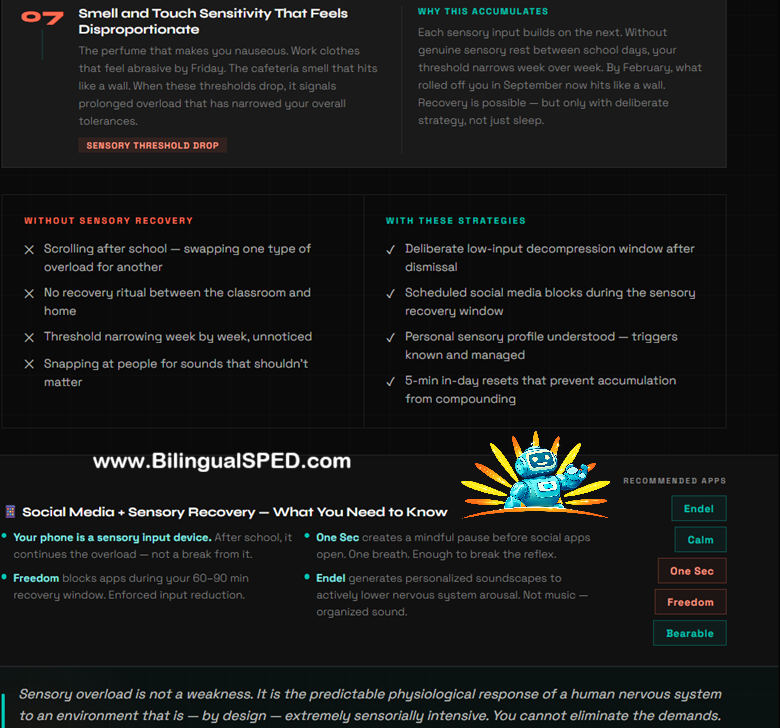
When smell and touch thresholds start dropping, that’s often a sign you’ve been operating in sensory overload for long enough that the overall system sensitivity has ratcheted upward. Your tolerances have narrowed. Things that didn’t register before now register hard.
How to Optimize Sensory Rest — And Where Social Media Fits In
Here’s the link between sensory overload and social media that most people miss: your phone is a sensory input delivery device, and it never stops.
After a day of fluorescent lights and competing sounds and constant visual stimulation, opening social media is — from a sensory nervous system perspective — the continuation of the overload, not a break from it. Scrolling delivers a constant stream of visual stimulation, auditory notifications, emotional triggers, and unpredictable content at a pace your already-depleted system has to keep processing.
The most protective thing you can do for your sensory system after school is reduce input, not swap it out for a different kind.
Use Endel — which generates personalized, scientifically designed soundscapes calibrated to your circadian rhythm and current state — to actively lower your nervous system’s arousal level during your wind-down period. It’s not music, which requires processing. It’s organized, non-threatening sound that gives your auditory system something steady to anchor to rather than compete with.
Use One Sec to interrupt automatic social media opening with a brief mindful pause. One full breath before Instagram opens. That moment of friction is enough to break the reflex and let you make a conscious choice about whether your nervous system is actually ready for more input.
For longer blocks, Freedom lets you schedule hard app-blocking windows — particularly valuable for the 60-90 minutes after school when your sensory system most needs genuine rest. Block the inputs. Let the nervous system come down.
In your classroom and workspace:
Keep a designated “low input” corner — even a chair facing away from the main room, with access to noise-canceling headphones — that you use during planning periods for genuine sensory recovery. Calm has body scan and sleep meditations that are specifically effective for nervous system downregulation. Five minutes between classes, headphones in, eyes closed, can genuinely reset your sensory threshold enough to make the afternoon qualitatively different.
Track your sensory load patterns with Bearable — a symptom and mood tracking app that lets you log triggers and responses over time, so you can start identifying which specific aspects of your environment are most costly to your system. Knowing your personal sensory profile is the beginning of working with it rather than against it.
The Bigger Picture
Sensory overload is not a weakness. It is not evidence that you’re not built for this work. It is the predictable physiological response of a human nervous system to an environment that is — by design — extremely sensorially intensive. The research confirms that teachers and nurses specifically are at elevated risk. The solution is not to become less sensitive. It’s to become more strategic about recovery.
You cannot eliminate the sensory demands of your classroom. But you can build the daily micro-recovery practices that keep your threshold high enough to stay present, regulated, and genuinely effective — for the entire school year and for many years beyond it.
Pay attention to what your nervous system is telling you. It’s speaking. And it’s worth listening to.
📬 Want More? Join the Weekly Newsletter
Every week I write one practical email for special educators — wellness strategies, classroom tools, sensory environment tips, and honest conversation about sustainability in this work. No fluff. No sales. Real support from someone who has lived it.
💬 Reflection Question
Which sign of sensory overload in this post felt most personal — the one you recognized most immediately — and what’s one thing you could change in your environment or your after-school routine this week to start addressing it?
Leave your answer in the comments. I read every one — and your reflection might help another teacher name something they’ve been carrying without language for it.
❓ Frequently Asked Questions
Q: Can teachers without any diagnosable condition experience genuine sensory overload?
Absolutely. Sensory overload can happen to anyone — it’s not limited to people with autism, ADHD, or sensory processing disorder. Any environment that consistently delivers more sensory input than the brain can effectively process will produce overload symptoms. A special education classroom qualifies for most adults on most days.
Q: How do I know if I’m experiencing sensory overload or just regular fatigue?
The key distinguishing feature is sensory specificity. Regular fatigue presents as tiredness, low energy, and a desire to rest. Sensory overload presents as heightened reactivity to specific stimuli — sounds, lights, textures — that wouldn’t normally bother you. If ordinary sounds are making you irritable, ordinary lights are bothering your eyes, and ordinary smells are hitting harder than they should — that pattern points toward sensory overload rather than plain fatigue.
Q: Is it possible for sensory overload to get worse over a school year?
Yes — and this is one of the most important things to understand. Without recovery strategies in place, high sensory sensitivity is associated with lower quality of life, affecting well-being, daily functioning, and overall health. Sensory load that isn’t regularly discharged accumulates. By February, many teachers are operating with a much lower sensory threshold than they had in September — not because they’ve gotten weaker, but because the load has been compounding without adequate recovery.
Q: Should I talk to a doctor about sensory overload?
If you experience severe or frequent episodes of sensory overload that significantly interfere with your functioning or quality of life, yes — a conversation with your primary care physician or a referral to an occupational therapist who specializes in sensory processing would be appropriate. Keeping a diary of signs, symptoms, and triggers before speaking to a doctor is especially helpful — this is exactly what apps like Bearable can help you build.
Q: How does sensory overload in teachers affect students?
Significantly. A teacher whose nervous system is in overload is operating with compromised emotional regulation, reduced patience, impaired decision-making, and a diminished capacity to attune to students’ needs. This is not a moral judgment — it’s physiological. Taking sensory rest seriously isn’t indulgent. It is professional responsibility.
📚 References
- Harrold, G., et al. (2024). The association between sensory processing and stress in the adult population: A systematic review. Applied Psychology: Health and Well-Being. https://doi.org/10.1111/aphw.12554
- Medical News Today. (2024). Sensory overload: Symptoms, causes, and treatment. https://www.medicalnewstoday.com/articles/sensory-overload
- Experia USA. (2024). 7 sensory overload symptoms to look out for. https://www.experia-usa.com/blog/7-sensory-overload-symptoms-to-look-out-for/
- Wikipedia. (2024). Sensory overload. https://en.wikipedia.org/wiki/Sensory_overload
- Griffin, K. (2025). What is sensory overload and how can I support it? Griffin Occupational Therapy. https://www.griffinot.com/what-is-sensory-overload/
- Banner Health. (2024). What does sensory overload look like in adults? https://www.bannerhealth.com/healthcareblog/better-me/what-is-sensory-overload-look-like-in-adults
- Choosing Therapy. (2024). Sensory overload: What it is, symptoms, and treatments. https://www.choosingtherapy.com/sensory-overload/
- Neurodivergent Insights. (2024). Navigating sensory issues in adults. https://neurodivergentinsights.com/sensory-issues-in-adults/
- Autism Awareness Centre. (2025). What does sensory overload look like and how can we help? https://autismawarenesscentre.com/what-does-sensory-overload-look-like-and-how-can-we-help/
- Healthline. (2024). Sensory processing disorder in adults: Symptoms, treatment, and more. https://www.healthline.com/health/mental-health/sensory-processing-disorder-in-adults
- Costa-López, B., et al. (2021). Relationship between sensory processing and quality of life: A systematic review. NCBI. https://www.ncbi.nlm.nih.gov/pmc/articles/PMC8432132/