Why connection is the most underrated professional skill in special education — and how to protect it.
I want to be honest with you about something I got wrong for the first several years of my career.
I thought being a good teacher meant being self-sufficient. I thought asking for help was a weakness. I thought keeping my head down, doing my own work, managing my own classroom, and staying in my lane was the right way to be professional. I was so committed to this idea that I barely spoke to colleagues during lunch. I declined most invitations to go out after work. I told myself I was just focused. That I’d make friends later, when I had more time.
Here’s what I actually was: isolated. And it was making me worse at everything — including the part I thought I was protecting by isolating: my teaching.
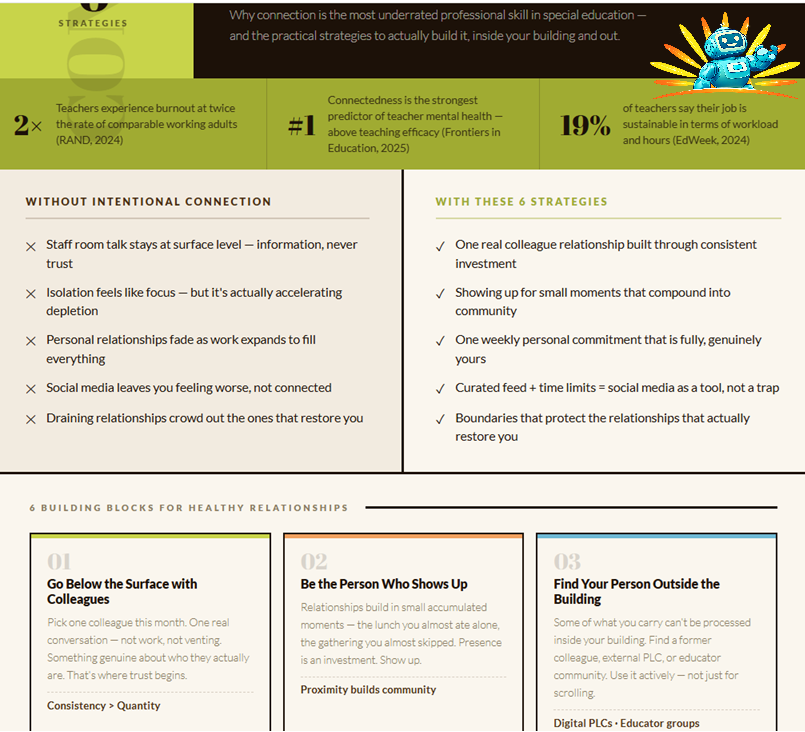
Connectedness is more strongly related to mental health than teaching efficacy. Let that land. The research published in Frontiers in Education (2025) found that how connected you feel — not how skilled you are — is the single greatest predictor of your mental health and burnout protection as a teacher. The relationships aren’t a nice-to-have. They are the infrastructure that holds the rest of the work up.
So this post is about building them intentionally — inside your building, outside of it, and even in the digital spaces where we increasingly spend our time. Because as a special educator, nobody can do this work sustainably alone. And I don’t want you to spend as many years learning that the hard way as I did.
Why Teachers Specifically Struggle to Build Relationships
Before we get to the strategies, let’s name the dynamic honestly.
Teachers are givers by trade. We are trained to orient outward — toward students, toward families, toward colleagues who are struggling. The idea of deliberately investing in our own relational needs can feel self-indulgent in a profession that celebrates selfless service.
And the structural realities don’t help. Teaching is isolating by design — you’re in your classroom, they’re in theirs, and the schedule rarely creates meaningful windows for genuine adult connection. A 2024 survey by the EdWeek Research Center found that only 19% of teachers reported their job was sustainable in terms of workload and schedule. Which means most of us are running at a pace that doesn’t leave obvious room for anything that feels optional — and relationships, tragically, often feel optional.
They’re not. Long-term loneliness can impact our mental and physical health — which has implications not just for individuals but also for society at large. Being lonely for a long time can lead to a negative spiral: loneliness makes it harder to connect, which leads to people being afraid of social situations, meaning it is harder to find joy in life and escape negative thoughts. That spiral is real, and teachers are not immune to it.
Here’s the good news: building and maintaining healthy relationships doesn’t require massive amounts of time. It requires intention, consistency, and knowing what you’re actually building toward.
Strategy #1: Start With Your Colleagues — But Go Beneath the Surface

Most staff rooms have plenty of workplace talk. “Did you see the schedule change?” “My IEP meeting ran over.” “The copier is jammed again.” That’s not connection. That’s information exchange.
Real collegial relationships — the kind that actually buffer burnout — happen when you get below the surface. When you know something real about the person across from you. When you share not just frustrations but actual moments of joy, pride, or uncertainty.
Collaborative planning reduces the burden on individual educators, allowing them to share strategies and work smarter, not harder, while fostering a sense of shared purpose and expertise. But the relationship has to come before the collaboration. People don’t genuinely collaborate with people they don’t trust or know.
So: pick one colleague this month — just one — and commit to one real conversation with them. Not work. Not venting. Something genuine. What they’re enjoying right now. A book, a show, a project outside work. Ask a question that invites them to be a whole person, not just a co-worker. Then listen.
That’s how it starts. Small, consistent, repeated.
Strategy #2: Be the Person Who Shows Up
Here’s a relational truth I’ve learned that sounds almost embarrassingly simple: the people who show up get connected. The birthday gathering after school you almost skipped. The quick lunch you almost ate alone. The five minutes you almost left immediately after the meeting was over — but didn’t.
Relationships don’t build in big moments. They build in the accumulated small ones. And in a profession where everyone is tired and pulled in seventeen directions, simply being present and available is a form of relational investment that most people notice and remember.
I’m not saying stay late every night or say yes to everything. I’m saying: when there’s a low-stakes opportunity to be around colleagues in a genuinely human way, take it. Teachers stay in their jobs when they feel a sense of community, and maintaining community is key to addressing teacher turnover and burnout. You don’t build community by yourself in your classroom. You build it in the moments between.
Strategy #3: Find Your Person Outside Your Building
Some of what you carry in this work cannot be processed with someone inside your building. There are layers to special education — the grief of watching a student struggle, the complexity of navigating systems that don’t serve kids well, the weight of caring deeply in a role that rarely acknowledges how much you carry — that require someone who truly gets it, but who isn’t tangled in the same institutional dynamics.
Find at least one person — a former colleague, a friend who also teaches, someone from a graduate program — who understands this work from the outside. Someone you can be genuinely honest with about the hard parts, without managing political fallout.
Online communities of special educators have become a genuinely significant resource for this. Facebook groups, Reddit communities for special education professionals, and professional PLCs (Professional Learning Communities) offer access to people who understand the specific texture of your job in a way your non-educator friends and family simply can’t. Use them. The isolation this field can create is real — the internet, used well, can break it.
Strategy #4: Invest in Your Relationships Outside of School — Deliberately
This is the one that disappears first when burnout sets in. The friendships outside work. The family dinners where you were actually mentally present. The relationship with your partner that didn’t revolve around exhaustion and the next problem to solve.
When teachers are pushed to their limits, they pull back — from everyone. It feels like conservation. But it’s actually depletion accelerating, because the relationships outside school are where many teachers get the things the job cannot provide: unconditional acceptance, laughter that has nothing to do with anything professional, being known as a whole person rather than a role.
Make time for hobbies, exercise, or socializing to recharge and maintain a healthy work-life balance. This is not peripheral advice. When you’re connected and happy in your personal life, you’re genuinely more effective in your professional one.
Protect one relational commitment per week — a dinner, a call, a walk — that is entirely about someone you love, with your full attention present. Put it in the calendar. Treat it with the same respect you’d give an IEP meeting.
Strategy #5: Learn to Give and Receive Support — Both Directions
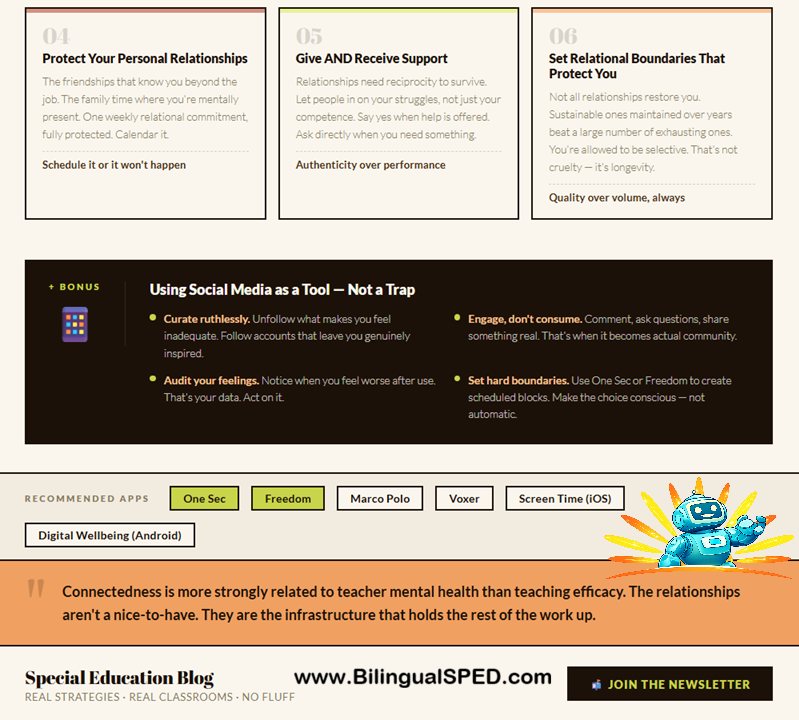
Special educators tend to be incredible at giving support and terrible at receiving it. The professional identity of being the helper can make asking for help feel like failure. But relationships require reciprocity to survive — and relationships built entirely on one person giving and the other receiving aren’t sustainable or genuinely nourishing for either party.
Sharing challenges and resources with colleagues fosters a supportive environment where teachers feel valued and appreciated. That sharing has to go both ways. Let colleagues in on your challenges, not just your competence. Let people help you. Say yes when someone offers. Ask directly when you need something.
The teachers I’ve mentored who built the deepest professional relationships were not the most competent or most organized. They were the ones who were genuinely present — honest about their struggles and generous about their support. People connect to authenticity far more readily than to performance.
Strategy #6: Set Relational Boundaries That Protect the Quality of Your Connections
Healthy relationships don’t just mean having more of them. They mean having ones where you feel genuinely safe and restored. And that requires knowing — and holding — your limits.
A relationship that consistently leaves you more depleted than when you arrived is not a restorative relationship, no matter how long or deeply established. A colleague who uses your conversations only to vent, never to listen. A friendship that pulls emotional resources you don’t have without returning anything. A family dynamic that requires constant management.
You’re allowed to be selective. You’re allowed to redirect conversations that consistently go somewhere that hurts. You’re allowed to limit your availability to people who reliably drain you. This is not cruelty — it’s sustainability. And sustainable relationships, maintained over years, are far more valuable to your wellbeing than a large number of exhausting ones.
The Social Media Section: Using Digital Connection as a Tool, Not a Trap
This deserves its own conversation, because social media is where many teachers’ relational lives are increasingly spending time — and where the risks and benefits are most misunderstood.
Let me be direct: social media is not the enemy. Used intentionally, it can be one of the best professional tools available to special educators — a source of community, inspiration, resources, and connection with people doing exactly what you do, all over the world. Used unintentionally, it’s an anxiety amplifier, a comparison engine, and an exhaustion machine.
The difference is almost entirely about how you approach it.
Curate your feed ruthlessly. Unfollow accounts that negatively impact your mental health. Follow accounts that leave you feeling inspired. Consider what you want your life to look like, and follow accounts that are living the life you want to live. This applies directly to the teacher accounts you follow. Some will energize you. Some will make you feel inadequate, overwhelmed, or behind. Be honest about which is which — and act accordingly.
Use it for genuine community, not passive consumption. There is a real difference between scrolling through content and actively engaging with a community of educators who share your specific interests and challenges. The latter is genuinely restorative. The former is rarely so. Comment. Ask questions. Share something real. That’s when social media starts functioning like an actual relationship and stops being just a screen.
Set time boundaries that you actually enforce. Apps like One Sec add a brief intentional pause before opening social media — a friction-creating moment that interrupts automatic, mindless usage without blocking it entirely. It’s one of the most elegant digital wellness tools I’ve seen because it doesn’t remove the choice; it makes the choice conscious. Freedom goes further, letting you schedule hard blocks on specific apps during times you want to protect — your morning routine, your wind-down window, your one genuine rest day.
Audit how it makes you feel. Ask yourself when technology leaves you feeling better — calmer, more productive, better connected, inspired — and when it leaves you feeling worse — more tired, irritable, angry, or sad. Take note of which behaviors leave you feeling depleted. Your phone’s built-in Screen Time or Digital Wellbeing features show you exactly where your time is going. Look at them honestly. If you’re spending two hours per night on social media and consistently feeling worse afterward — that’s data. Use it.
Join educator-specific professional communities, not just general social media. Platforms like Marco Polo allow asynchronous video messaging that creates genuine warmth and presence in digital relationships — particularly valuable for maintaining connections with former colleagues or friends in other districts. Voxer is used by teacher PLCs around the country for ongoing voice-message collaboration that builds actual community rather than the performance of community.
The bottom line on social media: it can deepen your relational life or hollow it out. The variable isn’t the platform. It’s your intentionality in how you use it.
Optimizing Everything: The Relational Architecture
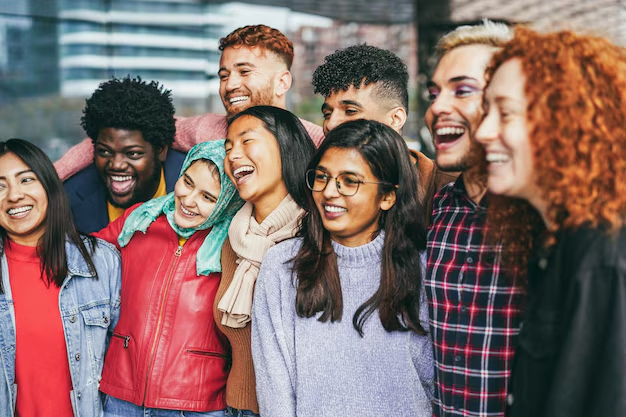
Here’s the framework I coach teachers to build — not a networking strategy, a relational infrastructure:
In your building: one genuine colleague connection you invest in consistently. One honest conversation per week that goes below the surface.
In your professional world: one external educator community you actively participate in — not just read.
In your personal life: one weekly commitment to someone you love, protected from work encroachment. One friendship outside teaching you maintain even when you’re tired.
Digitally: a curated feed of accounts that genuinely inspire you, a time limit that honors your mental health, and at least one digital community where you contribute rather than only consume.
None of this requires hours you don’t have. It requires intention applied to time you already spend — differently.
The Honest Conclusion
The research is unambiguous: connection protects teachers. It predicts job satisfaction, mental health, longevity in the profession, and effectiveness in the classroom. Teachers stay in their jobs when they feel a sense of community. Maintaining community is key to addressing teacher turnover and burnout.
You chose special education because you wanted to be in relationship with kids who needed a specific kind of person in their corner. Don’t let the demands of that work crowd out the relationships that keep you whole enough to show up for them.
Build your connections deliberately. Maintain them with consistency. Protect the ones that restore you. And let yourself be known — not just as a teacher, but as a whole person who happens to love this difficult, beautiful, irreplaceable work.
📬 Join the Weekly Newsletter
Every week I write one practical email for special educators — wellness strategies, classroom tools, honest conversation about sustainability in this work. Real content from someone who’s lived it.
No spam. No sales. Just genuine support, weekly.
💬 Reflection Question
Who is one person — in your building, outside of it, or in a digital community — you’ve been meaning to invest in but haven’t made the time for? And what’s one small step you could take this week to start?
Drop your answer in the comments below. I read every single one — and your honesty might be exactly what another teacher needed to see today.
❓ Frequently Asked Questions
Q: What if I’m genuinely introverted — does building relationships still matter for burnout prevention?
Absolutely — and the research doesn’t distinguish by personality type. Introverts need connection too; the difference is usually in the form it takes. Introverts typically restore in smaller, quieter relational contexts — a one-on-one lunch over a staff gathering, a text conversation over a group chat, a digital community over an in-person event. The principle is the same: genuine connection, matched to how you actually receive it.
Q: How do I build relationships with colleagues when the culture in my building is toxic?
This is genuinely hard — and it’s real in many schools. Start outside your building: professional communities, former colleagues, digital PLCs. Inside the building, look for even one person who seems to operate with integrity and warmth, and invest there. You don’t need a whole staff community to benefit from connection — you need one or two real ones.
Q: How much social media use is too much?
There’s no universal number, but the most reliable indicator is how it makes you feel. If you consistently feel worse — more anxious, more inadequate, more depleted — after using it, that’s too much regardless of the time. Built-in Screen Time features on iOS and Android give you honest data. Start there.
Q: What’s the difference between social rest and building relationships?
Social rest (from the seven types of rest framework) is specifically about being with people who require nothing from you — easy, restorative contact. Building relationships is the active, investment side of the relational equation. Both matter. You need relationships that can restore you (social rest) and the practice of building and maintaining them (the strategies in this post). They work together.
Q: Is it appropriate to maintain relationships with former students or their families on social media?
This varies significantly by district policy, and I’d always recommend checking your district’s social media guidelines before connecting with families or current/former students on personal accounts. Many educators maintain separate professional accounts for this purpose, which allows for community-building while preserving appropriate boundaries. When in doubt, err toward caution and connection through official school channels.
📚 References
- Frontiers in Education. (2025). From burnout to growth: The relationship between teachers’ job satisfaction, wellbeing and mental health. https://www.frontiersin.org/journals/education/articles/10.3389/feduc.2025.1708863/full
- RAND Corporation. (2024). State of the American Teacher Survey 2024. https://www.rand.org/education-and-labor/projects/state-of-the-american-teacher.html
- EdWeek Research Center. (2024). The teachers are not all right: Improving the mental well-being of teachers and principals. https://www.edweek.org
- Van Droogenbroeck, F., Spruyt, B., & Vanroelen, C. (2014). Burnout among senior teachers: Investigating the role of workload and interpersonal relationships at work. Teaching and Teacher Education, 43, 99–109. https://doi.org/10.1016/j.tate.2014.04.011
- AASPA. (2025). How to avoid teacher burnout and increase teacher retention. https://www.aaspa.org/news/how-to-avoid-teacher-burnout-and-increase-teacher-retention-2025
- iCEV Online. (2024). The 7 best ways to avoid teacher burnout. https://www.icevonline.com/blog/best-ways-to-avoid-teacher-burnout
- Springer Nature. (2025). Understanding digital wellbeing: Impacts, strategies, and the path to healthier technology practices. https://link.springer.com/article/10.1007/s44155-025-00259-5
- Linewize. (2024). 5 ways teachers can model positive digital habits. https://www.linewize.com/blog/5-ways-teachers-can-model-positive-digital-wellness
- Freedom Blog. (2024). How to develop healthy social media habits. https://freedom.to/blog/how-to-develop-healthy-social-media-habits-in-2024/
- Mental Health Foundation. (2024). Loneliness and mental health: Research and impact. https://www.mentalhealth.org.uk/explore-mental-health/a-z-topics/loneliness