
Welcome to the front lines of modern special education. If you’re reading this, you’re likely a few weeks or perhaps a few months into your first year, feeling that familiar mix of passion and “how-am-I-ever-going-to-finish-this-paperwork” dread. I’ve been where you are—standing in a classroom in Washington DC, balancing the needs of students with significant cognitive disabilities while trying to ensure every minute of our three-hour English, Financial Literacy, and Digital Literacy blocks is meaningful.
The secret I’ve learned as the Digital Literacy Academy lead is that we cannot work harder than the technology available to us. We have to work smarter. When I first started integrating the NorthStar Digital Literacy curriculum, I realized that the gap between “standard” materials and what my students with IEPs needed was a canyon. AI became the bridge.
Before we dive into the prompts that will save your Sundays, I want to share a resource I developed specifically for those late nights when the red circles under your eyes are matching the red ink on your data sheets. My AI-Supported IEP Writing Toolkit is designed to help you translate classroom observations into professional, compliant, and deeply personalized goals. It’s the perfect companion to the prompts we’re about to discuss.
Now, grab your coffee. Let’s look at 10 AI prompts that will transform your subject areas, utilizing the PLUSS framework and keeping our Level 1, 2, and 3 learners in mind.
1. English Language Arts (ELA): The Multi-Sensory Storyteller
In our 50-minute English block, we often struggle with decoding versus comprehension. For students with significant cognitive disabilities, abstract themes need to be grounded in the concrete.
The Prompt: “Act as a special education curriculum designer. Rewrite the following short story into three versions: Level 1 (pictorial/single words), Level 2 (simple sentences with visual icons), and Level 3 (compound sentences). Incorporate a ‘productive struggle’ question that asks students to predict the ending based on a visual cue.”
2. Financial Literacy: Making Money Real
Financial literacy isn’t just about math; it’s about independence. When we teach this at RTEC, we focus on workforce readiness.
The Prompt: “Create a ‘Do Now’ activity for a 50-minute Financial Literacy lesson on ‘Needs vs. Wants.’ Use a scenario involving a grocery store. Suggest a differentiated strategy: Level 1 students sort physical items, Level 2 use a digital drag-and-drop, and Level 3 calculate a $10 budget.”
3. Digital Literacy: The Curriculum Adaptation
Teaching our curriculum requires us to make digital concepts physical.
The Prompt: “Based on the Digital Literacy ‘Basic Computer Skills’ module, design a ‘Whole Group Instruction’ script that explains what a ‘cloud’ is using a metacognitive metaphor. Include an ‘I Do’ modeling step using a screen reader as an assistive technology tool.”
4. Mathematics: Functional Numeracy

For our students, math is often about time and schedules.
The Prompt: “Generate a ‘Practice (We Do)’ activity for a lesson on telling time to the hour. Provide a modification for students with visual impairments using tactile clock descriptions and ensure the lesson aligns with the PLUSS framework by integrating language supports for the word ‘o’clock’.”
5. Science: The Adaptive Lab
Science can be overstimulating or inaccessible. We need to simplify the input but keep the “wonder.”
The Prompt: “Draft a 10-minute ‘First Five’ introductory science hook about the weather. Provide a metacognitive prompt that asks students: ‘How do I know I need a coat today?’ and outline a partner-work activity for Level 1 learners using a sensory weather bin.”
6. Social Studies: Navigating the Community
Social Studies in a specialized setting is about the student’s place in the world.
The Prompt: “Write a lesson objective for a unit on ‘Community Helpers’ that meets DC state standards. Include an ‘Individual Work (You Do)’ task where students use Google Maps to find the nearest fire station, with a modified version for Level 1 students using printed photo cards.”
7. Life Skills: Workforce Readiness
We are preparing these students for certificates and for life. This is where the AI-Supported IEP Writing Toolkit really shines—helping you document the progress made in these functional areas.
The Prompt: “Create a checklist for a student learning to ‘Clock In’ at a job site. Break the task into 5 micro-steps. Suggest an adaptive software or app that could provide a visual timer for this task.”
8. Art and Multimedia: Visual Voice

Multimedia tools allow students who are non-verbal to express complex emotions.
The Prompt: “Design a ‘Partner Work’ activity using a tablet-based drawing app. One student chooses a color to represent a feeling (Metacognition), and the other student finds a corresponding emoji. Explain how this supports a Level 2 learner’s social-emotional goals.”
9. Physical Education/Motor Skills: Sensory Integration
Even in a digital-heavy day, we need to move.
The Prompt: “Suggest three 10-minute ‘Brain Break’ activities that integrate digital literacy, such as a ‘Simon Says’ game using keyboard command terms (e.g., ‘Escape,’ ‘Enter,’ ‘Space’).”
10. Self-Advocacy: The IEP Participant
The most important subject area is the student themselves.
The Prompt: “Draft a script for a student with a significant cognitive disability to introduce themselves at their IEP meeting. Create a ‘Level 1’ version using a Choice Board and a ‘Level 3’ version where the student identifies one ‘strength’ and one ‘struggle’ in the classroom.”
The Coaching Moment: Why This Matters
When you use these prompts, you aren’t “taking the easy way out.” You are acting as an architect. You are taking the raw stone of a general curriculum and carving out a path that your students can actually walk on.
In my classroom, we follow a strict agenda: First Five, Do Now, Standards, Whole Group, Practice, Partner Work, and Individual Work. It provides the predictability our students crave. By using AI to generate the content for these slots, you free up your mental energy to do the one thing AI can’t: build a relationship with the human being sitting in front of you.
As you refine these lessons, remember that your documentation needs to be just as strong as your instruction. I always keep my AI-Supported IEP Writing Toolkit open in a tab while I’m planning. It ensures that the “Practice” and “Individual Work” segments I’m creating are directly feeding into the data I need for their annual reviews.
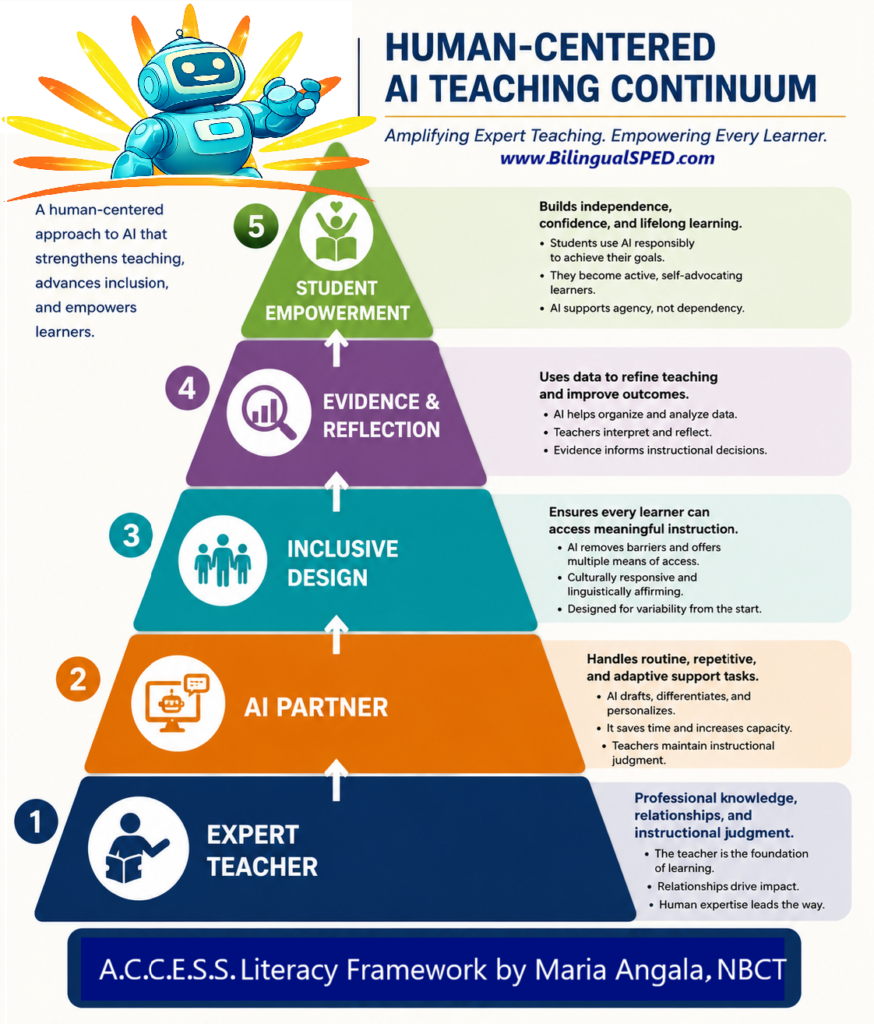
I developed a Human-Centered AI Teaching Continuum embedded within the A.C.C.E.S.S. Literacy Framework to guide educators in using AI ethically and effectively to amplify expert teaching for multilingual learners and students with disabilities.
Your Path Forward
Teaching students with significant cognitive disabilities is a marathon, not a sprint. You are doing the work that changes the trajectory of a family’s life. Don’t be afraid of the “productive struggle”—not just for your students, but for yourself as you learn these new AI tools.
If you found these prompts helpful and want more strategies on integrating assistive technology and modified curriculum into your daily routine, I’d love to stay in touch.
Join the Movement:
Let’s go back into the classroom tomorrow with a plan that works for every learner. You’ve got this, and I’m right here in your corner.
wish you all the best
Thank you!