I’ll be honest with you.
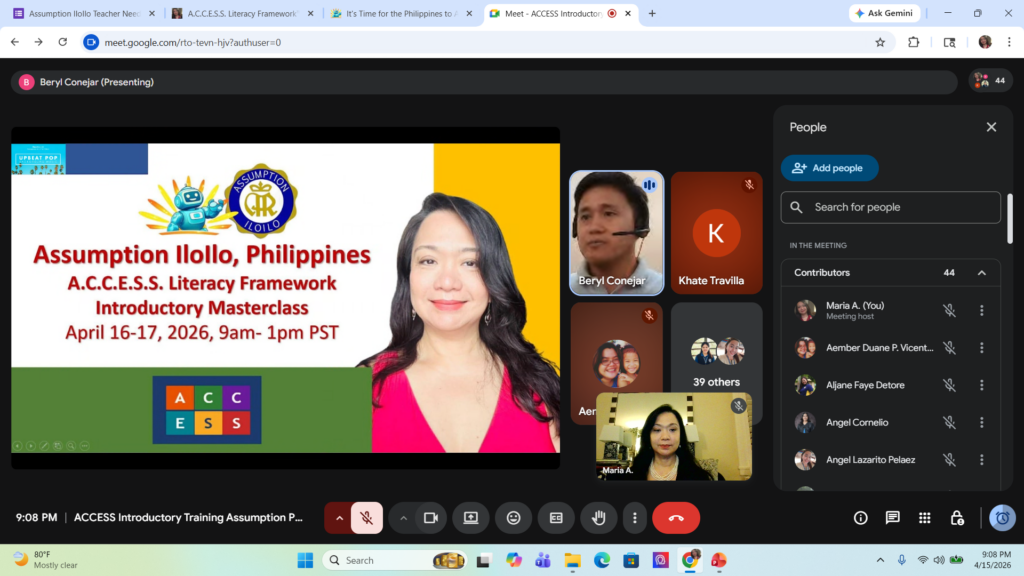
I walked into the 2-Day A.C.C.E.S.S. Literacy Framework™ Introductory Masterclass at Assumption Iloilo with a mix of excitement and nerves that I haven’t felt in a long time. Not the nervous-I-don’t-know-what-I’m-doing kind. The nervous-this-matters-so-much kind.
These are Filipino teachers. My teachers. The kind of educators who show up for every child in their classroom — the ones who speak multiple languages before 8am, manage 40+ students with genuine warmth, and still find time to care about every learner who slips through the cracks. I wanted to honor that. I wanted to give them something real.
And they did something for me in return that I didn’t expect.
They gave me data.
Not just polite feedback. Not just applause at the end of a session. They gave me honest, specific, actionable responses — in a pre-training needs survey and a post-training feedback form — that told me exactly where they are, exactly what they need, and exactly how we build this together.
This post is my response to that gift. It’s an analysis of what the data said, a reflection on the feedback I received as a presenter, and a strategic plan for what comes next — anchored in the A.C.C.E.S.S. Literacy Framework™ Certification Pathway and built specifically for the Assumption Iloilo community.
Let’s dig in.
What the Data Said: Reading the Needs Survey
Forty Assumption Iloilo teachers completed the pre-training needs assessment — five questions, each aligned to one stage of the A.C.C.E.S.S. framework. Here’s what they told us.
Question 1 — Activate: “Before students read a new lesson, what do you usually do?”
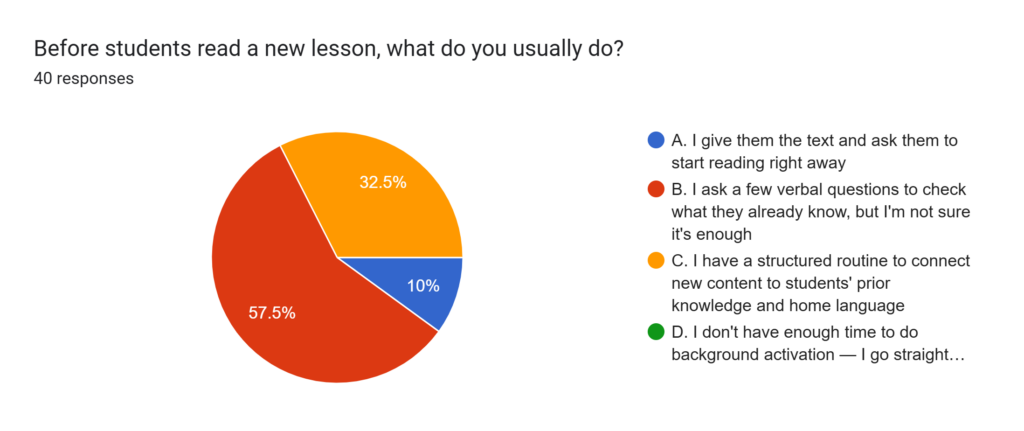
The majority — 57.5% — said they ask verbal questions to check prior knowledge but aren’t sure it’s enough. Another 32.5% already have a structured routine connecting content to students’ prior knowledge and home language. Only 10% said they hand over the text and start reading immediately.
Here’s what strikes me about this. These are not teachers who are indifferent to activation. They are teachers who are trying — they’re asking questions, they’re making the attempt — but they don’t yet have a system behind it. They have instinct without architecture.
That 32.5% with a structured routine? Those are your future A.C.C.E.S.S. champions. They already know what activation should feel like. They just need the language and the framework to teach it to everyone else.
Question 2 — Clarify: “How do you handle difficult vocabulary before a reading lesson?”
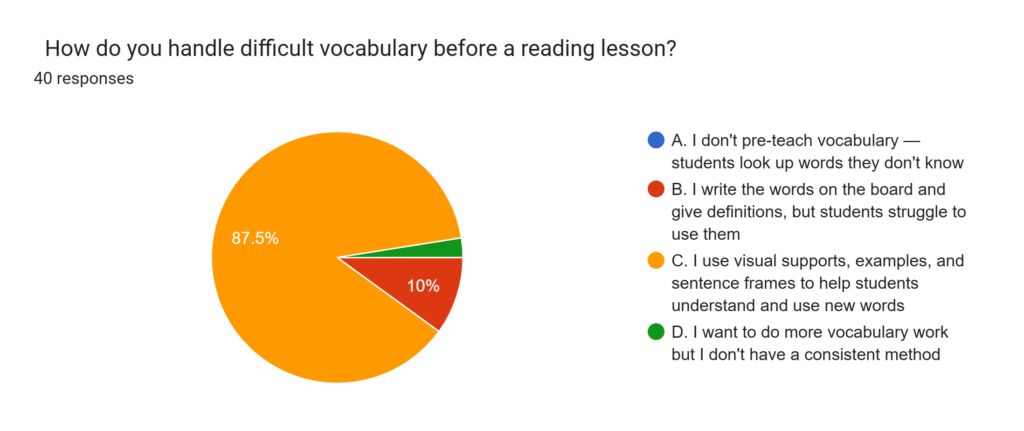
This was the most surprising result in the whole survey — and honestly, it was a gift.
87.5% of Assumption Iloilo teachers reported using visual supports, examples, and sentence frames to help students understand and use new words. Only 10% said they write words on the board with definitions and notice students still struggling. Just one teacher said she wants to do more but doesn’t have a consistent method.
Let me say what this means clearly: Assumption Iloilo teachers are already doing strong vocabulary instruction. They’re not starting from scratch. They’re starting from a solid base that the A.C.C.E.S.S. Clarify stage can refine, systematize, and extend.
This is actually harder to work with than a deficit — because when teachers are already doing something well, the challenge is helping them see why it works and how to make it even more intentional. That’s the work of certification, not just training.
Question 3 — Chunk: “What is the biggest challenge you face when assigning a reading passage?”

This is where the room told the truth.
47.5% said their biggest challenge is students with different reading levels — some finish immediately, others never start. 27.5% said it’s all of the above — different levels, comprehension gaps, and large class management simultaneously. 22.5% said students can decode fluently but cannot comprehend. Only 2.5% — one teacher — named large class management as the primary challenge.
What this tells me: differentiation is the urgent, pressing, daily reality for these teachers. It’s not a policy conversation for them. It’s the 7:30am problem. It’s the reason some students finish in five minutes while others are still on the first sentence when the bell rings.
The Chunk stage — specifically the 150-200 word rule, labeled sections, stop-and-jot, and numbered annotation protocols — is the direct answer to this. And critically, so is the AI integration component: the ability to generate multiple reading levels of the same passage in under a minute is not a luxury for these teachers. It’s a lifeline.
Question 4 — Engage: “When you ask students a comprehension question, what do you most often see?”
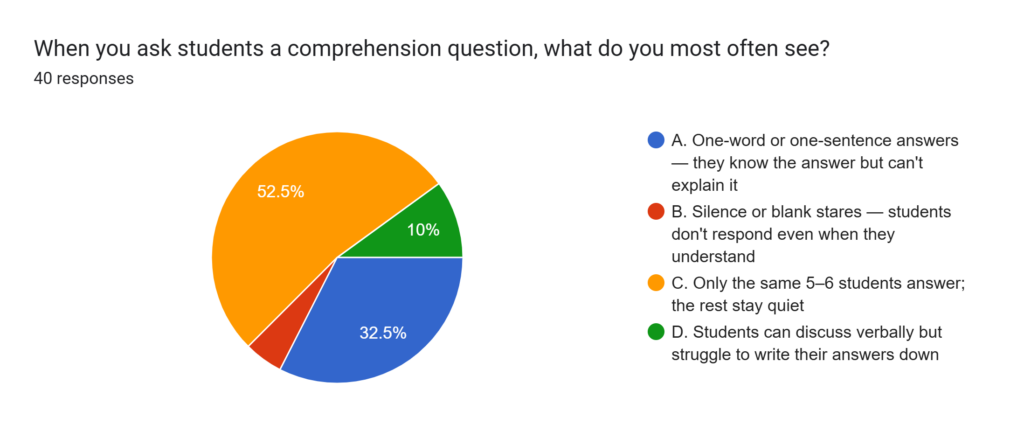
52.5% said the same five or six students always answer while the rest go quiet. 32.5% said students give one-word or one-sentence responses — they know the answer but can’t explain it. 10% said students can discuss verbally but struggle to write. Only 5% reported silence.
This is a two-headed problem that looks like one. The participation gap and the depth-of-response gap are related but different. Students who go quiet when questions are posed are experiencing something different from students who answer but can’t elaborate — and the RACE structure addresses both, though in different ways.
For the quiet majority — RACE gives everyone a structure to hold onto before they speak. When a student knows they need to Restate, Answer, Cite, and Explain, they don’t have to generate a response from nothing. They have a pathway. And pathways make participation feel possible.
For the students who answer without depth — the E in RACE is the breakthrough step. Why does the evidence prove your answer? So what? That question, asked consistently, does more for writing quality than any amount of red pen correction.
Question 5 — Support and Synthesize: “At the end of a lesson, how confident are you that students understood?”
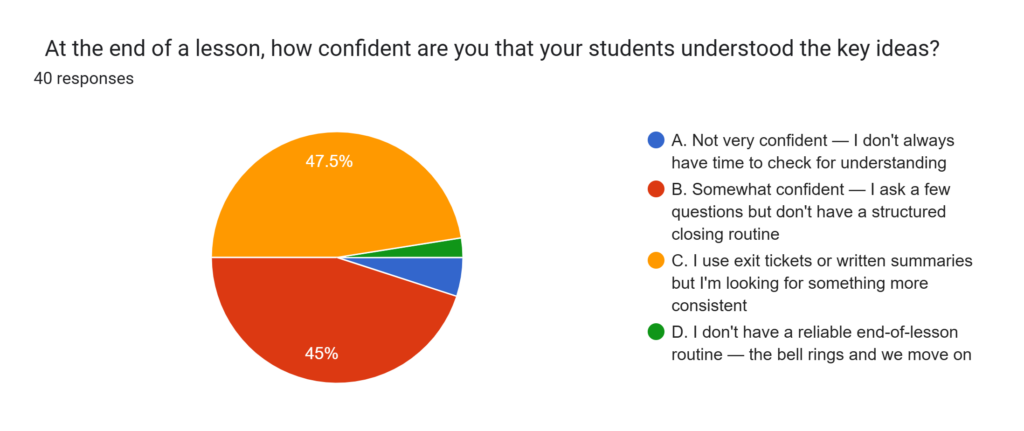
47.5% said they use exit tickets or written summaries but are looking for something more consistent. 45% said they’re somewhat confident — they ask a few questions but have no structured closing routine. 5% said they’re not very confident. Only one teacher said they have no reliable end-of-lesson routine.
Combined, 92.5% of Assumption Iloilo teachers — 37 out of 40 — are doing some synthesis work but lack the structured, repeatable closing routine that makes it predictive rather than intuitive.
This is significant. It means the Synthesize stage isn’t addressing a gap they don’t know exists. It’s naming a gap they already feel. They know the lesson ends before the learning is secured. They just haven’t had a system for closing that gap consistently.
That changes what training looks like — because you’re not convincing anyone of a problem. You’re handing them the solution to a problem they’ve already identified.
Reflection on the Feedback: How Did I Do?
Before I write a strategic plan, I want to sit with something uncomfortable.
Eighteen teachers submitted post-training feedback. And while the responses were overwhelmingly affirming — every single person rated delivery as Effective or Highly Effective — this is not the part I’m going to focus on. Because feedback that only tells you what went well doesn’t make you better.
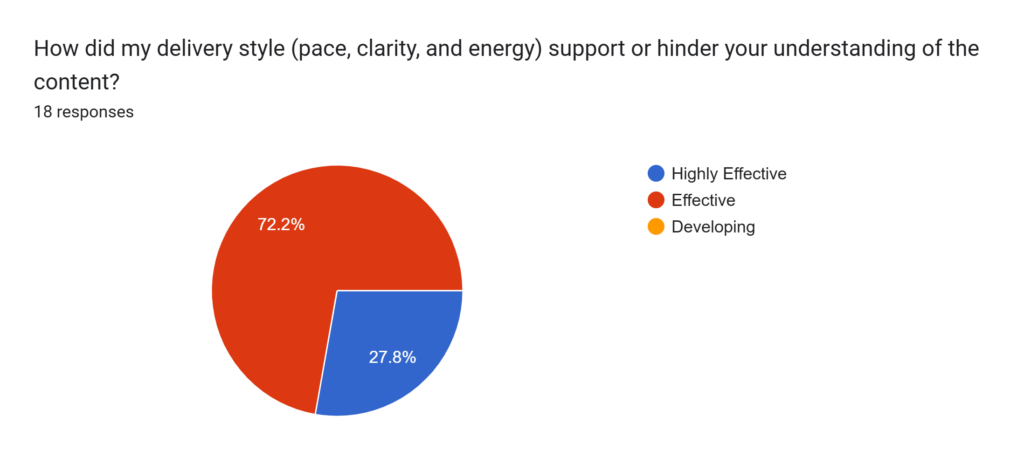
Here’s what the feedback actually taught me.
The delivery landed. Teachers described the pace as clear, the energy as engaging, and the use of real classroom examples as the primary reason they stayed focused. One teacher wrote that she didn’t speak much during discussion because she was too focused on note-taking — which is, honestly, the highest compliment I can imagine. Another described how the organized, step-by-step structure — especially around RACE and scaffolded prompts — kept her from feeling overwhelmed.
That matters. These are busy professionals who came to a professional development session after a full teaching day. The fact that they were taking notes feverishly rather than watching the clock means something was landing.
But the time pressure was real. Multiple teachers — at least four — flagged that there wasn’t enough time for the activities. One said the flow of activities felt a little overwhelming. Another specifically asked for time-bound activities with clearer pacing. One teacher noted that the platform we used — Teachable — was difficult for some participants to navigate, making it hard to post comments and participate fully.
I hear this. And honestly, this is the tension that lives in every professional development setting: there is always more to teach than there is time to teach it. The solution isn’t to cut content. It’s to be more deliberate about which activities are done during the session versus which are assigned as follow-through work. I’ll be redesigning the activity pacing for the next cohort with that distinction in mind.
Concrete examples are everything. Four teachers explicitly asked for sample lesson plans using the A.C.C.E.S.S. framework. One Grade 1 teacher asked specifically for more classroom-based examples for younger learners. A preschool teacher asked for more samples tailored to early childhood settings.
This is the clearest direction the feedback gave me: the framework is understood. The need now is demonstration. Annotated lesson plans. Before-and-after text examples. Grade-specific applications. This isn’t a gap in the framework — it’s a gap in the materials I brought to Iloilo. And it’s fixable.
The AI question surfaced — and it’s important. Two teachers asked specifically about AI: one wanted to know how to use it in her own teaching context. One asked a genuinely profound question: “Will AI still have hope in prompting students to actually learn independently instead of solely relying on it?” Another teacher asked how teachers can maintain the integrity of their work when AI is already being used in lesson planning.
These aren’t resistant questions. They’re the right questions. And they deserve a module of their own — which is exactly what we’re building.
There was one outlier in the feedback — a response that described the delivery as monotonous and the slides as too much. This was attributed to a different session entirely — AI for Academic Productivity — not the A.C.C.E.S.S. Masterclass. I note it here not to dismiss it but because it’s a useful reminder: every session has a different energy, a different audience, a different moment. What works in one room doesn’t automatically transfer to another. That keeps me humble.
And humble, I’ve learned, is exactly the right posture for this work.
The Strategic Plan: What We Build Next
Here’s the thing about data. It’s only as useful as what you do with it.
Forty teachers told me where they are. Eighteen told me what worked and what didn’t. Now I have an obligation — not just a professional one, but a personal one — to respond to that data with intention.
What follows is the strategic plan I’m committing to for Assumption Iloilo, built on the A.C.C.E.S.S. Literacy Framework™ Certification Pathway and designed to move these teachers from Introductory Masterclass participants to Certified Practitioners, Certified Instructors, and ultimately, Certified Trainers who can carry this work forward without me in the room.
That last part matters more than anything else I’m about to say. Because sustainable literacy reform doesn’t happen when an outside trainer flies in once a year. It happens when the strongest teachers in your building become the teachers who teach the teachers. That’s the end goal. Everything below is how we get there.
Phase 1 — Foundations and Differentiation Support (April 2026 Through December 2027)
The data-driven priority: differentiation.
Question 3 was the loudest result in the entire needs survey. 75% of Assumption Iloilo teachers named differentiated reading levels and comprehension gaps as their primary challenge. That is the first thing we address.
The immediate follow-through for this cohort is a differentiated instruction module focused specifically on chunking for mixed-ability classrooms. This means delivering the annotated lesson plan templates that teachers asked for — Grade 1 through Grade 12 examples showing exactly how the six A.C.C.E.S.S. stages look in practice at each level. For the early childhood teachers specifically — kindergarten and Grade 1 — we build out adapted examples that honor the developmental realities of young learners.
This phase also addresses the platform issue. Teachable works for the certification pathway, but for live training interactions — where teachers need to respond, post, and share in real time — we explore a simpler, more accessible tool. Google Classroom, Padlet, or even a shared Google Doc can replace the interactive elements that the Teachable comment function made difficult.
By the end of Phase 1, every teacher who completed the Introductory Masterclass has:
- Access to a grade-specific A.C.C.E.S.S. annotated lesson plan template
- A differentiated text-chunking guide with the 150-200 word rule applied to their content area
- The AI prompt library for generating chunked, multi-level versions of any passage in under 60 seconds
Phase 2 — Certification Pathway Launch (August 2026 Through December 2027)
This is where the real transformation begins.
The A.C.C.E.S.S. Literacy Framework™ Certification Pathway has four levels: Certified Educator Practitioner, Certified Instructional Leader, Certified Trainer, and A.C.C.E.S.S. Literacy Academy at the institutional level. For Assumption Iloilo, Phase 2 launches the first two levels across the full cohort.
Level 1 — Certified A.C.C.E.S.S. Educator Practitioner
Teachers complete all six modules of the A.C.C.E.S.S. Professional Development Certification course — available now on the Teachable platform — and submit an annotated lesson plan demonstrating all six framework stages with their own students. This is not a theoretical exercise. It is a real lesson, with real students, documented and submitted for review.
The focus for Assumption Iloilo’s Level 1 cohort, based on the needs survey data, is specifically on:
- Activation routines with home language bridges — honoring the multilingual reality of Filipino classrooms
- The RACE/RACES structure for written response — addressing the 85% of teachers who identified participation gaps and shallow written responses
- Synthesis structures — addressing the 92.5% who lack a consistent end-of-lesson routine
The expectation is not perfection. It’s fidelity — a genuine attempt to implement the framework with consistency, document what happens, and reflect on the results. That reflection is where the real learning lives.
Level 2 — Certified A.C.C.E.S.S. Instructional Leader
For the teachers who demonstrate strong fidelity in Level 1, the invitation to Level 2 comes from me directly — and I’ve built this requirement intentionally. Level 2 is not self-selected. It requires my review and approval, because the people who enter the Instructional Leader pathway are the people who will eventually train their peers. That bar matters.
Level 2 teachers at Assumption Iloilo submit a full unit portfolio — not just one lesson, but a connected sequence of lessons showing the A.C.C.E.S.S. framework implemented across multiple days with a consistent class. They also complete a peer coaching cycle — observing a colleague, providing structured feedback, and reflecting on the experience in writing.
This is a lot to ask. It is supposed to be. Because the teachers who complete it will have done something that changes how they see their own practice. They will have evidence of their own growth. And that evidence — that before-and-after — becomes one of the most powerful recruitment tools for the next cohort.
Phase 3 — Teachers Teaching Teachers (December 2027 Through June 2029)
This is the phase that makes everything sustainable.
By early 2027, Assumption Iloilo should have a small but solid group of Level 2 Certified Instructional Leaders who are ready to begin the Certified Trainer pathway. This is the phase where the professional development program stops depending on me and starts living inside the school.
Certified Trainers deliver a pilot training session — observed and assessed — and upon successful completion, are authorized to deliver A.C.C.E.S.S. trainings to their colleagues at the school and division level without an external facilitator.
What that means for Assumption Iloilo specifically: by the end of 2027, this school has the internal capacity to onboard every new teacher to the A.C.C.E.S.S. framework at the start of each school year. Without flying anyone in. Without waiting for another external training event. The knowledge lives in the building.
That is exactly how the Philippines scales this. Not one school at a time with an outside trainer. School by school, from the inside out, with Filipino educators training Filipino educators.
The AI Integration Thread — Running Through All Phases
Based on the feedback from Assumption Iloilo, AI is not a peripheral add-on to this work. It’s a thread that runs through every phase of the certification pathway.
Multiple teachers asked specifically about AI — how to use it, how to maintain integrity while using it, how to prevent student over-reliance on it. One teacher asked the question that actually keeps me up at night: will AI still motivate students to learn independently?
I don’t have a perfect answer to that question. But I have a principled one.
AI in the A.C.C.E.S.S. framework is always in service of the teacher’s instructional decision-making — never a replacement for it. The AI prompt that generates a chunked, multi-level text does not decide when to chunk, why to chunk, or how to use the chunked text with a specific group of learners. That decision belongs to the teacher. Always.
For student use, the same principle applies. AI can scaffold the process of writing — helping a student organize their RACE response, pre-teach vocabulary, or see a model — but the thinking that fills the RACE structure still belongs to the student. A student who uses AI to generate their Explain step hasn’t written a RACE response. They’ve used a tool to avoid the hardest, most growth-producing part of the work.
Teaching students to use AI with integrity is itself a literacy skill. And it belongs inside the A.C.C.E.S.S. certification pathway — not as a separate module, but woven into every stage.
What I’m Most Hopeful About
I’ve been thinking about something one of the teachers wrote in the feedback.
She said: “I am challenged on how to implement all the following strategies that I learned throughout the session. Thank you so much Ms. Maria Angala. All for Jesus.”
That line — the overwhelm and the gratitude in the same breath, ending with a prayer — is the most Filipino thing I’ve read in a long time. And it broke my heart a little, in the best possible way.
She wasn’t saying she couldn’t do it. She was saying she cared enough to feel the weight of it. That the work felt serious enough to be worth the challenge.
That is exactly the teacher the A.C.C.E.S.S. movement needs. Not the teacher who already has it figured out. The teacher who feels the complexity of this work, takes it seriously, and keeps showing up anyway.
Assumption Iloilo has 40 of them in this cohort alone.
The framework is on the ground. The community is forming. The data tells us exactly where to go next.
And the teachers of Assumption Iloilo — my teachers, my motherland’s teachers — are ready.
Hindi bukas. Ngayon na. Kayang kaya, basta sama sama.
Ready to join the A.C.C.E.S.S. movement?
Whether you’re a teacher in the Philippines, Southeast Asia, or anywhere in the world — if this work resonates, you belong in this community. Visit www.bilingualsped.com to explore the A.C.C.E.S.S. Literacy Framework™, the Certification Pathway, and what it means to be a Founding Member.
Because years from now, when this framework is in thousands of classrooms — I want some of you to say: “I was there from the beginning.”
💕 www.bilingualsped.com/a-c-c-e-s-s/
Angala, M. (2026). A.C.C.E.S.S. Literacy Framework™. BilingualSPED.com.
All data cited in this post is drawn from the Assumption Iloilo Teacher Needs Survey (n=40) and Post-Training Feedback Survey (n=18), administered April 2026.