
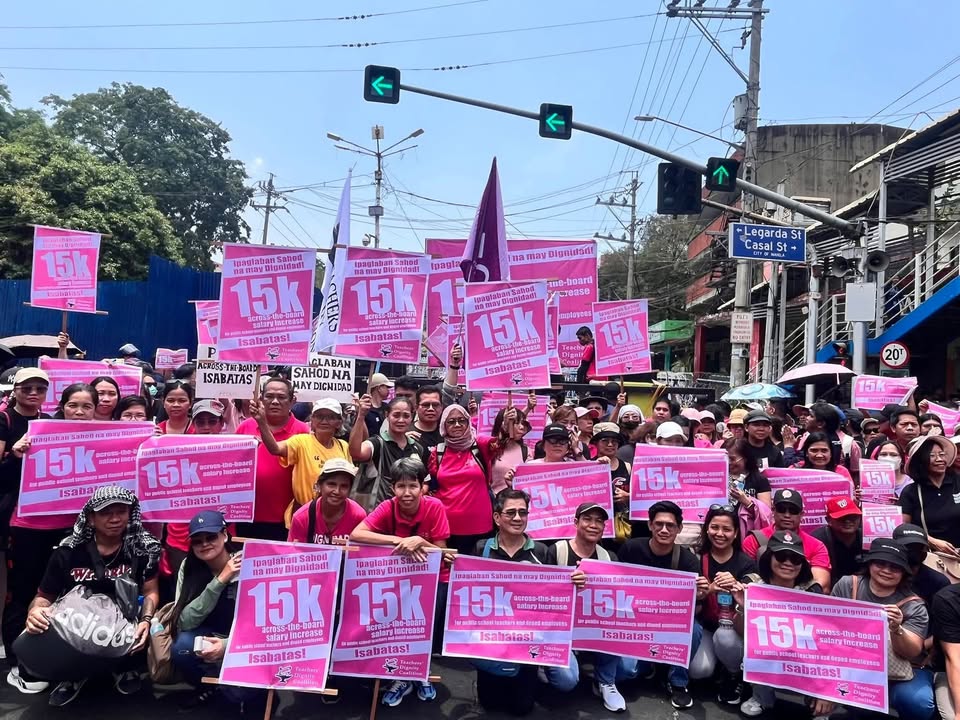
I want to tell you something that happened yesterday that I haven’t been able to stop thinking about.
Filipino teachers marched.
They walked from the Department of Budget and Management all the way to Mendiola Bridge in Manila — teachers from the National Capital Region, from Calabarzon, Central Luzon, Region 1 — demanding one thing: a ₱15,000 across-the-board salary increase. Not a bonus. Not a one-time payment. A salary — the kind that reflects what they actually do, what they actually carry, what they actually give every single day.
I was sitting in Washington, DC when I saw the news. And I felt it the way you feel something that is yours, even from thousands of miles away.
Because I am a Filipino teacher. And I know exactly what it feels like to march for something the system should have given you a long time ago.
What I Know About Teaching — and What the Numbers Don’t Show
I have been a teacher for over twenty-two years. Bilingual special education. Inner city public school. Self-contained classrooms with students who carry more complexity — linguistic, cognitive, emotional, systemic — than most people encounter in a lifetime.
I know what it means to spend your own money on your classroom. I know what it means to work a second job to cover what your salary doesn’t. I know what it means to be told, in a hundred subtle and not-so-subtle ways, that your work is important — and then be paid like it isn’t.
And I know — from my own experience as a union leader — that when teachers organize, when they walk, when they refuse to be silent anymore, it is not because they have given up on teaching.
It is because they love it too much to let it be destroyed.
The Four Reasons Filipino Teachers Are Drowning in Debt
Benjo Basas, National Chairperson of the Teachers’ Dignity Coalition, outlined four drivers pushing Filipino teachers into debt: medical emergencies without government health support, education and career advancement costs they must fund themselves, housing with no government program to support it, and out-of-pocket classroom expenses that should be the State’s responsibility.
I want to add a fifth.
The invisible tax of being a Filipino teacher in 2026.
The laptop they bought because the school didn’t have one. The printed materials they paid for because there was no budget. The internet connection they subscribed to so their students could keep learning. The food they bought for a student who came to school hungry. The medication they paid for out of pocket because a child needed it and the parent couldn’t afford it.
As Benjo said: “Madalas, ang guro na rin ang gumagastos para sa kanyang mga pangangailangan sa pagtuturo — laptop, printer, papel, gadgets, internet access, kahit pa TV sa classroom. Minsan, pati pangangailangan ng mga mag-aaral ay galing pa sa bulsa ng guro.”
This is not generosity. This is a structural failure that individual teachers are filling with their own bodies, their own savings, their own futures. And it has to stop.
A Direct Appeal: To DepEd, to Congress, to the Marcos Administration
I am speaking now not as a framework creator or a professional development trainer. I am speaking as a Filipino teacher, as a union leader, as someone who has sat at bargaining tables and knows exactly what it takes to make institutions listen.
Senate Bill 211 and House Bill 4500 are on the table. They are not radical. They are not unreasonable. They are the minimum expression of respect for a profession that holds the entire future of this country in its hands every single day.
Benjo said it clearly: “Our government can easily afford it. This is even a smaller amount compared to the funds discovered stolen in anomalous projects.”
He’s right. And it is deeply, painfully ironic that a government that found billions missing in flood control funds cannot find the political will to give the teachers of this nation a salary that covers their basic needs.
So I am saying this directly:
To the Department of Education: Stop issuing vague statements. Your teachers marched to Mendiola yesterday. They deserve a clear, unequivocal, on-the-record position in support of this salary increase. Silence is not neutrality. Silence is complicity.
To the members of Congress: Pass Senate Bill 211. Pass House Bill 4500. Not next term. Not after the election. Now. The teachers who are educating the children of your constituents are garnishing their salaries to pay for loans taken out to survive. This is not a policy debate. This is a moral emergency.
To President Marcos: The teachers of this country shaped every Filipino who has ever contributed something meaningful to this nation — including everyone in your cabinet. They are not asking for luxury. They are asking to live without debt for doing the most important work in the country. Hear them.
What Dignity Actually Means
I think about the word dignity a lot. It’s in the name of the coalition — Teachers’ Dignity Coalition. And I think Benjo chose it deliberately. Because the fight isn’t just about pesos. It never is.
Dignity means being paid what your work is worth. It means not having your salary garnished while you’re standing in front of 50 students trying to teach them to read. It means not choosing between your family’s healthcare and your classroom’s supplies. It means being treated — by policy, by budget, by law — as a professional whose expertise is irreplaceable and whose welfare matters.
Filipino teachers have incredible dignity. They carry themselves with it every single day, in classrooms that are understaffed and undersupplied and undervalued. What they are asking for is for the system to have dignity too. For the structures around them to finally reflect what everyone already knows:
Teaching is not a sacrifice. It is a profession. And it must be treated like one.
My Solidarity — And My Ask of You
I am a Filipino teacher living abroad. I benefit from a salary structure, union protections, and professional rights that Filipino teachers are still marching to earn. That fact does not sit lightly with me.
Which is why I am writing this. Which is why I am naming names and making direct appeals and refusing to soften this with diplomatic language.
If you are reading this outside the Philippines: share this post. Talk about it. Make noise. International attention matters.
If you are a Filipino educator: you are not alone. What you are carrying is real. Your exhaustion is real. Your debt is real. And your worth — your irreplaceable, immeasurable worth — is real too.
If you are a policymaker or a DepEd official reading this: I have been in classrooms for twenty-two years. I have worked with the students your current policies are failing. I am building an instructional framework to help Filipino teachers do more with less — but I want to be clear: they should not have to do more with less. The framework helps. The salary change is non-negotiable.
The Teachers’ Dignity Coalition has said it will continue protest actions until classes open in June. I will be watching. I will be speaking. And I will keep saying what I believe with everything I have:
Filipino teachers deserve dignity. Not someday. Now.
Maraming salamat sa lahat ng guro. Kayo ang pundasyon ng bansang ito. Huwag kayong titigil.
💕 Kayang-kaya basta sama-sama!