

I’ll never forget the first time I taught a student who had just arrived in the country—let’s call him “M.” M was a brilliant young man with a significant cognitive disability who also happened to be an English Language Learner (ELL). I sat him down during our 50-minute English block with a standard vocabulary worksheet, and I watched the light slowly go out in his eyes. It wasn’t that he couldn’t learn; it’s that I was speaking a code he hadn’t been given the key to crack yet.
If you’re a new teacher standing in that gap today, I want to pull you aside for a coaching session. Teaching vocabulary to ELL students with significant cognitive disabilities is not about more repetition; it’s about more structure. We are building a bridge between their primary language, their emerging English, and their functional needs for the workforce.
In my two decades of teaching diverse students, I’ve learned that we cannot leave vocabulary to chance. We need “the tools of the trade.” One of the most effective ways I’ve found to anchor this is through my AI-Enhanced CORE VALUES Quotes & RACE Writing Strategy bundle. It’s designed to give you that structured “key” to help students like M unlock meaning through values-based language.
1. The “Double Burden” of the ELL-SPED Learner
When we talk about our ELL students in special education, we have to look at the data to understand the gravity of our task. National statistics show that ELL students now make up roughly 10-15% of the total K-12 population in the U.S. Within the special education umbrella, the intersectionality is striking. For instance, Hispanic students make up about 28% of the total SPED population, while Black/African American students make up roughly 17%.
When these students have significant cognitive disabilities, they are carrying a “double burden”: processing a new language while navigating cognitive barriers.
The Coaching Tip: You aren’t just teaching a word; you are teaching a concept. If you teach the word “Budget” in your Financial Literacy block, an ELL student might know the concept in their native language but lack the English label. Or, they may lack both. Your job is to provide the Visual Anchor first.
2. The PLUSS Framework: Your Vocabulary Roadmap
To move from “I don’t get it” to “I can use it,” I rely on the PLUSS framework. Let’s look at how this applies to a 50-minute lesson block.
P: Pre-teach Vocabulary
Never start a reading passage without the “First Five” minutes dedicated to the “Power Words.”
- Level 1 (Sensory): Show a real object. If the word is “Keyboard,” let them touch it.
- Level 2 (Transitional): Use a picture card with the word in English and their native language.
- Level 3 (Independent): Use the CORE VALUES Quotes bundle to connect the word to a bigger idea, like “Responsibility.”
L: Language Modeling
ELL students need to hear the word in a “Think Aloud.” I might say: “I see the word ‘Respect.’ I show respect by listening to my partner.” I am modeling the metacognitive process of connecting a dry vocabulary word to a lived action.
3. The RACE Strategy: Writing as a Vocabulary Anchor
Writing is often the most intimidating part for ELL-SPED students. This is where the RACE strategy (Restate, Answer, Cite, Explain) becomes a life raft.
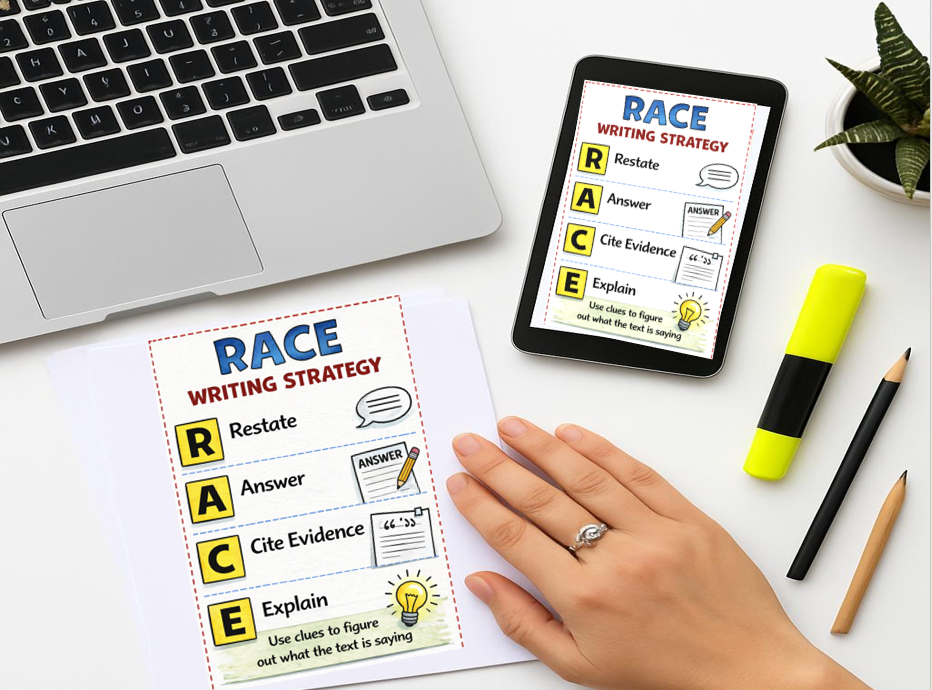
I use the RACE strategy to help students “own” their new vocabulary. When we are in our “Practice (We Do)” phase, we don’t just write sentences; we build them.
- R: Restate the question using the target vocabulary word.
- A: Answer the question.
- C: Cite a visual or text evidence (e.g., “The picture shows a person helping”).
- E: Explain why it matters.
By using the AI-Enhanced CORE VALUES & RACE Writing Strategy, you give your Level 2 and Level 3 learners a repeatable formula. They stop panicking about “what to write” and start focusing on “which word to use.”
4. Differentiating the “Sweet Spot” of Struggle
As your coach, I want to remind you: Productive struggle is a gift. If a student never struggles, they never grow. But for ELL students, we have to ensure the struggle is with the content, not just the language.
Level 1 Learners (Significant Support)
Use “Errorless Learning.” If the target word is “Earn,” give them two pictures: one of a person getting a paycheck and one of a person sleeping. Ask them to point to “Earn.” They are building the concept without the language barrier stopping them.
Level 2 Learners (Moderate Support)
Use Sentence Frames. “To earn money, I must ____.” This provides the grammatical “bones” so they can put the vocabulary “meat” on the frame.
Level 3 Learners (High Independence)
Ask them to apply the vocabulary to a new context. “How do you earn respect in the Digital Literacy Academy?” This moves them into the “Sustained Academic Talk” portion of the PLUSS framework.
5. Vocabulary in the 3-Hour Block: A Real-World Example
How do we make this cohesive across English, Financial Literacy, and Digital Literacy? We use Thematic Vocabulary.
- English (50 min): Read a quote about “Integrity” from the CORE VALUES bundle. Use the RACE strategy to reflect on it.
- Financial Literacy (50 min): Talk about “Integrity” at a job. Does integrity mean you tell the truth if you lose your paycheck?
- Digital Literacy (50 min): Talk about “Integrity” online. Do we share our passwords? No, because we have integrity.
By hitting the same word in three different contexts, you are creating “neural highways” in the student’s brain. For an ELL student, this repetition is the secret to moving words from short-term memory to long-term mastery.
A Final Coaching Note
The work you are doing is monumental. You are giving a voice to the voiceless. National data indicates that students who are both ELL and have a disability are at the highest risk for dropping out—sometimes as high as 20-25% in certain urban districts. You are the barrier against that statistic.
When you use structured supports like the AI-Enhanced CORE VALUES Quotes & RACE Writing Strategy, you aren’t just “giving a worksheet.” You are giving a student the ability to advocate for themselves in the workforce and in life.
Ready to Empower Your ELL Learners?
It’s time to stop the “guessing game” with vocabulary and start using a system that works.
Your Action Plan:
- Select Your “Power Words”: Pick 3 words for next week that work across all three of your subject blocks.
- Anchor Your Strategy: Download the AI-Enhanced CORE VALUES Quotes & RACE Writing Strategy bundle to provide that consistent, professional structure for your writers.
- Stay in the Community:
Let’s go build those bridges. You’ve got this.