
There’s a quote from Linda Darling-Hammond that I keep coming back to — about the most important function of a professional learning community being to disrupt the predictability of educational outcomes by race, language, and disability status. That sentence stopped me the first time I read it, because it named something I’d been watching happen in classrooms for years without having the language for it. This post is about what that quote means to me, how it shaped the A.C.C.E.S.S. Literacy Framework I created for multilingual learners and students with disabilities, and why I believe rigorous literacy instruction and truly inclusive teaching are not competing goals — they were always meant to be the same thing.
I’ve been in enough classrooms to know that inequity doesn’t usually announce itself.
It doesn’t show up as overt discrimination or deliberate neglect. It shows up as a reading group that never moves. As the same five students who never get called on for the hard questions. As an assignment that gets quietly simplified for “certain kids” until what’s left looks nothing like the original task. As a student who spends three years in a special education setting being asked to match pictures to words when, with the right support, they could have been writing full sentences.
Well-intentioned. All of it. But still inequitable.
That’s what Linda Darling-Hammond is naming when she says that the most important function of a professional learning community is to disrupt the predictability of educational outcomes by race, language, and disability status. Not to improve outcomes — though that’s part of it. To disrupt their predictability. Because when the same groups of students consistently underperform, year after year, school after school — that’s not a student problem. That’s a systemic design problem. And design problems require intentional redesign.
That redesign is what led me to build the A.C.C.E.S.S. Literacy Framework.
Why Does Darling-Hammond’s Equity Mandate Matter — and What Does It Actually Ask of Teachers?
Darling-Hammond has spent decades documenting the relationship between teaching quality and educational equity. In her research and writing — including foundational work on teacher preparation and professional learning — she’s been consistent about one thing: equitable outcomes require equitable instructional design, not just equitable intention.
According to the Learning Policy Institute, which Darling-Hammond leads, effective professional learning must be connected directly to students’ actual learning challenges — including the specific barriers faced by multilingual learners and students with disabilities. Generic professional development doesn’t move the needle. What moves the needle is teachers examining their own instructional practices with honest, student-centered data and then redesigning those practices in response.
That’s a harder ask than it sounds.
Because here’s the thing — most teachers who lower expectations don’t think of it that way. They think of it as meeting students where they are. They think of it as being kind. I’ve done it myself, earlier in my career, before I understood the difference between scaffolding and simplifying. And the difference is enormous.
Scaffolding keeps the destination the same and builds a better path.
Simplifying changes the destination — often without telling the student.
That’s the inequity hiding inside good intentions. And it’s the one I’ve spent my career trying to interrupt.
“The most important function of a professional learning community is to disrupt the predictability of educational outcomes by race, language, and disability status.”
— Linda Darling-Hammond
⚡ Quick Win — The Scaffolding vs. Simplifying CheckBefore modifying a task for a multilingual learner or student with a disability, ask yourself one question: “Am I changing how the student accesses this thinking — or am I changing what thinking they’re expected to do?” If you’re changing the access path: that’s scaffolding. If you’re reducing the cognitive demand: that’s simplifying. Scaffolding closes the gap. Simplifying widens it.
What Was the Problem I Was Actually Trying to Solve?
I want to be honest about where the A.C.C.E.S.S. framework came from — because it didn’t come from a conference presentation or a research article alone. It came from years of watching specific students fall through specific cracks in specific ways.
As a bilingual special education teacher, I worked primarily with multilingual learners who also had learning differences — students at the intersection of two populations that schools have historically underserved, both separately and especially together. And what I kept seeing was a pattern.
When a student struggled with reading, the first response was almost always to reduce the text complexity. Shorter sentences. Simpler vocabulary. Lower Lexile. And sometimes that’s the right call for the right moment. But when it becomes the permanent default — when a student spends years working below grade level because we’ve decided complexity is the problem rather than access to complexity — something has gone deeply wrong.
I’ve noticed that the students who needed the most support with literacy were also the students who got the least exposure to complex thinking. They spent more time on phonics drills and less time discussing ideas. More time decoding words and less time constructing meaning. More time completing worksheets and less time engaging with real texts that had something to say.
That’s the gap I was trying to close. Not the reading gap — though that matters — but the thinking gap. The space between where these students were and what they were being asked to think about.
And the answer I kept arriving at — the one I eventually built a whole framework around — is that students don’t need lower expectations. They need stronger pathways to reach the same ones.
What Is the A.C.C.E.S.S. Literacy Framework — and How Does Each Stage Remove a Specific Barrier?
The A.C.C.E.S.S. Literacy Framework is a structured approach to literacy instruction designed specifically for multilingual learners and students with disabilities — though, as I’ll say later, the research consistently shows these strategies improve outcomes for all learners. Each letter represents a stage that intentionally removes a barrier that often stands between a diverse learner and the complex thinking the task requires.
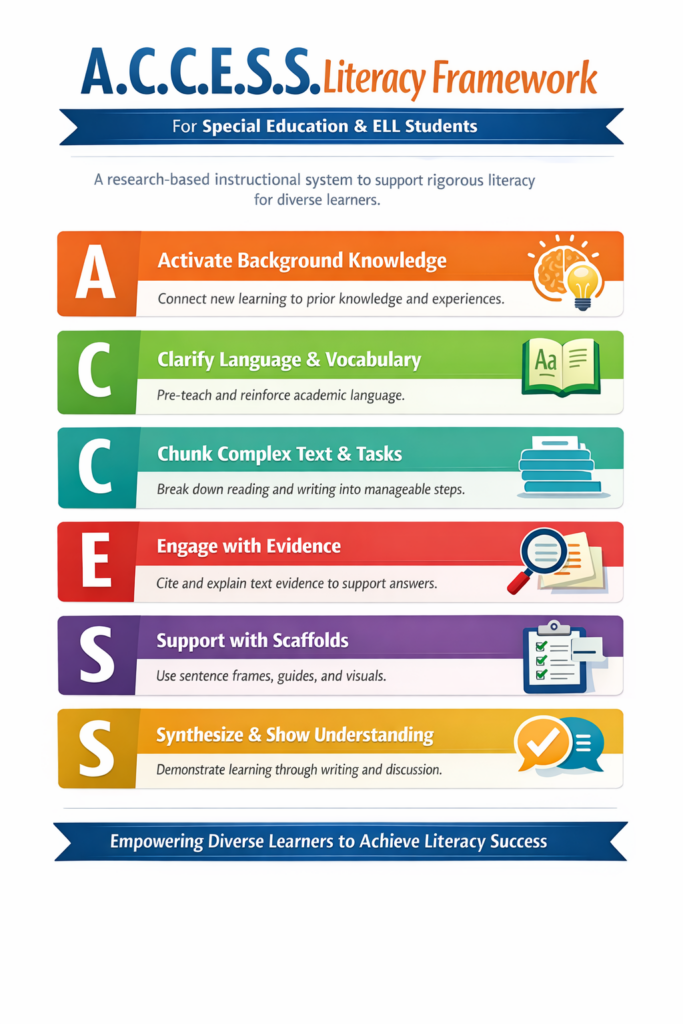
A
Activate Background Knowledge
Before a student can engage with a complex text, they need to locate what they already know that connects to it. For multilingual learners and students with cognitive processing differences, making that connection explicit — rather than assumed — is the difference between engagement and confusion. This stage uses structured discussion, visuals, anchor charts, and home language connections to build the bridge before the reading begins.
C
Clarify Vocabulary
Academic language is one of the most consistent barriers for multilingual learners — and vocabulary gaps affect comprehension even when decoding is strong. This stage doesn’t just define words; it builds the conceptual framework around them. Bilingual glossaries, visual vocabulary supports, cognate instruction for Spanish-speaking students, and semantic mapping all happen here. The goal is that key vocabulary becomes a tool for understanding, not an obstacle to it.
C
Chunk Text and Ideas
Cognitive overload is real. For students with processing differences, working memory limitations, or limited English proficiency, a dense paragraph can feel like a wall. Chunking — breaking text into manageable sections with structured pause points — reduces that overload without reducing the thinking. The student reads less at once but processes more deeply. Comprehension goes up. Frustration goes down.
E
Engage With Evidence
This stage asks students to interact actively with the text — marking, annotating, identifying evidence, and connecting ideas. For multilingual learners, structured annotation protocols in both English and the home language make the thinking visible. For students with learning differences, visual graphic organizers and guided annotation frames provide the scaffolding that makes evidence-based engagement possible rather than performative.
S
Scaffold Written Responses
Writing is where the gap between what a student understands and what they can produce is often most visible — and most heartbreaking. A student with ID or a multilingual learner may comprehend deeply but produce very little in writing because the language formulation demand is overwhelming. Sentence frames, structured response templates, bilingual supports, and staged drafting processes give the student a language frame to hang their thinking on. The thinking is theirs. The scaffold is just the structure.
S
Synthesize Learning
The final stage asks students to do the most cognitively demanding work: moving beyond recall toward genuine comprehension. Synthesis means taking what you’ve read, connecting it to what you knew before, and constructing new understanding. For multilingual learners and students with disabilities, this stage uses structured discussion protocols, bilingual summaries, and visual synthesis tools to support the kind of higher-order thinking that is too often reserved for students who don’t need as much support.
None of these stages lower the thinking level. Not one of them. What they do is remove the specific barriers that prevent diverse learners from reaching that thinking level — and then get out of the way.
⚡ Quick Win — The A.C.C.E.S.S. Equity TestFor each stage of a lesson you’re planning, ask: “Is this strategy opening a door — or widening a gap?” If vocabulary instruction involves students passively copying definitions: widening the gap. If it involves semantic mapping, bilingual connections, and discussion: opening the door. The A.C.C.E.S.S. framework isn’t a checklist. It’s a design philosophy. Every stage should be making complex thinking more reachable — not less.
How Does This Connect to the Research on Equitable Literacy Instruction?
I didn’t build this framework in a vacuum, and I want to name the research that shaped it — because teachers deserve to know their instructional decisions have a foundation beyond one person’s classroom experience.
The work of Darling-Hammond and the Learning Policy Institute on effective professional learning makes clear that equity-focused instruction must be designed around the specific learning profiles of the students being taught — not around a generic average learner who doesn’t actually exist in any real classroom.
The National Academies of Sciences, Engineering, and Medicine (2017) report on educating English learners found consistently that multilingual learners benefit most from instruction that maintains high cognitive demand while providing explicit language support — exactly the design principle behind A.C.C.E.S.S. Lowering the rigor is not a strategy. Building the language scaffold is.
Research from Understood.org on research-based literacy instruction for students with learning disabilities reinforces that explicit, structured literacy instruction with scaffolded supports improves outcomes for students with learning differences — and that these same strategies benefit general education students when implemented consistently.
And the Universal Design for Learning (UDL) framework from CAST — which has shaped my thinking since early in my career — is grounded in exactly this principle: design for the edges and you design better for everyone. The student who needs the most support reveals the instructional design flaws that are affecting every student, just more quietly.
What all of this research points toward is the same thing Darling-Hammond names in her equity mandate: the problem is not the student. The problem is the design. And the solution is better design.
What Does This Mean for New Teachers — and What Would I Tell Myself in Year One?
Honestly? I’d tell myself to stop confusing compassion with lowering the bar.
When you’re new, you care so much about your students that every moment of frustration feels like a signal that you need to make it easier. And sometimes that’s right. But often — more often than I understood early on — the frustration is a signal that the access path is broken, not that the destination is wrong.
I spent my first year making things easier. And my students spent that year not growing the way they were capable of growing. That’s on the instruction, not on them. And it took me longer than it should have to sit with that honestly.
What I know now, and what the A.C.C.E.S.S. framework is built around, is this: when a student can’t access a text, ask why. Not “can they read this?” but “what specifically is blocking their access?” Is it vocabulary? Is it background knowledge? Is it working memory overload from trying to decode and comprehend simultaneously? Is it the language of the task rather than the concept underneath it?
Each of those is a different problem. And each has a different instructional response. The framework gives you a structured way to diagnose the barrier and then design around it — rather than around the student.
💚 Equity Principle — Disrupt the Pattern, Not the StudentIf the same students are consistently struggling in your classroom, the first question to ask is not “what’s wrong with these students?” The first question is “what’s predictable about this outcome — and what in my instructional design is contributing to it?” That question is uncomfortable. It’s also the most important one a teacher can ask. Darling-Hammond didn’t say disrupt the students. She said disrupt the predictability of their outcomes. That disruption starts with instructional design.
The Technology That Supports Access-Based Instruction
The A.C.C.E.S.S. framework isn’t a technology framework — but the right tools make each stage significantly more powerful, especially for multilingual learners and students with disabilities. A few that I use and recommend:
- Newsela — real, relevant texts at multiple reading levels with built-in vocabulary support. Makes the “Chunk” stage dramatically more manageable without reducing content rigor.
- ReadWorks — free, research-based reading passages with comprehension scaffolds. Strong for the “Engage” stage because the evidence-based questions are built in.
- DeepL Translator — significantly more accurate than Google Translate for Spanish-English educational content. Useful for bilingual vocabulary clarification in the “Clarify” stage.
- NaturalReader — text-to-speech for students who need auditory access to complex texts. Keeps cognitive resources available for comprehension rather than decoding.
- Seesaw — multimodal response platform that allows students to demonstrate synthesis through voice recording, drawing, video, or text. Perfect for the “Synthesize” stage for students whose written output doesn’t reflect their actual understanding.
📘 Explore the Full A.C.C.E.S.S. Literacy Framework
If you want to see exactly how I apply each stage in real classrooms — including bilingual supports, visual scaffolds, and the instructional design thinking behind every component — the full framework is available right here on BilingualSPED.→ Explore the A.C.C.E.S.S. Literacy Framework →
And if you want the classroom-ready toolkit version with bilingual anchor charts, vocabulary organizers, and reading scaffolds for SPED and ELL students, I built a full resource bundle for exactly that — grab it on TpT here.
What Does “Disrupting Predictability” Actually Look Like in a Real Classroom?
It looks like a teacher who stops pulling a group of multilingual learners to the back table for a simpler text — and instead teaches them the vocabulary and background knowledge they need to work with the same text as the rest of the class.
It looks like an IEP goal that describes what a student is working toward — not a ceiling on what they’re allowed to attempt.
It looks like a writing assignment where the sentence frame makes the task possible rather than the task being replaced entirely.
It looks like a classroom where the student who needs the most support also gets exposed to the most rigorous thinking — because the teacher has designed the access path, not lowered the destination.
In my experience, the most powerful thing a teacher can do for a student who has been historically underestimated is maintain the expectation and change the approach. Not “I believe in you even though I’ll give you the easy version.” But “I believe in you, and I’m going to design this instruction so you can actually get there.”
That’s equity. Not as a slogan. As a design decision made before the lesson even begins.
⚡ Quick Win — The Predictability AuditLook at your classroom data for the last month. Which students consistently struggled? Which students consistently succeeded? Now look at those groups. Is there a pattern by language background? By disability status? By race? If there is — and in most classrooms there is — that’s not fate. That’s a design problem. And design problems are solvable. Start by asking: “What access barrier could the A.C.C.E.S.S. framework remove for the students in the struggling group?”
What Would I Refine — And What I’m Still Learning
I want to be honest here because I think it matters.
The A.C.C.E.S.S. framework is not a finished product. It’s a living one. And the most important thing I’ve learned in developing it is that equity-focused instructional design is not something you complete. It’s something you keep returning to — with fresh student data, with honest self-reflection, and with the humility to admit when what you thought was a scaffold was actually a substitute.
I’d refine how I teach the “Synthesize” stage for students with significant language processing differences. It’s the hardest stage to scaffold well because synthesis requires the student to hold multiple ideas simultaneously and construct something new from them — and that’s exactly where working memory limitations hit hardest. I’m still developing better tools for that stage, and if you have approaches that work, I genuinely want to hear them in the comments.
I’d also refine how I communicate the framework to teachers who are skeptical — the ones who believe, in their bones, that some students just can’t access grade-level thinking. That belief is the hardest barrier to disrupt. Because it’s not about method. It’s about expectation. And expectation is where equity begins and ends.
Darling-Hammond was right. The work is long. And it’s worth every bit of it.
3 FAQs About Equity-Based Literacy Instruction and the A.C.C.E.S.S. Framework
❓ Isn’t the A.C.C.E.S.S. framework just good teaching — why does it need to specifically address multilingual learners and students with disabilities?
This question comes up often, and I take it seriously. Yes — the strategies in the A.C.C.E.S.S. framework are grounded in broadly effective instructional principles. And the research consistently confirms that what works for multilingual learners and students with disabilities works better for everyone. But the framework is explicitly designed for these populations because they are the ones most consistently denied access to rigorous literacy instruction — not because of their inability to engage with it, but because of instructional design choices that place barriers in their path. Good teaching for everyone starts with intentional design for those who face the most barriers. That’s not a special case. That’s the whole principle.
❓ How do I use the A.C.C.E.S.S. framework if I’m a general education teacher with a few multilingual learners or students with IEPs in my class?
The framework works in exactly that context — and it doesn’t require you to teach two separate lessons. The six stages are designed to be embedded into standard lesson planning. Activating background knowledge, clarifying vocabulary, and chunking instruction benefit every student. The bilingual supports and specific scaffolds for students with disabilities can be layered in as needed without derailing the flow of instruction for the rest of the class. In practice, I’ve found that teachers who implement A.C.C.E.S.S. consistently report that it simplifies their differentiation planning rather than adding to it — because the framework builds the scaffolding into the original lesson design rather than treating it as an add-on.
❓ How does the A.C.C.E.S.S. framework connect to IDEA requirements for students with disabilities?
IDEA requires that students with disabilities have access to the general education curriculum — not a modified-down alternative, but the actual grade-level curriculum with appropriate supports. The A.C.C.E.S.S. framework is designed precisely to provide those supports in a way that makes general curriculum access genuinely possible. Each stage addresses a specific barrier that commonly prevents students with learning differences from engaging with grade-level content — and does so through scaffolding rather than substitution. For IEP teams designing instructional supports, the framework provides a research-based structure for meeting the “access to general curriculum” requirement in a way that goes beyond accommodation and toward genuine instructional design.
References
- Darling-Hammond, L., Hyler, M. E., & Gardner, M. (2017). Effective Teacher Professional Development. Learning Policy Institute. learningpolicyinstitute.org
- National Academies of Sciences, Engineering, and Medicine. (2017). Promoting the Educational Success of Children and Youth Learning English: Promising Futures. The National Academies Press. nap.edu
- CAST. Universal Design for Learning Guidelines. cast.org
- Understood.org. Research-Based Literacy Instruction for Students With Learning Disabilities. understood.org
- Darling-Hammond, L. (2010). The Flat World and Education: How America’s Commitment to Equity Will Determine Our Future. Teachers College Press.
💜 Get Equity-Focused Teaching Resources Delivered to Your Inbox
Join the BilingualSPED community — practical, research-grounded strategies for teachers who believe every student deserves access to rigorous thinking. The A.C.C.E.S.S. framework, IEP tools, classroom scaffolds, freebies, and honest conversations about what equity really looks like in real classrooms.
👉 Yes — sign me up for the BilingualSPED newsletter →
📘 Ready to Use the A.C.C.E.S.S. Framework in Your Classroom?
The full framework is available on BilingualSPED — and the classroom-ready bilingual anchor charts, vocabulary scaffolds, and reading and writing supports that bring each stage to life are on TpT. High expectations. Real pathways. For every student.→ Explore the Full A.C.C.E.S.S. Framework | → Grab the Classroom Toolkit on TpT
💬 Reflection Question
Think about the last time you modified a task for a student who was struggling. Was that modification a scaffold — keeping the destination the same and building a better path — or was it a simplification that quietly changed what the student was being asked to think about? And if it was the latter: what would the scaffolded version of that same task have looked like?
I’d genuinely love to hear your thinking in the comments. This is the conversation that changes practice — and practice is where equity actually lives.
📌 You Might Also Like
- The A.C.C.E.S.S. Literacy Framework — Full Overview
- Intellectual Disability (ID): High Expectations, Task Analysis, and What Real Instruction Looks Like
- Speech and Language Impairment: Articulation, Stuttering, and Language Processing in Bilingual Classrooms
- ELL Students in Special Education: Avoiding Misidentification and Building Real Equitable Support
- How to Write IEP Goals That Actually Maintain High Expectations for Every Student