Emotional Disturbance (ED) is an IDEA disability category covering students whose emotional or behavioral functioning significantly impacts their educational performance — including conditions like anxiety disorders, depression, schizophrenia, and conduct disorders. It’s the most misunderstood and most under-served category in special education, and students who carry this label need structured support, consistent relationship-building, and data-driven behavior intervention — not just consequences.

Let me tell you about the student nobody wanted in their class.
You’ve met this kid. Maybe you have one right now. The one whose name gets said in a certain tone in the hallway. The one who’s been to the office so many times that the secretary knows their lunch order. The one other teachers warn you about in August, before school even starts.
And then you meet them. And they’re eleven years old. And they’re scared. And they’re exhausted from fighting a brain that won’t cooperate in a system that keeps responding to their dysregulation with more punishment.
That kid? They often have Emotional Disturbance as their IDEA classification. And honestly, this category — more than any other in my career — is the one that forces you to examine your own biases, your patience, your understanding of what behavior actually is and what it’s trying to say.
Right from the start — before we dig into strategy — I want to mention something that changed how I track and respond to behavior in my classroom. I created an ABC Behavior Data Chart for special education on TpT that helps you document the Antecedent, Behavior, and Consequence in a structured, IEP-aligned format. Because when you’re working with ED students, data isn’t optional. It’s the thing that saves the student — and sometimes the teacher — from a broken system that defaults to exclusion when what’s needed is information.
What Is Emotional Disturbance Under IDEA? (And Why Is the Definition So Contested?)
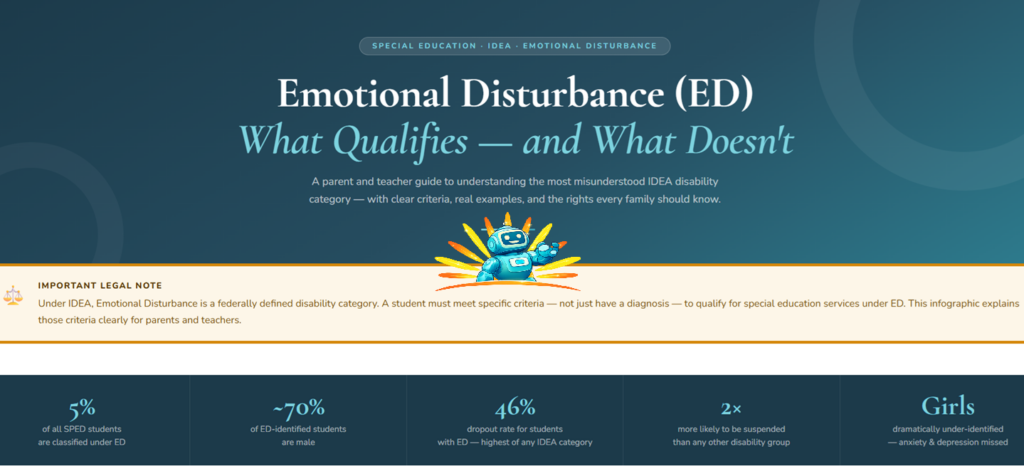
Under IDEA 34 CFR §300.8(c)(4), Emotional Disturbance is defined as a condition exhibiting one or more of the following characteristics over a long period of time and to a marked degree that adversely affects educational performance:
- An inability to learn that cannot be explained by intellectual, sensory, or health factors
- An inability to build or maintain satisfactory interpersonal relationships with peers and teachers
- Inappropriate types of behavior or feelings under normal circumstances
- A general pervasive mood of unhappiness or depression
- A tendency to develop physical symptoms or fears associated with personal or school problems
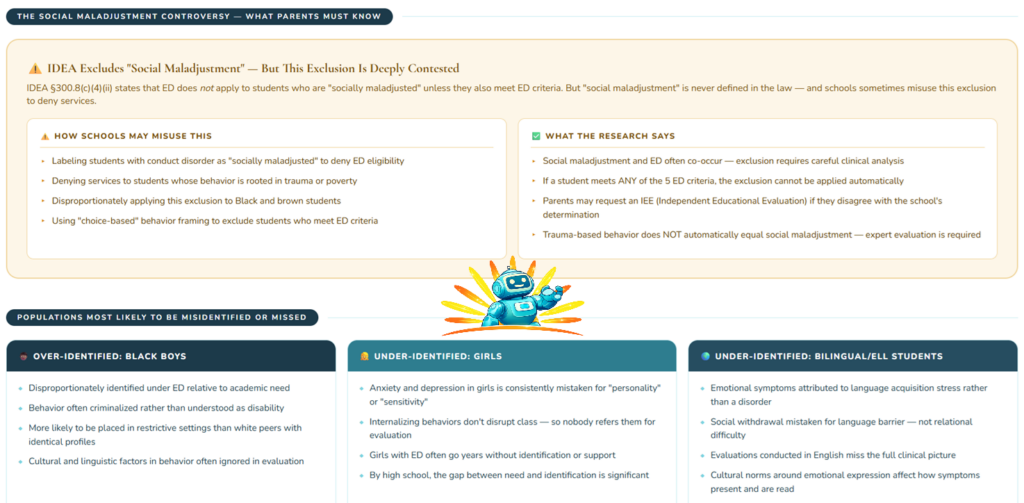
The definition also specifies that ED includes schizophrenia, but does not apply to students who are “socially maladjusted” unless they also meet the above criteria.
That last clause — the social maladjustment exclusion — is one of the most controversial in all of special education law. Because “social maladjustment” has never been clearly defined in IDEA, and schools have used it to deny services to students with conduct disorders, oppositional defiant disorder, and students from marginalized communities whose behavior is rooted in trauma — not disability. Which is, frankly, an injustice that the field is still wrestling with.
⚡ Quick Win — Understanding the DefinitionThree words in the ED definition carry enormous weight: “long period of time,” “marked degree,” and “adversely affects educational performance.” A student having a rough month after a family crisis doesn’t meet the criteria. The emotional or behavioral challenges have to be persistent, significant, and directly connected to how the student learns. Keep all three in mind during any ED eligibility conversation.
Who Actually Gets Identified Under ED — and Who Gets Missed?
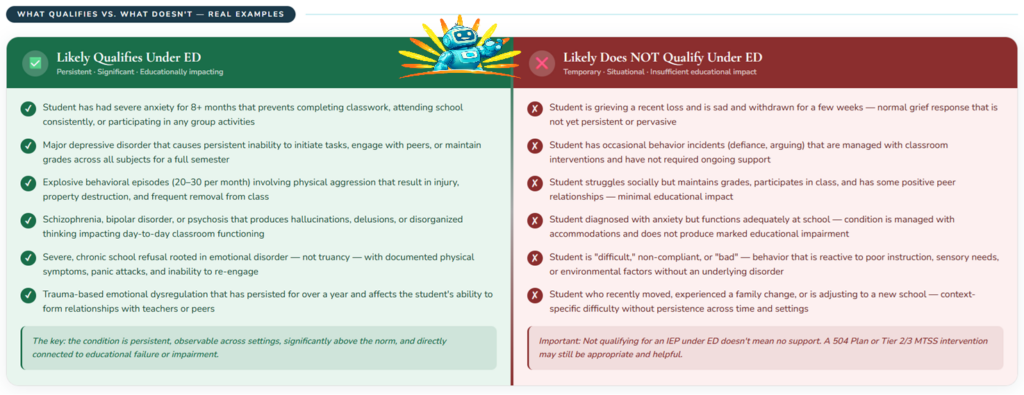
Here’s the data that should stop us in our tracks.
According to the National Center for Education Statistics (2022), students identified with Emotional Disturbance represent approximately 5% of all students receiving special education services — but they account for a disproportionate share of suspensions, expulsions, and placements in more restrictive educational settings.
And the racial disparities are staggering. Black students are significantly over-identified under ED compared to their white peers, while other groups — particularly girls of all backgrounds and students from Latino and Asian communities — are dramatically under-identified. The National Center for Learning Disabilities has documented that emotional and behavioral challenges in girls are consistently misread as personality traits rather than disability characteristics.
What this means practically: if you’re a new teacher looking at an ED caseload and every student is a Black or brown boy, that’s not an accident. That’s a systemic pattern worth naming. And if you’re not seeing girls on your caseload with ED, look harder. Anxiety, depression, and internalized emotional disturbance in girls often gets missed entirely because it doesn’t disrupt the classroom.
💔 Hard TruthStudents with Emotional Disturbance are the most likely of any disability group to drop out of high school, to be arrested within a few years of leaving school, and to have the worst post-secondary outcomes of any IDEA category. That’s not because they’re unfixable. It’s because the system consistently responds to their symptoms — behavior — instead of their underlying needs. We can do better than this.
What Does ED Actually Look Like in Your Classroom? (Because It’s Not Just Throwing Chairs)
I want to push back on the most common mental image people have of an ED student — because it’s doing real damage to how these students get identified and supported.
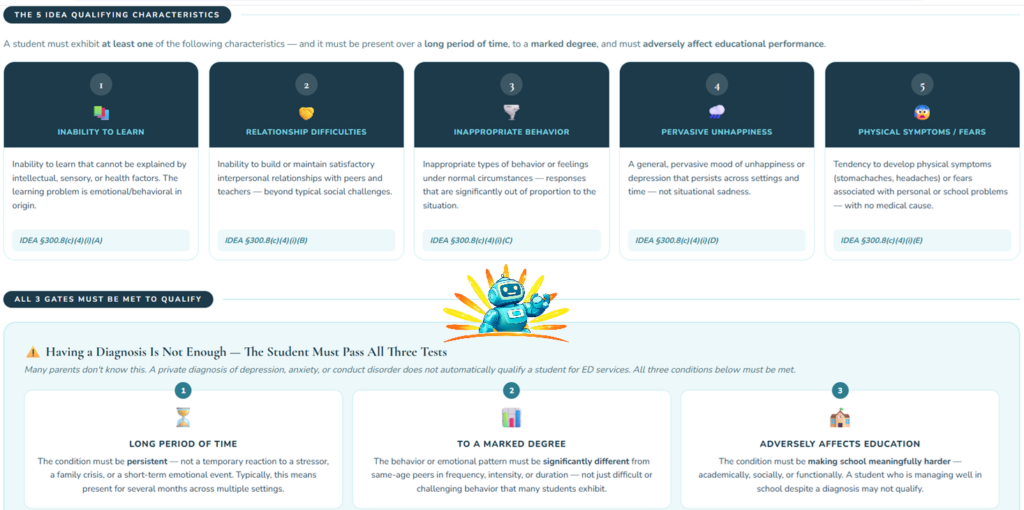
Yes. Sometimes ED looks like explosive behavior, physical aggression, persistent defiance. That presentation gets attention fast. But ED also looks like:
- The student who puts their head down every day and refuses to engage — not because they’re lazy, but because depression is a genuine disability that makes initiating tasks feel like moving through concrete
- The student with crippling anxiety who can’t speak in class, can’t turn in work they’ve completed, can’t ask for help even when they’re drowning
- The student who cries at transitions, who shuts down after perceived criticism, who has panic attacks in the hallway that look like “overreacting”
- The student who has learned that being sent out of the classroom is the only way they know to escape an environment that feels unbearable
These are all ED presentations. And they all require different interventions. Which is why one of the most important tools you can have is a strong behavior data system that tracks what’s actually happening before, during, and after each incident — not just whether it happened.
I use my ABC Behavior Data Chart for exactly this purpose. Antecedent — what happened right before? Behavior — what did it look like specifically? Consequence — what happened after, and did that consequence increase or decrease the behavior over time? When you have three weeks of ABC data, patterns emerge that you genuinely cannot see in the moment. And those patterns tell you what the behavior is actually communicating.
What Are the Instructional Challenges — and How Do You Actually Teach Through Them?
Look, I’m not going to pretend that teaching a student with significant emotional disturbance is easy. It’s not. There are days where the entire lesson you planned gets set aside because a student arrives in crisis and that’s the only thing that matters right now. That’s the reality.
But here’s what I’ve learned after years in this work: the relationship IS the intervention. I’ve seen evidence-based behavior plans fail because the teacher implementing them hadn’t built trust with the student. And I’ve seen simple, consistent warmth and structure do more than any formal plan ever could when the relationship was genuinely strong.
Strategy 1 — Predictable Routines and Visual Structure
Students with ED often come from environments where nothing is predictable. The classroom may be the most regulated environment in their life. Which means that predictability — knowing exactly what happens next, in what order, with what expectations — is not just helpful. It’s genuinely therapeutic.
Visual daily schedules. Posted expectations in clear, non-punitive language. Transition warnings. The same opening routine every single day. These aren’t “nice extras.” They’re the architecture of safety for a student whose nervous system has been in survival mode for a long time.
And for bilingual students with ED — post those schedules in both languages. Check-in charts, emotion scales, and visual rules in the home language reduce the cognitive load at exactly the moment when cognitive resources are most depleted. I’ve seen a Spanish-English emotion chart do more for a dysregulated student than ten minutes of verbal de-escalation in English only.
⚡ Quick Win — The 2×10 StrategyFor two weeks, spend two minutes per day having a non-academic, purely personal conversation with a challenging student. Talk about anything they care about. Don’t mention behavior or work. Research from Responsive Classroom suggests this simple investment builds enough relational trust to reduce behavioral incidents significantly. I’ve tried it. It works. It’s annoyingly simple and surprisingly effective.
Strategy 2 — Proactive Sensory Accommodations
This is the piece that gets left out of most ED conversations and it shouldn’t be. A significant number of students with Emotional Disturbance have sensory processing differences that contribute to — or trigger — their behavioral dysregulation. The fluorescent lights. The noise of 30 people moving through a small space. The unpredictability of group work. These aren’t just annoying. For some students, they’re actively dysregulating.
Proactive sensory supports for ED students:
- A calm-down corner — not a punishment space. A proactive regulation space with visual choices: a squeeze tool, a visual breathing card, an emotion chart, a brief task card (“what do I need right now?”). The student needs to practice using it before crisis — not discover it for the first time during one.
- Flexible seating — the option to stand, sit on the floor, use a wobble cushion. Not every student can regulate their body in a hard chair all day.
- Sensory breaks built into the schedule — not as a reward for good behavior, but as a proactive nervous system reset. A 3-minute walk, some heavy work, a quiet corner with headphones. Built in. Predictable. Not earned.
- Reduced visual and auditory stimulation during high-demand periods — clutter-free desk, noise-reducing headphones, reduced group size when possible
Strategy 3 — Social Stories and Emotional Literacy Instruction
Here’s something I wish more teachers knew: many students with Emotional Disturbance have genuinely limited emotional vocabulary. Not because they don’t feel things — they feel everything, intensely — but because nobody has ever taught them to name and understand what they’re feeling. And you can’t regulate a feeling you can’t name.
Social stories work for ED students the same way they work for students with ASD — by making implicit social and emotional rules explicit. A social story about what to do when you feel your body getting angry. A social story about how to ask for a break instead of walking out. A story about what it looks like when a friend is joking versus being mean.
Here’s a sample you can adapt:
“Sometimes I feel angry at school. My face feels hot and my chest feels tight. When this happens, I can take three deep breaths. I can ask my teacher for a break. I can go to the calm corner and choose something that helps. Getting angry is not bad. What I do with the anger is what matters. I am learning to handle big feelings.”
Translate into the student’s home language. Keep a laminated copy in their folder. Review it together during regulated moments — not after an incident. The research on social stories and emotional regulation in students with behavioral challenges is consistently supportive. It’s not magic. But it’s a starting point that costs nothing and can open real conversations.
Strategy 4 — Data-Driven Behavior Support
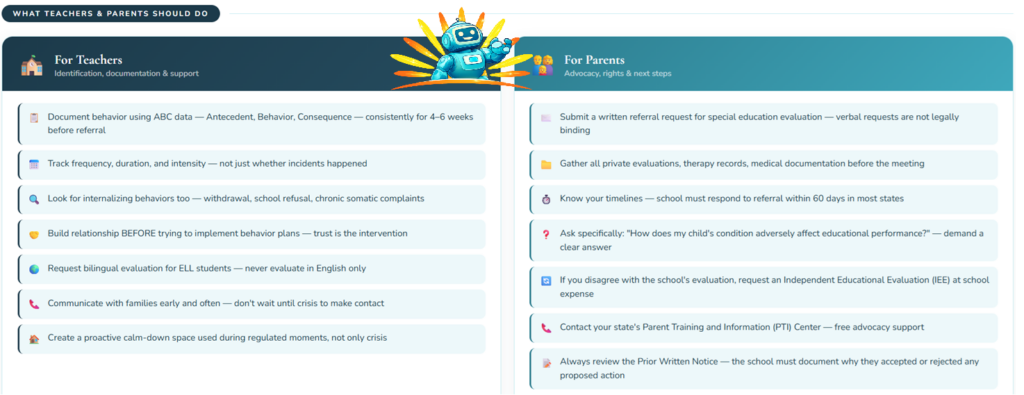
I cannot stress this enough. For ED students, anecdotal descriptions of behavior are not enough. “He was difficult today” tells you nothing. “He had a verbal outburst when asked to transition from math to reading, lasting approximately 4 minutes, after which he refused to re-engage for 15 minutes” — that tells you something you can actually work with.
The ABC framework — Antecedent, Behavior, Consequence — is the foundation of any meaningful behavior intervention. And tracking it consistently over time is what moves you from reacting to preventing.
My ABC Behavior Data Chart was designed for exactly this — with SPED teachers in mind, IEP progress monitoring built in, and a format that makes it easy to collect data across multiple students without spending your entire prep period on paperwork. If you want the ready-made version of what I’m describing, that’s where to start.
Strategy 5 — Technology Tools That Support Emotional Regulation
- Zones of Regulation app — color-coded emotional regulation framework, widely used in SPED settings, with tools for identifying and shifting emotional states
- Headspace for Educators — mindfulness and regulation practices, free for educators, surprisingly accessible for upper elementary and secondary students
- ClassDojo — Big Life Journal — growth mindset and emotional resilience content for K–8 students
- Calm for Schools — structured breathing exercises and body scan activities that work as regulation tools for students in crisis or pre-crisis
- Mood Meter — based on Yale Center for Emotional Intelligence research, helps students map and name their emotional states with increasing precision
🛠️ Track Behavior the Right Way — From Day One
If you’re working with ED students and you don’t have a solid behavior data system, you’re flying blind. I built an ABC Behavior Data Chart specifically for SPED teachers — IEP-aligned, easy to use across a caseload, and designed to help you see patterns before they become crises.→ Grab the ABC Behavior Data Chart on TpT
What Would I Refine? (A Genuinely Honest Teacher Reflection)
I’d build the relationship before I tried to build the behavior plan. Every single time.
Early in my career, I approached ED students with a clipboard. Data first. Systems first. Plan first. And I wonder — looking back — how many of those students felt like a problem to be managed rather than a person to be known. Because there’s a version of behavior support that’s warm, curious, and human. And there’s a version that’s clinical and disconnected. And I’ve done both.
The students who made the most progress were the ones where I led with curiosity. What do you love? What makes you feel safe? What does your body feel like right before things get hard? Those conversations — before the data, before the plan — are what make everything else work.
I also would have sent the social story home on day one. Not after the first crisis. Day one. So the family could read it too, reinforce the language, and feel like a partner in the process instead of a recipient of bad news calls.
And I would have used my ABC tracking system from week one — not after things escalated. Because by the time you start tracking reactively, you’ve already missed weeks of pattern data that could have changed your approach entirely.
3 FAQs About Emotional Disturbance Under IDEA
❓ What’s the difference between Emotional Disturbance and Social Maladjustment under IDEA?
This is genuinely one of the most contested questions in special education law — and the honest answer is that nobody fully agrees. IDEA explicitly excludes “socially maladjusted” students from ED eligibility unless they also meet the ED criteria. But IDEA never defines social maladjustment. In practice, some schools use this exclusion to deny services to students with conduct disorders, substance use issues, or behavioral histories rooted in trauma — arguing that these are “choices” rather than disabilities. Most experts argue this interpretation is both legally incorrect and ethically harmful. If a student’s behavior meets the ED criteria — present for a long period of time, to a marked degree, adversely affecting educational performance — they should be considered for ED eligibility regardless of the behavioral pattern’s origin.
❓ Can a student with trauma qualify for ED under IDEA?
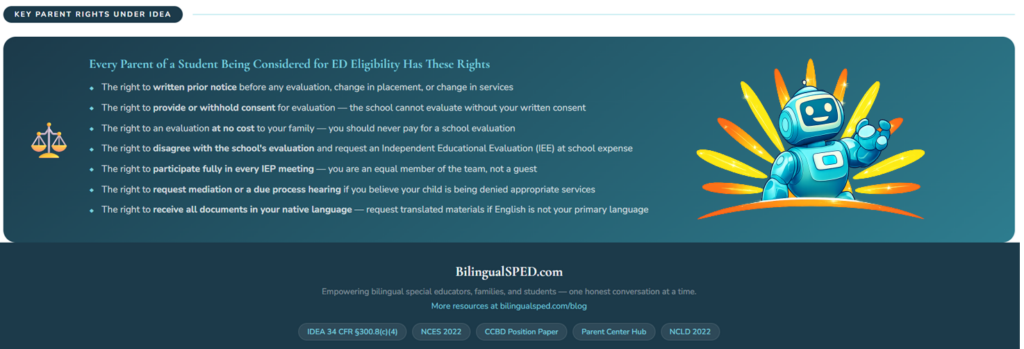
Yes. Trauma is not an exclusionary factor under ED. If a student has experienced significant trauma and the resulting emotional and behavioral responses meet the IDEA criteria — persistent, significant, educationally impacting — they may qualify. The distinction is whether the condition creates educational impact requiring specialized instruction. Many students with trauma histories do qualify for ED, and trauma-informed practices should be central to their IEP and behavioral support. What the school cannot do is deny eligibility by saying “this is trauma, not a disability” — because trauma-based conditions can absolutely constitute a disability under IDEA’s definition.
❓ Do students with Emotional Disturbance always need a more restrictive placement?
No — and the law is clear on this. IDEA’s Least Restrictive Environment (LRE) requirement applies to ED students the same as every other disability category. The default is always inclusion in the general education environment with supplementary aids and services. A more restrictive placement — a self-contained classroom, a therapeutic day school — should only happen when the IEP team determines that inclusion with supports cannot meet the student’s needs. In practice, ED students are removed from general education at much higher rates than other disability groups, often without the rigorous LRE analysis the law requires. New teachers should know this — and should advocate for the least restrictive setting that genuinely meets the student’s needs.
References
- U.S. Department of Education. IDEA Regulations, 34 CFR §300.8(c)(4): Emotional Disturbance. sites.ed.gov/idea
- National Center for Education Statistics. (2022). Students with Disabilities Served Under IDEA. nces.ed.gov
- National Center for Learning Disabilities. (2022). State of Learning Disabilities: Understanding the 1 in 5. ncld.org
- Responsive Classroom. The Power of Morning Meeting and Relationship-Building Strategies. responsiveclassroom.org
- Council for Children with Behavioral Disorders. Emotional or Behavioral Disorders: Position Paper. ccbd.net
💜 Get More Real-Talk Special Education Resources in Your Inbox
Join the BilingualSPED community — practical, research-backed strategies for bilingual special educators who are doing the real work every single day. IEP frameworks, behavior tools, freebies, and honest coaching delivered straight to you.
📊 Don’t Track Behavior Without This
The ABC Behavior Data Chart I use with every ED student on my caseload — IEP progress monitoring built in, designed for real SPED classrooms, and ready to use from day one. Stop reacting. Start seeing patterns.→ Get the ABC Behavior Data Chart on TpT
💬 Reflection Question
Think about the student on your caseload — or in your building — whose behavior you find most challenging right now. If that behavior is communication, what do you think it’s trying to say? And what’s one thing you could change about the environment or your response that might shift things — even slightly — this week?
Leave your answer in the comments. I read every single one — and this is the kind of conversation that makes all of us better at this work.
📌 You Might Also Like
- Other Health Impairment (OHI) & ADHD: What Teachers and Families Need to Know
- Autism Spectrum Disorder (ASD): Medical Diagnosis vs. IDEA Eligibility — The Difference That Matters
- How to Write IEP Goals That Actually Work for Bilingual Special Education Students
- Specific Learning Disabilities: A Teacher’s Real Guide to Dyslexia, Dyscalculia & Dysgraphia
- Visual Supports and Anchor Charts That Work for SPED and ELL Classrooms