
When you first begin working with students who have significant cognitive abilities or those navigating the complexities of a new language, you quickly realize that the biggest hurdle isn’t the content itself—it’s the “how” of learning. In a typical lesson, we often focus on the finish line, but for our neurodiverse learners, the path to get there is often fog-filled. They might start a task without a plan, get stuck in the middle without a way out, or finish a worksheet without actually knowing if they learned anything at all.
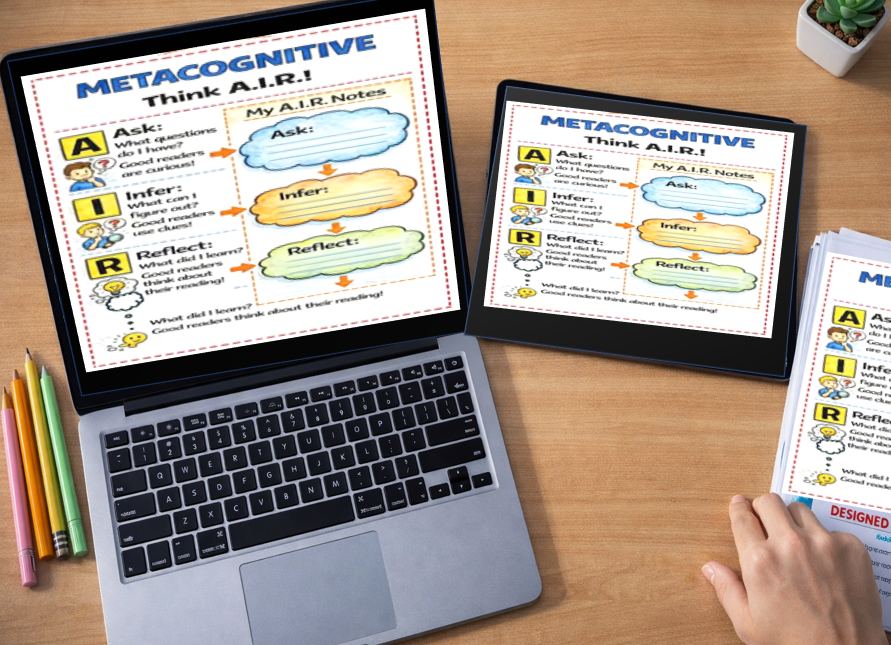
How I Teach Metacognition Strategy | Problem Solving Steps
As a mentor, I’ve found that the most transformative tool we can give them is the ability to look inward. We have to teach them to think about their thinking. In my classroom, we’ve shifted from just teaching “the work” to teaching the Metacognition Strategy. It’s the difference between a student who waits for you to tell them they made a mistake and a student who catches it themselves.
The Architecture of a Thinking Routine
For a student with an IEP or an ELL student, “metacognition” is a heavy, abstract word. To make it functional, we have to turn it into a concrete, repeatable cycle. I recently introduced the Metacognition Strategy Toolkit into our daily routine, and it has changed the way we approach every block—from English to Financial Literacy.
Instead of letting students dive blindly into a task, we use visual cues and simple task-analysis steps to ground them. We break the learning process into three distinct, manageable phases:
- The Plan: What is my goal? What tools do I need?
- The Monitor: Am I making sense of this? Do I need to slow down?
- The Reflect: What worked for me? What will I do differently next time?
Observations from the “Do Now” and Practice
During a recent lesson on digital literacy—specifically, navigating a complex online bank statement—I watched how this structure supported a student who usually shuts down when a task feels too large.
In the “Plan” phase, instead of staring at the screen with an empty gaze, the student looked at our metacognition anchor chart. They pulled out their highlighter and a word bank. I watched them whisper to themselves, “I need to find the balance first.” They were setting a goal before they even touched the mouse.
What surprised me most was what happened during the “Monitor” phase of our Partner Work. I overheard two students discussing a mistake one of them had made while calculating interest. In the past, this might have led to frustration. Instead, one student said, “Wait, check your thinking. Does that number make sense?” They were using the visual cues from the toolkit to catch their own errors in real-time. Their independence didn’t come from knowing the right answer immediately; it came from having a strategy to find it.
Scaffolding for Executive Functioning
For students with significant cognitive disabilities, executive functioning—the ability to organize and execute a plan—is often a point of “productive struggle.” By providing student-friendly visuals and step-by-step task analysis, we give them a mental skeleton to hang their thoughts on.
In our Individual Work phase, the confidence in the room was palpable. I saw a student who frequently asks “Is this right?” every two minutes sitting quietly, checking their own work against the rubric. When I finally walked by, they didn’t ask for my approval. They pointed to their reflection sheet and said, “I used the word bank, and it helped me find the right words.” They weren’t just showing me the work; they were showing me their awareness of their own success.
Why Metacognition is a Workforce Skill
We are always looking toward the horizon—preparing these students for the workforce. In any job, whether it’s in a warehouse or an office, the ability to self-monitor is the key to accountability. A supervisor isn’t always going to be there to “check the thinking.” By teaching our students to plan, monitor, and reflect now, we are giving them the tools to be independent adults.
Teachers love this Metacognition Strategy | Problem Solving Steps toolkit because it moves beyond “just another poster.” It becomes a thinking routine that students actually use across all subjects. It improves focus, builds self-awareness, and makes learning “stick” because the student is the one in the driver’s seat of their own brain.
As you mentor your students through their lessons this week, watch for that quiet moment when a student pauses, looks at the chart, and corrects themselves before you even reach their desk. That is the moment they stop being a student of your teaching and start being a student of their own learning.
When we stop providing the answers and start providing the “thinking tools,” how does the shift in a student’s self-awareness change the way they handle a task they previously labeled as “too hard”?
References & Further Reading
The following peer-reviewed and practitioner resources informed the strategies described in this article:
1. National Reading Panel (2000). Teaching Children to Read: An Evidence-Based Assessment of the Scientific Research Literature on Reading and Its Implications for Reading Instruction. National Institute of Child Health and Human Development. https://www.nichd.nih.gov/publications/pubs/nrp
2. What Works Clearinghouse (2010). Improving Reading Comprehension in Kindergarten Through 3rd Grade. U.S. Department of Education, Institute of Education Sciences. https://ies.ed.gov/ncee/wwc/
3. Graham, S., & Hebert, M. (2011). Writing to Read: A Meta-Analysis of the Impact of Writing and Writing Instruction on Reading. Harvard Educational Review, 81(4), 710–744. https://doi.org/10.17763/haer.81.4.t2k0m13756113566
4. Boardman, A. G., et al. (2008). Reading Comprehension Instruction for Students with Learning Disabilities. Learning Disabilities Research & Practice, 23(2), 74–86. https://doi.org/10.1111/j.1540-5826.2008.00265.x
5. Calderon, M., Slavin, R., & Sanchez, M. (2011). Effective Instruction for English Learners. The Future of Children, 21(1), 103–127. Princeton University. https://futureofchildren.princeton.edu
Frequently Asked Questions (FAQs)
Q1: What is the best summarizing strategy for students with learning disabilities?
The most effective summarizing strategy for students with learning disabilities is one that makes the thinking process explicit, visual, and repeatable. The 5W’s and 1H framework (Who, What, When, Where, Why, How) meets all three criteria. By pairing this framework with a color-coded highlighting routine and a structured graphic organizer, teachers reduce cognitive load and give students a concrete process for filtering essential information from a text. Research consistently supports the use of explicit strategy instruction with visual scaffolds for students with IEPs, particularly for reading comprehension and written expression goals.
Q2: How do you teach summarizing to English Language Learners (ELLs) in a bilingual special education setting?
Teaching summarizing to ELLs in a bilingual or dual-language special education setting requires separating the language demand from the comprehension strategy. The 5W’s framework is effective because it provides structured question stems that can be displayed bilingually—students process comprehension in their strongest language, then bridge to academic English writing using sentence frames. Bilingual anchor charts, visual supports, and partner discussion in the home language before writing in English are all evidence-aligned practices that support both language acquisition and reading comprehension simultaneously.
Q3: How can I connect summarizing instruction to IEP goals and transition planning?
Summarizing can be directly embedded into IEP goals across multiple domains. For reading comprehension goals, target the student’s ability to identify the main idea and two to three supporting details across informational and literary texts at their instructional reading level. For written expression goals, measure summary length, accuracy, and use of the student’s own words. For transition and communication goals, frame summarizing as a workplace skill—the ability to give a clear, concise oral or written update is directly applicable to employment and independent living contexts. Progress monitoring is straightforward: collect written summaries regularly and measure against a rubric tied to the 5W’s framework.
The Moment That Matters
As you guide your students through their reading blocks this week, watch for a particular shift: the moment a student stops trying to tell you everything—and starts telling you what matters. That is the moment they move from passive repeater to active, purposeful communicator. It is not just a literacy milestone. It is the beginning of self-advocacy, critical thinking, and independence.
When you provide a student with the 5W’s as a visual filter, you are not just improving their reading comprehension score. You are teaching them how to think.