
.
AI does not create easier work. It creates multiple pathways to the same rigorous learning goal.
– A.C.C.E.S.S. Literacy Framework
.
Here is your complete, fully functional A.C.C.E.S.S. AI Lesson Scaffold & Assessment Generator.
This application builds on our core philosophy and integrates our precise A.C.C.E.S.S. Literacy Framework, WIDA level differentiations, Home Language supports, dynamic criteria/scaffold generation, and local storage state management into a modern, accessible UI.
.
.
1. Interactive Lesson Scaffold Generator Tool
.
A.C.C.E.S.S. AI Lesson Scaffold & Assessment Generator
Instructional Plan Package
Ready to Build Differentiated Content
Complete your lesson goals and student demographics on the left, then click “Generate Lesson Package” to create a complete 15-section UDL instructional suite.
.
2. Quick-Reference Scaffolding Framework
.
When reviewing or planning lesson modifications, use this reference matrix to verify that all necessary support structures are in place:
.
Scaffold Reference Breakdown
.
| Output Category | 🌱 Newcomer / Level 1 | 🌿 Developing / Level 2–3 | 🌳 Expanding / Level 4+ |
| Vocabulary | Picture dictionaries, dual-language flashcards, gestural anchors. | Categorized word banks, visual glossaries, cognate lists. | Concept maps, morphologic breakdowns (prefixes/suffixes). |
| Sentence Frames | Single-word completion frames (“This is _____.”). | Two-part structured starters (“I selected _____ because _____.”). | Signal word prompts (“In contrast to _____ , I argue _____.”). |
| Visual Supports | Concrete objects (realia), labeled diagrams, color-coded steps. | Annotated flowcharts, visual schedules, graphic models. | Independent graphic organizers, visual rubrics. |
| Graphic Organizers | Pre-filled visual maps, matching grids, drag-and-drop layouts. | Guided T-charts, Venn diagrams with word banks. | Blank multi-step planning webs, main idea matrices. |
| Small-Group Model | Direct modeling (I Do / We Do), manipulative-based guided practice. | Peer pairing (heterogeneous grouping), structured turn-and-talks. | Independent practice groups with peer-editing protocol. |
| Extensions | Add labels or simple drawings to extend work. | Use 2 new vocabulary words in a summary sentence. | Create a digital audio/visual summary explaining reasons. |
.
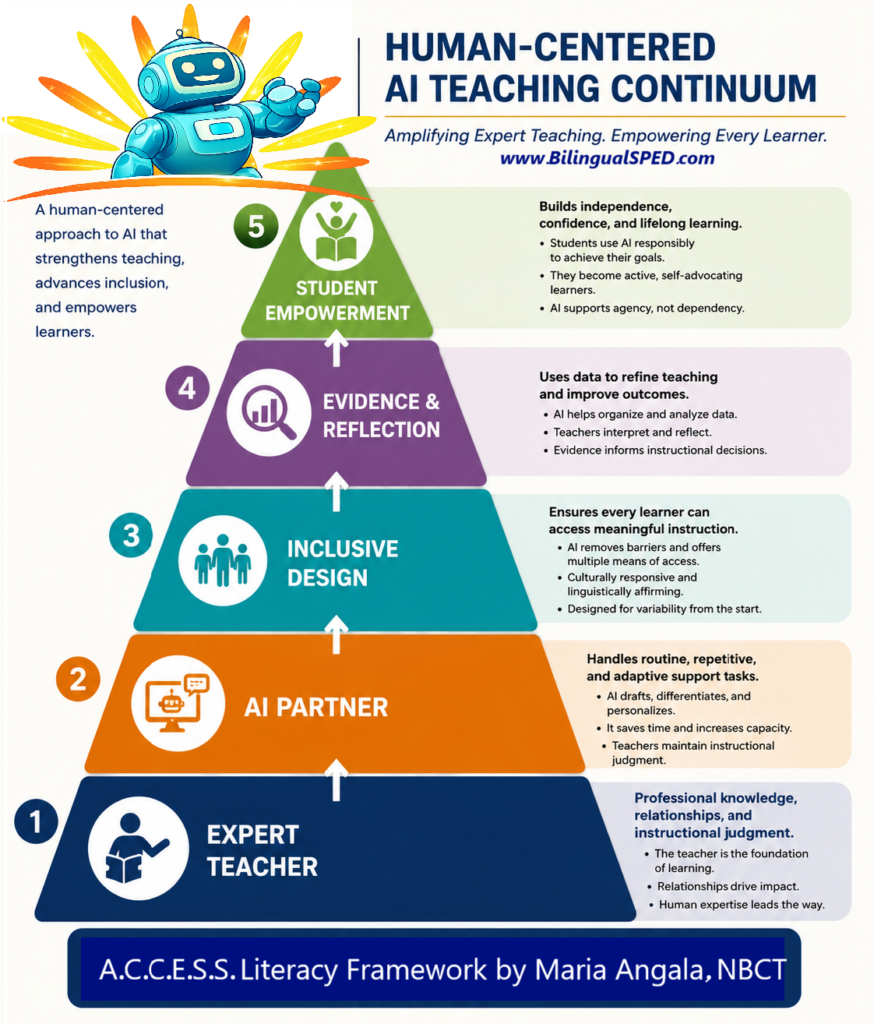
Alignment with the Human-Centered AI Teaching Continuum
.
This tool exemplifies the Human-Centered AI Teaching Continuum by placing the teacher in control of instructional decisions while AI reduces the cognitive load of adapting materials.
.
- Expert Teacher: Defines the assignment, success criteria, and instructional goals.
- AI Partner: Converts academic language into proficiency-appropriate, emoji-supported rubric descriptors, generates multilingual reflections, and recommends scaffolds.
- Inclusive Design: Produces accessible rubrics tailored to WIDA proficiency levels and students’ home languages without lowering academic expectations.
- Evidence & Reflection: Includes student self-assessment, teacher notes, and progress-monitoring prompts that can inform instructional adjustments.
- Student Empowerment: Gives learners clear, understandable success criteria and opportunities to reflect in their strongest language, increasing independence and ownership of learning.
- .
Integrated into the A.C.C.E.S.S. Literacy Framework, this generator becomes more than a rubric tool—it would function as an AI-assisted accessibility engine that helps ensure every multilingual learner can understand what quality work looks like while maintaining rigorous grade-level expectations.
.
You are the calm in their storm. Keep showing up, keep tracking the data, and keep respecting their dignity. You’ve got this.
.
Join our FUNSHINE Community to receive our latest free A.C.C.E.S.S. AI tools and other updates:
.