
Real talk from a special educator who’s been in the trenches
I remember the exact moment I knew something had to change.
It was a Tuesday in February—which, if you teach, you already know is the longest month of the school year—and I was sitting in my car in the parking lot for 15 minutes before walking in. Not because I was early. Because I couldn’t make myself get out.
That’s burnout. Not the cute, Instagram-aesthetic “I need a spa day” kind. The real, bone-tired, what-am-I-even-doing-here kind. And if you’re reading this, chances are you’ve been in that parking lot too.
Here’s the thing: nobody becomes a special education teacher for the paycheck. We do it because we genuinely love these kids. But loving your job and being destroyed by your job can happen at the same time. And a lot of us confuse the two.
So this post is my coaching session for you. Not a listicle. Not a “just practice self-care!” pep talk. Real strategies—the ones that actually worked for me and the teachers I’ve mentored. Let’s get into it.
First—Let’s Be Honest About What’s Actually Happening
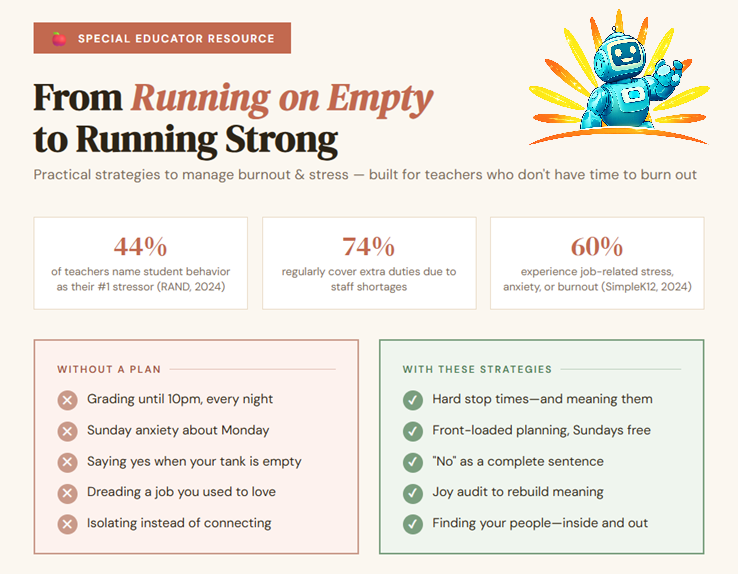
Before we fix anything, we need to name it correctly. Teacher burnout isn’t a personality flaw. It’s not laziness. According to the RAND Corporation’s 2024 State of the American Teacher Survey, nearly 44% of teachers identified student behavior as their top stressor, while 74% report regularly taking on extra duties due to staff shortages. That’s not a you problem. That’s a system problem.
But here’s the part nobody tells you in ed school: waiting for the system to fix itself is not a strategy. You have to build your own scaffolding while the house is still under construction.

Strategy #1: Audit Your Energy, Not Just Your Time
Most time-management advice for teachers is useless because it treats all tasks as equal. Grading a stack of IEP goals at 9pm after a full day of co-teaching is not the same energy cost as grading it at 7am with a coffee. Same task. Completely different toll.
I started doing something I call an Energy Audit every Sunday. It takes literally 10 minutes. I write down every major task I’m facing that week and rate each one: High Energy Drain, Medium, or Low. Then I schedule my high-drain tasks during my peak hours—for me, that’s early morning—and protect those windows like my life depends on it.
Because honestly? My longevity in this profession does.
Try the app Todoist for this. It’s free, clean, and lets you color-code and prioritize tasks in a way that a basic Google Keep list just doesn’t. I’ve been recommending it to new teachers for years. Once you see your week laid out by energy cost instead of just deadline, everything shifts.
Strategy #2: Build a “Minimum Viable Day” Template
Here’s something I tell every new special educator I mentor: you need a floor, not just a ceiling.
What’s the bare minimum you need to accomplish to consider a day professionally successful? Not the perfect day. Not the Pinterest day. The enough day.
Mine looks like this: IEP compliance tasks done, student safety maintained, one meaningful connection with a struggling student. That’s it. On the hard days, hitting the floor is a win.
This matters because burnout often comes from constantly measuring yourself against an ideal that’s impossible on a Tuesday with three staff call-outs and a fire drill during your prep period. The minimum viable day reframes success.
Write yours down. Put it somewhere you’ll see it when things go sideways—because they will.
Strategy #3: Use the 5-Minute Reset, Seriously
I know. You’ve heard “mindfulness” so many times it’s lost all meaning. Bear with me.
Mindfulness practices can reduce stress, improve focus, and increase emotional regulation—all crucial skills for effective teaching. When teachers practice mindfulness, they report feeling more patient with students, more creative in their teaching approaches, and better able to handle classroom challenges.
The key word there is minutes. Not an hour. Not a retreat. Five minutes.
Headspace has an “SOS” feature that offers emergency stress relief sessions as short as 3 minutes—designed specifically for moments when you need to reset fast. Headspace is currently free for teachers and support staff in the U.S. Free. For teachers. Go download it right now if you haven’t.
I use it between classes sometimes. I close my classroom door, put in my earbuds, and do a 3-minute breathing session. My kids think I’m “setting up for the next period.” Works fine.
Calm is another one I rotate in—it was voted “App of the Year” by Apple and features guided meditations ranging from 3 to 25 minutes, so you pick what fits. Both apps are genuinely excellent. Try both, see which voice/style resonates with you.
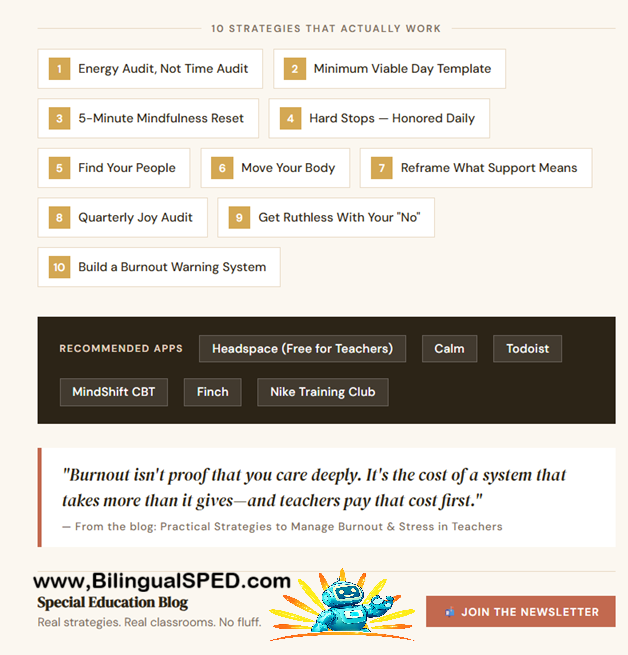
Strategy #4: Create Hard Stops—And Actually Honor Them
This one is the hardest for special educators specifically, because our work never feels done. There’s always another accommodation to document, another behavior plan to revise, another parent email sitting in your inbox.
Setting a hard stop time—let’s say 5:30pm—feels impossible until you realize that working until 9pm every night isn’t making you a better teacher. It’s making you a more exhausted one who makes more mistakes.
Here’s how I made hard stops stick: I started treating my end time like a student pickup time. You don’t stay late grading papers when a parent is waiting at the door. Give yourself the same urgency.
Teachers who wait until the last minute often plan lessons on Sunday night, creating what’s called the “Sunday Blues”—where teachers can’t enjoy their Sundays because they’ve become unofficial workdays. The fix? Front-load your planning. Whatever can be done Friday afternoon, do it Friday afternoon. Protect your weekend like it’s sacred. Because it is.
Strategy #5: Stop Isolating—Find Your People
Special education is uniquely isolating. You’re often the only person in your building who truly understands the complexity of your caseload. Your general ed colleagues mean well, but there’s a limit to how much they can relate.
Find your people outside your building. Seriously. Online communities of special educators are some of the most supportive, no-nonsense groups I’ve ever been part of. Facebook groups, Teacher Reddit, special education forums—these are spaces where someone gets it immediately when you say “my FBA just fell apart and I have an IEP meeting tomorrow.”
And don’t underestimate your colleagues within your building either. No one understands your frustrations and challenges better than your colleagues. Communicating with peers is one of the best ways to prevent burnout because they can offer the best support.
Even a 10-minute lunch together—not talking about work—can change the texture of a hard week. I’ve seen it happen. Go find your person.

Strategy #6: Get Your Body Into It
I know, I know. You’re exhausted. Exercise sounds cruel.
But here’s what changed my mind: I started thinking of movement not as adding another thing but as removing suffering. Because that’s what it does. Exercise is one of the only evidence-based interventions we have for chronic stress. Working out—whether lifting weights, jogging, or yoga—alleviates depression, anxiety, and stress, and it makes you ready for sleep every evening.
It doesn’t have to be a gym. A 20-minute walk during your lunch break counts. Parking farther away counts. Yoga in your living room at 6am counts. The bar is low. Start there.
The app Nike Training Club is free and has workouts as short as 15 minutes. Finch is a surprisingly effective self-care app—you raise a little virtual bird by completing daily wellness goals, which sounds ridiculous until you realize it actually works as a habit-builder for adults who respond well to low-stakes accountability.
Strategy #7: Reframe What “Support” Looks Like
One of the hardest things I’ve done as a special educator is ask for help. We’re trained to be the ones who support others. Asking for support ourselves feels like admitting failure.
It’s not.
Many schools offer mental health resources, and using them is vital in managing stress. Your EAP (Employee Assistance Program) likely offers free counseling sessions. A surprising number of teachers don’t use them—either because they don’t know they exist or because they feel weird about it. Use them. A therapist who specializes in workplace stress has changed the trajectory of more teaching careers than I can count.
If therapy feels like too much of a leap, start with Woebot—a free CBT-based app that walks you through cognitive reframing exercises when you’re spiraling. Or MindShift, developed by Anxiety Canada, which uses proven CBT strategies to help manage stress and reorient thinking patterns. Users can record their mood and anxiety levels in a Thought Journal, listen to guided mindfulness meditations, and set goals to keep themselves motivated.
These tools won’t replace a good therapist. But they bridge the gap on a Wednesday when you can’t get an appointment.
Strategy #8: Do a “Joy Audit” Once Per Quarter
Burnout doesn’t just drain energy. It drains meaning. And when meaning goes, the job becomes just a job—which for a special educator is a particularly brutal kind of loss.
Four times a year, I do what I call a Joy Audit. I ask myself three questions:
What part of my job has felt genuinely good lately? What’s something I used to love about teaching that I’ve stopped doing? What’s one small thing I could reintroduce this month?
Sometimes the answer is something tiny—like I used to play music during transition times and stopped. Sometimes it reveals something bigger that needs addressing. Either way, you can’t fix what you don’t name.
Strategy #9: Get Ruthless About Your “No”
Special educators are notorious people-pleasers. It’s almost a job requirement. But every time you say yes to something you don’t have capacity for, you’re borrowing from a future version of yourself who’s already tired.
Saying no is a skill. Practice it with low-stakes stuff first. “No, I can’t cover that lunch duty today.” “No, I can’t chair that committee this semester.” You don’t owe anyone an elaborate explanation. “I don’t have the bandwidth for that right now” is a complete sentence.
Your job is to show up fully for your students. You can’t do that if you’re spread so thin you’re transparent.
Strategy #10: Build a Personal “Burnout Early Warning System”
Here’s something I wish someone had told me ten years ago: burnout doesn’t show up all at once. It creeps. By the time most teachers realize what’s happened, they’re already deep in it.
Know your personal warning signs. Mine are: I stop enjoying lesson planning (which I normally love), I start dreading Monday on Friday afternoon, and I lose patience with things that normally roll off me. When two of those three show up together—that’s my signal to intervene, not push through.
What are yours? Write them down now, while you’re not in crisis. So you’ll recognize them later when you are.
The Bottom Line
Burnout isn’t a badge of honor. It’s not proof that you care deeply. It’s the cost of a system that takes more than it gives—and teachers, especially special educators, pay that cost first.
But you’re not powerless here. Every strategy in this post is something you can start this week. You don’t need administrative buy-in. You don’t need a school initiative. You need a Sunday night audit, a downloaded app, a hard stop time, and someone to eat lunch with.
Start there. The rest builds.
📬 Want More Like This? Join the Newsletter.
If this resonated with you, I want you in my corner. Every week, I send practical, no-fluff strategies for special educators navigating the real work—IEP tips, classroom tools, self-care that actually fits a teaching schedule, and honest conversation about what this job costs us.
No spam. No sales. Just one educator talking to another.
💬 Reflection Question for You
What’s one warning sign that tells you your burnout tank is getting low—and what’s one thing you’ve done (or could do) to refuel before it hits empty?
Drop your answer in the comments below. I read every single one, and I’d love to know what’s working for you.
❓ Frequently Asked Questions
Q: Is teacher burnout the same as general job stress? A: Not exactly. Job stress is usually situational and temporary. Burnout is chronic—it involves emotional exhaustion, depersonalization (feeling detached from your students or work), and a reduced sense of personal accomplishment. If you’ve felt all three of those together for more than a few weeks, that’s burnout territory.
Q: Can I recover from burnout while still teaching? A: Yes—but it requires deliberate intervention, not just time off. Summer break helps, but it rarely fixes the underlying patterns. The strategies in this post are designed for active recovery during the school year, not just maintenance during breaks.
Q: What’s the single most effective thing I can do right now? A: Honestly? Set a hard stop time tonight and honor it. It sounds too simple, but reclaiming even one hour of genuine rest each evening starts rebuilding your reserves faster than almost anything else.
Q: Are these strategies specific to special education teachers? A: The strategies work for all teachers, but I’ve written them with special educators in mind—because our caseloads, documentation requirements, and emotional labor are uniquely intense. If you’re a general ed teacher reading this, everything still applies. We’re all in the same boat; ours just has more paperwork.
Q: When should I consider leaving teaching? A: That’s a deeply personal question, and I’d never answer it for someone else. But a good litmus test: if you’ve implemented real strategies for 3-6 months and still feel no improvement, and the thought of another school year genuinely scares you—it might be time to talk to someone you trust about options. Leaving isn’t failure. Staying at the cost of your health isn’t heroism either.
📚 References
- RAND Corporation. (2024). State of the American Teacher Survey. https://www.rand.org
- Maslach, C., & Leiter, M. P. (2016). Understanding the burnout experience: Recent research and its implications for psychiatry. World Psychiatry, 15(2), 103–111.
- Tsang, K. K. Y., et al. (2021). Teacher burnout and mindfulness-based intervention: A randomized controlled trial. Teaching and Teacher Education, 106, 103453.
- Edutopia. (2023). 5 Mindfulness Apps for Teachers. https://www.edutopia.org/article/5-mindfulness-apps-teachers
- Teach For America. (2024). Apps and Tools to Help Manage Stress for Teachers. https://www.teachforamerica.org/stories/apps-tools-manage-stress
- American Psychological Association. (2023). Teacher burnout and workplace stress: A national survey. https://www.apa.org
- SimpleK12. (2024). Top Mental Health Resources for Teachers. https://www.simplek12.com/blog/mental-health-resources-teachers
- iCEV. (2024). The 7 Best Ways to Avoid Teacher Burnout. https://www.icevonline.com/blog/best-ways-to-avoid-teacher-burnout