
What your body has been trying to tell you — and how to finally listen.
I need to tell you about a spring semester that almost ended my career.
Not dramatically. No single catastrophic moment. Just a slow, grinding accumulation of not enough sleep, too many consecutive weekends working, skipping lunch more times than I could count, and telling myself every single day that I’d rest “when things slow down.” You probably already know how that sentence ends. Things don’t slow down. Not in special education. Not in April. Not ever, really.
By March of that year, I was getting up every morning with a low-grade headache that I’d stopped even noticing. My shoulders were in permanent knots. I caught every virus that moved through my classroom. I was sleeping seven hours a night and waking up feeling like I hadn’t slept at all. A colleague asked me if I was okay one Tuesday afternoon and I almost cried in the hallway — which was alarming, because I’m not a crier.
That was my body screaming at me in the only language it had left.
Here’s what I didn’t understand then, that I want to make sure you understand now: physical exhaustion isn’t just feeling tired. It’s a systemic shutdown. And the signs — the real ones — go way beyond yawning a lot. If you’re a teacher reading this, especially in special education where the physical and emotional demands are uniquely relentless, this post is my coaching session for you. We’re going to talk about what physical depletion actually looks like, why it’s happening, and specifically how to start recovering.
Let’s start with what your body is actually trying to say.
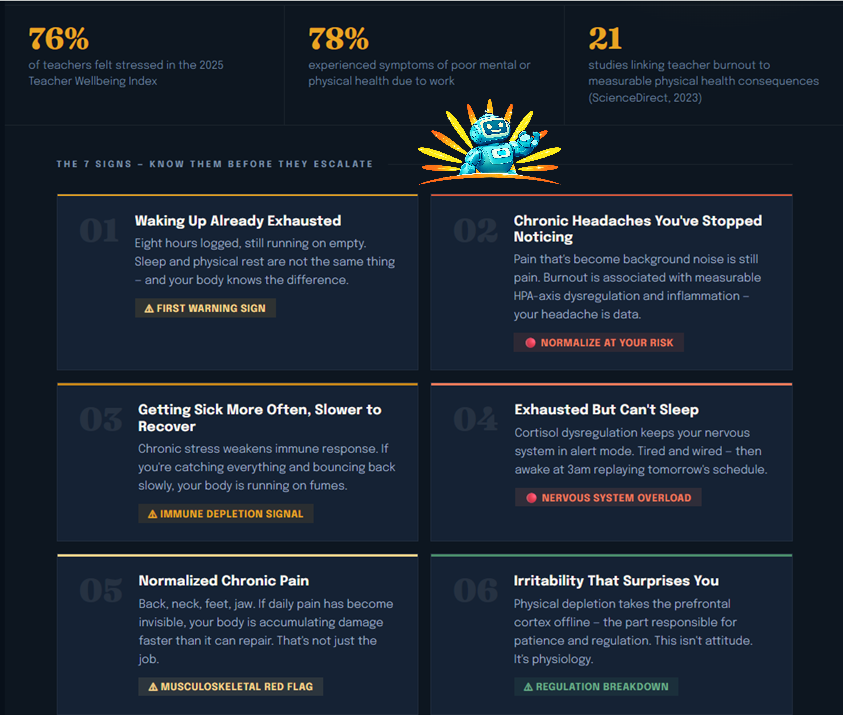
Sign #1: You Wake Up Already Exhausted
This one sounds simple but it’s the most important sign to take seriously. You could still sleep your full 7-9 hours and wake up feeling mentally and physically exhausted — in a fog, unable to focus like you used to, or just plain tired all the time.
That’s not laziness. That’s not Monday. That’s a sign your body has accumulated a physical debt it cannot pay back with a single night’s sleep.
In my experience, this is the sign most teachers dismiss the longest — because we’re so conditioned to treat exhaustion as normal. “Teaching is tiring” becomes a mantra that lets us ignore what the body is actually communicating. And by the time the waking-up-exhausted feeling becomes impossible to ignore, the physical debt has usually been building for months.
If you’ve woken up tired every day for two or more weeks — regardless of how many hours you logged — your body is not getting physical rest. It’s getting sleep, which is not the same thing.
Sign #2: Chronic Headaches and Muscle Tension You’ve Started Ignoring
Physical symptoms are a critical aspect of burnout that manifest as persistent headaches, muscle tension, and changes in sleep patterns. Teachers experiencing burnout often report frequent headaches and muscle tension that significantly impact their ability to perform their duties effectively.
Here’s the part that should concern you: the word “ignoring.” Because most depleted teachers aren’t alarmed by their headaches anymore. They’ve become background noise. A normal Tuesday. “I’ll take ibuprofen” replaces “I should sit down for 20 minutes.”
A systematic review of 21 studies including over 5,000 teachers found that burnout was consistently associated with somatic complaints like headaches, gastrointestinal issues, voice disorders, and biomarkers of HPA-axis dysregulation — meaning measurable hormonal and inflammatory changes in the body. This isn’t just discomfort. Chronic stress changes your cortisol patterns, your inflammatory markers, your immune response. The headache isn’t an inconvenience. It’s your nervous system waving a red flag.
If you’re treating tension headaches the way you treat a low-battery notification — just acknowledging it and moving on — that’s a sign you need physical rest urgently.
Sign #3: You Keep Getting Sick
I remember a year where I caught something almost every single month from September through February. Each time I thought: bad luck, occupational hazard, classroom germs. And those things are real. But what I wasn’t acknowledging was that I was getting sick faster than my colleagues, taking longer to recover, and never fully bouncing back between illnesses.
Chronic stress related to burnout can weaken the immune system, making teachers more susceptible to illnesses — and increased frequency of sickness can lead to more absences and further strain on both physical and mental health.
A physically rested body has a robust immune response. A chronically depleted one doesn’t. If you’re the person in your building who catches everything, who needs an extra week to shake a cold everyone else shook in three days — that’s not just bad luck. That’s your immune system running on fumes.
Sign #4: You Can’t Fall Asleep — Or Can’t Stay Asleep
This one is maddeningly cruel, and I want to name it because it confuses so many teachers: some teachers experiencing burnout will find themselves completely and fully exhausted long before the end of the day — but when the time comes to sleep, they can’t. Insomnia, especially when coupled with fatigue, is a sign of burnout.
The reason this happens is physiological. When your body is chronically stressed, your cortisol levels — which are supposed to rise in the morning and drop at night — get dysregulated. Your nervous system gets stuck in a low-grade “alert” state that makes genuine sleep elusive even when you’re exhausted. You’re tired but wired. Your body can’t find the off switch.
If you’ve been lying awake replaying tomorrow’s schedule, this week’s IEP meeting, that parent email you haven’t answered — and waking up at 3am unable to get back to sleep — that’s not just anxiety. It’s a physical sign that your stress response needs intervention, not just a better mattress.

Sign #5: Your Body Hurts in Ways You’ve Normalized
Back pain. Neck stiffness. Jaw clenching at night. Feet that throb from the moment you take off your shoes. If you teach — especially in a hands-on classroom — you know this list intimately. And most of us have quietly accepted it as “just part of the job.”
It doesn’t have to be. Physical pain that’s become chronic is your musculoskeletal system telling you it doesn’t have enough time and recovery to repair itself between demands. Teachers are on their feet for six or seven hours. We crouch, we carry, we redirect physically, we sit in chairs designed for nine-year-olds. The body absorbs all of that — and without genuine physical rest, it starts accumulating damage faster than it can heal.
Normalizing chronic pain is one of the most common — and most dangerous — things teachers do. Because it makes the sign invisible until something more serious shows up.
Sign #6: You’re More Irritable Than You Used to Be
A classic sign of burnout is sudden irritability. When someone’s struggling with exhaustion, they can become easily frustrated by small problems that wouldn’t usually bother them.
Here’s the part I want you to hear: this isn’t a personality flaw. It’s a physiological response. When your body is physically depleted, your prefrontal cortex — the part responsible for emotional regulation, patience, and thoughtful responses — goes offline faster. You snap at a student over something that would’ve rolled off you in September. You feel your shoulders go up when a colleague asks you a simple question. You have zero tolerance for things that are genuinely minor.
If the people who know you best have started commenting that you seem “off” or more on edge, believe them. That’s not criticism. That’s them noticing what physical depletion looks like from the outside.
Sign #7: You’ve Stopped Doing the Things That Used to Restore You
This is the subtlest sign, and in some ways the most telling. Not just that you’re tired — but that you’ve stopped reaching for the things that used to help. You used to take walks after school. You used to read at night. You used to go to yoga on Saturdays. And slowly, one by one, those things fell off the schedule — and you didn’t even notice until they were gone.
Constant fatigue is a key sign your body is under too much stress — feeling exhausted even after a full night’s sleep. But the downstream effect of that fatigue is that recovery behaviors stop too. The very things that would help are the first things you stop doing. And that’s when the spiral really starts.
How to Optimize Physical Rest: What Actually Works
Identifying the signs is only half the work. Here’s the practical half — broken down into what you can implement this week.
Start with sleep quality, not just sleep quantity. Eight hours of fragmented, cortisol-elevated sleep isn’t the same as seven hours of deep, restorative sleep. Calm has a sleep collection specifically designed to bring your nervous system down from its peak-activation state — their “Sleep Stories” and body scan meditations are among the most evidence-adjacent tools I’ve recommended to burned-out teachers. Headspace (free for educators in the U.S.) has a dedicated “Wind Down” series. Use one of these for two weeks and track whether waking up feels different.
Build active physical rest into your weekly rhythm. This is not the same as exercise. Active physical rest means movement designed specifically to release tension and aid recovery — yoga, stretching, restorative movement. Insight Timer has hundreds of free restorative yoga and yoga nidra sessions ranging from 10 to 45 minutes. Their “sleep” and “body” filters will pull exactly what you need. No subscription required.
Take micro-recovery moments during the school day. This sounds impossible until you actually try it. Between classes, close your classroom door. Sit down. Put your feet flat on the floor. Do three slow, complete breaths. That’s it. Thirty seconds. You’re not meditating — you’re giving your nervous system a signal that it’s safe to downregulate, even briefly. Over time, these micro-moments compound.
Track your sleep and recovery patterns. You can’t improve what you can’t see. Rise: Sleep & Energy Tracker is one of the most sophisticated sleep optimization apps available — it tracks your sleep debt, predicts your energy peaks and troughs throughout the day, and tells you the optimal time to go to bed based on your biology. It was designed with athletes in mind. Teachers need it more.
Protect one full rest day per week. Not a “lighter workday.” A genuine rest day where school-related work doesn’t happen. This is the hardest one for special educators because the caseload never feels done enough to stop. But research on recovery and performance consistently shows that a true day off accelerates recovery faster than partial rest every day. Your brain needs full permission to stop before it can genuinely repair.
Address the physical symptoms directly. If chronic headaches, back pain, or insomnia have been present for more than a month, please see a doctor. I say this not to alarm you but because teachers are notorious for deferring their own medical care while advocating relentlessly for everyone else’s. Your body deserves the same level of attention you give your students.
The Bottom Line
Teachers experience frequent job-related stress or burnout at nearly twice the rate of comparable working adults, and are about three times more likely to struggle with coping. That’s not because teachers are weaker. It’s because the demands are genuinely extraordinary — and the professional culture around teaching glorifies pushing through rather than recovering intelligently.
Physical rest is not a reward you earn by getting everything done. It’s a prerequisite for getting anything done well. The teacher who rests consistently is more patient, more creative, more present, more effective — for a longer span of years — than the one who runs themselves into the ground out of dedication.
You chose this work because it matters. Take care of the person doing it.
📬 Join the Weekly Newsletter
Every week I send one practical, no-fluff email for special educators — classroom strategies, wellness tools, honest conversations about sustainability in this profession. Real content from someone who’s lived it.
No spam. No sales. Just one educator showing up in your corner, weekly.
💬 Reflection Question
Which sign on this list felt most familiar — the one you’ve been quietly ignoring — and what’s one concrete thing you could do this week to start addressing it?
Drop your answer in the comments. I read every single one. And your honest response might be exactly what another teacher needed to see today.
❓ Frequently Asked Questions
Q: Is physical exhaustion different from emotional burnout?
They’re deeply interconnected, but yes — physical exhaustion is its own category. You can be emotionally engaged with your work and still be physically depleted. And chronic physical depletion eventually creates emotional burnout, even in teachers who love their job and feel purposeful. Addressing physical rest is often the first and most urgent intervention.
Q: How long does it take to recover from chronic physical depletion?
There’s no universal timeline, but research on sleep debt and recovery suggests meaningful improvement is possible within 2-4 weeks of consistent sleep quality improvements and recovery behaviors. The deeper the depletion and the longer it’s been building, the longer recovery takes. Be patient with yourself.
Q: I can’t sleep even when I’m exhausted. What do I do?
This is extremely common in burned-out teachers and is related to cortisol dysregulation — your stress response staying elevated even when you need to sleep. Start with a wind-down routine at least 30 minutes before bed: no screens, dim lights, and a guided body scan or breathing exercise. Apps like Calm and Headspace have specific tools for this. If insomnia persists beyond two weeks, see your doctor.
Q: Can I recover from physical exhaustion during the school year, or do I need summer break?
You can absolutely begin recovery during the school year. Summer helps, but it rarely fixes the underlying patterns — and waiting until June to start often means deeper depletion by the time you get there. The strategies in this post are designed for active recovery during the school year, not just maintenance.
Q: Is it normal to hurt physically from teaching?
Some degree of physical fatigue is normal in a physically demanding role. Chronic pain — pain that has become a daily baseline — is not, and it’s a signal that warrants both medical attention and a serious look at your recovery practices. Don’t normalize it.
📚 References
- RAND Corporation. (2024). State of the American Teacher Survey 2024. https://www.rand.org/education-and-labor/projects/state-of-the-american-teacher.html
- Hennig, C. W., Crabtree, C. R., & Baum, D. (2023). Teacher burnout and physical health: A systematic review. ScienceDirect. https://www.sciencedirect.com/science/article/pii/S088303552300037X
- Maslach, C., & Leiter, M. P. (2016). Understanding the burnout experience: Recent research and its implications for psychiatry. World Psychiatry, 15(2), 103–111. https://doi.org/10.1002/wps.20311
- Teaching Channel. (2023). Warning signs of teacher burnout. https://www.teachingchannel.com/k12-hub/blog/warning-signs-of-teacher-burnout
- AFA Education. (2024). Teacher burnout symptoms: Top warning signs and how to address them. https://afaeducation.org/blog/teacher-burnout-symptoms-top-warning-signs-how-to-address-them
- Elevate K12. (2024). Key signs of teacher burnout and how to prevent it. https://www.elevatek12.com/blog/elevate-in-action/teacher-burnout
- Choosing Therapy. (2024). Teacher burnout: Symptoms, causes, and prevention. https://www.choosingtherapy.com/teacher-burnout
- Dalton-Smith, S. (2019). Sacred Rest: Recover Your Life, Renew Your Energy, Restore Your Sanity. FaithWords.
- American Psychological Association. (2023). Workplace burnout: Causes, symptoms, and recovery. https://www.apa.org/topics/healthy-workplaces/work-burnout
- Education Support. (2025). Teacher burnout and how to avoid it. https://www.educationsupport.org.uk/resources/for-individuals/articles/teacher-burnout-and-how-to-avoid-it