
How I Teach Vocabulary to ELL Students with Structured Supports

Vocabulary instruction for multilingual learners cannot rely on memorization or isolated word lists. Many English learners—especially those who also receive special education services—need vocabulary to be taught in ways that are explicit, structured, and deeply connected to meaning. In my classroom, vocabulary instruction is carefully scaffolded so that students can interact with new words multiple times and in multiple ways.

Each new word begins with clear context. Instead of presenting vocabulary in isolation, I introduce it through short texts, visuals, or shared discussions so students can see how the word functions in real language. We analyze the word together, exploring its meaning, possible translations, related forms, and how it might appear in academic tasks such as reading or writing.

Structured supports make the difference. Graphic organizers, sentence frames, visuals, and guided discussion help students practice using the word safely before they are expected to use it independently. Students repeat, say, write, and apply the word across activities so the learning moves beyond recognition toward real ownership.

Most importantly, vocabulary instruction is not a one-day lesson. Words return throughout the week in reading passages, writing prompts, and partner conversations. This repeated exposure helps students gradually internalize meaning while building the confidence to use new academic language in authentic ways.

How My Special Education and ELL Students Used This “Evaluating Point of View” Lesson And What Actually Worked

 As a Special Education and English Learner teacher, I used this lesson with students who struggle with reading comprehension and written expression at my Washington DC school. In the specialized world of the Digital Literacy Academy, my classroom serves as a bridge between foundational communication and the practical skills required for the workforce. My students … Read more

How I Tried This “St. Patrick’s Day” Differentiated Writing Lesson With My SPED Students — Here’s the Data and Student Growth

As a Special Education and English Learner teacher, I used this lesson with students who struggle with reading comprehension and written expression at my Washington DC school. In the high-stakes environment of my classroom, my days are spent navigating the intersection of cognitive disability and language acquisition. I am the lead teacher for a group … Read more

How My Special Education & ELL Students Used “Citing Textual Evidence” Lesson — And What Actually Worked

As a Special Education and English Learner teacher, I used this lesson with students who struggle with reading comprehension and written expression, and what I witnessed was a powerful shift in how they engaged with informational text. My name is Maria, and for the past 22 years as a teacher in an inner city school … Read more

How to Teach RI 6.7 Analyzing Text Features AI Enhanced Visual Lesson for SPED & ELL

I often tell new teachers that our students often miss the “signposts” that authors leave behind. These signposts—headings, captions, charts, and bold words—are not just decorations; they are the keys to the kingdom of informational text. In the 6th-grade landscape, specifically under Standard RI.6.7, we focus on integrating information presented in different media or formats. … Read more

How I Tried This Differentiated “Valentine’s Day” Reading Lesson With My SPED Students — Here’s the Data and Student Growth

As a Special Education and English Learner teacher, I used this lesson with students who struggle with reading comprehension and written expression at my Washington DC school. In the world of intensive intervention, the arrival of February often brings a specific kind of anxiety. While the rest of the building is focused on candy and … Read more

How to Use Making Inferences Reading Comprehension Strategy

In a standard classroom, we often tell students to “read between the lines,” but for a neurodiverse learner, those lines can feel like a solid, impenetrable wall. If the information isn’t stated explicitly, it simply doesn’t exist to them yet. As a mentor, I’ve learned that our role isn’t to ask our students to be … Read more

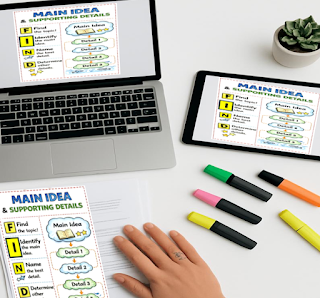
How to Use Main Idea & Details Reading Comprehension Strategy

To a student with an IEP, every sentence often carries the same weight. They might read an entire passage and, when asked for the big idea, fixate on a minor, colorful detail about a character’s shoes rather than the central message. As a mentor, I’ve learned that our most important task isn’t just to teach … Read more

Differentiating Instruction: What Actually Works (With Classroom Examples)

I remember sitting in my classroom a few years ago, staring at a stack of generic curriculum guides and then looking at my students. In one corner, I had a student who could tell you everything about the history of space travel but struggled to write a single sentence. In another, I had a student … Read more

How to Teach Analyzing Characterization & Plot RL 6.3| AI Enhanced Visual Lesson | SPED & ELL

Learn how to teach characterization and plot analysis to SPED and ELL students using an AI-enhanced visual lesson aligned to RL.6.3. This post walks bilingual special education teachers through a structured 60-minute block—Mini-Lesson, Guided Practice, and Independent Work—built around a clear 3-step strategy: Identify the Event, Observe the Reaction, and Determine the Change. Think-aloud modeling, high-contrast visual organizers, and sentence frames help neurodiverse and Tier 3 learners move beyond “what happened” to understanding how plot episodes shape a character’s growth. Includes extension activities connecting to RL.6.5, a Quick Quiz for IEP data collection, and an accommodations checklist—giving every student the tools to see themselves in the stories they read.