Special education teachers lose hours every week to documentation, progress monitoring, and IEP paperwork — time that should go to actual instruction and relationships with students. This post breaks down what the data says about that hidden productivity crisis, and how thoughtfully used AI can hand real time back without cutting corners on quality or compliance. Written from 22+ years in bilingual special education, not a productivity app’s sales page.
The Sunday Night That Made Me Finally Try This
I used to spend a chunk of every Sunday night writing progress notes. Not because I was behind — because there simply wasn’t time during the actual school week to do it well. Between instruction, transitions, behavior support, and the fifty small things that happen in a special education classroom before lunch, documentation got pushed to whatever hours were left. Which, for most of us, means nights and weekends nobody’s paying us for.
And I want to be clear about something before I go further: this isn’t a personal productivity failure. It’s structural. National surveys keep landing on the same number, over and over — special education teachers report spending five or more hours a week on IEP paperwork alone, with that paperwork consistently named as the single biggest thing pulling us away from actual teaching. Five hours. That’s basically a whole extra workday, every single week, on top of everything else already on your plate.
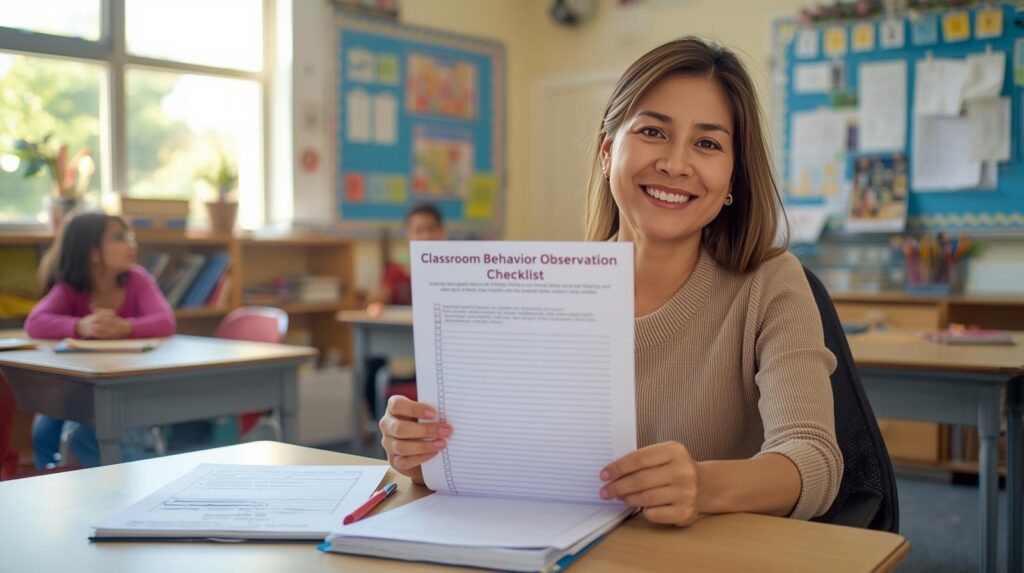
So when I finally started using AI for the documentation side of this job — cautiously, and with a lot of editing — it wasn’t about chasing a trend. It was about getting Sunday night back. Let’s dig into where this actually works, where it doesn’t, and how to use it without cutting corners on the parts of documentation that legally and ethically can’t be shortcut.
Why Is Documentation Such a Massive Burden in Special Education Specifically?
General education teachers have grading and lesson planning. We have that, plus IEPs, progress monitoring, compliance meetings, behavior data collection, and family communication that often needs translation or extra care given a family’s prior experiences with schools. It compounds fast.
One analysis of the field put it plainly: special education teachers face a documentation burden unlike anything else in K-12, with IEPs, progress monitoring, compliance tracking, and communication combined sometimes consuming more hours than the actual teaching does. Which is honestly kind of a wild thing to say out loud about a job whose entire purpose is teaching kids — and yet, if you’ve lived it, you know it’s not an exaggeration.
The burnout research backs this up too. A recent synthesis on special education teacher burnout and occupational wellbeing found paperwork and administrative load showing up again and again as a core driver — not classroom management, not student behavior alone, but the sheer volume of required documentation stacked on top of everything else.
Quick Win: Track your own documentation hours for one week, honestly, including anything done after contract hours. Most teachers underestimate this until they actually log it — and the number is usually the thing that finally gets a schedule change approved.
Where AI Actually Helps (Not Hype — Real Time Back)
1. IEP Drafting and Present-Levels Language
This is the single biggest time-saver I’ve found, hands down. Instead of starting present-levels language from a blank page every time, I draft from actual student data and let an AI tool generate a first pass — then I edit for accuracy, specificity, and anything that needs a sensory accommodation, a visual support in a family’s home language, or a social story referenced. The editing pass is non-negotiable. But starting from a draft instead of a blank page saves real time, every single time.
I built an entire toolkit around exactly this workflow because I got tired of rebuilding my process every caseload cycle. If you want the ready-made version of what I’m describing here, check out the AI-Supported IEP Writing Toolkit on TpT — it’s built specifically for this documentation gap.
2. Progress Monitoring That Doesn’t Eat Your Planning Period
Consistent, accessible progress monitoring data doesn’t just support better instructional decisions — it makes IEP writing itself dramatically easier down the line, since you’re pulling from real, ongoing data instead of reconstructing a semester from memory in May. AI-powered data collection tools can flag which students are behind on service minutes or which progress reports are coming due, cutting down the mental load of tracking deadlines manually across an entire caseload.
Tools worth trying:
- Google Forms paired with a shared spreadsheet, for simple, fast data collection that AI can later summarize
- Otter.ai for transcribing IEP meetings so you’re not trying to write and listen simultaneously
3. Repetitive Task Automation

Compliance tracking, deadline alerts, templated parent notices — this is where AI-adjacent tools shine without much risk, because the content is low-stakes and highly repetitive. One resource on reducing SPED paperwork specifically noted that automated alerts weeks before deadlines give teachers enough runway to prepare, instead of the last-minute scramble that tends to produce errors in the first place.
Quick Win: Pick one recurring task — parent notices, progress report templates, deadline tracking — and automate just that one thing this month. Don’t try to overhaul your entire workflow at once. Small wins compound.
4. Multilingual Family Communication
This one matters enormously in bilingual special education specifically. AI-assisted translation tools can draft a first version of a parent letter, a progress update, or a social story in a family’s home language — again, with a human review pass for nuance — instead of that communication getting delayed or skipped because there wasn’t time to coordinate a translator.
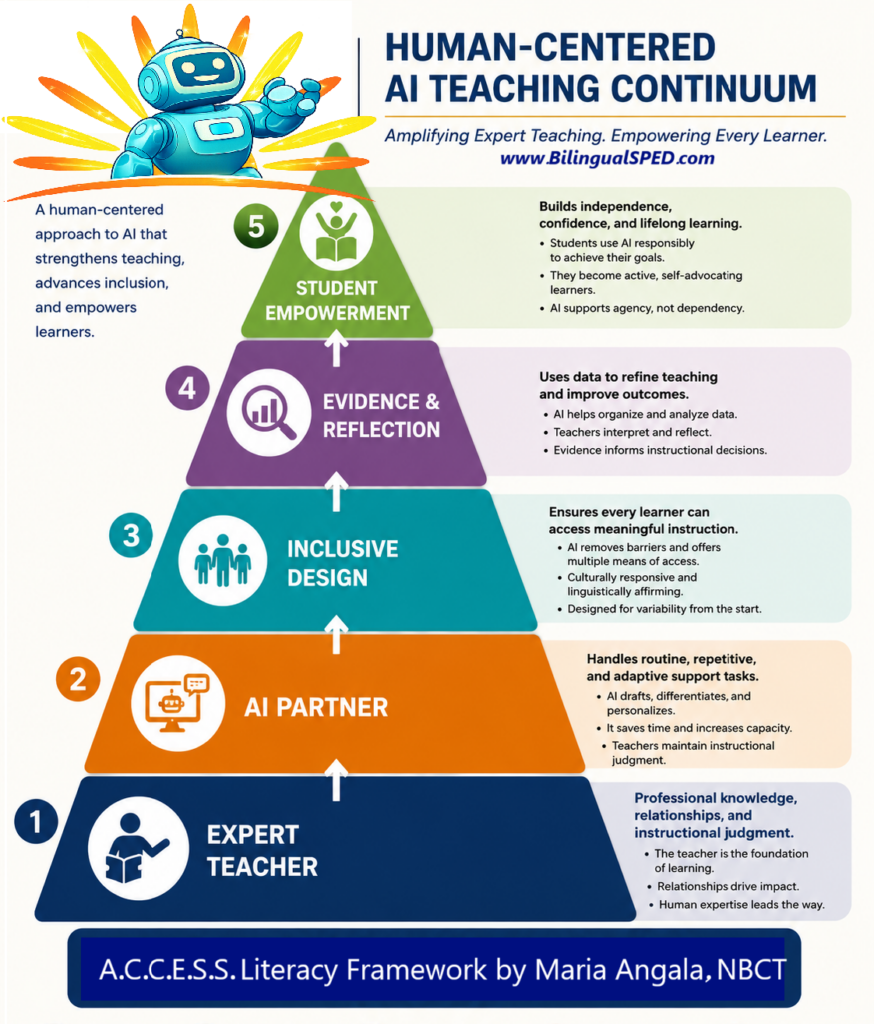
I developed a Human-Centered AI Teaching Continuum embedded within the A.C.C.E.S.S. Literacy Framework to guide educators in using AI ethically and effectively to amplify expert teaching for multilingual learners and students with disabilities.
A Lesson Where Getting Documentation Off My Plate Actually Changed My Teaching
Classroom context: A caseload that included a student needing consistent sensory accommodations throughout the day, and a multilingual family who needed every progress update translated and, ideally, explained by phone given some prior confusion with paperwork.
The instructional challenge: I was spending so much prep time on documentation that I’d started cutting corners on the actual instructional piece — reusing the same visual supports instead of adjusting them, skipping the social story I knew this student needed before transitions because I just didn’t have the twenty minutes to build it.
The lesson approach: I moved my present-levels drafting to an AI-assisted first draft, which freed up real prep time. I used that reclaimed time specifically to build a fresh, photo-based visual schedule for the sensory-sensitive student and a short social story about an upcoming transition, translated into the family’s home language for consistency at home too.
Student response: The transition that used to cause visible anxiety went noticeably smoother once the social story was actually current and specific to that week, instead of a generic one I’d reused for months because I hadn’t had time to update it. Small change. Real difference.
Teacher reflection: I’ll admit I felt a little guilty at first using AI for something as important as IEP language — like it was cutting a corner I shouldn’t cut. But the corner I’d actually been cutting before was the instructional side, the social stories, the updated visuals — not the documentation. Reordering where my time went didn’t lower the quality of anything. It raised it, for the parts that mattered most.
What I’d refine next time: I’d build a standing weekly block specifically for the reclaimed time, instead of letting it get absorbed into “whatever’s most urgent” — because without that boundary, saved time has a way of quietly disappearing into more paperwork anyway.
If you’re navigating this same trade-off between documentation and instruction time, the AI-Supported IEP Writing Toolkit was built around exactly this problem — take a look at it here.
What AI Can’t Fix — And Why That Matters
Look, I want to be honest here. AI can speed up drafting. It cannot fix a caseload that’s simply too large, or a schedule with no protected time for compliance work, or a district culture where paperwork is expected after contract hours as the norm. Teachers in North Dakota testified directly to lawmakers this year about exactly this — burnout, uncompensated work time, and colleagues leaving the field entirely because the workload became unsustainable. AI is not a substitute for those structural fixes. It’s one tool that can lighten the load while those bigger conversations happen.
Quick Win: If AI-assisted documentation saves you real time, use some of that saved time to advocate — with data in hand — for the structural fixes (protected case-management blocks, reasonable caseloads) that AI alone can’t provide.
Frequently Asked Questions
How much time do special education teachers actually spend on paperwork?
National data points to five or more hours per week on IEP paperwork alone, not counting progress monitoring, compliance meetings, and family communication — and much of it happens after contract hours because the school day doesn’t allocate protected time for it.
Is it ethical to use AI for IEP writing?
Yes, with a critical caveat: AI should draft, not decide. Every AI-generated present-level statement, goal, or note needs a human review pass for accuracy, specificity, and compliance before it becomes part of a legal document — AI speeds up the first draft, but professional judgment finalizes it.
Will AI reduce special education teacher burnout?
It can help with one piece of the puzzle — administrative burden — but burnout research points to workload, caseload size, and lack of structural support as the deeper drivers. AI can hand back hours; it can’t fix an unreasonable caseload or a lack of protected planning time on its own.
References
- TeachTools, “Tools to Reduce Paperwork for Special Education Teachers” (2026)
- TeachTools, “15 Strategies for Reducing Teacher Workload Burnout” (2026)
- North Dakota Monitor via KVRR News, “Special Education Teachers Report Burnout, Uncompensated Work Time” (2026)
- Garwood, Stark, Jones & Thompson, “Special Education Teacher Burnout and the Implementation of Behavior Intervention Plans” (2026)
- SLP Now, “Paperwork Time Savers for School-Based SLPs (That Actually Reduce Burnout)” (2026)
Where to Go From Here
The productivity crisis in special education was never really about laziness or poor time management — it’s a structural mismatch between what the job requires and how much time the school day actually protects for it. AI won’t solve that mismatch entirely. But used thoughtfully, and with real editing every single time, it can hand back hours that belong to your students, your family communication, and honestly, your own Sunday nights.
If you want a documentation workflow that’s already built around this exact trade-off, the AI-Supported IEP Writing Toolkit is available on TpT here — built from real caseload trial and error, not a productivity app’s best-case demo.
Want more honest, classroom-tested strategies for reclaiming your time without cutting corners on quality? Sign up for my email newsletter and I’ll send new tools and templates straight to your inbox.
Reflection question: If you tracked your own documentation hours honestly for one week, what do you think that number would actually be — and what would you do with even two of those hours back?
You Might Also Like
More strategy and tools like this over at the BilingualSPED.com blog — including posts on the A.C.C.E.S.S. Literacy Framework, IEP writing strategies, and reclaiming instructional time in special education classrooms.