
Why you can sleep eight hours, have an “easy” day, and still feel completely empty — and what to do about it.
Let me tell you about a Thursday that changed how I understand this work.
It wasn’t a bad day by any metric. No major behavioral incidents. No crisis IEP meeting. No catastrophic staff call-out. By all external measures, it was a normal Thursday in a special education classroom. And yet by the time I got to my car at 4pm, I felt like someone had scooped out my chest and left nothing there. Hollow in a way I couldn’t explain to anyone who wasn’t doing this job.
I sat in the parking lot for a while, trying to figure out what was wrong with me. Nothing happened. Why do I feel like this?
Here’s what I eventually learned: something did happen. It happened all day, in a thousand small invisible transactions. I held space for a student who was dysregulated before they even got through the door. I managed the anxiety in the room during a transition that didn’t go smoothly. I modulated my voice, my face, my body language — constantly — to stay calm so the room stayed calm. I absorbed one parent’s frustration on a phone call without letting it show. I encouraged a colleague who was having a harder day than me. I poured out emotional energy all day long, with no one pouring anything back in.
That’s emotional labor. And for special educators specifically, it is relentless, largely invisible, and never listed in the job description.
Emotional rest is about recovering from exactly that. Not the big dramatic moments. The thousand small ones. And it is, in my experience mentoring teachers, the most urgently needed and least practiced type of rest in our profession.
This post is your coaching session on how to actually do it.
What Emotional Rest Really Is
Dr. Saundra Dalton-Smith, the physician and researcher who developed the seven types of rest framework, describes emotional rest this way: giving yourself permission to feel your feelings authentically — without performance, management, or suppression.
That’s a deceptively radical idea in a profession that requires constant emotional management. Teaching — especially in special education — requires what researchers call surface acting and deep acting. Surface acting is managing your facial expression and tone regardless of what you feel inside. Deep acting is going further, actually working to change what you feel so you can show up differently. Both are forms of emotional labor, and a 2021 systematic review in the International Journal of Environmental Research and Public Health found that both are significantly correlated with burnout.
You are doing this all day. The question is what you’re doing at 4:15pm to restore what was spent.
Emotional rest is not about venting. It’s not about pretending everything is fine. It’s about creating space — intentionally — where you don’t have to manage anything. Where you can feel whatever you actually feel. Where someone or something is receiving you instead of requiring something from you.
Here’s exactly how to build that into your life.
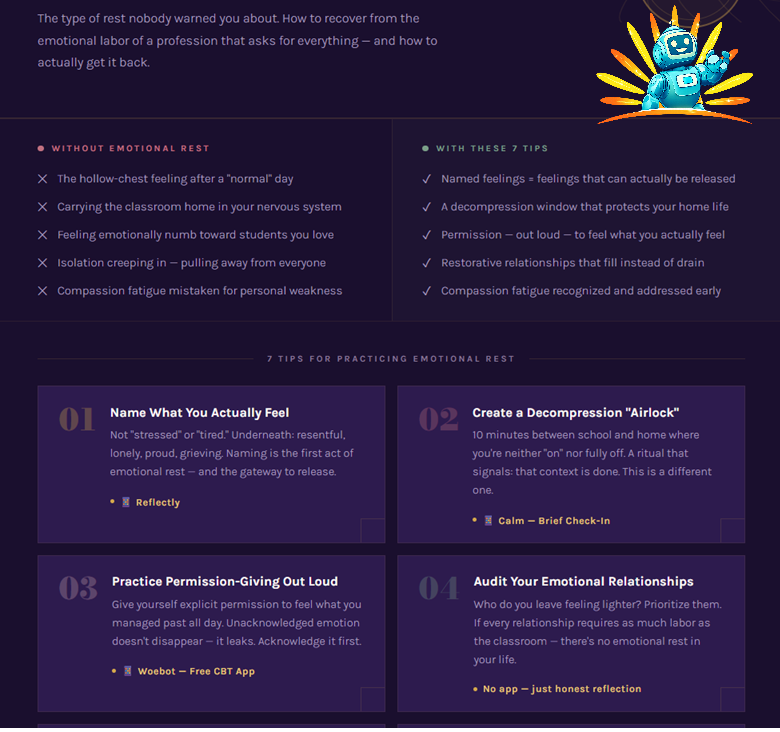
Tip #1: Learn to Identify What You Actually Feel
This sounds almost embarrassingly simple. But teachers are so practiced at emotional management that many of us genuinely lose track of what we’re feeling underneath the performance. We know what we should feel. We know what’s appropriate to express. We stop checking on what’s actually happening inside.
Emotional rest starts with emotional honesty. Not for anyone else’s benefit. Just yours.
Try this tonight: sit somewhere quiet for five minutes and ask yourself, what am I actually feeling right now? Not “stressed” or “tired” — those are generic. Go deeper. Resentful? Sad? Disappointed? Proud of something you haven’t let yourself celebrate? Grieving a connection with a student that didn’t go how you hoped? Lonely in a building full of people?
Naming is the first act of emotional rest. It stops the background hum of unprocessed feeling from consuming energy without ever being addressed. Reflectly is a guided emotional journal I’ve recommended to teachers for years — its AI-driven prompts help you go past “fine” and actually land on what’s underneath. Five minutes before bed. Genuinely shifts things.

Tip #2: Create a “Decompression Window” Before You Enter Your Home
I call this one the “airlock” — and it’s the single tip I push hardest with new teachers I mentor.
The emotional residue of the school day does not politely stay at the school. It follows you home in your nervous system, your shoulders, your jaw, the way you respond to the first question someone asks you the minute you walk in the door. And because you never had a chance to process the transition from “on” to “off,” you end up pouring the classroom’s emotional weight onto whoever shares your home.
A decompression window is a deliberate, protected block of time — even 10 minutes — between work and home. It’s not the commute, because you’re often still mentally back in the building during the commute. It’s a specific ritual that signals to your nervous system: that context is done. This is a different one.
Mine used to be: park, sit for five minutes in silence with my hands in my lap, then listen to one song I specifically loved before walking in. Other teachers I’ve coached use: a 10-minute walk around the block before entering the house, a brief journaling session in the car, or a body scan using Calm‘s brief check-in feature before touching anything inside.
The content matters less than the consistency. Find your ritual. Protect it like an appointment.
Tip #3: Practice Permission-Giving — Out Loud
Emotional exhaustion feeds on suppression. And teachers — especially those of us who work with students who need constant emotional regulation — often unconsciously suppress our own emotional responses all day to model regulation.
Which is admirable. And also quietly devastating over time.
Emotional rest includes giving yourself explicit permission to feel things you’ve been professionally required to set aside. Permission to be frustrated. Permission to grieve when something with a student doesn’t go the way you hoped. Permission to cry in the car. Permission to feel proud of something without immediately moving to the next thing. Permission to be angry about a system failure without shame.
This isn’t wallowing. It’s acknowledgment — which is the gateway to release. Unacknowledged emotions don’t disappear. They accumulate, and they find other exits — impatience, cynicism, emotional numbness, the hollow-chest feeling I described at the beginning of this post.
Woebot is a free CBT-based app that walks you through cognitive and emotional processing in real time. It’s not therapy — but it’s a genuinely useful tool for the days when you need to work through something and there’s no one immediately available to talk to. It asks good questions. It helps you hear yourself.
Tip #4: Audit Your Emotional Relationships
Here is something I’ve learned from years of coaching teachers and living this work myself: not all relationships restore you. Some require as much emotional labor as the job itself.
Emotional rest includes deliberately increasing time with people who give you energy and decreasing time with people who only draw on it. This is not about being selfish or cutting people out of your life. It’s about recognizing that if your relational life is also predominantly a performance — where you manage someone else’s emotions, mediate conflicts, absorb criticism, or provide support with nothing coming back — you have no restorative relationship in your life.
Ask yourself honestly: who in your life do you leave feeling better than when you arrived? Lighter, more like yourself, a little more okay with the world? That person — prioritize them. Schedule time with them the same way you schedule obligations.
And recognize that isolation is a symptom, not a preference. Teachers struggling with burnout often begin isolating from colleagues — avoiding interactions and teamwork, reluctant to participate in school activities. If you’ve pulled back from people who used to fill you up, that’s not introversion. That’s depletion. And the answer is reaching back out, even when it feels like too much effort.
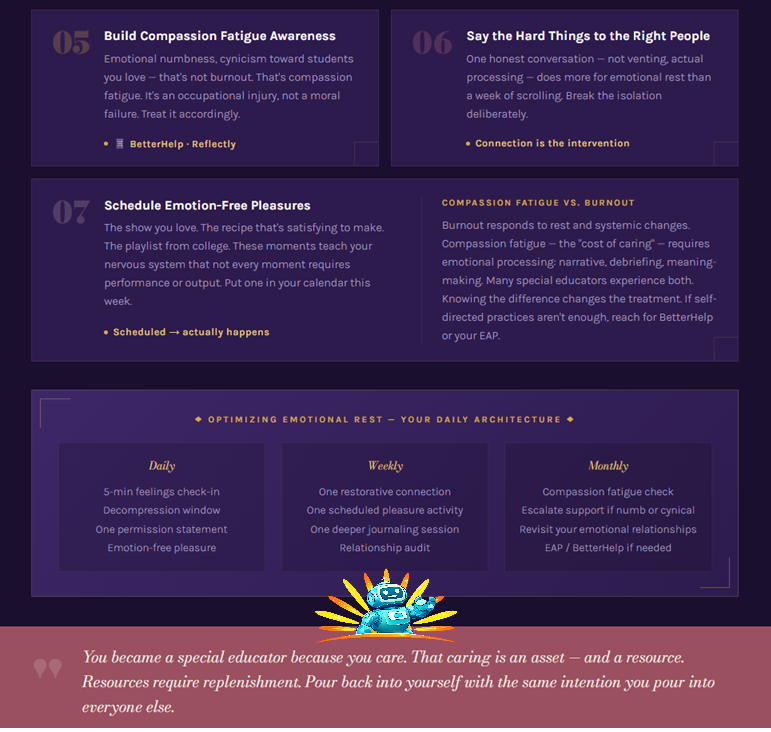
Tip #5: Build Compassion Fatigue Awareness Into Your Practice
This one matters especially in special education, and it doesn’t get said often enough: what you may be experiencing isn’t just burnout. It might be compassion fatigue.
Compassion fatigue is described as the “cost of caring” — a state in which the emotional labor of caregiving depletes a professional’s capacity to continue providing that care effectively, resulting in a shift in occupational world view and a loss of altruism.
The distinction matters because the treatment differs. Burnout is addressed with systemic changes and rest. Compassion fatigue specifically requires emotional processing — debriefing, narrative, meaning-making — in addition to rest. Teachers experiencing compassion fatigue often describe feeling emotionally numb, cynical toward students they genuinely love, or detached in a way that frightens them.
If that resonates, please hear this: it is not a moral failure. It is an occupational injury that happens to people who care deeply, routinely, without enough recovery.
BetterHelp offers flexible, online therapy that fits into a teaching schedule far better than in-person appointments — and many EAP plans cover it partially or fully. If the word “therapy” feels like too big a step, start with Reflectly or Woebot to begin processing. But please don’t leave compassion fatigue unaddressed. It doesn’t resolve with a weekend off.
Tip #6: Say the Hard Things to the Right People
Emotional rest doesn’t only happen in solitude. Some of the deepest emotional restoration happens in genuine, honest conversation — and most teachers are not having those conversations nearly enough.
The research is clear: starting to talk with someone — a trusted colleague, friend, or family member — and getting it all out, including the ranting, the laughing, the crying, is one of the most effective burnout recovery strategies, because it breaks the isolation and restores the sense that you’re not alone.
The key word is genuine. Not the staff-lounge version of venting, which often stays at the level of shared frustration and never reaches actual processing. I mean the conversation where you tell someone how it actually is — the specific thing that’s weighing on you, the fear underneath the exhaustion, the thing you haven’t said out loud because you thought it would sound like complaining.
Find one person who can hold that for you. In teaching, isolation is endemic and quiet — it takes effort to break it deliberately. Worth every bit of that effort.
Tip #7: Schedule Emotion-Free Pleasures
This one sounds small. It isn’t.
Emotional rest includes time doing things that bring you low-stakes, uncomplicated joy. Things that don’t require processing, don’t involve relationships that need tending, don’t produce anything that needs to be evaluated. The guilty pleasure TV show. The novel you read purely because you love it. The playlist you’ve had since college. The recipe you make just because it’s satisfying to make.
These things aren’t frivolous. They’re the moments when your emotional self gets to exist without labor. They teach your nervous system that not every moment needs to be productive or meaningful or caregiving. They refill something that depleted teaching tends to drain.
Schedule one per week, minimum. In your actual calendar. Because if it’s not scheduled, it won’t happen — and you’ll spend the evening doing something that feels easier in the moment (scrolling) but actually costs more than it gives.

How to Optimize Emotional Rest: The Architecture
All seven tips above work best together. Here’s how I coach teachers to build the architecture:
Daily non-negotiables: Five-minute feelings check-in (morning or evening), decompression window before entering home, one explicit permission statement (“I’m allowed to feel frustrated today”).
Weekly: One restorative social connection — with someone who fills you up. One emotion-free pleasure activity, scheduled in advance. One journaling session that goes deeper than “I’m tired.”
Monthly: Check your compassion fatigue level. Are you feeling emotionally numb? Cynical toward students you love? Those are signals to escalate your support — whether that’s a trusted mentor conversation, your EAP, or a therapist.
As needed: Reach out. Use BetterHelp, Woebot, or Reflectly on the hard days. Break the isolation before it sets.
The goal isn’t a perfect emotional wellness practice. The goal is staying in this work — showing up fully, for years — without the emotional cost of the job becoming the cost of yourself.
The Honest Close
Nobody told me, when I started teaching, that the hardest part wouldn’t be the academics. It wouldn’t be the IEP paperwork or the behavior plans or the data. It would be the feeling of giving my emotional self away piece by piece across every school day — and never learning how to get it back.
Emotional rest is how you get it back. Daily. Deliberately. Without guilt.
You became a special educator because you are someone who genuinely cares. That caring is an asset — for your students, your classroom, this profession. But it is also a resource. And resources require replenishment.
Pour back into yourself with the same intention you pour into everyone else. Your students need that version of you far more than they need the empty version who pushed through.
📬 Join the Weekly Newsletter
Every week I send one practical email built specifically for special educators — classroom strategies, wellness tools, honest conversations about what this job costs us and what keeps us in it.
No spam. No sales. Just real support, every week.
💬 Reflection Question
Which tip in this post described something you’ve been quietly neglecting — and who is one person in your life who genuinely fills you up that you haven’t spent real time with lately?
Share your answer in the comments below. I read every single one — and your reflection might be exactly what another teacher needed to see today.
❓ Frequently Asked Questions
Q: What’s the difference between emotional rest and just “taking a break”?
A break is a pause from activity. Emotional rest is something more specific: deliberately creating space where you’re not performing, managing, or suppressing emotion — and where you’re doing something that receives you rather than requires something from you. You can take a break and still be emotionally depleted if the break involves more emotional labor (a difficult conversation, a high-stress show, social media).
Q: How do I practice emotional rest when I’m also a caregiver at home?
This is one of the most common — and hardest — situations for teachers. Start with the decompression window before entering the home, even if it’s only five minutes. Protect that transition. Find one activity per week that is yours alone — not caregiving, not relational management, just yours. And build one honest relationship outside of the home where you can be received without performing.
Q: Is compassion fatigue the same as burnout?
No, and the distinction matters. Burnout is a response to chronic workplace stress and is addressed by systemic and behavioral changes plus rest. Compassion fatigue specifically involves the cost of caring for others through crisis or trauma, and it requires emotional processing — narrative, debriefing, meaning-making — in addition to rest. Many special educators experience both simultaneously.
Q: Can I practice emotional rest during the school day?
Yes — brief versions of it. Naming what you’re feeling between classes takes 30 seconds. Giving yourself permission to feel something that just happened takes no time at all. The decompression window after dismissal is technically still “school day adjacent.” These in-day micro-practices don’t replace deeper evening and weekly restoration, but they prevent the accumulation from becoming overwhelming.
Q: How do I know if I need professional support rather than self-directed practices?
If you’re experiencing persistent emotional numbness, cynicism toward students you love, an inability to feel positive emotions, or intrusive thoughts about work-related trauma, those are signs that self-directed practices alone aren’t sufficient. Your EAP, a therapist specializing in occupational stress, or a compassion fatigue specialist can help. Reaching out is not weakness. It’s the professional thing to do.
📚 References
- Dalton-Smith, S. (2019). Sacred Rest: Recover Your Life, Renew Your Energy, Restore Your Sanity. FaithWords. https://www.drdaltonsmith.com
- Kariou, A., Koutsimani, P., Montgomery, A., & Lainidi, O. (2021). Emotional labor and burnout among teachers: A systematic review. International Journal of Environmental Research and Public Health, 18(23), 12760. https://doi.org/10.3390/ijerph182312760
- Alberta Teachers’ Association. (2020). Compassion fatigue, emotional labour and educator burnout: Research study. https://teachers.ab.ca/sites/default/files/2024-09/coor-101-30_compassion_fatigue_study.pdf
- Figley, C. R. (1995). Compassion Fatigue: Coping with Secondary Traumatic Stress Disorder in Those Who Treat the Traumatized. Brunner/Mazel.
- Parallel Learning. (2024). 10 restorative activities for educators to try on your next break. https://www.parallellearning.com/post/10-restorative-activities-for-educators-to-try-on-your-next-break
- RAND Corporation. (2024). State of the American Teacher Survey 2024. https://www.rand.org/education-and-labor/projects/state-of-the-american-teacher.html
- Maslach, C., & Leiter, M. P. (2016). Understanding the burnout experience: Recent research and its implications for psychiatry. World Psychiatry, 15(2), 103–111. https://doi.org/10.1002/wps.20311
- Jeung, D. Y., Kim, C., & Chang, S. J. (2018). Emotional labor and burnout: A review of the literature. Yonsei Medical Journal, 59(2), 187–193. https://doi.org/10.3349/ymj.2018.59.2.187
- Prodigy Education. (2024). 8 proven ways to overcome teacher burnout and love teaching again. https://www.prodigygame.com/main-en/blog/teacher-burnout
- Keiser University. (2025). Addressing burnout and self-care: Strategies for maintaining well-being in education. https://www.keiseruniversity.edu/addressing-burnout-and-self-care-strategies-for-maintaining-well-being-in-education/