Real talk from a special educator who almost didn’t make it to year six.
Let me tell you something nobody said at my teacher orientation.
Nobody warned me that I’d spend more mental energy managing my own emotional state than managing a classroom. Nobody said burnout doesn’t announce itself—it just quietly empties you, one exhausting Tuesday at a time, until one day you’re staring at a lesson plan you wrote three years ago thinking, I used to love making these.
I’ve been there. I’ve coached brand-new teachers through it. And I’ve watched brilliant educators walk out of special education—not because they stopped caring about kids, but because nobody gave them the right tools before the crash.
This post is those tools. Five of them. Not ten. Not twenty. Five that actually move the needle, backed by research and field-tested in classrooms like yours.
Let’s get into it.
Why Teacher Burnout Isn’t a Character Flaw
Before the strategies, we need to settle something.
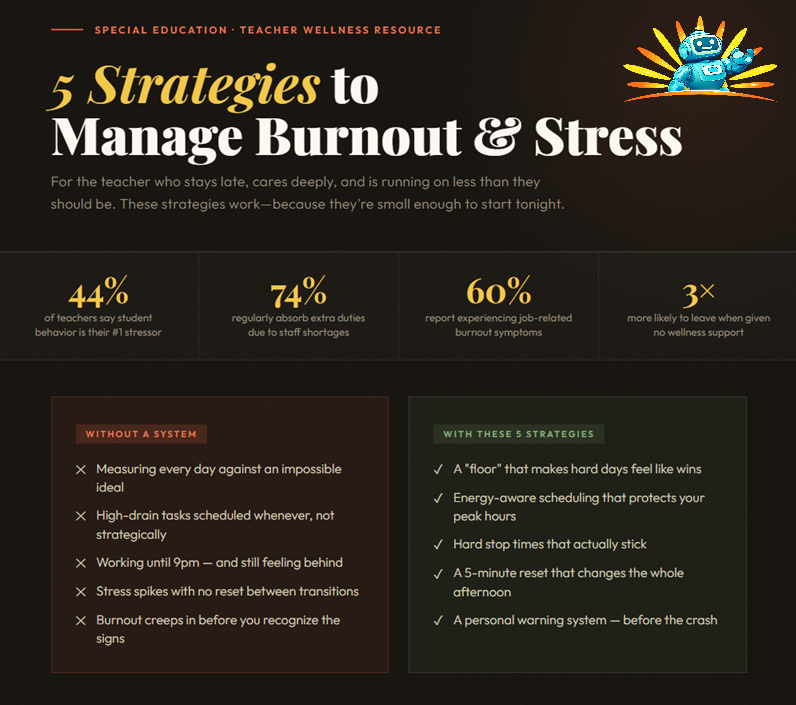
Burnout is not proof that you’re soft, or unprepared, or not cut out for this work. According to the RAND Corporation’s 2024 State of the American Teacher Survey, 44% of teachers named student behavioral challenges as their top stressor, and 74% reported regularly absorbing extra duties because of staff shortages. That’s not a personal failure. That’s a structural problem wearing your face.
The American Psychological Association defines burnout as chronic workplace stress that hasn’t been managed—marked by three things: emotional exhaustion, depersonalization (that creeping feeling of detachment from your students), and a reduced sense of personal accomplishment. All three can happen to the most dedicated, most caring teacher in the building. Actually, especially to them.
Knowing that matters. Because the first step to managing burnout is stopping the self-blame loop that keeps you stuck.
Now. The strategies.

Strategy 1: Build Your “Minimum Viable Day”
Here’s something I tell every teacher I mentor in their first year: you need a floor, not just a ceiling.
Most of us operate with an ideal day in mind—the lesson that lands perfectly, every accommodation in place, progress notes done, inbox at zero. And when the reality of the day (a dysregulated student, a last-minute IEP revision, a fire drill during your one prep period) crashes into that ideal, we feel like we failed.
That’s not burnout-proof thinking. That’s a trap.
A Minimum Viable Day asks a different question: What’s the least I need to accomplish today to consider this a professionally successful day? Not the best day. Not the Pinterest day. The enough day.
Mine looks like three things: compliance tasks done, students physically safe, one genuine connection made with a kid who needed it. That’s it. When two staff members call out and the copy machine jams and the afternoon bus is 40 minutes late—if those three things happened, I did my job.
Write yours down. Put it somewhere physical—a sticky note inside your plan book, a phone wallpaper, wherever you’ll actually see it on a hard Thursday. Then on the hardest days, measure yourself against the floor instead of the ceiling.
This single reframe has saved more teacher careers than any professional development session I’ve ever sat through.
Strategy 2: Do an Energy Audit (Not a Time Audit)
Most productivity advice treats all tasks as equal. But any special educator knows that writing a functional behavior assessment after a full teaching day is a completely different experience than writing it fresh at 7am. Same task. Entirely different cost.
The fix isn’t better time management. It’s energy-aware scheduling.
Every Sunday—takes me 10 minutes max—I look at the week ahead and sort my tasks into three buckets: High Drain, Medium, and Low. Then I schedule my High Drain tasks during my peak energy hours. For me that’s early morning. I protect that window hard. No checking email, no hallway conversations. Just the work that requires the most of me.
For this, I genuinely love Todoist. It’s free, color-coded, and lets you build a weekly view that actually reflects what costs what rather than just what’s due when. Once you can see your energy load across a week, you stop accidentally scheduling two high-drain tasks back to back and wondering why you’re destroyed by Wednesday.
Try it for two weeks. I’ve never had a teacher go back.
A note for special educators specifically: IEP writing, behavior plan revisions, parent meetings that go sideways—these are High Drain by default. Schedule them when you actually have something in the tank. Doing them when you’re already depleted is how good documentation turns into sloppy documentation, and how good teachers turn into burned-out ones.
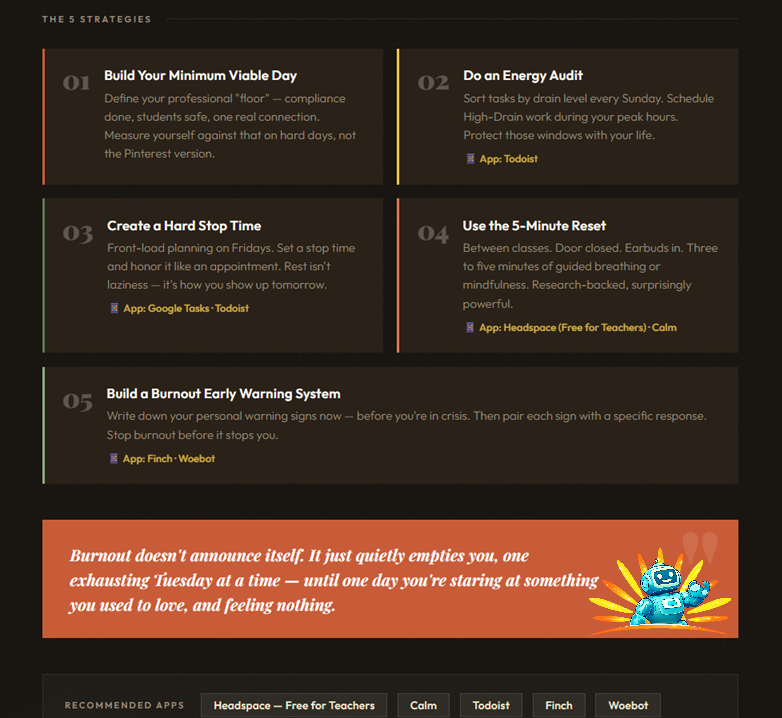
Strategy 3: Create a Hard Stop Time—and Actually Honor It
This is the one teachers resist the most. And I get it.
The work never feels done. There’s always another email, another accommodation to tweak, another set of data to chart. The idea of stopping at 5pm when the pile is still there feels irresponsible. Even selfish.
But here’s what I’ve learned after years in this work: teachers who work until 9pm every night don’t become better teachers. They become more exhausted versions of themselves making slower, worse decisions. The pile doesn’t get smaller. Your capacity to handle it does.
Set a hard stop. 5:30pm. 6pm. Whatever is realistic for your situation. Then treat it like a commitment to another person—because in a real way, it is. Future You is counting on Present You to leave something in the tank.
Two things that made hard stops stick for me:
Front-load your planning on Fridays. Whatever can be prepped for next week, do it before you leave on Friday. That way Monday morning isn’t a scramble, and Sunday doesn’t become a stealth workday. The “Sunday Scaries” that plague so many teachers are often directly caused by unfinished planning bleeding into the weekend. Close that loop on Friday.
Use Google Tasks or Todoist to capture everything still on your mind at stop time. Write it down, close the laptop, and let your brain actually rest. The act of externalizing the list is—neurologically—what allows your brain to stop rehearsing it at 11pm.
One more thing: this strategy is an act of care for your students, not an escape from them. A teacher who genuinely rests comes back with more patience, more creativity, and more presence. That’s what your kids need from you.
Strategy 4: Use the 5-Minute Reset Between Transitions
I know what you’re thinking. Mindfulness. You’ve been told to meditate so many times it’s become meaningless noise.
Stay with me for a second.
I’m not talking about a 30-minute morning yoga practice or a guided retreat. I’m talking about three to five minutes between classes, with your classroom door closed and your earbuds in. That’s it.
The research is hard to argue with. A 2021 randomized controlled trial published in Teaching and Teacher Education found that teachers who practiced brief mindfulness interventions showed significantly lower burnout scores and reported higher emotional regulation and patience with students than their control group counterparts. Three to five minutes. Measurable difference.
Headspace offers a free subscription for educators in the U.S.—it has an “SOS” feature that’s literally designed for moments of acute stress, with sessions as short as 3 minutes. I’ve done these in a supply closet. Parked in my car. Sitting at my desk with the lights off. It works.
Calm is the other one I rotate in—gorgeous interface, more variety in session length, and a strong sleep section if you’re also struggling to wind down at night (which, let’s be honest, most burned-out teachers are).
Pick one. Try it for a full week—not just once on a bad day. The benefit is cumulative. Your nervous system needs repeated evidence that you’re safe and okay before it stops bracing for impact during every transition.
And if apps aren’t your thing? Box breathing works just as well with zero technology. Inhale for 4 counts, hold for 4, exhale for 4, hold for 4. Do that three times. Your cortisol levels don’t care whether you paid $12.99 a month.
Strategy 5: Build a Personal Burnout Early Warning System
This last one is the most important. And the most underused.
Burnout doesn’t arrive all at once. It creeps. By the time most teachers recognize it, they’re already in the deep end—running on fumes, snapping at students they love, fantasizing about different careers. The window for early intervention has closed.
The fix is a personal early warning system: a short list of your specific signs that burnout is approaching, written down before you’re in crisis, so you can recognize them when your judgment is compromised.
Mine look like this: I stop enjoying lesson planning (which I normally love), I start dreading Monday on Friday afternoon, and I have zero patience for things that normally roll off me. When two of those three show up together? I intervene. I don’t push through.
Yours might be different. Maybe you stop responding to texts from teacher friends. Maybe your appetite changes. Maybe you stop caring whether your lessons are good or just adequate. Whatever your pattern is—name it now, while you’re clearheaded enough to be honest.
Then pair your warning system with a response plan. When warning sign #1 appears: schedule that hard stop tonight without exception. When two signs appear: reach out to another educator for a real conversation (not venting—connection). When all three appear: contact your EAP (Employee Assistance Program). Most districts offer free counseling sessions. Most teachers don’t use them. That gap is costing careers.
For daily mood tracking that feeds into this system, Finch is surprisingly effective—you raise a small virtual bird by completing daily wellness goals, which sounds ridiculous until you realize it’s built genuine habit compliance in teachers who respond to low-stakes accountability. Woebot uses evidence-based CBT techniques to walk you through cognitive reframing in real time and is completely free.
The point isn’t the app. The point is that you’re watching for yourself with the same attentiveness you bring to watching for your students. You deserve that level of care. Truly.

The Real Talk Conclusion
Here’s what I want you to hold onto after this:
Burnout is not a rite of passage. It’s not what separates the serious teachers from the ones who “couldn’t hack it.” It’s what happens when a person with enormous capacity gives more than they’re given back—and doesn’t have the right structures in place to catch themselves before the fall.
The five strategies in this post aren’t revolutionary. They’re not a secret. But they work—and they work specifically because they’re small enough to actually do while you’re already tired.
Start with one. Just one. Pick whichever one felt most urgent when you were reading. Implement it this week. Then come back for the next one.
You didn’t get into this work to survive it. You got into it to do it—for a long time, with your whole self, for kids who need you to still be standing in year fifteen.
Take care of the teacher. So the teacher can take care of the room.
📬 Ready for More? Join the Weekly Newsletter.
Every week I send one email: practical, no-fluff strategies for special educators navigating the real work. IEP tips, classroom tools, honest conversations about what this job costs us—and what keeps us in it.
No spam. No sales. Just one educator in your corner, every single week.
💬 Reflection Question
What’s your personal burnout early warning sign—the one thing that shows up first when you’re running too low—and what’s one thing you’ve done that actually helped refuel you?
Leave your answer in the comments. I read every single one. Your experience might be exactly what another teacher needs to hear today.
❓ Frequently Asked Questions
Q: Is burnout the same as just being tired?
No—and this distinction matters. Being tired is situational and resolves with rest. Burnout is chronic and involves three components: emotional exhaustion, depersonalization (feeling detached from your students or work), and a reduced sense of personal accomplishment. If rest isn’t restoring you anymore, that’s a signal it’s moved into burnout territory.
Q: Can I recover from burnout without taking time off?
Yes, but it requires deliberate effort—not just willpower. Time off helps, but it doesn’t fix the underlying patterns. The strategies in this post are designed specifically for active recovery during the school year, not just maintenance during breaks.
Q: What if my administration won’t support any of this?
Most of these strategies don’t require administrative buy-in. A hard stop time, an energy audit, a 5-minute mindfulness reset, a Minimum Viable Day—all of these are entirely within your control. Start there. Advocacy for systemic change matters, but you can’t wait for the system to be fixed before you take care of yourself.
Q: Are these strategies specific to special education?
The strategies apply broadly, but I’ve written them with special educators specifically in mind—because our caseloads, compliance demands, and emotional labor are uniquely intense. If you’re a general education teacher reading this, everything here still applies.
Q: When should I consider leaving teaching?
That’s deeply personal, and I’d never answer it for someone else. A useful frame: if you’ve implemented real strategies for three to six months and still feel no sustained improvement—and the thought of another school year genuinely frightens you—it may be worth speaking with a therapist or trusted mentor about your options. Leaving isn’t failure. And staying at the cost of your health isn’t dedication.
📚 References
- RAND Corporation. (2024). State of the American Teacher Survey 2024. https://www.rand.org/education-and-labor/projects/state-of-the-american-teacher.html
- Maslach, C., & Leiter, M. P. (2016). Understanding the burnout experience: Recent research and its implications for psychiatry. World Psychiatry, 15(2), 103–111. https://doi.org/10.1002/wps.20311
- Tsang, K. K. Y., Lian, Y., & Teng, Y. (2021). Teacher burnout and mindfulness-based intervention: A randomized controlled trial. Teaching and Teacher Education, 106, 103453. https://doi.org/10.1016/j.tate.2021.103453
- American Psychological Association. (2023). Work, stress, and health: Teacher mental health. https://www.apa.org/topics/teacher-stress
- Edutopia. (2023). Mindfulness apps for teachers: What actually works in the classroom. https://www.edutopia.org
- Headspace for Educators. (2024). Free access for U.S. teachers and school staff. https://www.headspace.com/educators
- SimpleK12. (2024). 60+ mental health statistics every educator should know. https://www.simplek12.com
- Anxiety Canada. (2024). MindShift CBT — Cognitive behavioral therapy tools for anxiety and stress. https://www.anxietycanada.com/resources/mindshift-cbt