I remember sitting in a windowless conference room early in my career, staring at a draft IEP for a student who was both a newcomer to the country and a learner with a significant cognitive disability. The goal I had written was generic: “The student will read 10 sight words with 80% accuracy.” My mentor leaned over, tapped the paper, and asked, “Is he failing to read those words because of his disability, or because he’s still acquiring the English language? And how will this goal help him get a job one day?”
I didn’t have an answer. In that moment, I realized that writing IEP goals for English Language Learners (ELLs) with disabilities is like trying to solve a Rubik’s cube while the colors are still shifting. It’s a delicate balance of linguistic acquisition and cognitive support.
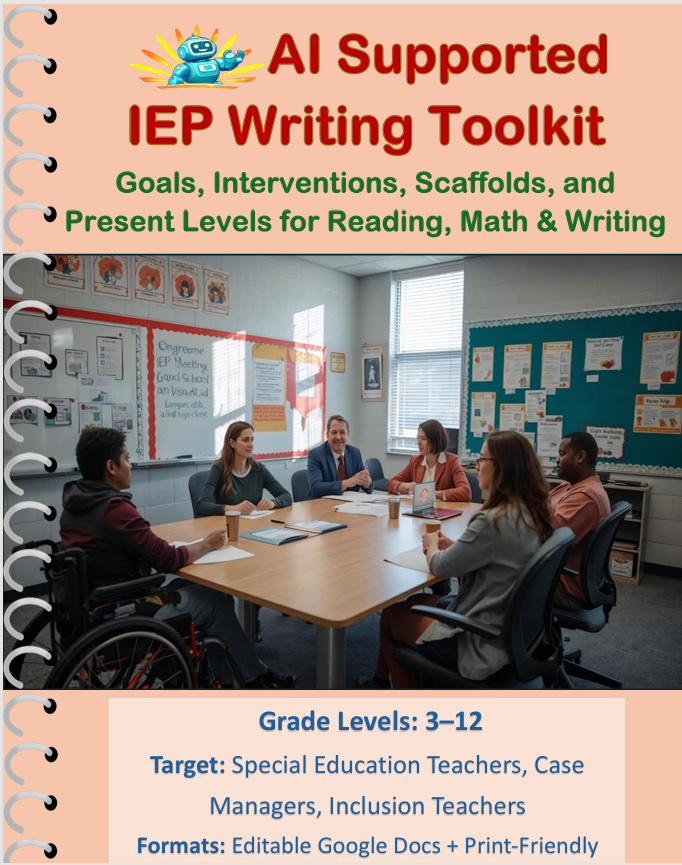
If you’re a new teacher feeling that same “drafting paralysis,” I’m coaching you today. We are going to move away from “cookie-cutter” goals and toward objectives that respect the student’s heritage while preparing them for the workforce. To make this process less of a midnight headache, I’ve started using my AI-Supported IEP Writing Toolkit. It’s the framework I use to ensure I’m hitting all the legal checkboxes without losing the student’s humanity.
1. The “Dual Lens” Framework
When we write for ELL-SPED students, we must look through two lenses simultaneously: the Individualized Education Program (IEP) and the English Language Proficiency (ELP) standards.
Common Mistake: The “Language-Only” Goal
Many teachers accidentally write goals that penalize a student for not being fluent in English. For example, requiring a student to “verbally explain” a complex financial concept when they are in the “Pre-production” phase of language learning is testing language, not math.
The Coaching Shift: Focus on Language-Independent Markers. Can the student show you the answer? Can they sort? Can they use a digital icon?
2. Before and After: The Transformation
Let’s look at how to take a “Compliance Goal” and turn it into a “Functional Independence Goal.”
| The “Before” (Generic) | The “After” (Functional & ELL-Sensitive) | Why it Works |
| Student will identify 5 coins in English with 80% accuracy. | Given a visual price tag and a field of 3 coins, Student will select the correct coin to “pay” for an item using a bilingual communication board with 4/5 correct trials. | It uses visual supports (PLUSS) and focuses on the vocational “action” rather than just naming a noun. |
| Student will write a 3-sentence paragraph in English. | Using a RACE writing frame and a translated word bank, Student will construct a 3-part digital reflection on a workplace safety video with 1 or fewer gestural prompts. | It honors the “Productive Struggle” by providing the bridge (the frame) for the language gap. |
3. Integrating the PLUSS Framework into Goals

If you want your goals to be successful in our 3-hour blocks (English, Financial Literacy, and Digital Literacy), you must bake the PLUSS framework directly into the “Condition” section of your IEP goal.
- P (Pre-teaching): “Following a pre-taught vocabulary lesson…”
- L (Language Modeling): “…after a teacher-led metacognitive model…”
- U (Visuals): “…using high-contrast icons and bilingual labels…”
- S (Strategic Integration): “…using a digital translation tool…”
- S (Sustained Talk): “…after discussing the prompt with a peer…”
By embedding these into the goal, you aren’t just saying what they will do; you are legally requiring the support that helps them do it. I’ve refined these “Condition Statements” in the AI-Supported IEP Writing Toolkit so you can copy and paste the scaffolds that fit your Level 1, 2, or 3 learners.
4. Downloadable Goal Bank Templates
Here are three templates you can use for your next ARD or IEP meeting. These are designed for students with significant cognitive disabilities who are also ELLs.
The Vocational Reading Goal (Level 2/3)
“Given a digital informational text (e.g., a bus schedule or work order) and a bilingual visual checklist, [Student] will identify the ‘start time’ and ‘location’ by highlighting the text in 4 out of 5 daily trials as measured by a Digital Literacy Academy log.”
The Functional Communication Goal (Level 1)
“During the ‘Partner Work’ phase of a Financial Literacy lesson, [Student] will use a picture exchange system or AAC device to request a ‘Needs’ or ‘Wants’ item from a peer in 3 out of 5 opportunities across 2 consecutive weeks.”
The Metacognitive Writing Goal (Level 3)
“Given a RACE writing frame and a word bank of core values, [Student] will select and ‘write’ (via typing or speech-to-text) a reflection sentence describing a personal strength in 80% of English block assignments.”
5. Avoiding the “Prompt Dependency” Trap
When writing these goals, be very careful with your “Criteria for Success.” If you write “With teacher assistance,” you are writing a goal for yourself, not the student.
The Strategy: Use a Prompt Hierarchy.
- “With 2 or fewer gestural prompts…”
- “Independently using a visual schedule…”
- “Following a natural cue…”
We want these students to be workforce-ready. In a job, the natural cue is the “Done” pile, not the teacher saying “Good job, now do the next one.” Tracking this on a data sheet is vital, and having a toolkit like the AI-Supported IEP Writing Toolkit helps you generate the specific “Criteria” language that reflects true growth in independence.
6. The “Digital Literacy” Connection

For our ELL-SPED students, technology is the great equalizer. When I write goals, I almost always include Adaptive Software or Multimedia Tools. If a student can’t write with a pencil, can they use a “Drag and Drop” feature on a tablet? If they can’t speak English fluently, can they use an AI-powered translation app to communicate with a coworker?
These aren’t “cheating”; they are Assistive Technology requirements that belong in the IEP.
A Final Coaching Note
The paperwork is hard, but the purpose is clear. Every goal you write is a promise to that student that you see their potential, regardless of the language they speak or the way their brain processes information.
Don’t let the technicality of the IEP process drown out your “Teacher Voice.” You are the one who knows how they smile when they finally match that “Budget” icon correctly. Write that success into the document.
Reclaim Your Weekends
Stop staring at the blinking cursor. You have a classroom to lead and students to inspire.
Your Action Plan:
- Audit one goal: Look at a current ELL-SPED goal. Is it testing language or the actual skill?
- Streamline your drafting: Grab the AI-Supported IEP Writing Toolkit to help you bridge the gap between “Compliance” and “Connection.”
- Join the community:
Reflection Question: Think about your most complex learner who is also an ELL. If you could remove the “Language Barrier” for just one hour, what academic skill do you think they would surprise you with the most? I’d love to hear your thoughts—it usually tells you exactly what their next IEP goal should be.