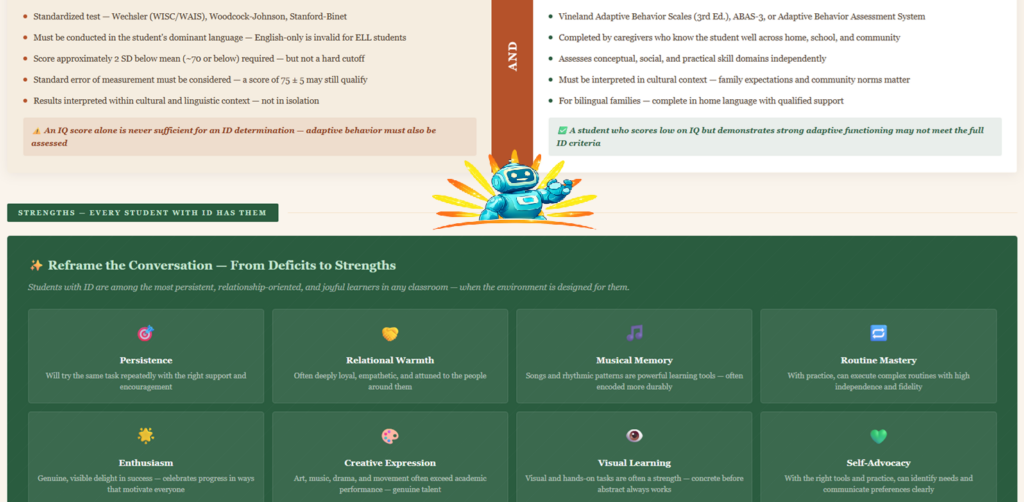
Intellectual Disability under IDEA requires significant deficits in both intellectual functioning AND adaptive behavior — not just a low IQ score. It is not a ceiling on what a student can learn; it is a description of where they are starting from. This post covers eligibility, evidence-based instruction strategies, sensory accommodations, and the bilingual-specific considerations every teacher needs to understand before working with students who carry this label.

I want to start with something honest before we get into any definitions or data.
The label “Intellectual Disability” carries history. A long, painful, undignified history of segregation and institutionalization and profoundly low expectations. And while the field has moved forward significantly, I still walk into classrooms where 15-year-olds with ID are coloring worksheets. Where IEP goals haven’t meaningfully changed in three years. Where the teacher — genuinely caring, genuinely trying — has quietly stopped expecting growth because nobody modeled for them what high expectations actually look like in this context.
That’s not malice. It’s what happens when good people don’t have good tools or honest coaching.
So consider this that coaching.
And before we dig in — if you’re building your classroom supports as you read, I want to point you to my AI-Enhanced Anchor Charts for SPED & ELL students on TpT. For students with ID specifically, a well-designed anchor chart functions differently than it does for other learners — it’s not just a reference. It’s a cognitive prosthetic. It externalizes the steps of a task so the student’s limited working memory can go toward actually doing the work, rather than holding the directions in mind. That distinction matters a lot. I’ll keep coming back to it.
What Is Intellectual Disability Under IDEA — and Why Does the Full Definition Matter So Much?
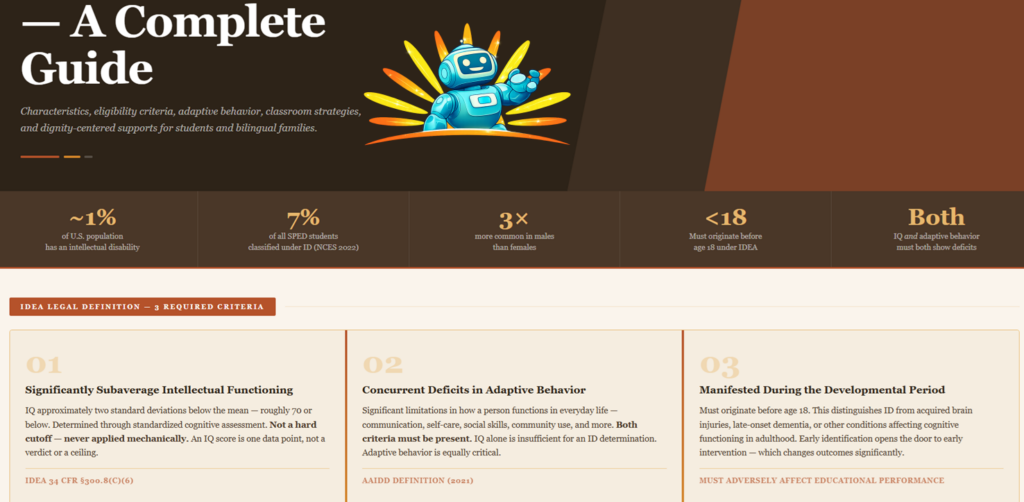
Under IDEA 34 CFR §300.8(c)(6), Intellectual Disability is defined as “significantly subaverage general intellectual functioning, existing concurrently with deficits in adaptive behavior and manifested during the developmental period, that adversely affects a child’s educational performance.”
Three parts. All three matter.
Part 1: Significantly subaverage general intellectual functioning. Typically determined through standardized cognitive assessment — IQ scores approximately two standard deviations below the mean, meaning roughly IQ 70 or below. But this is not a hard cutoff and should never be applied mechanically. An IQ score is one data point. It is not a verdict. It is not a ceiling. It is a snapshot of performance on a specific set of tasks on a specific day under specific conditions. Nothing more.
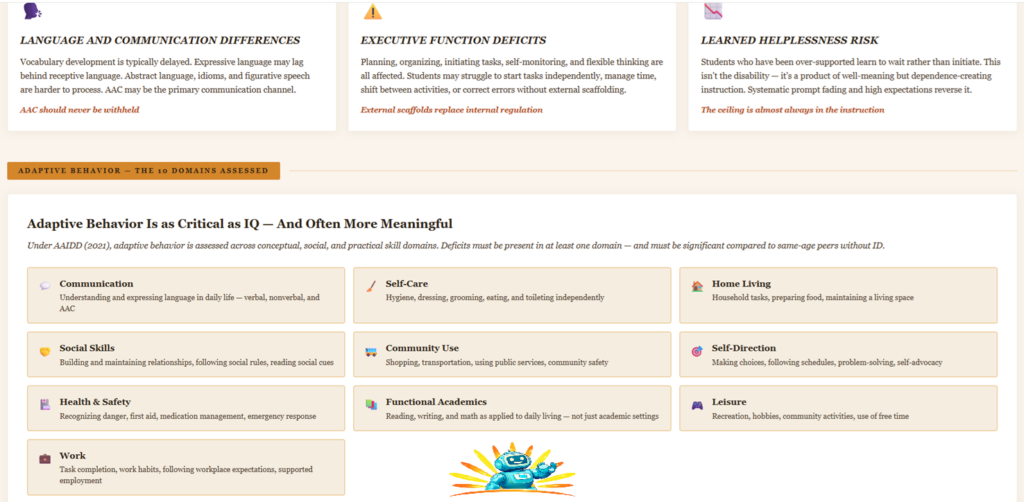
Part 2: Deficits in adaptive behavior. This is the criterion that gets underweighted in practice — and that underweighting has done real damage. According to the American Association on Intellectual and Developmental Disabilities (AAIDD), both intellectual functioning AND adaptive behavior must show significant limitations for ID to apply. Adaptive behavior means how a person actually functions in daily life: communication, self-care, home living, safety, social skills, community use, self-direction, health, functional academics, work, and leisure. A student with a low IQ who manages daily life with relative independence may not meet the full criteria. A student with borderline cognitive scores who has significant adaptive deficits across multiple domains very well might.
Part 3: During the developmental period — before age 18. This distinguishes ID from acquired brain injuries or late-onset conditions that affect cognitive functioning in adulthood.
All three. Together. With demonstrated educational impact. That’s the legal standard, and knowing it prevents the reductive “they got a low score so they have ID” thinking that has caused so much harm.
According to the National Center for Education Statistics (2022), approximately 7% of students receiving special education services are classified under Intellectual Disability — making it the third most common IDEA category after Speech/Language Impairment and Specific Learning Disability.
⚡ Quick Win — The Language Shift That Actually Changes Practice“Mental Retardation” was replaced in federal law by “Intellectual Disability” through Rosa’s Law in 2010. But changing language in a statute doesn’t automatically change language in hallways and staffrooms. Use person-first language consistently: “student with an intellectual disability” — not “intellectually disabled student” and absolutely never any outdated term. The words we use shape the expectations we hold. They signal what we believe is possible. Watch yours closely.
What Does ID Actually Look Like in Your Classroom — and Why Is the Range So Wide?
Here’s something nobody tells new teachers clearly enough about working with students with ID: the category is extraordinarily heterogeneous. The range of communication styles, cognitive profiles, support needs, sensory presentations, and individual strengths across students who qualify under this single label is wider than almost any other IDEA category.
You might have a student who communicates fluently in two languages and navigates their neighborhood independently but struggles significantly with abstract reasoning and working memory demands. You might have another who is minimally verbal, uses AAC for all communication, and needs full support for many daily living tasks. Both may qualify under ID. Both need completely different instruction.
Which is the most important point I can make about teaching students with ID: there is no generic ID instruction. There is only individual instruction — built from each student’s actual profile, held to genuinely high expectations for growth.
Working Memory: The Core Challenge
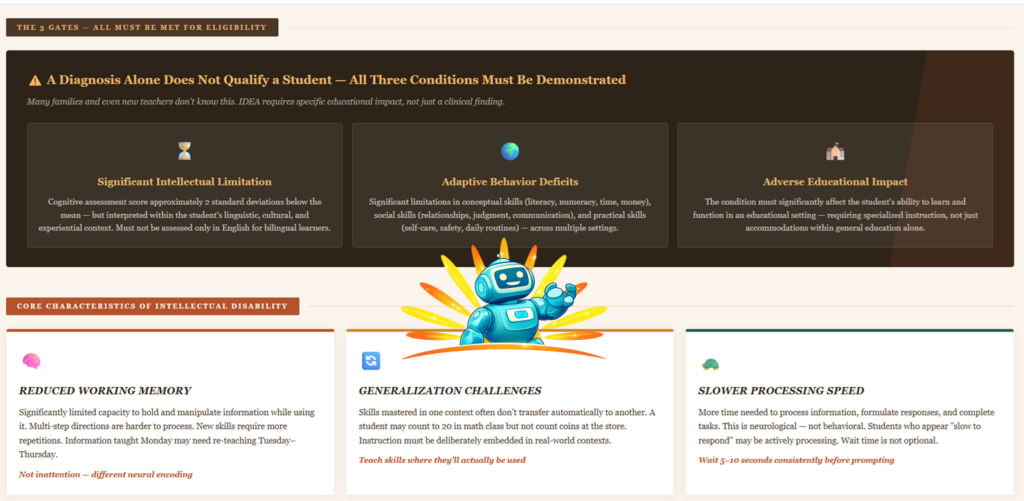
Across the range of ID presentations, one of the most consistent patterns is reduced working memory — the brain’s capacity to hold and manipulate information while using it. Multi-step directions are harder to follow not because of inattention, but because the neural architecture for holding multiple instructions simultaneously is genuinely different. A concept taught on Monday may need to be revisited on Tuesday, Wednesday, and Thursday before it’s independently retrievable — not because the student wasn’t paying attention, but because encoding takes more time and requires more varied practice.
The instructional response to this isn’t simpler content or slower pacing. It’s better designed instruction — broken into smaller chunks, with more practice opportunities, multiple encoding modalities, and consistent visual supports that externalize what working memory can’t hold. This is why visual anchor charts aren’t optional for students with ID. They do real cognitive work. My bilingual SPED and ELL anchor charts were built specifically to function this way — as consistent, accessible reference tools in both English and the home language, visible and used throughout the day.
The Generalization Problem
Students with ID often master a skill in one context and then can’t apply it in a different one. They learn to count to 20 in math but not in the lunch line. They read a decodable reader accurately but can’t apply the same phonics patterns in a science text. This isn’t a memory failure — it’s a characteristic of how learning generalizes differently when working memory and executive function are constrained.
The solution isn’t drilling in isolation. It’s deliberately teaching the skill across multiple settings, with varied materials, with explicit bridges between contexts, and ideally in the environments where the skill will actually be used. Community-based instruction exists for exactly this reason.
Learned Helplessness — and How We Create It
This one’s hard to say but necessary. Many students with ID have been in environments so defined by support and simplified tasks that they’ve learned to wait rather than try. They watch the paraprofessional. They pause and look before initiating anything. They’ve been trained — by well-meaning adults — into a pattern where dependence is the default.
That’s not the disability. That’s the instruction. And it’s reversible. But reversing it requires you to design for independence from day one — including tolerating the discomfort of waiting, of watching a student struggle briefly, of resisting the jump-in impulse that comes from care but produces dependence.
💚 Dignity-Centered Teaching — This Is Non-NegotiableAge-appropriate materials for every student, every age. A 16-year-old with significant ID should not be doing worksheets with cartoon characters designed for kindergarteners. The academic level can be modified. The vocabulary can be simplified. The materials must reflect who this student actually is — their age, their identity, their dignity. This matters for how the student sees themselves and how everyone around them sees them too. It is not optional.
What Does Evidence-Based Instruction Actually Look Like for Students With ID?
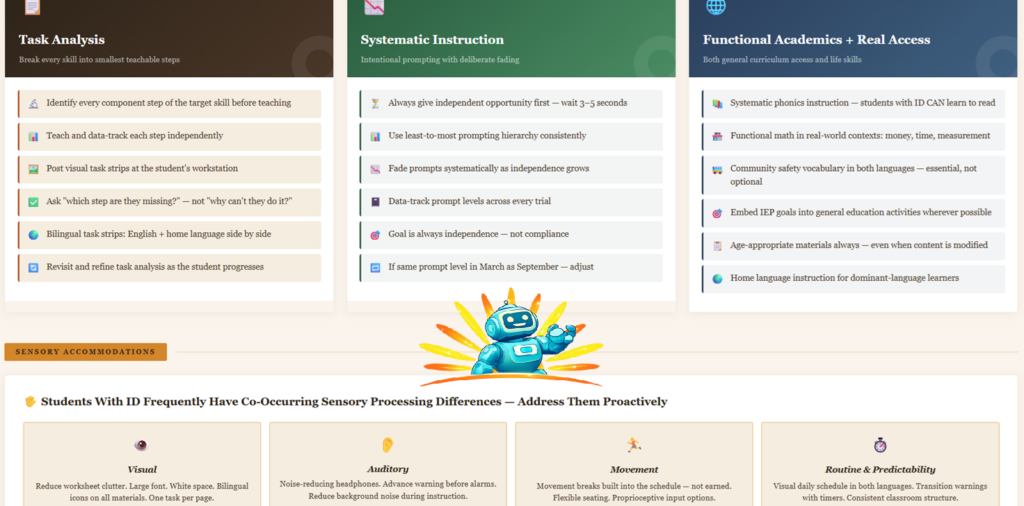
Strategy 1 — Task Analysis: The Foundation Before Everything Else
Task analysis is the process of breaking a complex skill into its smallest teachable components, then teaching each component explicitly and sequentially with data. It sounds simple. It is profoundly, consistently underused in practice.
For a student with ID, the question isn’t “can they learn to write a paragraph?” The question is: “What are every single component steps involved in writing a paragraph, and which ones does this student currently have — and which ones are missing?” Generating an idea. Turning the idea into a sentence. Starting with a capital letter. Ending with a period. Adding a second connecting sentence. Checking the work. Each step, explicitly taught, data tracked.
When you task analyze well, you stop asking “why can’t they do this” and start asking “which specific step are they missing and how do I teach it?” The second question is answerable. And it’s the one that actually leads somewhere.
This is exactly why visual anchor charts function as genuine instructional infrastructure for students with ID — not classroom decoration, not optional supports, but the scaffolding that makes independent task completion possible. The bilingual reading, writing, and math anchor charts I built for SPED and ELL classrooms are designed around this principle: break the process into visible, accessible steps that the student can navigate independently over time.
Strategy 2 — Systematic Instruction and Deliberate Prompt Fading
The research base for systematic instruction with students with intellectual and developmental disabilities is among the strongest in all of special education. According to the AFIRM Modules at UNC Frank Porter Graham Child Development Institute, systematic instruction is one of the most empirically supported practices available for students with ID — across academic, functional, and social skill domains.
The most widely researched approach is the system of least prompts: give the student an opportunity to respond independently first. If they don’t respond within 3–5 seconds, provide the least intrusive prompt necessary. Work up the hierarchy to more intrusive prompts only if needed. Track which prompt level was required. Fade prompts systematically as independence builds.
The goal is always independence. If you’re providing the same prompt level in March that you were providing in September for the same skill, something needs to change — either in how the task is broken down, how prompts are sequenced, or how mastery is being defined.
⚡ Quick Win — The Reframe That Changes EverythingStop asking “what is this student’s IQ?” and start asking “what does this student need to learn this skill?” The first question gives you a number. The second gives you an instructional plan. The most effective teachers of students with ID that I’ve ever worked alongside have stopped thinking in terms of cognitive ceilings and started thinking entirely in terms of instructional design. In my experience, the ceiling is almost always in the instruction — not the student.
Strategy 3 — Functional Academics Alongside Real Academic Content
Here’s the tension every ID teacher has to navigate honestly: IDEA requires access to the general curriculum AND many students with significant ID need functional life skills instruction. Both are true. And the answer isn’t either/or — it’s both, thoughtfully integrated, based on what this particular student needs to live a full and self-determined life.
A student can be working toward genuine literacy — real, systematic, explicit phonics instruction — while also learning to identify community safety signs, manage money, prepare food, and navigate public transportation. These aren’t alternatives to academics. They’re alongside them, with the same rigor and the same expectation of growth.
For bilingual students with ID, functional academic instruction should happen in the home language when that’s the student’s dominant language. The words for “danger,” “exit,” “help,” and “poison” may need to be learned and generalized in Spanish before they transfer reliably to English. Safety doesn’t wait for language acquisition.
Strategy 4 — AAC and Technology That Remove Communication Barriers
For students with ID who are minimally verbal or nonverbal, AAC is not supplementary. It’s the primary channel through which learning and communication can happen. Withholding AAC because a student “needs to use their voice first” is not just incorrect — it’s harmful and entirely unsupported by any evidence base.
- Proloquo2Go — the most widely used AAC app in special education, customizable, available in multiple languages including Spanish
- Boardmaker Online — create bilingual visual schedules, communication boards, task analysis strips, and social stories with picture symbol support
- News-2-You — adapted current events and literacy content at multiple access levels for students with significant ID
- Unique Learning System — standards-based adapted curriculum across multiple differentiated levels for students with significant support needs
- Choiceworks — visual schedule and choice-making app that supports both receptive language processing and behavioral regulation
- TouchChat HD — strong AAC option with vocabulary depth and bilingual support built in
🛠️ Visual Task Analysis Tools Built for Students With ID
If you want the ready-made version of the bilingual visual supports and task analysis anchor charts I described throughout this post — designed specifically for SPED and ELL classrooms — I built a complete classroom toolkit on TpT. These aren’t decoration. They’re designed to function as genuine cognitive scaffolds that build toward student independence.→ Grab the AI-Enhanced Anchor Chart Bundle on TpT
Sensory Accommodations, Visual Supports in Multiple Languages, and Social Stories
Students with ID frequently have co-occurring sensory processing differences — and these are chronically underaddressed. The student covering their ears during whole-group instruction isn’t being difficult. The student who mouths objects or rocks during independent work is self-regulating. These behaviors communicate sensory need. Responding with redirection rather than accommodation misses the point entirely and makes the underlying dysregulation worse.
Sensory accommodations that actually move the needle:
- Predictable daily routines posted visually in English and the home language — schedule changes are significantly harder for students with ID who have fewer verbal resources for processing unexpected change
- Transition warnings paired with visual countdown timers — verbal warnings alone may not be processed reliably
- A proactive calm-down space that students practice using during calm moments, not discovered for the first time in crisis
- Reduced visual clutter on instructional materials — white space, large font, one task per page, clear visual hierarchy
- Built-in movement opportunities throughout the day — not earned through behavior, but structured into the schedule as regulation tools
- Fidget tools and proprioceptive input options as standard classroom equipment, not special accommodations
For bilingual students with ID, visual supports in the home language aren’t extras — they’re access. A student who processes information better in Spanish should have their daily schedule, task cards, first-then boards, and communication supports in Spanish. The cognitive effort that goes toward language processing should go toward the learning target. That is an equity issue and needs to be treated as one consistently.
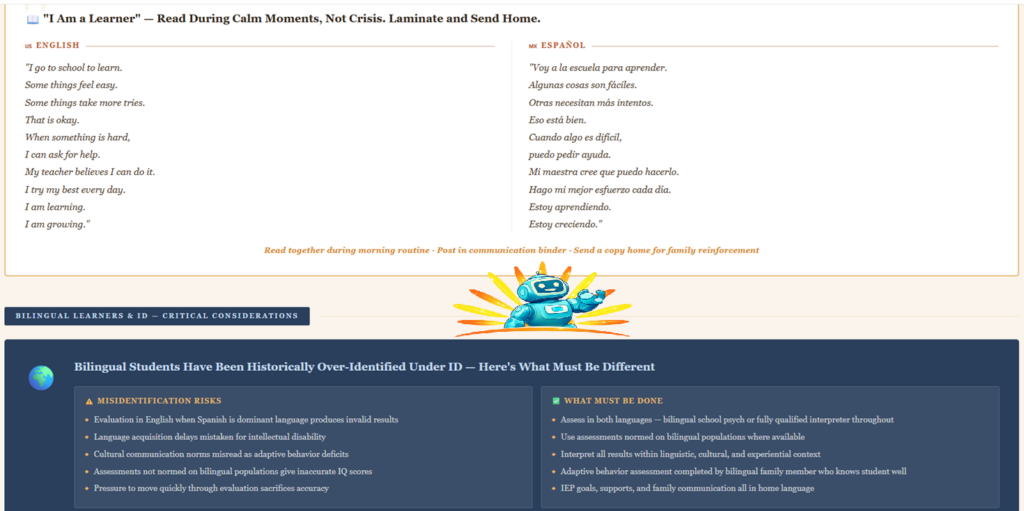
Social Story: “I Am a Learner” — English and Spanish
English: “I go to school to learn. Some things feel easy. Some things take more tries. That is okay. When something is hard, I can ask for help. My teacher believes I can do it. I try my best every day. I am learning. I am growing.”
Spanish: “Voy a la escuela para aprender. Algunas cosas son fáciles. Otras necesitan más intentos. Eso está bien. Cuando algo es difícil, puedo pedir ayuda. Mi maestra cree que puedo hacerlo. Hago mi mejor esfuerzo cada día. Estoy aprendiendo. Estoy creciendo.”
Read it together during the morning routine — not after a difficult moment. Send a copy home. Revisit it when a student is frustrated, not as a correction but as grounding. These simple narratives shape how a student tells their own story as a learner. Over time, that internal narrative does real work.
The Bilingual-ID Intersection: Where the Most Harm Has Been Done and the Most Repair Is Needed
This section is non-negotiable for anyone working in a bilingual or multilingual context.
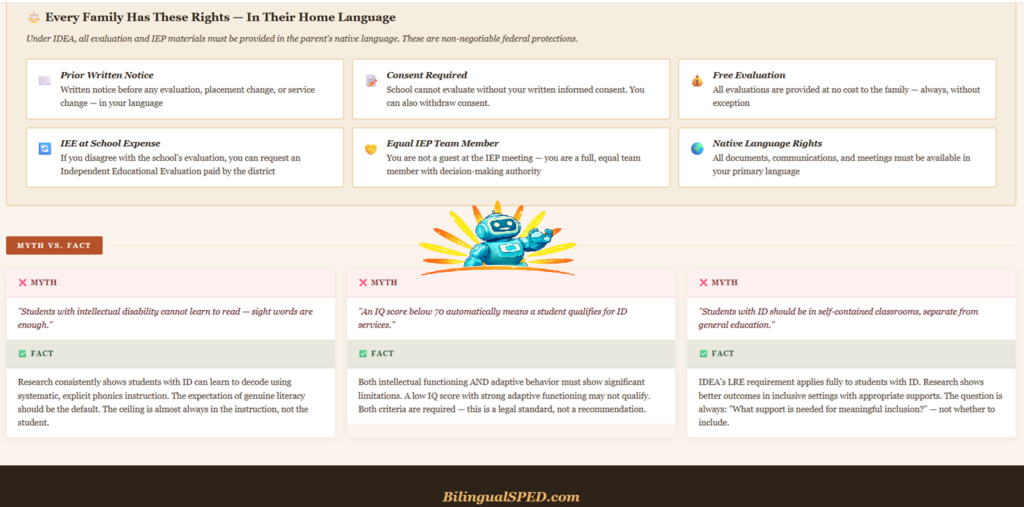
Bilingual students have been systematically over-identified for Intellectual Disability for decades — evaluated in English when English was not their dominant language, assessed using measures not normed on bilingual populations, and placed in ID programs based on results that reflected language acquisition, not cognitive functioning. According to Colorín Colorado’s research on ELLs and special education, this pattern of misidentification is well-documented and ongoing across the U.S.
The standard for any ID evaluation of a bilingual student must be: assessment conducted in both languages, by a bilingual school psychologist or with a fully qualified interpreter involved throughout the assessment process — not just the parent meeting — using instruments normed on bilingual populations where available, and interpreted within the student’s full linguistic, cultural, and life experience context.
For students correctly identified with both ID and ELL status — and this is a real population that deserves both labels honored simultaneously — the IEP must address both realities. Instruction in the home language where appropriate. Communication supports in the home language. Family engagement in the home language. Goals that account for where the student actually functions across both language contexts.
⚠️ Know This — and Push Back When It’s ViolatedUnder IDEA, evaluations must be conducted in the child’s native language or other mode of communication unless clearly not feasible. If a student’s dominant language is Spanish and the evaluation is conducted only in English, those results are not valid for determining ID eligibility. Full stop. Push back on this when you see it — even when the pressure is to move quickly. The student’s future is worth the slower, more accurate process.
What Would I Refine? An Honest Teacher Reflection
If I could go back to my first years teaching students with ID, I’d write better IEP goals from the start.
My first goals were vague and low. Honestly written to guarantee success rather than promote growth — which feels kind until you realize that a student with ID who completes every goal with ease at the end of the year didn’t grow because the goal didn’t demand it. “Student will improve reading skills with 80% accuracy.” What skill? Under what conditions? With what materials? Measured how? A substitute should be able to implement that goal correctly on day one. Mine couldn’t.
I’d also involve families in goal-setting genuinely and early — not presenting goals to sign, but actually asking: What does your child need to do at home that they currently can’t? What would change their daily life? What does independence look like in your family’s context and culture? Those answers belong in the IEP. And bilingual families especially deserve this conversation in their language, not through a rushed interpreter at the very end of a 45-minute meeting.
And I would have used my bilingual anchor charts from week one — consistently visible, consistently referenced, consistently used — so students built the habit of going to the chart independently before asking for help. That shift from teacher-directed to student-initiated is the whole goal. It takes time to build. Start early. Start intentionally.
3 FAQs About Intellectual Disability Under IDEA
❓ Is Intellectual Disability determined by an IQ score alone?
No — and this is one of the most important corrections to make in how ID is understood and evaluated. Under IDEA and the AAIDD definition, Intellectual Disability requires significant limitations in both intellectual functioning AND adaptive behavior, originating during the developmental period. A low IQ score is one component — not a sufficient condition on its own. A student with a low score who demonstrates strong adaptive functioning across daily life domains may not meet the full criteria. A student with borderline cognitive scores who has significant adaptive deficits across communication, self-care, social skills, and practical domains may well qualify. The evaluation must be comprehensive, conducted in the student’s dominant language, and interpreted by a multidisciplinary team that considers the full picture — not a single number from a single assessment day.
❓ Can students with Intellectual Disability learn to read — real reading, not just sight words?
Yes. Full stop. This question gets asked more often than it should, and that frequency tells you something about the low expectations baked into how we think about ID. Research consistently demonstrates that students with intellectual disability can learn to decode and read using systematic, explicit phonics instruction — the same foundational approach that works for all beginning readers. The pace will likely differ. More repetitions and more varied practice will be needed for mastery. The instructional design needs to be tighter and more intentional than it might be for a typical learner. But the cognitive architecture for learning to read exists in the brains of most students with ID, and the expectation of genuine literacy should be the default for every student on your caseload until the specific evidence with that specific student says otherwise. In my experience, the ceiling is in the instruction far more often than it is in the student.
❓ Should students with Intellectual Disability be educated in general education settings?
Yes — to the maximum extent appropriate, which is exactly what IDEA’s Least Restrictive Environment requirement mandates for every disability category, including ID. The research on inclusion for students with intellectual disability is consistent: students educated in inclusive settings demonstrate better academic outcomes, stronger social skills development, and better post-secondary outcomes compared to students educated primarily in segregated settings. This doesn’t mean inclusion without support. It means thoughtfully designed inclusive environments with appropriate co-teaching, paraprofessional support, modified materials, and IEP goals embedded into general education contexts. The question for every placement decision should never be “can this student be included?” It should be “what supports does this student need to be meaningfully included in this setting?” The answer to that question determines the supports — not the placement.
References
- U.S. Department of Education. IDEA Regulations, 34 CFR §300.8(c)(6): Intellectual Disability. sites.ed.gov/idea
- American Association on Intellectual and Developmental Disabilities. Definition of Intellectual Disability. aaidd.org
- AFIRM Modules, Frank Porter Graham Child Development Institute, UNC Chapel Hill. Systematic Instruction for Students with Intellectual and Developmental Disabilities. afirm.fpg.unc.edu
- Colorín Colorado. Special Education and English Language Learners. colorincolorado.org
- National Center for Education Statistics. (2022). Students with Disabilities Served Under IDEA. nces.ed.gov
💜 Get More Real-Talk Special Education Resources in Your Inbox
Join the BilingualSPED community — practical, research-backed coaching for bilingual special educators who are doing the real, complicated, meaningful work of teaching students with disabilities. IEP tools, classroom strategies, freebies, and the honest conversation this field needs more of.
📚 The Classroom Toolkit Built for Students With ID and ELL Students
Bilingual task analysis anchor charts, step-by-step reading and writing process scaffolds, and math supports — designed to function as genuine cognitive tools, not decoration. Built for real SPED classrooms by a bilingual special educator who’s been in the room and knows what teachers actually need.→ Get the AI-Enhanced Anchor Chart Bundle on TpT
💬 Reflection Question
Think about a student with ID on your caseload right now. If you’re really honest with yourself — are the goals in their IEP genuinely ambitious? Or were they written to make sure the student succeeds rather than grows? What’s one goal you could rewrite this week that raises the bar while still being achievable with the right instructional design?
Drop your answer in the comments. The most powerful professional learning I’ve ever experienced happened in conversations exactly like this one. Don’t hold back.
📌 You Might Also Like
- Autism Spectrum Disorder (ASD): Medical Diagnosis vs. IDEA Eligibility — The Difference That Matters
- Speech and Language Impairment: Articulation, Stuttering, and Language Processing Explained
- Emotional Disturbance (ED): What Qualifies, What Doesn’t, and How to Support Students Who Are Struggling
- ELL Students in Special Education: Avoiding Misidentification and Building Real Support
- How to Write IEP Goals That Actually Move Students Forward