
.
AI helps maintain rigorous learning goals while removing barriers to access.
- A.C.C.E.S.S. Literacy Framework
.
The A.C.C.E.S.S. AI Lesson Scaffold Generator could become the flagship tool in our AI ecosystem because it operationalizes our core philosophy: maintain rigorous learning goals while removing barriers to access.
Unlike generic “lesson plan generators,” this tool should focus on scaffolding, not replacing teacher planning. It should help teachers answer:
- How can I make this lesson accessible to multilingual learners?
- How can I support students with disabilities without lowering expectations?
- What scaffolds can I gradually release as students gain independence?
- How can I align supports to WIDA, UDL, and evidence-based practices?
.
.
A.C.C.E.S.S. AI Partner
Instructional Scaffold Plan
Ready to Design Scaffolds
Fill in your lesson parameters on the left panel and click “Generate Scaffold Plan” to build your differentiated framework while maintaining grade-level rigor.
.
Key Features Included:
.
- Full WCAG 2.2 AA Accessibility & UDL Focus: High contrast mode toggle, dark mode, keyboard navigation, clear ARIA labeling, and responsive design.
- Pedagogical Integrity: Built with WIDA Can-Do philosophy, Specially Designed Instruction (SDI) principles, and standard-aligned cognitive rigor preservation.
- Comprehensive Scaffold Output (15 Sections): Includes Accessibility Snapshot, Gradual Release Roadmap, MLL Word/Sentence Supports, SPED Accommodations, UDL Matrix, 4-Tier Differentiation Pathways, Scripts, Student-Friendly Statements, Materials Checklist, Assessment Plan, Small Group Groups, Family Connection Bridge, and printable Quick-Ref Card.
- Export & Persistence Capabilities: Instant local session saving (
localStorage), Copy to Clipboard, Browser Printing, PDF Export, and Word (.docx) file generation.
.
You are the calm in their storm. Keep showing up, keep tracking the data, and keep respecting their dignity. You’ve got this.
.
Join our FUNSHINE Community to receive our latest free A.C.C.E.S.S. AI tools and other updates:
.
The engine is very easy to use! I love it
It turns hours of agonizing lesson preparation into minutes of quick, satisfying review. I am now convinced! Here’s what I just did:
Plan
Opening Check: Quick 2-minute thumbs-up/down or whiteboard response to prior knowledge check.
During Lesson Checks: Teacher clipboard check during partner practice using targeted rubric checklist.
Closing Assessment: Multimodal Exit Ticket (choice of written sentence, labeled diagram, or voice recording).
Suggested Exit Ticket: “Explain in your own words or diagram how Identify the main idea of a short inform… works.”
Evidence to Collect: Completed exit tickets categorized into 3 piles: Mastered, Near Mastery, Needs Targeted Small Group.
Teacher Reflection Question: Which scaffold made the biggest difference today? Which students need follow-up in tomorrow’s small group?
11. Accommodation Alignment
Category Accommodation How it Provides Access Supports Independence
Presentation Provided simplified text formatting & visual aids Reduces reading fatigue & cognitive overload Allows student to read and process directions independently
Response Speech-to-text / Audio response option Bypasses graphomotor and writing anxiety barriers Enables expression of complex thoughts without physical bottleneck
Environment Preferential seating near instruction & visual wall Minimizes auditory and visual distractions Enhances focus and self-monitoring
12. Small Group Recommendations
Reteaching Group
Purpose: Re-model core objective with simplified concrete examples
Students Served: Students scoring <50% on warm-up/exit ticket
Teacher Action: Teacher-led 8-minute guided explicit re-teach
Expected Outcome: Mastery of foundational step
Language Support Group
Purpose: Focus on oral rehearsal & sentence construction
Students Served: WIDA Level 1-2 Multilingual Learners
Teacher Action: Co-teacher led structured dialogue drills using sentence strips
Expected Outcome: Confident oral production of objective
Intervention Group
Purpose: Address specific skill gap (e.g., decoding/math facts)
Students Served: Students with explicit IEP goal interventions
Teacher Action: Targeted skill practice with specialized manipulatives
Expected Outcome: Progress on specialized IEP goals
Extension Group
Purpose: Deepen conceptual synthesis & critical analysis
Students Served: Advanced learners seeking challenge
Teacher Action: Self-directed peer inquiry project prompt
Expected Outcome: Created novel synthesis model
13. Family Connection & Home Bridge
Family Summary: In class today, our learning goal was: "Identify the main idea of a short informational paragraph.". Students explored this concept through hands-on practice and discussions.
Home Activity Suggestion: Ask your student to explain one thing they learned about this topic today in your home language (Filipino)! You can also look for real-world examples together at home.
Note: This message can be sent home in Filipino using school translation tools.
15. Printable Teacher Quick Reference Sheet
LESSON SCAFFOLD QUICK REFERENCE SHEET
Grade: 3-5 | Reading
Objective: Identify the main idea of a short informational paragraph.
Target Profiles: Multilingual Learners
Core Scaffolds: Chunked text, tiered graphic organizer (sentence starters provided), sentence strips, structured partner roles.
Key Sentence Frame: "[Concept] is important because ______________."
Assessment Check: Explain in your own words or diagram how Identify the main idea of a short inform… works.
Teacher Reflection Notes: ___________________________________________________________________________________
Wow, this is a cool tool! It truly validates the teacher’s role as the indispensable heart of equity in the classroom.
Category Accommodation How it Provides Access Supports Independence
Presentation Provided simplified text formatting & visual aids Reduces reading fatigue & cognitive overload Allows student to read and process directions independently
Response Speech-to-text / Audio response option Bypasses graphomotor and writing anxiety barriers Enables expression of complex thoughts without physical bottleneck
Environment Preferential seating near instruction & visual wall Minimizes auditory and visual distractions Enhances focus and self-monitoring
12. Small Group Recommendations
Reteaching Group
Purpose: Re-model core objective with simplified concrete examples
Students Served: Students scoring <50% on warm-up/exit ticket
Teacher Action: Teacher-led 8-minute guided explicit re-teach
Expected Outcome: Mastery of foundational step
Language Support Group
Purpose: Focus on oral rehearsal & sentence construction
Students Served: WIDA Level 1-2 Multilingual Learners
Teacher Action: Co-teacher led structured dialogue drills using sentence strips
Expected Outcome: Confident oral production of objective
Intervention Group
Purpose: Address specific skill gap (e.g., decoding/math facts)
Students Served: Students with explicit IEP goal interventions
Teacher Action: Targeted skill practice with specialized manipulatives
Expected Outcome: Progress on specialized IEP goals
Extension Group
Purpose: Deepen conceptual synthesis & critical analysis
Students Served: Advanced learners seeking challenge
Teacher Action: Self-directed peer inquiry project prompt
Expected Outcome: Created novel synthesis model
13. Family Connection & Home Bridge
Family Summary: In class today, our learning goal was: "To enhance their writing skills". Students explored this concept through hands-on practice and discussions.
Home Activity Suggestion: Ask your student to explain one thing they learned about this topic today in your home language (Filipino)! You can also look for real-world examples together at home.
Note: This message can be sent home in Filipino using school translation tools.
15. Printable Teacher Quick Reference Sheet
LESSON SCAFFOLD QUICK REFERENCE SHEET
Grade: 3-5 | Writing
Objective: To enhance their writing skills
Target Profiles: Multilingual Learners, Students with Autism, Students with Learning Disabilities, Advanced Learners
Core Scaffolds: Chunked text, tiered graphic organizer (sentence starters provided), sentence strips, structured partner roles.
Key Sentence Frame: "[Concept] is important because ______________."
Assessment Check: Explain in your own words or diagram how To enhance their writing skills… works.
Teacher Reflection Notes: ___________________________________________________________________________________
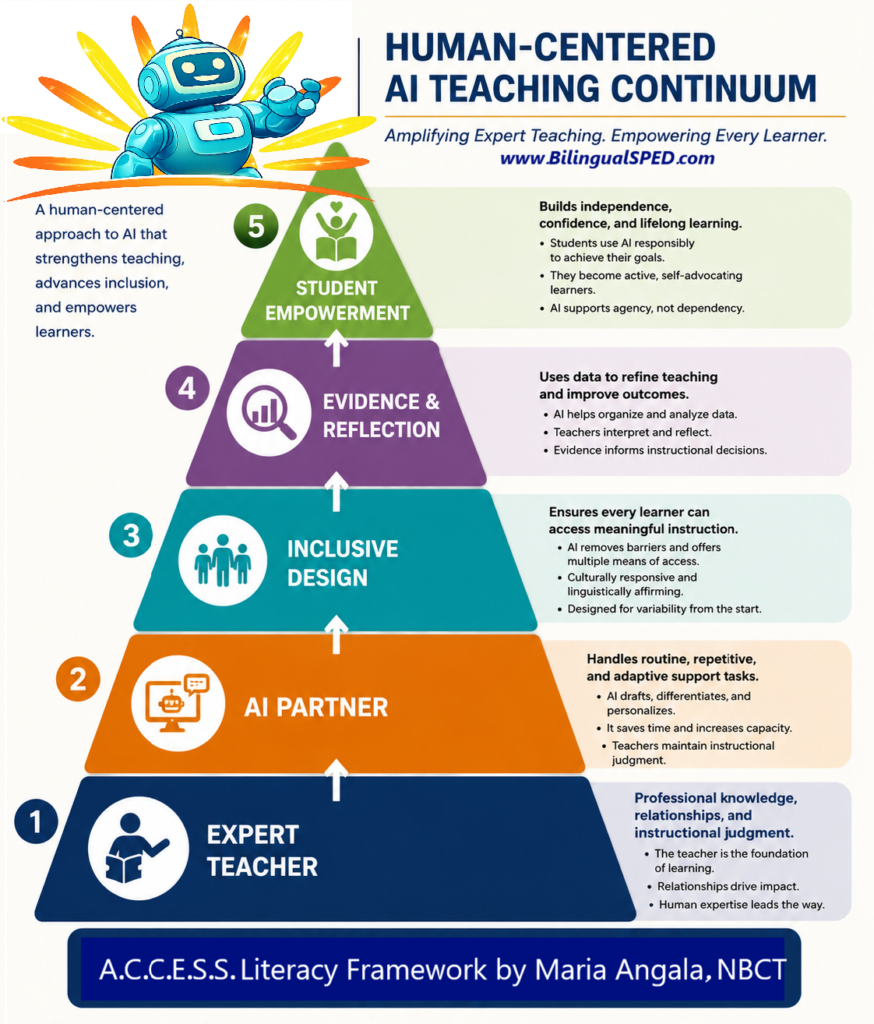
Human-Centered AI Teaching Continuum Alignment is the ultimate marriage of high-speed technical capability and irreplaceable human empathy. I have now more time for my family and friends, and students, building more meaningful relationships with them and with myself!
1. Expert Teacher
Identifies learning goals, understands student strengths, retains instructional ownership.
2. AI Partner
Generates differentiated scaffolds and planning options saving valuable teacher time.
3. Inclusive Design
Ensures multiple pathways for MLLs & SPED learners to access rigorous content.
4. Evidence & Reflection
Teacher collects real-time student evidence to adjust instruction dynamically.
5. Student Agency
Learners understand expectations, use strategies independently, and own learning.
1. Lesson Accessibility Snapshot
Learning Objective:
Student can learn and give examples
Grade-Level Expectation:
Students will achieve full mastery of Math (3-5) grade-level rigor without lowering expectations.
Student Barriers Addressed:
Speaking confidence, Listening comprehension, Attention, Memory, Processing speed
Recommended Access Points:
Multimodal representation (visuals, graphic organizers), tiered sentence frames (Emerging (2) level), explicit modeling, and scaffolded peer interaction.
2. Scaffolding Roadmap (Gradual Release)
Before Learning (Activate & Access)
Teacher Actions: Explicitly connect prior knowledge to Student can learn and give examples. Pre-teach 3-4 key academic terms using visual anchors and Filipino cognates. Model lesson task using a Think-Aloud.
Student Actions: Engage in Quick-Pair Talk using provided sentence frames; preview graphic organizer and visual glossary.
Scaffolds Provided: Visual word wall, bilingual glossary terms, realia/images, previewed video clip.
Purpose: Activate background knowledge, reduce cognitive load, and establish clear purpose.
During Learning (Guided & Collaborative)
Teacher Actions: Guide students through core concepts. Use silent signals, chunk reading/tasks into 10-minute intervals, and facilitate partner discourse.
Student Actions: Complete structured notes/organizer with a partner, using tiered response frames to communicate reasoning.
Scaffolds Provided: Chunked text, tiered graphic organizer (sentence starters provided), sentence strips, structured partner roles.
Purpose: Maintain high academic rigor while providing structural safety nets during guided practice.
After Learning (Synthesize & Express)
Teacher Actions: Facilitate a structured wrap-up reflection. Collect formative evidence using multimodal options.
Student Actions: Complete exit ticket choosing preferred expression modality (written, verbal recording, visual diagram).
Scaffolds Provided: Multimodal exit ticket (choice board format), peer feedback rubric, sentence starters for reflection.
Purpose: Solidify retention, enable self-assessment, and provide actionable teacher formative data.
3. Multilingual Learner Scaffolds (WIDA Emerging (2))
Vocabulary Supports
Key Word Student Definition Visual Suggestion Filipino Cognate
Core Concept Term 1 Essential domain word for Math. Icon or diagram showing process/relationship. Direct Translation Anchor
Academic Function Term 2 Action verb describing what students do (e.g., Evaluate, Contrast). Flowchart or step arrow Cross-linguistic link
Sentence Frames:
“[Concept] is important because ______________.”
“I observed that ______________, which leads me to conclude ______________.”
“While ______________ shows ______________, on the other hand ______________ indicates ______________.”
Discussion Stems:
“My evidence shows that…”
“I agree with [Name], and I want to add that…”
“A key difference I noticed is…”
Reading & Writing Supports:
Reading: Text pre-reading via picture walk, highlighted key academic terms, dual-language preview glossary, chunked paragraph breaks.
Writing: Model exemplar writing anchor chart, cloze-paragraph draft template, word bank categorized by parts of speech/function.
4. Special Education Scaffolds
Presentation Supports
Provide visual step-by-step direction card at student desk.
Highlight key instructions using color-coded text (e.g., Green = Action, Yellow = Detail).
Break complex oral instructions into max 2 steps at a time.
Response Supports
Option to utilize Speech-to-Text software or audio recordings for longer responses.
Provide word banks and graphic organizers pre-filled with main topic headers.
Allow point-and-explain or choice board selection during formative checks.
Executive Function Supports
Visual timer displayed on screen for task timing.
Student self-check task checklist (Step 1, Step 2, Done).
Desk-bound schedule strip breaking lesson into 3 distinct segments.
Engagement Supports
Structured choice in order of sub-tasks completion.
Movement break integrated between guided and independent practice.
Frequent positive reinforcement for task initiation (first 2 minutes).
5. Universal Design for Learning (UDL)
Multiple Means of Engagement (Why)
Strategy: Provide student choice in working partner/solo and task entry points tied to authentic real-world contexts.
Access Impact: Increases intrinsic motivation and minimizes affective barriers for reluctant learners.
Multiple Means of Representation (What)
Strategy: Present concepts using dual-coding: explicit text, auditory think-aloud, graphic organizers, and visual diagrams.
Access Impact: Provides equitable access to core content regardless of reading level or processing speed.
Multiple Means of Action & Expression (How)
Strategy: Offer choices for exit demonstration: written paragraph, annotated diagram, or oral explanation.
Access Impact: Allows students to demonstrate true domain knowledge without language or fine-motor bottlenecks.
6. Differentiated Instruction Plan (Pathways)
Beginning Support Level
Heavy scaffolding: Sentence frames for all writing, visual word bank provided, paired with supportive peer partner, chunked task cards.
Developing Support Level
Moderate scaffolding: Sentence stems available as reference, graphic organizer with outline headers, teacher check-ins at transitions.
Independent Level
Standard pathway: Graphic organizer supplied, self-monitoring checklist used for writing/problem solving.
Extension Level
Advanced pathway: Apply concept to novel complex scenario, evaluate competing perspectives, design student-generated synthesis question.
7. Teacher Script Support
Introduction Script: “Class, today we are exploring “Learning Addition and Subtraction”. Our goal is to Student can learn and give examples. By the end of today, every single one of you will be able to demonstrate this!”
Vocabulary Intro: “Let’s look at our anchor word for today. Look at this visual anchor. In Filipino, you might recognize a similar word root. Say it with me: [Word]. It means…”
Modeling Language: “Watch how I analyze this problem. First, I am going to ask myself: “What is the main task?” I see that… So I will highlight… Notice how I used my graphic organizer here.”
Think-Aloud Prompt: “Hmm, I notice something tricky here. I’m wondering: Why did this happen? Let me look back at my visual guide…”
Checking for Understanding: “Show me on your response card: Which step comes next, A or B? Turn to your partner and explain WHY using stem #1.”
Closure Script: “Today, we mastered Student can learn and give examples. Who can share one key takeaway using our sentence starter on the board?”
8. Student-Friendly Version
Goal: I can student can learn and give examples.
Success Criteria
I can use key vocabulary words during group discussion.
I can complete my graphic organizer with accurate evidence.
I can explain my answer to a peer using my sentence frame.
My Checklist
1. Watch Teacher Model
2. Complete Partner Activity
3. Finish Graphic Organizer
4. Complete Exit Ticket
9. Materials & Resources Checklist
Teacher Materials
Anchor slide deck with visual anchors
Model exemplar completed graphic organizer
Timer / Bell
Student Materials
Differentiated graphic organizer (Tier 1/2/3)
Visual vocabulary card set
Highlighters
Visual Supports
Visual word wall posters
Process flowchart anchor chart
Technology Tools
Speech-to-Text tool access
Bilingual dictionary software
Interactive presentation screen
Manipulatives
Sentence strip cards
Color-coded highlighter pens
Assessment Tools
Multimodal Exit Ticket Cards
Self-reflection rubric
10. Formative Assessment Plan
Opening Check: Quick 2-minute thumbs-up/down or whiteboard response to prior knowledge check.
During Lesson Checks: Teacher clipboard check during partner practice using targeted rubric checklist.
Closing Assessment: Multimodal Exit Ticket (choice of written sentence, labeled diagram, or voice recording).
Suggested Exit Ticket: “Explain in your own words or diagram how Student can learn and give examples… works.”
Evidence to Collect: Completed exit tickets categorized into 3 piles: Mastered, Near Mastery, Needs Targeted Small Group.
Teacher Reflection Question: Which scaffold made the biggest difference today? Which students need follow-up in tomorrow’s small group?
11. Accommodation Alignment
Category Accommodation How it Provides Access Supports Independence
Presentation Provided simplified text formatting & visual aids Reduces reading fatigue & cognitive overload Allows student to read and process directions independently
Response Speech-to-text / Audio response option Bypasses graphomotor and writing anxiety barriers Enables expression of complex thoughts without physical bottleneck
Environment Preferential seating near instruction & visual wall Minimizes auditory and visual distractions Enhances focus and self-monitoring
12. Small Group Recommendations
Reteaching Group
Purpose: Re-model core objective with simplified concrete examples
Students Served: Students scoring <50% on warm-up/exit ticket
Teacher Action: Teacher-led 8-minute guided explicit re-teach
Expected Outcome: Mastery of foundational step
Language Support Group
Purpose: Focus on oral rehearsal & sentence construction
Students Served: WIDA Level 1-2 Multilingual Learners
Teacher Action: Co-teacher led structured dialogue drills using sentence strips
Expected Outcome: Confident oral production of objective
Intervention Group
Purpose: Address specific skill gap (e.g., decoding/math facts)
Students Served: Students with explicit IEP goal interventions
Teacher Action: Targeted skill practice with specialized manipulatives
Expected Outcome: Progress on specialized IEP goals
Extension Group
Purpose: Deepen conceptual synthesis & critical analysis
Students Served: Advanced learners seeking challenge
Teacher Action: Self-directed peer inquiry project prompt
Expected Outcome: Created novel synthesis model
13. Family Connection & Home Bridge
Family Summary: In class today, our learning goal was: "Student can learn and give examples". Students explored this concept through hands-on practice and discussions.
Home Activity Suggestion: Ask your student to explain one thing they learned about this topic today in your home language (Filipino)! You can also look for real-world examples together at home.
Note: This message can be sent home in Filipino using school translation tools.
15. Printable Teacher Quick Reference Sheet
LESSON SCAFFOLD QUICK REFERENCE SHEET
Grade: 3-5 | Math
Objective: Student can learn and give examples
Target Profiles: Whole Class Differentiation
Core Scaffolds: Chunked text, tiered graphic organizer (sentence starters provided), sentence strips, structured partner roles.
Key Sentence Frame: "[Concept] is important because ______________."
Assessment Check: Explain in your own words or diagram how Student can learn and give examples… works.
Teacher Reflection Notes: ___________________________________________________________________________________
I love that it guides my instruction without ever dictating or overstepping my bounds. Thank you, Ms. Angala!
1. Lesson Accessibility Snapshot
Learning Objective:
The students will understand the basics of Morphology
Grade-Level Expectation:
Students will achieve full mastery of Reading (3-5) grade-level rigor without lowering expectations.
Student Barriers Addressed:
Reading comprehension
Recommended Access Points:
Multimodal representation (visuals, graphic organizers), tiered sentence frames (Not Specified level), explicit modeling, and scaffolded peer interaction.
2. Scaffolding Roadmap (Gradual Release)
Before Learning (Activate & Access)
Teacher Actions: Explicitly connect prior knowledge to The students will understand the basics of Morphology. Pre-teach 3-4 key academic terms using visual anchors and Other cognates. Model lesson task using a Think-Aloud.
Student Actions: Engage in Quick-Pair Talk using provided sentence frames; preview graphic organizer and visual glossary.
Scaffolds Provided: Visual word wall, bilingual glossary terms, realia/images, previewed video clip.
Purpose: Activate background knowledge, reduce cognitive load, and establish clear purpose.
During Learning (Guided & Collaborative)
Teacher Actions: Guide students through core concepts. Use silent signals, chunk reading/tasks into 10-minute intervals, and facilitate partner discourse.
Student Actions: Complete structured notes/organizer with a partner, using tiered response frames to communicate reasoning.
Scaffolds Provided: Chunked text, tiered graphic organizer (sentence starters provided), sentence strips, structured partner roles.
Purpose: Maintain high academic rigor while providing structural safety nets during guided practice.
After Learning (Synthesize & Express)
Teacher Actions: Facilitate a structured wrap-up reflection. Collect formative evidence using multimodal options.
Student Actions: Complete exit ticket choosing preferred expression modality (written, verbal recording, visual diagram).
Scaffolds Provided: Multimodal exit ticket (choice board format), peer feedback rubric, sentence starters for reflection.
Purpose: Solidify retention, enable self-assessment, and provide actionable teacher formative data.
3. Multilingual Learner Scaffolds (WIDA Not Specified)
Vocabulary Supports
Key Word Student Definition Visual Suggestion Other Cognate
Core Concept Term 1 Essential domain word for Reading. Icon or diagram showing process/relationship. Direct Translation Anchor
Academic Function Term 2 Action verb describing what students do (e.g., Evaluate, Contrast). Flowchart or step arrow Cross-linguistic link
Sentence Frames:
“[Concept] is important because ______________.”
“I observed that ______________, which leads me to conclude ______________.”
“While ______________ shows ______________, on the other hand ______________ indicates ______________.”
Discussion Stems:
“My evidence shows that…”
“I agree with [Name], and I want to add that…”
“A key difference I noticed is…”
Reading & Writing Supports:
Reading: Text pre-reading via picture walk, highlighted key academic terms, dual-language preview glossary, chunked paragraph breaks.
Writing: Model exemplar writing anchor chart, cloze-paragraph draft template, word bank categorized by parts of speech/function.
4. Special Education Scaffolds
Presentation Supports
Provide visual step-by-step direction card at student desk.
Highlight key instructions using color-coded text (e.g., Green = Action, Yellow = Detail).
Break complex oral instructions into max 2 steps at a time.
Response Supports
Option to utilize Speech-to-Text software or audio recordings for longer responses.
Provide word banks and graphic organizers pre-filled with main topic headers.
Allow point-and-explain or choice board selection during formative checks.
Executive Function Supports
Visual timer displayed on screen for task timing.
Student self-check task checklist (Step 1, Step 2, Done).
Desk-bound schedule strip breaking lesson into 3 distinct segments.
Engagement Supports
Structured choice in order of sub-tasks completion.
Movement break integrated between guided and independent practice.
Frequent positive reinforcement for task initiation (first 2 minutes).
5. Universal Design for Learning (UDL)
Multiple Means of Engagement (Why)
Strategy: Provide student choice in working partner/solo and task entry points tied to authentic real-world contexts.
Access Impact: Increases intrinsic motivation and minimizes affective barriers for reluctant learners.
Multiple Means of Representation (What)
Strategy: Present concepts using dual-coding: explicit text, auditory think-aloud, graphic organizers, and visual diagrams.
Access Impact: Provides equitable access to core content regardless of reading level or processing speed.
Multiple Means of Action & Expression (How)
Strategy: Offer choices for exit demonstration: written paragraph, annotated diagram, or oral explanation.
Access Impact: Allows students to demonstrate true domain knowledge without language or fine-motor bottlenecks.
6. Differentiated Instruction Plan (Pathways)
Beginning Support Level
Heavy scaffolding: Sentence frames for all writing, visual word bank provided, paired with supportive peer partner, chunked task cards.
Developing Support Level
Moderate scaffolding: Sentence stems available as reference, graphic organizer with outline headers, teacher check-ins at transitions.
Independent Level
Standard pathway: Graphic organizer supplied, self-monitoring checklist used for writing/problem solving.
Extension Level
Advanced pathway: Apply concept to novel complex scenario, evaluate competing perspectives, design student-generated synthesis question.
7. Teacher Script Support
Introduction Script: “Class, today we are exploring “Understanding the morphology”. Our goal is to The students will understand the basics of Morphology. By the end of today, every single one of you will be able to demonstrate this!”
Vocabulary Intro: “Let’s look at our anchor word for today. Look at this visual anchor. In Other, you might recognize a similar word root. Say it with me: [Word]. It means…”
Modeling Language: “Watch how I analyze this problem. First, I am going to ask myself: “What is the main task?” I see that… So I will highlight… Notice how I used my graphic organizer here.”
Think-Aloud Prompt: “Hmm, I notice something tricky here. I’m wondering: Why did this happen? Let me look back at my visual guide…”
Checking for Understanding: “Show me on your response card: Which step comes next, A or B? Turn to your partner and explain WHY using stem #1.”
Closure Script: “Today, we mastered The students will understand the basics of Morphology. Who can share one key takeaway using our sentence starter on the board?”
8. Student-Friendly Version
🎯 Goal: I can the students will understand the basics of morphology.
Success Criteria ✨
I can use key vocabulary words during group discussion.
I can complete my graphic organizer with accurate evidence.
I can explain my answer to a peer using my sentence frame.
My Checklist 📝
1. Watch Teacher Model
2. Complete Partner Activity
3. Finish Graphic Organizer
4. Complete Exit Ticket
9. Materials & Resources Checklist
Teacher Materials
Anchor slide deck with visual anchors
Model exemplar completed graphic organizer
Timer / Bell
Student Materials
Differentiated graphic organizer (Tier 1/2/3)
Visual vocabulary card set
Highlighters
Visual Supports
Visual word wall posters
Process flowchart anchor chart
Technology Tools
Speech-to-Text tool access
Bilingual dictionary software
Interactive presentation screen
Manipulatives
Sentence strip cards
Color-coded highlighter pens
Assessment Tools
Multimodal Exit Ticket Cards
Self-reflection rubric
10. Formative Assessment Plan
Opening Check: Quick 2-minute thumbs-up/down or whiteboard response to prior knowledge check.
During Lesson Checks: Teacher clipboard check during partner practice using targeted rubric checklist.
Closing Assessment: Multimodal Exit Ticket (choice of written sentence, labeled diagram, or voice recording).
Suggested Exit Ticket: “Explain in your own words or diagram how The students will understand the basics … works.”
Evidence to Collect: Completed exit tickets categorized into 3 piles: Mastered, Near Mastery, Needs Targeted Small Group.
Teacher Reflection Question: Which scaffold made the biggest difference today? Which students need follow-up in tomorrow’s small group?
11. Accommodation Alignment
Category Accommodation How it Provides Access Supports Independence
Presentation Provided simplified text formatting & visual aids Reduces reading fatigue & cognitive overload Allows student to read and process directions independently
Response Speech-to-text / Audio response option Bypasses graphomotor and writing anxiety barriers Enables expression of complex thoughts without physical bottleneck
Environment Preferential seating near instruction & visual wall Minimizes auditory and visual distractions Enhances focus and self-monitoring
12. Small Group Recommendations
Reteaching Group
Purpose: Re-model core objective with simplified concrete examples
Students Served: Students scoring <50% on warm-up/exit ticket
Teacher Action: Teacher-led 8-minute guided explicit re-teach
Expected Outcome: Mastery of foundational step
Language Support Group
Purpose: Focus on oral rehearsal & sentence construction
Students Served: WIDA Level 1-2 Multilingual Learners
Teacher Action: Co-teacher led structured dialogue drills using sentence strips
Expected Outcome: Confident oral production of objective
Intervention Group
Purpose: Address specific skill gap (e.g., decoding/math facts)
Students Served: Students with explicit IEP goal interventions
Teacher Action: Targeted skill practice with specialized manipulatives
Expected Outcome: Progress on specialized IEP goals
Extension Group
Purpose: Deepen conceptual synthesis & critical analysis
Students Served: Advanced learners seeking challenge
Teacher Action: Self-directed peer inquiry project prompt
Expected Outcome: Created novel synthesis model
13. Family Connection & Home Bridge
Family Summary: In class today, our learning goal was: "The students will understand the basics of Morphology". Students explored this concept through hands-on practice and discussions.
Home Activity Suggestion: Ask your student to explain one thing they learned about this topic today in your home language (Other)! You can also look for real-world examples together at home.
Note: This message can be sent home in Other using school translation tools.
15. Printable Teacher Quick Reference Sheet
LESSON SCAFFOLD QUICK REFERENCE SHEET
Grade: 3-5 | Reading
Objective: The students will understand the basics of Morphology
Target Profiles: Multilingual Learners
Core Scaffolds: Chunked text, tiered graphic organizer (sentence starters provided), sentence strips, structured partner roles.
Key Sentence Frame: "[Concept] is important because ______________."
Assessment Check: Explain in your own words or diagram how The students will understand the basics … works.
Teacher Reflection Notes:
It’s like someone really is finally listening to the teachers, salamat po Ms. Angala! Unlike generic AI models, this system honors the specific context and culture of my classroom.
1. Lesson Accessibility Snapshot
Learning Objective:
able to have a number sense
Grade-Level Expectation:
Students will achieve full mastery of Math (K-2) grade-level rigor without lowering expectations.
Student Barriers Addressed:
Processing speed
Recommended Access Points:
Multimodal representation (visuals, graphic organizers), tiered sentence frames (Not Specified level), explicit modeling, and scaffolded peer interaction.
2. Scaffolding Roadmap (Gradual Release)
Before Learning (Activate & Access)
Teacher Actions: Explicitly connect prior knowledge to able to have a number sense. Pre-teach 3-4 key academic terms using visual anchors and Filipino cognates. Model lesson task using a Think-Aloud.
Student Actions: Engage in Quick-Pair Talk using provided sentence frames; preview graphic organizer and visual glossary.
Scaffolds Provided: Visual word wall, bilingual glossary terms, realia/images, previewed video clip.
Purpose: Activate background knowledge, reduce cognitive load, and establish clear purpose.
During Learning (Guided & Collaborative)
Teacher Actions: Guide students through core concepts. Use silent signals, chunk reading/tasks into 10-minute intervals, and facilitate partner discourse.
Student Actions: Complete structured notes/organizer with a partner, using tiered response frames to communicate reasoning.
Scaffolds Provided: Chunked text, tiered graphic organizer (sentence starters provided), sentence strips, structured partner roles.
Purpose: Maintain high academic rigor while providing structural safety nets during guided practice.
After Learning (Synthesize & Express)
Teacher Actions: Facilitate a structured wrap-up reflection. Collect formative evidence using multimodal options.
Student Actions: Complete exit ticket choosing preferred expression modality (written, verbal recording, visual diagram).
Scaffolds Provided: Multimodal exit ticket (choice board format), peer feedback rubric, sentence starters for reflection.
Purpose: Solidify retention, enable self-assessment, and provide actionable teacher formative data.
3. Multilingual Learner Scaffolds (WIDA Not Specified)
Vocabulary Supports
Key Word Student Definition Visual Suggestion Filipino Cognate
Core Concept Term 1 Essential domain word for Math. Icon or diagram showing process/relationship. Direct Translation Anchor
Academic Function Term 2 Action verb describing what students do (e.g., Evaluate, Contrast). Flowchart or step arrow Cross-linguistic link
Sentence Frames:
“[Concept] is important because ______________.”
“I observed that ______________, which leads me to conclude ______________.”
“While ______________ shows ______________, on the other hand ______________ indicates ______________.”
Discussion Stems:
“My evidence shows that…”
“I agree with [Name], and I want to add that…”
“A key difference I noticed is…”
Reading & Writing Supports:
Reading: Text pre-reading via picture walk, highlighted key academic terms, dual-language preview glossary, chunked paragraph breaks.
Writing: Model exemplar writing anchor chart, cloze-paragraph draft template, word bank categorized by parts of speech/function.
4. Special Education Scaffolds
Presentation Supports
Provide visual step-by-step direction card at student desk.
Highlight key instructions using color-coded text (e.g., Green = Action, Yellow = Detail).
Break complex oral instructions into max 2 steps at a time.
Response Supports
Option to utilize Speech-to-Text software or audio recordings for longer responses.
Provide word banks and graphic organizers pre-filled with main topic headers.
Allow point-and-explain or choice board selection during formative checks.
Executive Function Supports
Visual timer displayed on screen for task timing.
Student self-check task checklist (Step 1, Step 2, Done).
Desk-bound schedule strip breaking lesson into 3 distinct segments.
Engagement Supports
Structured choice in order of sub-tasks completion.
Movement break integrated between guided and independent practice.
Frequent positive reinforcement for task initiation (first 2 minutes).
5. Universal Design for Learning (UDL)
Multiple Means of Engagement (Why)
Strategy: Provide student choice in working partner/solo and task entry points tied to authentic real-world contexts.
Access Impact: Increases intrinsic motivation and minimizes affective barriers for reluctant learners.
Multiple Means of Representation (What)
Strategy: Present concepts using dual-coding: explicit text, auditory think-aloud, graphic organizers, and visual diagrams.
Access Impact: Provides equitable access to core content regardless of reading level or processing speed.
Multiple Means of Action & Expression (How)
Strategy: Offer choices for exit demonstration: written paragraph, annotated diagram, or oral explanation.
Access Impact: Allows students to demonstrate true domain knowledge without language or fine-motor bottlenecks.
6. Differentiated Instruction Plan (Pathways)
Beginning Support Level
Heavy scaffolding: Sentence frames for all writing, visual word bank provided, paired with supportive peer partner, chunked task cards.
Developing Support Level
Moderate scaffolding: Sentence stems available as reference, graphic organizer with outline headers, teacher check-ins at transitions.
Independent Level
Standard pathway: Graphic organizer supplied, self-monitoring checklist used for writing/problem solving.
Extension Level
Advanced pathway: Apply concept to novel complex scenario, evaluate competing perspectives, design student-generated synthesis question.
7. Teacher Script Support
Introduction Script: “Class, today we are exploring “number sense”. Our goal is to able to have a number sense. By the end of today, every single one of you will be able to demonstrate this!”
Vocabulary Intro: “Let’s look at our anchor word for today. Look at this visual anchor. In Filipino, you might recognize a similar word root. Say it with me: [Word]. It means…”
Modeling Language: “Watch how I analyze this problem. First, I am going to ask myself: “What is the main task?” I see that… So I will highlight… Notice how I used my graphic organizer here.”
Think-Aloud Prompt: “Hmm, I notice something tricky here. I’m wondering: Why did this happen? Let me look back at my visual guide…”
Checking for Understanding: “Show me on your response card: Which step comes next, A or B? Turn to your partner and explain WHY using stem #1.”
Closure Script: “Today, we mastered able to have a number sense. Who can share one key takeaway using our sentence starter on the board?”
8. Student-Friendly Version
🎯 Goal: I can able to have a number sense.
Success Criteria ✨
I can use key vocabulary words during group discussion.
I can complete my graphic organizer with accurate evidence.
I can explain my answer to a peer using my sentence frame.
My Checklist 📝
1. Watch Teacher Model
2. Complete Partner Activity
3. Finish Graphic Organizer
4. Complete Exit Ticket
9. Materials & Resources Checklist
Teacher Materials
Anchor slide deck with visual anchors
Model exemplar completed graphic organizer
Timer / Bell
Student Materials
Differentiated graphic organizer (Tier 1/2/3)
Visual vocabulary card set
Highlighters
Visual Supports
Visual word wall posters
Process flowchart anchor chart
Technology Tools
Speech-to-Text tool access
Bilingual dictionary software
Interactive presentation screen
Manipulatives
Sentence strip cards
Color-coded highlighter pens
Assessment Tools
Multimodal Exit Ticket Cards
Self-reflection rubric
10. Formative Assessment Plan
Opening Check: Quick 2-minute thumbs-up/down or whiteboard response to prior knowledge check.
During Lesson Checks: Teacher clipboard check during partner practice using targeted rubric checklist.
Closing Assessment: Multimodal Exit Ticket (choice of written sentence, labeled diagram, or voice recording).
Suggested Exit Ticket: “Explain in your own words or diagram how able to have a number sense… works.”
Evidence to Collect: Completed exit tickets categorized into 3 piles: Mastered, Near Mastery, Needs Targeted Small Group.
Teacher Reflection Question: Which scaffold made the biggest difference today? Which students need follow-up in tomorrow’s small group?
11. Accommodation Alignment
Category Accommodation How it Provides Access Supports Independence
Presentation Provided simplified text formatting & visual aids Reduces reading fatigue & cognitive overload Allows student to read and process directions independently
Response Speech-to-text / Audio response option Bypasses graphomotor and writing anxiety barriers Enables expression of complex thoughts without physical bottleneck
Environment Preferential seating near instruction & visual wall Minimizes auditory and visual distractions Enhances focus and self-monitoring
12. Small Group Recommendations
Reteaching Group
Purpose: Re-model core objective with simplified concrete examples
Students Served: Students scoring <50% on warm-up/exit ticket
Teacher Action: Teacher-led 8-minute guided explicit re-teach
Expected Outcome: Mastery of foundational step
Language Support Group
Purpose: Focus on oral rehearsal & sentence construction
Students Served: WIDA Level 1-2 Multilingual Learners
Teacher Action: Co-teacher led structured dialogue drills using sentence strips
Expected Outcome: Confident oral production of objective
Intervention Group
Purpose: Address specific skill gap (e.g., decoding/math facts)
Students Served: Students with explicit IEP goal interventions
Teacher Action: Targeted skill practice with specialized manipulatives
Expected Outcome: Progress on specialized IEP goals
Extension Group
Purpose: Deepen conceptual synthesis & critical analysis
Students Served: Advanced learners seeking challenge
Teacher Action: Self-directed peer inquiry project prompt
Expected Outcome: Created novel synthesis model
13. Family Connection & Home Bridge
Family Summary: In class today, our learning goal was: "able to have a number sense". Students explored this concept through hands-on practice and discussions.
Home Activity Suggestion: Ask your student to explain one thing they learned about this topic today in your home language (Filipino)! You can also look for real-world examples together at home.
Note: This message can be sent home in Filipino using school translation tools.
15. Printable Teacher Quick Reference Sheet
LESSON SCAFFOLD QUICK REFERENCE SHEET
Grade: K-2 | Math
Objective: able to have a number sense
Target Profiles: Multilingual Learners
Core Scaffolds: Chunked text, tiered graphic organizer (sentence starters provided), sentence strips, structured partner roles.
Key Sentence Frame: "[Concept] is important because ______________."
Assessment Check: Explain in your own words or diagram how able to have a number sense… works.
I love this! It ensures every single child in my inclusive classroom has an entry point into the core curriculum. This is what’s needed in every real classroom around the world!
1. Lesson Accessibility Snapshot
Learning Objective:
Identify fractions and name their parts, such as the numerator and denominator.
Grade-Level Expectation:
Students will achieve full mastery of Math (3-5) grade-level rigor without lowering expectations.
Student Barriers Addressed:
Attention, Memory, Communication
Recommended Access Points:
Multimodal representation (visuals, graphic organizers), tiered sentence frames (Not Specified level), explicit modeling, and scaffolded peer interaction.
2. Scaffolding Roadmap (Gradual Release)
Before Learning (Activate & Access)
Teacher Actions: Explicitly connect prior knowledge to Identify fractions and name their parts, such as the numerator and denominator.. Pre-teach 3-4 key academic terms using visual anchors and Filipino cognates. Model lesson task using a Think-Aloud.
Student Actions: Engage in Quick-Pair Talk using provided sentence frames; preview graphic organizer and visual glossary.
Scaffolds Provided: Visual word wall, bilingual glossary terms, realia/images, previewed video clip.
Purpose: Activate background knowledge, reduce cognitive load, and establish clear purpose.
During Learning (Guided & Collaborative)
Teacher Actions: Guide students through core concepts. Use silent signals, chunk reading/tasks into 10-minute intervals, and facilitate partner discourse.
Student Actions: Complete structured notes/organizer with a partner, using tiered response frames to communicate reasoning.
Scaffolds Provided: Chunked text, tiered graphic organizer (sentence starters provided), sentence strips, structured partner roles.
Purpose: Maintain high academic rigor while providing structural safety nets during guided practice.
After Learning (Synthesize & Express)
Teacher Actions: Facilitate a structured wrap-up reflection. Collect formative evidence using multimodal options.
Student Actions: Complete exit ticket choosing preferred expression modality (written, verbal recording, visual diagram).
Scaffolds Provided: Multimodal exit ticket (choice board format), peer feedback rubric, sentence starters for reflection.
Purpose: Solidify retention, enable self-assessment, and provide actionable teacher formative data.
3. Multilingual Learner Scaffolds (WIDA Not Specified)
Vocabulary Supports
Key Word Student Definition Visual Suggestion Filipino Cognate
Core Concept Term 1 Essential domain word for Math. Icon or diagram showing process/relationship. Direct Translation Anchor
Academic Function Term 2 Action verb describing what students do (e.g., Evaluate, Contrast). Flowchart or step arrow Cross-linguistic link
Sentence Frames:
“[Concept] is important because ______________.”
“I observed that ______________, which leads me to conclude ______________.”
“While ______________ shows ______________, on the other hand ______________ indicates ______________.”
Discussion Stems:
“My evidence shows that…”
“I agree with [Name], and I want to add that…”
“A key difference I noticed is…”
Reading & Writing Supports:
Reading: Text pre-reading via picture walk, highlighted key academic terms, dual-language preview glossary, chunked paragraph breaks.
Writing: Model exemplar writing anchor chart, cloze-paragraph draft template, word bank categorized by parts of speech/function.
4. Special Education Scaffolds
Presentation Supports
Provide visual step-by-step direction card at student desk.
Highlight key instructions using color-coded text (e.g., Green = Action, Yellow = Detail).
Break complex oral instructions into max 2 steps at a time.
Response Supports
Option to utilize Speech-to-Text software or audio recordings for longer responses.
Provide word banks and graphic organizers pre-filled with main topic headers.
Allow point-and-explain or choice board selection during formative checks.
Executive Function Supports
Visual timer displayed on screen for task timing.
Student self-check task checklist (Step 1, Step 2, Done).
Desk-bound schedule strip breaking lesson into 3 distinct segments.
Engagement Supports
Structured choice in order of sub-tasks completion.
Movement break integrated between guided and independent practice.
Frequent positive reinforcement for task initiation (first 2 minutes).
5. Universal Design for Learning (UDL)
Multiple Means of Engagement (Why)
Strategy: Provide student choice in working partner/solo and task entry points tied to authentic real-world contexts.
Access Impact: Increases intrinsic motivation and minimizes affective barriers for reluctant learners.
Multiple Means of Representation (What)
Strategy: Present concepts using dual-coding: explicit text, auditory think-aloud, graphic organizers, and visual diagrams.
Access Impact: Provides equitable access to core content regardless of reading level or processing speed.
Multiple Means of Action & Expression (How)
Strategy: Offer choices for exit demonstration: written paragraph, annotated diagram, or oral explanation.
Access Impact: Allows students to demonstrate true domain knowledge without language or fine-motor bottlenecks.
6. Differentiated Instruction Plan (Pathways)
Beginning Support Level
Heavy scaffolding: Sentence frames for all writing, visual word bank provided, paired with supportive peer partner, chunked task cards.
Developing Support Level
Moderate scaffolding: Sentence stems available as reference, graphic organizer with outline headers, teacher check-ins at transitions.
Independent Level
Standard pathway: Graphic organizer supplied, self-monitoring checklist used for writing/problem solving.
Extension Level
Advanced pathway: Apply concept to novel complex scenario, evaluate competing perspectives, design student-generated synthesis question.
7. Teacher Script Support
Introduction Script: “Class, today we are exploring “fraction”. Our goal is to Identify fractions and name their parts, such as the numerator and denominator.. By the end of today, every single one of you will be able to demonstrate this!”
Vocabulary Intro: “Let’s look at our anchor word for today. Look at this visual anchor. In Filipino, you might recognize a similar word root. Say it with me: [Word]. It means…”
Modeling Language: “Watch how I analyze this problem. First, I am going to ask myself: “What is the main task?” I see that… So I will highlight… Notice how I used my graphic organizer here.”
Think-Aloud Prompt: “Hmm, I notice something tricky here. I’m wondering: Why did this happen? Let me look back at my visual guide…”
Checking for Understanding: “Show me on your response card: Which step comes next, A or B? Turn to your partner and explain WHY using stem #1.”
Closure Script: “Today, we mastered Identify fractions and name their parts, such as the numerator and denominator.. Who can share one key takeaway using our sentence starter on the board?”
8. Student-Friendly Version
🎯 Goal: I can identify fractions and name their parts, such as the numerator and denominator..
Success Criteria ✨
I can use key vocabulary words during group discussion.
I can complete my graphic organizer with accurate evidence.
I can explain my answer to a peer using my sentence frame.
My Checklist 📝
1. Watch Teacher Model
2. Complete Partner Activity
3. Finish Graphic Organizer
4. Complete Exit Ticket
9. Materials & Resources Checklist
Teacher Materials
Anchor slide deck with visual anchors
Model exemplar completed graphic organizer
Timer / Bell
Student Materials
Differentiated graphic organizer (Tier 1/2/3)
Visual vocabulary card set
Highlighters
Visual Supports
Visual word wall posters
Process flowchart anchor chart
Technology Tools
Speech-to-Text tool access
Bilingual dictionary software
Interactive presentation screen
Manipulatives
Sentence strip cards
Color-coded highlighter pens
Assessment Tools
Multimodal Exit Ticket Cards
Self-reflection rubric
10. Formative Assessment Plan
Opening Check: Quick 2-minute thumbs-up/down or whiteboard response to prior knowledge check.
During Lesson Checks: Teacher clipboard check during partner practice using targeted rubric checklist.
Closing Assessment: Multimodal Exit Ticket (choice of written sentence, labeled diagram, or voice recording).
Suggested Exit Ticket: “Explain in your own words or diagram how Identify fractions and name their parts,… works.”
Evidence to Collect: Completed exit tickets categorized into 3 piles: Mastered, Near Mastery, Needs Targeted Small Group.
Teacher Reflection Question: Which scaffold made the biggest difference today? Which students need follow-up in tomorrow’s small group?
11. Accommodation Alignment
Category Accommodation How it Provides Access Supports Independence
Presentation Provided simplified text formatting & visual aids Reduces reading fatigue & cognitive overload Allows student to read and process directions independently
Response Speech-to-text / Audio response option Bypasses graphomotor and writing anxiety barriers Enables expression of complex thoughts without physical bottleneck
Environment Preferential seating near instruction & visual wall Minimizes auditory and visual distractions Enhances focus and self-monitoring
12. Small Group Recommendations
Reteaching Group
Purpose: Re-model core objective with simplified concrete examples
Students Served: Students scoring <50% on warm-up/exit ticket
Teacher Action: Teacher-led 8-minute guided explicit re-teach
Expected Outcome: Mastery of foundational step
Language Support Group
Purpose: Focus on oral rehearsal & sentence construction
Students Served: WIDA Level 1-2 Multilingual Learners
Teacher Action: Co-teacher led structured dialogue drills using sentence strips
Expected Outcome: Confident oral production of objective
Intervention Group
Purpose: Address specific skill gap (e.g., decoding/math facts)
Students Served: Students with explicit IEP goal interventions
Teacher Action: Targeted skill practice with specialized manipulatives
Expected Outcome: Progress on specialized IEP goals
Extension Group
Purpose: Deepen conceptual synthesis & critical analysis
Students Served: Advanced learners seeking challenge
Teacher Action: Self-directed peer inquiry project prompt
Expected Outcome: Created novel synthesis model
13. Family Connection & Home Bridge
Family Summary: In class today, our learning goal was: "Identify fractions and name their parts, such as the numerator and denominator.". Students explored this concept through hands-on practice and discussions.
Home Activity Suggestion: Ask your student to explain one thing they learned about this topic today in your home language (Filipino)! You can also look for real-world examples together at home.
Note: This message can be sent home in Filipino using school translation tools.
15. Printable Teacher Quick Reference Sheet
LESSON SCAFFOLD QUICK REFERENCE SHEET
Grade: 3-5 | Math
Objective: Identify fractions and name their parts, such as the numerator and denominator.
Target Profiles: Multilingual Learners, Students needing intervention, Whole Class Differentiation
Core Scaffolds: Chunked text, tiered graphic organizer (sentence starters provided), sentence strips, structured partner roles.
Key Sentence Frame: "[Concept] is important because ______________."
Assessment Check: Explain in your own words or diagram how Identify fractions and name their parts,… works.
So nice to have this! The differentiation goes way beyond just changing text size or font; it changes the cognitive pathway. Thank you, Ms. Angala!
Alignment
Category Accommodation How it Provides Access Supports Independence
Presentation Provided simplified text formatting & visual aids Reduces reading fatigue & cognitive overload Allows student to read and process directions independently
Response Speech-to-text / Audio response option Bypasses graphomotor and writing anxiety barriers Enables expression of complex thoughts without physical bottleneck
Environment Preferential seating near instruction & visual wall Minimizes auditory and visual distractions Enhances focus and self-monitoring
12. Small Group Recommendations
Reteaching Group
Purpose: Re-model core objective with simplified concrete examples
Students Served: Students scoring <50% on warm-up/exit ticket
Teacher Action: Teacher-led 8-minute guided explicit re-teach
Expected Outcome: Mastery of foundational step
Language Support Group
Purpose: Focus on oral rehearsal & sentence construction
Students Served: WIDA Level 1-2 Multilingual Learners
Teacher Action: Co-teacher led structured dialogue drills using sentence strips
Expected Outcome: Confident oral production of objective
Intervention Group
Purpose: Address specific skill gap (e.g., decoding/math facts)
Students Served: Students with explicit IEP goal interventions
Teacher Action: Targeted skill practice with specialized manipulatives
Expected Outcome: Progress on specialized IEP goals
Extension Group
Purpose: Deepen conceptual synthesis & critical analysis
Students Served: Advanced learners seeking challenge
Teacher Action: Self-directed peer inquiry project prompt
Expected Outcome: Created novel synthesis model
13. Family Connection & Home Bridge
Family Summary: In class today, our learning goal was: "Students will be able to use different pronouns (first, second and third person pronouns)". Students explored this concept through hands-on practice and discussions.
Home Activity Suggestion: Ask your student to explain one thing they learned about this topic today in your home language (Filipino)! You can also look for real-world examples together at home.
Note: This message can be sent home in Filipino using school translation tools.
15. Printable Teacher Quick Reference Sheet
LESSON SCAFFOLD QUICK REFERENCE SHEET
Grade: 3-5 | Writing
Objective: Students will be able to use different pronouns (first, second and third person pronouns)
Target Profiles: Multilingual Learners, Advanced Learners, Students needing intervention, Whole Class Differentiation
Core Scaffolds: Chunked text, tiered graphic organizer (sentence starters provided), sentence strips, structured partner roles.
Key Sentence Frame: "[Concept] is important because ______________."
Assessment Check: Explain in your own words or diagram how Students will be able to use different p… works.
Teacher Reflection Notes: ___________________________________________________________________________________
Yes! It fills the gaps for students who are dually identified as ELL and SPED with total ease. Finally, Ms. Angala is someone who truly understand the needs of us teachers because she is an educator herself.
Extension Group
Purpose: Deepen conceptual synthesis & critical analysis
Students Served: Advanced learners seeking challenge
Teacher Action: Self-directed peer inquiry project prompt
Expected Outcome: Created novel synthesis model
13. Family Connection & Home Bridge
Family Summary: In class today, our learning goal was: “Identifies real-life situations that make use of integers.”. Students explored this concept through hands-on practice and discussions.
Home Activity Suggestion: Ask your student to explain one thing they learned about this topic today in your home language (Filipino)! You can also look for real-world examples together at home.
Note: This message can be sent home in Filipino using school translation tools.
15. Printable Teacher Quick Reference Sheet
LESSON SCAFFOLD QUICK REFERENCE SHEET
Grade: 6-8 | Math
Objective: Identifies real-life situations that make use of integers.
Target Profiles: Multilingual Learners, Students with ADHD, Students with Intellectual Disabilities
Core Scaffolds: Chunked text, tiered graphic organizer (sentence starters provided), sentence strips, structured partner roles.
Key Sentence Frame: “[Concept] is important because ______________.”
Assessment Check: Explain in your own words or diagram how Identifies real-life situations that mak… works.
Teacher Reflection Notes: ___________________________________________________________________________________
It’s great to have this, I think it can really help me preparing my lesson plan
Extension Group
Purpose: Deepen conceptual synthesis & critical analysis
Students Served: Advanced learners seeking challenge
Teacher Action: Self-directed peer inquiry project prompt
Expected Outcome: Created novel synthesis model
13. Family Connection & Home Bridge
Family Summary: In class today, our learning goal was: “Identifies real-life situations that make use of integers.”. Students explored this concept through hands-on practice and discussions.
Home Activity Suggestion: Ask your student to explain one thing they learned about this topic today in your home language (Filipino)! You can also look for real-world examples together at home.
Note: This message can be sent home in Filipino using school translation tools.
15. Printable Teacher Quick Reference Sheet
LESSON SCAFFOLD QUICK REFERENCE SHEET
Grade: 6-8 | Math
Objective: Identifies real-life situations that make use of integers.
Target Profiles: Multilingual Learners, Students with ADHD, Students with Intellectual Disabilities
Core Scaffolds: Chunked text, tiered graphic organizer (sentence starters provided), sentence strips, structured partner roles.
Key Sentence Frame: “[Concept] is important because ______________.”
Assessment Check: Explain in your own words or diagram how Identifies real-life situations that mak… works.
Teacher Reflection Notes: ___________________________________________________________________________________
Totally what teachers need, and Ms. Angala just innovatively created more of these AI tools. It builds multi-tiered assignments that map perfectly onto individual IEP goals.
Human-Centered AI Teaching Continuum Alignment
1. Expert Teacher
Identifies learning goals, understands student strengths, retains instructional ownership.
2. AI Partner
Generates differentiated scaffolds and planning options saving valuable teacher time.
3. Inclusive Design
Ensures multiple pathways for MLLs & SPED learners to access rigorous content.
4. Evidence & Reflection
Teacher collects real-time student evidence to adjust instruction dynamically.
5. Student Agency
Learners understand expectations, use strategies independently, and own learning.
1. Lesson Accessibility Snapshot
Learning Objective:
To identify different parts of the body
Grade-Level Expectation:
Students will achieve full mastery of Science (3-5) grade-level rigor without lowering expectations.
Student Barriers Addressed:
Memory
Recommended Access Points:
Multimodal representation (visuals, graphic organizers), tiered sentence frames (Developing (3) level), explicit modeling, and scaffolded peer interaction.
2. Scaffolding Roadmap (Gradual Release)
Before Learning (Activate & Access)
Teacher Actions: Explicitly connect prior knowledge to To identify different parts of the body. Pre-teach 3-4 key academic terms using visual anchors and Filipino cognates. Model lesson task using a Think-Aloud.
Student Actions: Engage in Quick-Pair Talk using provided sentence frames; preview graphic organizer and visual glossary.
Scaffolds Provided: Visual word wall, bilingual glossary terms, realia/images, previewed video clip.
Purpose: Activate background knowledge, reduce cognitive load, and establish clear purpose.
During Learning (Guided & Collaborative)
Teacher Actions: Guide students through core concepts. Use silent signals, chunk reading/tasks into 10-minute intervals, and facilitate partner discourse.
Student Actions: Complete structured notes/organizer with a partner, using tiered response frames to communicate reasoning.
Scaffolds Provided: Chunked text, tiered graphic organizer (sentence starters provided), sentence strips, structured partner roles.
Purpose: Maintain high academic rigor while providing structural safety nets during guided practice.
After Learning (Synthesize & Express)
Teacher Actions: Facilitate a structured wrap-up reflection. Collect formative evidence using multimodal options.
Student Actions: Complete exit ticket choosing preferred expression modality (written, verbal recording, visual diagram).
Scaffolds Provided: Multimodal exit ticket (choice board format), peer feedback rubric, sentence starters for reflection.
Purpose: Solidify retention, enable self-assessment, and provide actionable teacher formative data.
3. Multilingual Learner Scaffolds (WIDA Developing (3))
Vocabulary Supports
Key Word Student Definition Visual Suggestion Filipino Cognate
Core Concept Term 1 Essential domain word for Science. Icon or diagram showing process/relationship. Direct Translation Anchor
Academic Function Term 2 Action verb describing what students do (e.g., Evaluate, Contrast). Flowchart or step arrow Cross-linguistic link
Sentence Frames:
“[Concept] is important because ______________.”
“I observed that ______________, which leads me to conclude ______________.”
“While ______________ shows ______________, on the other hand ______________ indicates ______________.”
Discussion Stems:
“My evidence shows that…”
“I agree with [Name], and I want to add that…”
“A key difference I noticed is…”
Reading & Writing Supports:
Reading: Text pre-reading via picture walk, highlighted key academic terms, dual-language preview glossary, chunked paragraph breaks.
Writing: Model exemplar writing anchor chart, cloze-paragraph draft template, word bank categorized by parts of speech/function.
4. Special Education Scaffolds
Presentation Supports
Provide visual step-by-step direction card at student desk.
Highlight key instructions using color-coded text (e.g., Green = Action, Yellow = Detail).
Break complex oral instructions into max 2 steps at a time.
Response Supports
Option to utilize Speech-to-Text software or audio recordings for longer responses.
Provide word banks and graphic organizers pre-filled with main topic headers.
Allow point-and-explain or choice board selection during formative checks.
Executive Function Supports
Visual timer displayed on screen for task timing.
Student self-check task checklist (Step 1, Step 2, Done).
Desk-bound schedule strip breaking lesson into 3 distinct segments.
Engagement Supports
Structured choice in order of sub-tasks completion.
Movement break integrated between guided and independent practice.
Frequent positive reinforcement for task initiation (first 2 minutes).
5. Universal Design for Learning (UDL)
Multiple Means of Engagement (Why)
Strategy: Provide student choice in working partner/solo and task entry points tied to authentic real-world contexts.
Access Impact: Increases intrinsic motivation and minimizes affective barriers for reluctant learners.
Multiple Means of Representation (What)
Strategy: Present concepts using dual-coding: explicit text, auditory think-aloud, graphic organizers, and visual diagrams.
Access Impact: Provides equitable access to core content regardless of reading level or processing speed.
Multiple Means of Action & Expression (How)
Strategy: Offer choices for exit demonstration: written paragraph, annotated diagram, or oral explanation.
Access Impact: Allows students to demonstrate true domain knowledge without language or fine-motor bottlenecks.
6. Differentiated Instruction Plan (Pathways)
Beginning Support Level
Heavy scaffolding: Sentence frames for all writing, visual word bank provided, paired with supportive peer partner, chunked task cards.
Developing Support Level
Moderate scaffolding: Sentence stems available as reference, graphic organizer with outline headers, teacher check-ins at transitions.
Independent Level
Standard pathway: Graphic organizer supplied, self-monitoring checklist used for writing/problem solving.
Extension Level
Advanced pathway: Apply concept to novel complex scenario, evaluate competing perspectives, design student-generated synthesis question.
7. Teacher Script Support
Introduction Script: “Class, today we are exploring “Parts of the Body”. Our goal is to To identify different parts of the body. By the end of today, every single one of you will be able to demonstrate this!”
Vocabulary Intro: “Let’s look at our anchor word for today. Look at this visual anchor. In Filipino, you might recognize a similar word root. Say it with me: [Word]. It means…”
Modeling Language: “Watch how I analyze this problem. First, I am going to ask myself: “What is the main task?” I see that… So I will highlight… Notice how I used my graphic organizer here.”
Think-Aloud Prompt: “Hmm, I notice something tricky here. I’m wondering: Why did this happen? Let me look back at my visual guide…”
Checking for Understanding: “Show me on your response card: Which step comes next, A or B? Turn to your partner and explain WHY using stem #1.”
Closure Script: “Today, we mastered To identify different parts of the body. Who can share one key takeaway using our sentence starter on the board?”
8. Student-Friendly Version
Goal: I can to identify different parts of the body.
Success Criteria
I can use key vocabulary words during group discussion.
I can complete my graphic organizer with accurate evidence.
I can explain my answer to a peer using my sentence frame.
My Checklist
1. Watch Teacher Model
2. Complete Partner Activity
3. Finish Graphic Organizer
4. Complete Exit Ticket
9. Materials & Resources Checklist
Teacher Materials
Anchor slide deck with visual anchors
Model exemplar completed graphic organizer
Timer / Bell
Student Materials
Differentiated graphic organizer (Tier 1/2/3)
Visual vocabulary card set
Highlighters
Visual Supports
Visual word wall posters
Process flowchart anchor chart
Technology Tools
Speech-to-Text tool access
Bilingual dictionary software
Interactive presentation screen
Manipulatives
Sentence strip cards
Color-coded highlighter pens
Assessment Tools
Multimodal Exit Ticket Cards
Self-reflection rubric
10. Formative Assessment Plan
Opening Check: Quick 2-minute thumbs-up/down or whiteboard response to prior knowledge check.
During Lesson Checks: Teacher clipboard check during partner practice using targeted rubric checklist.
Closing Assessment: Multimodal Exit Ticket (choice of written sentence, labeled diagram, or voice recording).
Suggested Exit Ticket: “Explain in your own words or diagram how To identify different parts of the body… works.”
Evidence to Collect: Completed exit tickets categorized into 3 piles: Mastered, Near Mastery, Needs Targeted Small Group.
Teacher Reflection Question: Which scaffold made the biggest difference today? Which students need follow-up in tomorrow’s small group?
11. Accommodation Alignment
Category Accommodation How it Provides Access Supports Independence
Presentation Provided simplified text formatting & visual aids Reduces reading fatigue & cognitive overload Allows student to read and process directions independently
Response Speech-to-text / Audio response option Bypasses graphomotor and writing anxiety barriers Enables expression of complex thoughts without physical bottleneck
Environment Preferential seating near instruction & visual wall Minimizes auditory and visual distractions Enhances focus and self-monitoring
12. Small Group Recommendations
Reteaching Group
Purpose: Re-model core objective with simplified concrete examples
Students Served: Students scoring <50% on warm-up/exit ticket
Teacher Action: Teacher-led 8-minute guided explicit re-teach
Expected Outcome: Mastery of foundational step
Language Support Group
Purpose: Focus on oral rehearsal & sentence construction
Students Served: WIDA Level 1-2 Multilingual Learners
Teacher Action: Co-teacher led structured dialogue drills using sentence strips
Expected Outcome: Confident oral production of objective
Intervention Group
Purpose: Address specific skill gap (e.g., decoding/math facts)
Students Served: Students with explicit IEP goal interventions
Teacher Action: Targeted skill practice with specialized manipulatives
Expected Outcome: Progress on specialized IEP goals
Extension Group
Purpose: Deepen conceptual synthesis & critical analysis
Students Served: Advanced learners seeking challenge
Teacher Action: Self-directed peer inquiry project prompt
Expected Outcome: Created novel synthesis model
13. Family Connection & Home Bridge
Family Summary: In class today, our learning goal was: "To identify different parts of the body". Students explored this concept through hands-on practice and discussions.
Home Activity Suggestion: Ask your student to explain one thing they learned about this topic today in your home language (Filipino)! You can also look for real-world examples together at home.
Note: This message can be sent home in Filipino using school translation tools.
15. Printable Teacher Quick Reference Sheet
LESSON SCAFFOLD QUICK REFERENCE SHEET
Grade: 3-5 | Science
Objective: To identify different parts of the body
Target Profiles: Multilingual Learners
Core Scaffolds: Chunked text, tiered graphic organizer (sentence starters provided), sentence strips, structured partner roles.
Key Sentence Frame: "[Concept] is important because ______________."
Assessment Check: Explain in your own words or diagram how To identify different parts of the body… works.
Teacher Reflection Notes: ___________________________________________________________________________________
This is great! Human-Centered AI Teaching Continuum Alignment bridges the gap between simple technology access and meaningful, deep learning. Here’s my lesson plan I created:
1. Expert Teacher
Identifies learning goals, understands student strengths, retains instructional ownership.
2. AI Partner
Generates differentiated scaffolds and planning options saving valuable teacher time.
3. Inclusive Design
Ensures multiple pathways for MLLs & SPED learners to access rigorous content.
4. Evidence & Reflection
Teacher collects real-time student evidence to adjust instruction dynamically.
5. Student Agency
Learners understand expectations, use strategies independently, and own learning.
1. Lesson Accessibility Snapshot
Learning Objective:
Student can learn and give examples
Grade-Level Expectation:
Students will achieve full mastery of Math (3-5) grade-level rigor without lowering expectations.
Student Barriers Addressed:
Speaking confidence, Listening comprehension, Attention, Memory, Processing speed
Recommended Access Points:
Multimodal representation (visuals, graphic organizers), tiered sentence frames (Emerging (2) level), explicit modeling, and scaffolded peer interaction.
2. Scaffolding Roadmap (Gradual Release)
Before Learning (Activate & Access)
Teacher Actions: Explicitly connect prior knowledge to Student can learn and give examples. Pre-teach 3-4 key academic terms using visual anchors and Filipino cognates. Model lesson task using a Think-Aloud.
Student Actions: Engage in Quick-Pair Talk using provided sentence frames; preview graphic organizer and visual glossary.
Scaffolds Provided: Visual word wall, bilingual glossary terms, realia/images, previewed video clip.
Purpose: Activate background knowledge, reduce cognitive load, and establish clear purpose.
During Learning (Guided & Collaborative)
Teacher Actions: Guide students through core concepts. Use silent signals, chunk reading/tasks into 10-minute intervals, and facilitate partner discourse.
Student Actions: Complete structured notes/organizer with a partner, using tiered response frames to communicate reasoning.
Scaffolds Provided: Chunked text, tiered graphic organizer (sentence starters provided), sentence strips, structured partner roles.
Purpose: Maintain high academic rigor while providing structural safety nets during guided practice.
After Learning (Synthesize & Express)
Teacher Actions: Facilitate a structured wrap-up reflection. Collect formative evidence using multimodal options.
Student Actions: Complete exit ticket choosing preferred expression modality (written, verbal recording, visual diagram).
Scaffolds Provided: Multimodal exit ticket (choice board format), peer feedback rubric, sentence starters for reflection.
Purpose: Solidify retention, enable self-assessment, and provide actionable teacher formative data.
3. Multilingual Learner Scaffolds (WIDA Emerging (2))
Vocabulary Supports
Key Word Student Definition Visual Suggestion Filipino Cognate
Core Concept Term 1 Essential domain word for Math. Icon or diagram showing process/relationship. Direct Translation Anchor
Academic Function Term 2 Action verb describing what students do (e.g., Evaluate, Contrast). Flowchart or step arrow Cross-linguistic link
Sentence Frames:
“[Concept] is important because ______________.”
“I observed that ______________, which leads me to conclude ______________.”
“While ______________ shows ______________, on the other hand ______________ indicates ______________.”
Discussion Stems:
“My evidence shows that…”
“I agree with [Name], and I want to add that…”
“A key difference I noticed is…”
Reading & Writing Supports:
Reading: Text pre-reading via picture walk, highlighted key academic terms, dual-language preview glossary, chunked paragraph breaks.
Writing: Model exemplar writing anchor chart, cloze-paragraph draft template, word bank categorized by parts of speech/function.
4. Special Education Scaffolds
Presentation Supports
Provide visual step-by-step direction card at student desk.
Highlight key instructions using color-coded text (e.g., Green = Action, Yellow = Detail).
Break complex oral instructions into max 2 steps at a time.
Response Supports
Option to utilize Speech-to-Text software or audio recordings for longer responses.
Provide word banks and graphic organizers pre-filled with main topic headers.
Allow point-and-explain or choice board selection during formative checks.
Executive Function Supports
Visual timer displayed on screen for task timing.
Student self-check task checklist (Step 1, Step 2, Done).
Desk-bound schedule strip breaking lesson into 3 distinct segments.
Engagement Supports
Structured choice in order of sub-tasks completion.
Movement break integrated between guided and independent practice.
Frequent positive reinforcement for task initiation (first 2 minutes).
5. Universal Design for Learning (UDL)
Multiple Means of Engagement (Why)
Strategy: Provide student choice in working partner/solo and task entry points tied to authentic real-world contexts.
Access Impact: Increases intrinsic motivation and minimizes affective barriers for reluctant learners.
Multiple Means of Representation (What)
Strategy: Present concepts using dual-coding: explicit text, auditory think-aloud, graphic organizers, and visual diagrams.
Access Impact: Provides equitable access to core content regardless of reading level or processing speed.
Multiple Means of Action & Expression (How)
Strategy: Offer choices for exit demonstration: written paragraph, annotated diagram, or oral explanation.
Access Impact: Allows students to demonstrate true domain knowledge without language or fine-motor bottlenecks.
6. Differentiated Instruction Plan (Pathways)
Beginning Support Level
Heavy scaffolding: Sentence frames for all writing, visual word bank provided, paired with supportive peer partner, chunked task cards.
Developing Support Level
Moderate scaffolding: Sentence stems available as reference, graphic organizer with outline headers, teacher check-ins at transitions.
Independent Level
Standard pathway: Graphic organizer supplied, self-monitoring checklist used for writing/problem solving.
Extension Level
Advanced pathway: Apply concept to novel complex scenario, evaluate competing perspectives, design student-generated synthesis question.
7. Teacher Script Support
Introduction Script: “Class, today we are exploring “Learning Addition and Subtraction”. Our goal is to Student can learn and give examples. By the end of today, every single one of you will be able to demonstrate this!”
Vocabulary Intro: “Let’s look at our anchor word for today. Look at this visual anchor. In Filipino, you might recognize a similar word root. Say it with me: [Word]. It means…”
Modeling Language: “Watch how I analyze this problem. First, I am going to ask myself: “What is the main task?” I see that… So I will highlight… Notice how I used my graphic organizer here.”
Think-Aloud Prompt: “Hmm, I notice something tricky here. I’m wondering: Why did this happen? Let me look back at my visual guide…”
Checking for Understanding: “Show me on your response card: Which step comes next, A or B? Turn to your partner and explain WHY using stem #1.”
Closure Script: “Today, we mastered Student can learn and give examples. Who can share one key takeaway using our sentence starter on the board?”
8. Student-Friendly Version
Goal: I can student can learn and give examples.
Success Criteria
I can use key vocabulary words during group discussion.
I can complete my graphic organizer with accurate evidence.
I can explain my answer to a peer using my sentence frame.
My Checklist
1. Watch Teacher Model
2. Complete Partner Activity
3. Finish Graphic Organizer
4. Complete Exit Ticket
9. Materials & Resources Checklist
Teacher Materials
Anchor slide deck with visual anchors
Model exemplar completed graphic organizer
Timer / Bell
Student Materials
Differentiated graphic organizer (Tier 1/2/3)
Visual vocabulary card set
Highlighters
Visual Supports
Visual word wall posters
Process flowchart anchor chart
Technology Tools
Speech-to-Text tool access
Bilingual dictionary software
Interactive presentation screen
Manipulatives
Sentence strip cards
Color-coded highlighter pens
Assessment Tools
Multimodal Exit Ticket Cards
Self-reflection rubric
10. Formative Assessment Plan
Opening Check: Quick 2-minute thumbs-up/down or whiteboard response to prior knowledge check.
During Lesson Checks: Teacher clipboard check during partner practice using targeted rubric checklist.
Closing Assessment: Multimodal Exit Ticket (choice of written sentence, labeled diagram, or voice recording).
Suggested Exit Ticket: “Explain in your own words or diagram how Student can learn and give examples… works.”
Evidence to Collect: Completed exit tickets categorized into 3 piles: Mastered, Near Mastery, Needs Targeted Small Group.
Teacher Reflection Question: Which scaffold made the biggest difference today? Which students need follow-up in tomorrow’s small group?
11. Accommodation Alignment
Category Accommodation How it Provides Access Supports Independence
Presentation Provided simplified text formatting & visual aids Reduces reading fatigue & cognitive overload Allows student to read and process directions independently
Response Speech-to-text / Audio response option Bypasses graphomotor and writing anxiety barriers Enables expression of complex thoughts without physical bottleneck
Environment Preferential seating near instruction & visual wall Minimizes auditory and visual distractions Enhances focus and self-monitoring
12. Small Group Recommendations
Reteaching Group
Purpose: Re-model core objective with simplified concrete examples
Students Served: Students scoring <50% on warm-up/exit ticket
Teacher Action: Teacher-led 8-minute guided explicit re-teach
Expected Outcome: Mastery of foundational step
Language Support Group
Purpose: Focus on oral rehearsal & sentence construction
Students Served: WIDA Level 1-2 Multilingual Learners
Teacher Action: Co-teacher led structured dialogue drills using sentence strips
Expected Outcome: Confident oral production of objective
Intervention Group
Purpose: Address specific skill gap (e.g., decoding/math facts)
Students Served: Students with explicit IEP goal interventions
Teacher Action: Targeted skill practice with specialized manipulatives
Expected Outcome: Progress on specialized IEP goals
Extension Group
Purpose: Deepen conceptual synthesis & critical analysis
Students Served: Advanced learners seeking challenge
Teacher Action: Self-directed peer inquiry project prompt
Expected Outcome: Created novel synthesis model
13. Family Connection & Home Bridge
Family Summary: In class today, our learning goal was: "Student can learn and give examples". Students explored this concept through hands-on practice and discussions.
Home Activity Suggestion: Ask your student to explain one thing they learned about this topic today in your home language (Filipino)! You can also look for real-world examples together at home.
Note: This message can be sent home in Filipino using school translation tools.
15. Printable Teacher Quick Reference Sheet
LESSON SCAFFOLD QUICK REFERENCE SHEET
Grade: 3-5 | Math
Objective: Student can learn and give examples
Target Profiles: Whole Class Differentiation
Core Scaffolds: Chunked text, tiered graphic organizer (sentence starters provided), sentence strips, structured partner roles.
Key Sentence Frame: "[Concept] is important because ______________."
Assessment Check: Explain in your own words or diagram how Student can learn and give examples… works.
Teacher Reflection Notes: ___________________________________________________________________________________
The engine is very easy to use, making the lesson plan making easy for teachers and future teachers
Human-Centered AI Teaching Continuum Alignment targets specific sensory, processing, and linguistic needs with unmatched precision. Here’s my sample:
1. Expert Teacher
Identifies learning goals, understands student strengths, retains instructional ownership.
2. AI Partner
Generates differentiated scaffolds and planning options saving valuable teacher time.
3. Inclusive Design
Ensures multiple pathways for MLLs & SPED learners to access rigorous content.
4. Evidence & Reflection
Teacher collects real-time student evidence to adjust instruction dynamically.
5. Student Agency
Learners understand expectations, use strategies independently, and own learning.
1. Lesson Accessibility Snapshot
2. Scaffolding Roadmap (Gradual Release)
Before Learning (Activate & Access)
Teacher Actions: Explicitly connect prior knowledge to Provide reading intervention for learners to improve fluency. Pre-teach 3-4 key academic terms using visual anchors and Filipino cognates. Model lesson task using a Think-Aloud.
Student Actions: Engage in Quick-Pair Talk using provided sentence frames; preview graphic organizer and visual glossary.
Scaffolds Provided: Visual word wall, bilingual glossary terms, realia/images, previewed video clip.
Purpose: Activate background knowledge, reduce cognitive load, and establish clear purpose.
During Learning (Guided & Collaborative)
Teacher Actions: Guide students through core concepts. Use silent signals, chunk reading/tasks into 10-minute intervals, and facilitate partner discourse.
Student Actions: Complete structured notes/organizer with a partner, using tiered response frames to communicate reasoning.
Scaffolds Provided: Chunked text, tiered graphic organizer (sentence starters provided), sentence strips, structured partner roles.
Purpose: Maintain high academic rigor while providing structural safety nets during guided practice.
After Learning (Synthesize & Express)
Teacher Actions: Facilitate a structured wrap-up reflection. Collect formative evidence using multimodal options.
Student Actions: Complete exit ticket choosing preferred expression modality (written, verbal recording, visual diagram).
Scaffolds Provided: Multimodal exit ticket (choice board format), peer feedback rubric, sentence starters for reflection.
Purpose: Solidify retention, enable self-assessment, and provide actionable teacher formative data.
3. Multilingual Learner Scaffolds (WIDA Not Specified)
Vocabulary Supports
Key Word Student Definition Visual Suggestion Filipino Cognate
Core Concept Term 1 Essential domain word for Reading. Icon or diagram showing process/relationship. Direct Translation Anchor
Academic Function Term 2 Action verb describing what students do (e.g., Evaluate, Contrast). Flowchart or step arrow Cross-linguistic link
Sentence Frames:
“[Concept] is important because ______________.”
“I observed that ______________, which leads me to conclude ______________.”
“While ______________ shows ______________, on the other hand ______________ indicates ______________.”
Discussion Stems:
“My evidence shows that…”
“I agree with [Name], and I want to add that…”
“A key difference I noticed is…”
Reading & Writing Supports:
Reading: Text pre-reading via picture walk, highlighted key academic terms, dual-language preview glossary, chunked paragraph breaks.
Writing: Model exemplar writing anchor chart, cloze-paragraph draft template, word bank categorized by parts of speech/function.
4. Special Education Scaffolds
Presentation Supports
Provide visual step-by-step direction card at student desk.
Highlight key instructions using color-coded text (e.g., Green = Action, Yellow = Detail).
Break complex oral instructions into max 2 steps at a time.
Response Supports
Option to utilize Speech-to-Text software or audio recordings for longer responses.
Provide word banks and graphic organizers pre-filled with main topic headers.
Allow point-and-explain or choice board selection during formative checks.
Executive Function Supports
Visual timer displayed on screen for task timing.
Student self-check task checklist (Step 1, Step 2, Done).
Desk-bound schedule strip breaking lesson into 3 distinct segments.
Engagement Supports
Structured choice in order of sub-tasks completion.
Movement break integrated between guided and independent practice.
Frequent positive reinforcement for task initiation (first 2 minutes).
5. Universal Design for Learning (UDL)
Multiple Means of Engagement (Why)
Strategy: Provide student choice in working partner/solo and task entry points tied to authentic real-world contexts.
Access Impact: Increases intrinsic motivation and minimizes affective barriers for reluctant learners.
Multiple Means of Representation (What)
Strategy: Present concepts using dual-coding: explicit text, auditory think-aloud, graphic organizers, and visual diagrams.
Access Impact: Provides equitable access to core content regardless of reading level or processing speed.
Multiple Means of Action & Expression (How)
Strategy: Offer choices for exit demonstration: written paragraph, annotated diagram, or oral explanation.
Access Impact: Allows students to demonstrate true domain knowledge without language or fine-motor bottlenecks.
6. Differentiated Instruction Plan (Pathways)
Beginning Support Level
Heavy scaffolding: Sentence frames for all writing, visual word bank provided, paired with supportive peer partner, chunked task cards.
Developing Support Level
Moderate scaffolding: Sentence stems available as reference, graphic organizer with outline headers, teacher check-ins at transitions.
Independent Level
Standard pathway: Graphic organizer supplied, self-monitoring checklist used for writing/problem solving.
Extension Level
Advanced pathway: Apply concept to novel complex scenario, evaluate competing perspectives, design student-generated synthesis question.
7. Teacher Script Support
Introduction Script: “Class, today we are exploring “Reading Intervention Plan”. Our goal is to Provide reading intervention for learners to improve fluency. By the end of today, every single one of you will be able to demonstrate this!”
Vocabulary Intro: “Let’s look at our anchor word for today. Look at this visual anchor. In Filipino, you might recognize a similar word root. Say it with me: [Word]. It means…”
Modeling Language: “Watch how I analyze this problem. First, I am going to ask myself: “What is the main task?” I see that… So I will highlight… Notice how I used my graphic organizer here.”
Think-Aloud Prompt: “Hmm, I notice something tricky here. I’m wondering: Why did this happen? Let me look back at my visual guide…”
Checking for Understanding: “Show me on your response card: Which step comes next, A or B? Turn to your partner and explain WHY using stem #1.”
Closure Script: “Today, we mastered Provide reading intervention for learners to improve fluency. Who can share one key takeaway using our sentence starter on the board?”
8. Student-Friendly Version
Goal: I can provide reading intervention for learners to improve fluency.
Success Criteria
I can use key vocabulary words during group discussion.
I can complete my graphic organizer with accurate evidence.
I can explain my answer to a peer using my sentence frame.
My Checklist
1. Watch Teacher Model
2. Complete Partner Activity
3. Finish Graphic Organizer
4. Complete Exit Ticket
9. Materials & Resources Checklist
Teacher Materials
Anchor slide deck with visual anchors
Model exemplar completed graphic organizer
Timer / Bell
Student Materials
Differentiated graphic organizer (Tier 1/2/3)
Visual vocabulary card set
Highlighters
Visual Supports
Visual word wall posters
Process flowchart anchor chart
Technology Tools
Speech-to-Text tool access
Bilingual dictionary software
Interactive presentation screen
Manipulatives
Sentence strip cards
Color-coded highlighter pens
Assessment Tools
Multimodal Exit Ticket Cards
Self-reflection rubric
10. Formative Assessment Plan
Opening Check: Quick 2-minute thumbs-up/down or whiteboard response to prior knowledge check.
During Lesson Checks: Teacher clipboard check during partner practice using targeted rubric checklist.
Closing Assessment: Multimodal Exit Ticket (choice of written sentence, labeled diagram, or voice recording).
Suggested Exit Ticket: “Explain in your own words or diagram how Provide reading intervention for learner… works.”
Evidence to Collect: Completed exit tickets categorized into 3 piles: Mastered, Near Mastery, Needs Targeted Small Group.
Teacher Reflection Question: Which scaffold made the biggest difference today? Which students need follow-up in tomorrow’s small group?
11. Accommodation Alignment
Category Accommodation How it Provides Access Supports Independence
Presentation Provided simplified text formatting & visual aids Reduces reading fatigue & cognitive overload Allows student to read and process directions independently
Response Speech-to-text / Audio response option Bypasses graphomotor and writing anxiety barriers Enables expression of complex thoughts without physical bottleneck
Environment Preferential seating near instruction & visual wall Minimizes auditory and visual distractions Enhances focus and self-monitoring
12. Small Group Recommendations
Reteaching Group
Purpose: Re-model core objective with simplified concrete examples
Students Served: Students scoring <50% on warm-up/exit ticket
Teacher Action: Teacher-led 8-minute guided explicit re-teach
Expected Outcome: Mastery of foundational step
Language Support Group
Purpose: Focus on oral rehearsal & sentence construction
Students Served: WIDA Level 1-2 Multilingual Learners
Teacher Action: Co-teacher led structured dialogue drills using sentence strips
Expected Outcome: Confident oral production of objective
Intervention Group
Purpose: Address specific skill gap (e.g., decoding/math facts)
Students Served: Students with explicit IEP goal interventions
Teacher Action: Targeted skill practice with specialized manipulatives
Expected Outcome: Progress on specialized IEP goals
Extension Group
Purpose: Deepen conceptual synthesis & critical analysis
Students Served: Advanced learners seeking challenge
Teacher Action: Self-directed peer inquiry project prompt
Expected Outcome: Created novel synthesis model
13. Family Connection & Home Bridge
Family Summary: In class today, our learning goal was: "Provide reading intervention for learners to improve fluency". Students explored this concept through hands-on practice and discussions.
Home Activity Suggestion: Ask your student to explain one thing they learned about this topic today in your home language (Filipino)! You can also look for real-world examples together at home.
Note: This message can be sent home in Filipino using school translation tools.
15. Printable Teacher Quick Reference Sheet
LESSON SCAFFOLD QUICK REFERENCE SHEET
Grade: 3-5 | Reading
Objective: Provide reading intervention for learners to improve fluency
Target Profiles: Multilingual Learners
Core Scaffolds: Chunked text, tiered graphic organizer (sentence starters provided), sentence strips, structured partner roles.
Key Sentence Frame: "[Concept] is important because ______________."
Assessment Check: Explain in your own words or diagram how Provide reading intervention for learner… works.
Teacher Reflection Notes: ___________________________________________________________________________________
Wow, Human-Centered AI Teaching Continuum Alignment formats text with integrated home-language supports that keep my multilingual learners fully engaged. Salamat po for this AI tool, Ma’am Angala!
1. Expert Teacher
Identifies learning goals, understands student strengths, retains instructional ownership.
2. AI Partner
Generates differentiated scaffolds and planning options saving valuable teacher time.
3. Inclusive Design
Ensures multiple pathways for MLLs & SPED learners to access rigorous content.
4. Evidence & Reflection
Teacher collects real-time student evidence to adjust instruction dynamically.
5. Student Agency
Learners understand expectations, use strategies independently, and own learning.
1. Lesson Accessibility Snapshot
Learning Objective:
To identify different parts of the body
Grade-Level Expectation:
Students will achieve full mastery of Science (3-5) grade-level rigor without lowering expectations.
Student Barriers Addressed:
Memory
Recommended Access Points:
Multimodal representation (visuals, graphic organizers), tiered sentence frames (Developing (3) level), explicit modeling, and scaffolded peer interaction.
2. Scaffolding Roadmap (Gradual Release)
Before Learning (Activate & Access)
Teacher Actions: Explicitly connect prior knowledge to To identify different parts of the body. Pre-teach 3-4 key academic terms using visual anchors and Filipino cognates. Model lesson task using a Think-Aloud.
Student Actions: Engage in Quick-Pair Talk using provided sentence frames; preview graphic organizer and visual glossary.
Scaffolds Provided: Visual word wall, bilingual glossary terms, realia/images, previewed video clip.
Purpose: Activate background knowledge, reduce cognitive load, and establish clear purpose.
During Learning (Guided & Collaborative)
Teacher Actions: Guide students through core concepts. Use silent signals, chunk reading/tasks into 10-minute intervals, and facilitate partner discourse.
Student Actions: Complete structured notes/organizer with a partner, using tiered response frames to communicate reasoning.
Scaffolds Provided: Chunked text, tiered graphic organizer (sentence starters provided), sentence strips, structured partner roles.
Purpose: Maintain high academic rigor while providing structural safety nets during guided practice.
After Learning (Synthesize & Express)
Teacher Actions: Facilitate a structured wrap-up reflection. Collect formative evidence using multimodal options.
Student Actions: Complete exit ticket choosing preferred expression modality (written, verbal recording, visual diagram).
Scaffolds Provided: Multimodal exit ticket (choice board format), peer feedback rubric, sentence starters for reflection.
Purpose: Solidify retention, enable self-assessment, and provide actionable teacher formative data.
3. Multilingual Learner Scaffolds (WIDA Developing (3))
Vocabulary Supports
Key Word Student Definition Visual Suggestion Filipino Cognate
Core Concept Term 1 Essential domain word for Science. Icon or diagram showing process/relationship. Direct Translation Anchor
Academic Function Term 2 Action verb describing what students do (e.g., Evaluate, Contrast). Flowchart or step arrow Cross-linguistic link
Sentence Frames:
“[Concept] is important because ______________.”
“I observed that ______________, which leads me to conclude ______________.”
“While ______________ shows ______________, on the other hand ______________ indicates ______________.”
Discussion Stems:
“My evidence shows that…”
“I agree with [Name], and I want to add that…”
“A key difference I noticed is…”
Reading & Writing Supports:
Reading: Text pre-reading via picture walk, highlighted key academic terms, dual-language preview glossary, chunked paragraph breaks.
Writing: Model exemplar writing anchor chart, cloze-paragraph draft template, word bank categorized by parts of speech/function.
4. Special Education Scaffolds
Presentation Supports
Provide visual step-by-step direction card at student desk.
Highlight key instructions using color-coded text (e.g., Green = Action, Yellow = Detail).
Break complex oral instructions into max 2 steps at a time.
Response Supports
Option to utilize Speech-to-Text software or audio recordings for longer responses.
Provide word banks and graphic organizers pre-filled with main topic headers.
Allow point-and-explain or choice board selection during formative checks.
Executive Function Supports
Visual timer displayed on screen for task timing.
Student self-check task checklist (Step 1, Step 2, Done).
Desk-bound schedule strip breaking lesson into 3 distinct segments.
Engagement Supports
Structured choice in order of sub-tasks completion.
Movement break integrated between guided and independent practice.
Frequent positive reinforcement for task initiation (first 2 minutes).
5. Universal Design for Learning (UDL)
Multiple Means of Engagement (Why)
Strategy: Provide student choice in working partner/solo and task entry points tied to authentic real-world contexts.
Access Impact: Increases intrinsic motivation and minimizes affective barriers for reluctant learners.
Multiple Means of Representation (What)
Strategy: Present concepts using dual-coding: explicit text, auditory think-aloud, graphic organizers, and visual diagrams.
Access Impact: Provides equitable access to core content regardless of reading level or processing speed.
Multiple Means of Action & Expression (How)
Strategy: Offer choices for exit demonstration: written paragraph, annotated diagram, or oral explanation.
Access Impact: Allows students to demonstrate true domain knowledge without language or fine-motor bottlenecks.
6. Differentiated Instruction Plan (Pathways)
Beginning Support Level
Heavy scaffolding: Sentence frames for all writing, visual word bank provided, paired with supportive peer partner, chunked task cards.
Developing Support Level
Moderate scaffolding: Sentence stems available as reference, graphic organizer with outline headers, teacher check-ins at transitions.
Independent Level
Standard pathway: Graphic organizer supplied, self-monitoring checklist used for writing/problem solving.
Extension Level
Advanced pathway: Apply concept to novel complex scenario, evaluate competing perspectives, design student-generated synthesis question.
7. Teacher Script Support
Introduction Script: “Class, today we are exploring “Parts of the Body”. Our goal is to To identify different parts of the body. By the end of today, every single one of you will be able to demonstrate this!”
Vocabulary Intro: “Let’s look at our anchor word for today. Look at this visual anchor. In Filipino, you might recognize a similar word root. Say it with me: [Word]. It means…”
Modeling Language: “Watch how I analyze this problem. First, I am going to ask myself: “What is the main task?” I see that… So I will highlight… Notice how I used my graphic organizer here.”
Think-Aloud Prompt: “Hmm, I notice something tricky here. I’m wondering: Why did this happen? Let me look back at my visual guide…”
Checking for Understanding: “Show me on your response card: Which step comes next, A or B? Turn to your partner and explain WHY using stem #1.”
Closure Script: “Today, we mastered To identify different parts of the body. Who can share one key takeaway using our sentence starter on the board?”
8. Student-Friendly Version
Goal: I can to identify different parts of the body.
Success Criteria
I can use key vocabulary words during group discussion.
I can complete my graphic organizer with accurate evidence.
I can explain my answer to a peer using my sentence frame.
My Checklist
1. Watch Teacher Model
2. Complete Partner Activity
3. Finish Graphic Organizer
4. Complete Exit Ticket
9. Materials & Resources Checklist
Teacher Materials
Anchor slide deck with visual anchors
Model exemplar completed graphic organizer
Timer / Bell
Student Materials
Differentiated graphic organizer (Tier 1/2/3)
Visual vocabulary card set
Highlighters
Visual Supports
Visual word wall posters
Process flowchart anchor chart
Technology Tools
Speech-to-Text tool access
Bilingual dictionary software
Interactive presentation screen
Manipulatives
Sentence strip cards
Color-coded highlighter pens
Assessment Tools
Multimodal Exit Ticket Cards
Self-reflection rubric
10. Formative Assessment Plan
Opening Check: Quick 2-minute thumbs-up/down or whiteboard response to prior knowledge check.
During Lesson Checks: Teacher clipboard check during partner practice using targeted rubric checklist.
Closing Assessment: Multimodal Exit Ticket (choice of written sentence, labeled diagram, or voice recording).
Suggested Exit Ticket: “Explain in your own words or diagram how To identify different parts of the body… works.”
Evidence to Collect: Completed exit tickets categorized into 3 piles: Mastered, Near Mastery, Needs Targeted Small Group.
Teacher Reflection Question: Which scaffold made the biggest difference today? Which students need follow-up in tomorrow’s small group?
11. Accommodation Alignment
Category Accommodation How it Provides Access Supports Independence
Presentation Provided simplified text formatting & visual aids Reduces reading fatigue & cognitive overload Allows student to read and process directions independently
Response Speech-to-text / Audio response option Bypasses graphomotor and writing anxiety barriers Enables expression of complex thoughts without physical bottleneck
Environment Preferential seating near instruction & visual wall Minimizes auditory and visual distractions Enhances focus and self-monitoring
12. Small Group Recommendations
Reteaching Group
Purpose: Re-model core objective with simplified concrete examples
Students Served: Students scoring <50% on warm-up/exit ticket
Teacher Action: Teacher-led 8-minute guided explicit re-teach
Expected Outcome: Mastery of foundational step
Language Support Group
Purpose: Focus on oral rehearsal & sentence construction
Students Served: WIDA Level 1-2 Multilingual Learners
Teacher Action: Co-teacher led structured dialogue drills using sentence strips
Expected Outcome: Confident oral production of objective
Intervention Group
Purpose: Address specific skill gap (e.g., decoding/math facts)
Students Served: Students with explicit IEP goal interventions
Teacher Action: Targeted skill practice with specialized manipulatives
Expected Outcome: Progress on specialized IEP goals
Extension Group
Purpose: Deepen conceptual synthesis & critical analysis
Students Served: Advanced learners seeking challenge
Teacher Action: Self-directed peer inquiry project prompt
Expected Outcome: Created novel synthesis model
13. Family Connection & Home Bridge
Family Summary: In class today, our learning goal was: "To identify different parts of the body". Students explored this concept through hands-on practice and discussions.
Home Activity Suggestion: Ask your student to explain one thing they learned about this topic today in your home language (Filipino)! You can also look for real-world examples together at home.
Note: This message can be sent home in Filipino using school translation tools.
15. Printable Teacher Quick Reference Sheet
LESSON SCAFFOLD QUICK REFERENCE SHEET
Grade: 3-5 | Science
Objective: To identify different parts of the body
Target Profiles: Multilingual Learners
Core Scaffolds: Chunked text, tiered graphic organizer (sentence starters provided), sentence strips, structured partner roles.
Key Sentence Frame: "[Concept] is important because ______________."
Assessment Check: Explain in your own words or diagram how To identify different parts of the body… works.
Teacher Reflection Notes: ___________________________________________________________________________________
I love that it guides my instruction without ever dictating or overstepping my bounds.
Learning Objective:
• Identify key elements of a story (setting, characters, plot) from different cultural backgrounds.
Grade-Level Expectation:
Students will achieve full mastery of Other (3-5) grade-level rigor without lowering expectations.
Student Barriers Addressed:
Reading comprehension, Vocabulary, Listening comprehension, Social interaction
Recommended Access Points:
Multimodal representation (visuals, graphic organizers), tiered sentence frames (Not Specified level), explicit modeling, and scaffolded peer interaction.
True equity! It bridges the gap between simple technology access and meaningful, deep learning.
organizer
Timer / Bell
Student Materials
Differentiated graphic organizer (Tier 1/2/3)
Visual vocabulary card set
Highlighters
Visual Supports
Visual word wall posters
Process flowchart anchor chart
Technology Tools
Speech-to-Text tool access
Bilingual dictionary software
Interactive presentation screen
Manipulatives
Sentence strip cards
Color-coded highlighter pens
Assessment Tools
Multimodal Exit Ticket Cards
Self-reflection rubric
10. Formative Assessment Plan
Opening Check: Quick 2-minute thumbs-up/down or whiteboard response to prior knowledge check.
During Lesson Checks: Teacher clipboard check during partner practice using targeted rubric checklist.
Closing Assessment: Multimodal Exit Ticket (choice of written sentence, labeled diagram, or voice recording).
Suggested Exit Ticket: “Explain in your own words or diagram how The students will be able to write essay… works.”
Evidence to Collect: Completed exit tickets categorized into 3 piles: Mastered, Near Mastery, Needs Targeted Small Group.
Teacher Reflection Question: Which scaffold made the biggest difference today? Which students need follow-up in tomorrow’s small group?
11. Accommodation Alignment
Category Accommodation How it Provides Access Supports Independence
Presentation Provided simplified text formatting & visual aids Reduces reading fatigue & cognitive overload Allows student to read and process directions independently
Response Speech-to-text / Audio response option Bypasses graphomotor and writing anxiety barriers Enables expression of complex thoughts without physical bottleneck
Environment Preferential seating near instruction & visual wall Minimizes auditory and visual distractions Enhances focus and self-monitoring
12. Small Group Recommendations
Reteaching Group
Purpose: Re-model core objective with simplified concrete examples
Students Served: Students scoring <50% on warm-up/exit ticket
Teacher Action: Teacher-led 8-minute guided explicit re-teach
Expected Outcome: Mastery of foundational step
Language Support Group
Purpose: Focus on oral rehearsal & sentence construction
Students Served: WIDA Level 1-2 Multilingual Learners
Teacher Action: Co-teacher led structured dialogue drills using sentence strips
Expected Outcome: Confident oral production of objective
Intervention Group
Purpose: Address specific skill gap (e.g., decoding/math facts)
Students Served: Students with explicit IEP goal interventions
Teacher Action: Targeted skill practice with specialized manipulatives
Expected Outcome: Progress on specialized IEP goals
Extension Group
Purpose: Deepen conceptual synthesis & critical analysis
Students Served: Advanced learners seeking challenge
Teacher Action: Self-directed peer inquiry project prompt
Expected Outcome: Created novel synthesis model
13. Family Connection & Home Bridge
Family Summary: In class today, our learning goal was: "The students will be able to write essay up to 200 words minimum". Students explored this concept through hands-on practice and discussions.
Home Activity Suggestion: Ask your student to explain one thing they learned about this topic today in your home language (Filipino)! You can also look for real-world examples together at home.
Note: This message can be sent home in Filipino using school translation tools.
15. Printable Teacher Quick Reference Sheet
LESSON SCAFFOLD QUICK REFERENCE SHEET
Grade: 3-5 | Writing
Objective: The students will be able to write essay up to 200 words minimum
Target Profiles: Multilingual Learners, Students with Learning Disabilities, Advanced Learners, Whole Class Differentiation
Core Scaffolds: Chunked text, tiered graphic organizer (sentence starters provided), sentence strips, structured partner roles.
Key Sentence Frame: "[Concept] is important because ______________."
Assessment Check: Explain in your own words or diagram how The students will be able to write essay… works.
Teacher Reflection Notes: ___________________________________________________________________________________
Yes! It targets specific sensory, processing, and linguistic needs with unmatched precision. Thank you, Ms. Angala!
Assessment Check: Explain in your own words or diagram how At the end of the lesson, the learners s… works.
Teacher Reflection Notes: ___________________________________________________________________________________
A.C.C.E.S.S. AI Lesson Scaffold Generator • Designed with UDL & WIDA Frameworks
AI Partner Philosophy: Preserve Academic Rigor • Differentiate Pathways, Not Expectations • Teacher Remains Instructional Leader
.
Key Features Included:
.
Full WCAG 2.2 AA Accessibility & UDL Focus: High contrast mode toggle, dark mode, keyboard navigation, clear ARIA labeling, and responsive design.
Pedagogical Integrity: Built with WIDA Can-Do philosophy, Specially Designed Instruction (SDI) principles, and standard-aligned cognitive rigor preservation.
Comprehensive Scaffold Output (15 Sections): Includes Accessibility Snapshot, Gradual Release Roadmap, MLL Word/Sentence Supports, SPED Accommodations, UDL Matrix, 4-Tier Differentiation Pathways, Scripts, Student-Friendly Statements, Materials Checklist, Assessment Plan, Small Group Groups, Family Connection Bridge, and printable Quick-Ref Card.
Export & Persistence Capabilities: Instant local session saving (localStorage), Copy to Clipboard, Browser Printing, PDF Export, and Word (.docx) file generation.
It formats text with integrated home-language supports that keep my multilingual learners fully engaged. This Human-Centered AI Teaching Continuum Alignment is unbelievable, totally what I need in my lesson planning assistant!
1. Expert Teacher
Identifies learning goals, understands student strengths, retains instructional ownership.
2. AI Partner
Generates differentiated scaffolds and planning options saving valuable teacher time.
3. Inclusive Design
Ensures multiple pathways for MLLs & SPED learners to access rigorous content.
4. Evidence & Reflection
Teacher collects real-time student evidence to adjust instruction dynamically.
5. Student Agency
Learners understand expectations, use strategies independently, and own learning.
1. Lesson Accessibility Snapshot
Learning Objective:
1. Identify and name the five main parts of a plant (roots, stem, leaves, flowers, fruits/seeds); 2. Describe the function of each part of the plant; 3. Explain why each part is important for the plant’s survival;
Grade-Level Expectation:
Students will achieve full mastery of Science (3-5) grade-level rigor without lowering expectations.
Student Barriers Addressed:
Reading comprehension, Processing speed
Recommended Access Points:
Multimodal representation (visuals, graphic organizers), tiered sentence frames (Not Specified level), explicit modeling, and scaffolded peer interaction.
2. Scaffolding Roadmap (Gradual Release)
Before Learning (Activate & Access)
Teacher Actions: Explicitly connect prior knowledge to 1. Identify and name the five main parts of a plant (roots, stem, leaves, flowers, fruits/seeds); 2. Describe the function of each part of the plant; 3. Explain why each part is important for the plant’s survival;. Pre-teach 3-4 key academic terms using visual anchors and Filipino cognates. Model lesson task using a Think-Aloud.
Student Actions: Engage in Quick-Pair Talk using provided sentence frames; preview graphic organizer and visual glossary.
Scaffolds Provided: Visual word wall, bilingual glossary terms, realia/images, previewed video clip.
Purpose: Activate background knowledge, reduce cognitive load, and establish clear purpose.
During Learning (Guided & Collaborative)
Teacher Actions: Guide students through core concepts. Use silent signals, chunk reading/tasks into 10-minute intervals, and facilitate partner discourse.
Student Actions: Complete structured notes/organizer with a partner, using tiered response frames to communicate reasoning.
Scaffolds Provided: Chunked text, tiered graphic organizer (sentence starters provided), sentence strips, structured partner roles.
Purpose: Maintain high academic rigor while providing structural safety nets during guided practice.
After Learning (Synthesize & Express)
Teacher Actions: Facilitate a structured wrap-up reflection. Collect formative evidence using multimodal options.
Student Actions: Complete exit ticket choosing preferred expression modality (written, verbal recording, visual diagram).
Scaffolds Provided: Multimodal exit ticket (choice board format), peer feedback rubric, sentence starters for reflection.
Purpose: Solidify retention, enable self-assessment, and provide actionable teacher formative data.
3. Multilingual Learner Scaffolds (WIDA Not Specified)
Vocabulary Supports
Key Word Student Definition Visual Suggestion Filipino Cognate
Core Concept Term 1 Essential domain word for Science. Icon or diagram showing process/relationship. Direct Translation Anchor
Academic Function Term 2 Action verb describing what students do (e.g., Evaluate, Contrast). Flowchart or step arrow Cross-linguistic link
Sentence Frames:
“[Concept] is important because ______________.”
“I observed that ______________, which leads me to conclude ______________.”
“While ______________ shows ______________, on the other hand ______________ indicates ______________.”
Discussion Stems:
“My evidence shows that…”
“I agree with [Name], and I want to add that…”
“A key difference I noticed is…”
Reading & Writing Supports:
Reading: Text pre-reading via picture walk, highlighted key academic terms, dual-language preview glossary, chunked paragraph breaks.
Writing: Model exemplar writing anchor chart, cloze-paragraph draft template, word bank categorized by parts of speech/function.
4. Special Education Scaffolds
Presentation Supports
Provide visual step-by-step direction card at student desk.
Highlight key instructions using color-coded text (e.g., Green = Action, Yellow = Detail).
Break complex oral instructions into max 2 steps at a time.
Response Supports
Option to utilize Speech-to-Text software or audio recordings for longer responses.
Provide word banks and graphic organizers pre-filled with main topic headers.
Allow point-and-explain or choice board selection during formative checks.
Executive Function Supports
Visual timer displayed on screen for task timing.
Student self-check task checklist (Step 1, Step 2, Done).
Desk-bound schedule strip breaking lesson into 3 distinct segments.
Engagement Supports
Structured choice in order of sub-tasks completion.
Movement break integrated between guided and independent practice.
Frequent positive reinforcement for task initiation (first 2 minutes).
5. Universal Design for Learning (UDL)
Multiple Means of Engagement (Why)
Strategy: Provide student choice in working partner/solo and task entry points tied to authentic real-world contexts.
Access Impact: Increases intrinsic motivation and minimizes affective barriers for reluctant learners.
Multiple Means of Representation (What)
Strategy: Present concepts using dual-coding: explicit text, auditory think-aloud, graphic organizers, and visual diagrams.
Access Impact: Provides equitable access to core content regardless of reading level or processing speed.
Multiple Means of Action & Expression (How)
Strategy: Offer choices for exit demonstration: written paragraph, annotated diagram, or oral explanation.
Access Impact: Allows students to demonstrate true domain knowledge without language or fine-motor bottlenecks.
6. Differentiated Instruction Plan (Pathways)
Beginning Support Level
Heavy scaffolding: Sentence frames for all writing, visual word bank provided, paired with supportive peer partner, chunked task cards.
Developing Support Level
Moderate scaffolding: Sentence stems available as reference, graphic organizer with outline headers, teacher check-ins at transitions.
Independent Level
Standard pathway: Graphic organizer supplied, self-monitoring checklist used for writing/problem solving.
Extension Level
Advanced pathway: Apply concept to novel complex scenario, evaluate competing perspectives, design student-generated synthesis question.
7. Teacher Script Support
Introduction Script: “Class, today we are exploring “Plant parts and it’s function”. Our goal is to 1. Identify and name the five main parts of a plant (roots, stem, leaves, flowers, fruits/seeds); 2. Describe the function of each part of the plant; 3. Explain why each part is important for the plant’s survival;. By the end of today, every single one of you will be able to demonstrate this!”
Vocabulary Intro: “Let’s look at our anchor word for today. Look at this visual anchor. In Filipino, you might recognize a similar word root. Say it with me: [Word]. It means…”
Modeling Language: “Watch how I analyze this problem. First, I am going to ask myself: “What is the main task?” I see that… So I will highlight… Notice how I used my graphic organizer here.”
Think-Aloud Prompt: “Hmm, I notice something tricky here. I’m wondering: Why did this happen? Let me look back at my visual guide…”
Checking for Understanding: “Show me on your response card: Which step comes next, A or B? Turn to your partner and explain WHY using stem #1.”
Closure Script: “Today, we mastered 1. Identify and name the five main parts of a plant (roots, stem, leaves, flowers, fruits/seeds); 2. Describe the function of each part of the plant; 3. Explain why each part is important for the plant’s survival;. Who can share one key takeaway using our sentence starter on the board?”
8. Student-Friendly Version
Goal: I can 1. identify and name the five main parts of a plant (roots, stem, leaves, flowers, fruits/seeds); 2. describe the function of each part of the plant; 3. explain why each part is important for the plant’s survival;.
Success Criteria
I can use key vocabulary words during group discussion.
I can complete my graphic organizer with accurate evidence.
I can explain my answer to a peer using my sentence frame.
My Checklist
1. Watch Teacher Model
2. Complete Partner Activity
3. Finish Graphic Organizer
4. Complete Exit Ticket
9. Materials & Resources Checklist
Teacher Materials
Anchor slide deck with visual anchors
Model exemplar completed graphic organizer
Timer / Bell
Student Materials
Differentiated graphic organizer (Tier 1/2/3)
Visual vocabulary card set
Highlighters
Visual Supports
Visual word wall posters
Process flowchart anchor chart
Technology Tools
Speech-to-Text tool access
Bilingual dictionary software
Interactive presentation screen
Manipulatives
Sentence strip cards
Color-coded highlighter pens
Assessment Tools
Multimodal Exit Ticket Cards
Self-reflection rubric
10. Formative Assessment Plan
Opening Check: Quick 2-minute thumbs-up/down or whiteboard response to prior knowledge check.
During Lesson Checks: Teacher clipboard check during partner practice using targeted rubric checklist.
Closing Assessment: Multimodal Exit Ticket (choice of written sentence, labeled diagram, or voice recording).
Suggested Exit Ticket: “Explain in your own words or diagram how 1. Identify and name the five main part… works.”
Evidence to Collect: Completed exit tickets categorized into 3 piles: Mastered, Near Mastery, Needs Targeted Small Group.
Teacher Reflection Question: Which scaffold made the biggest difference today? Which students need follow-up in tomorrow’s small group?
11. Accommodation Alignment
Category Accommodation How it Provides Access Supports Independence
Presentation Provided simplified text formatting & visual aids Reduces reading fatigue & cognitive overload Allows student to read and process directions independently
Response Speech-to-text / Audio response option Bypasses graphomotor and writing anxiety barriers Enables expression of complex thoughts without physical bottleneck
Environment Preferential seating near instruction & visual wall Minimizes auditory and visual distractions Enhances focus and self-monitoring
12. Small Group Recommendations
Reteaching Group
Purpose: Re-model core objective with simplified concrete examples
Students Served: Students scoring <50% on warm-up/exit ticket
Teacher Action: Teacher-led 8-minute guided explicit re-teach
Expected Outcome: Mastery of foundational step
Language Support Group
Purpose: Focus on oral rehearsal & sentence construction
Students Served: WIDA Level 1-2 Multilingual Learners
Teacher Action: Co-teacher led structured dialogue drills using sentence strips
Expected Outcome: Confident oral production of objective
Intervention Group
Purpose: Address specific skill gap (e.g., decoding/math facts)
Students Served: Students with explicit IEP goal interventions
Teacher Action: Targeted skill practice with specialized manipulatives
Expected Outcome: Progress on specialized IEP goals
Extension Group
Purpose: Deepen conceptual synthesis & critical analysis
Students Served: Advanced learners seeking challenge
Teacher Action: Self-directed peer inquiry project prompt
Expected Outcome: Created novel synthesis model
13. Family Connection & Home Bridge
Family Summary: In class today, our learning goal was: "1. Identify and name the five main parts of a plant (roots, stem, leaves, flowers, fruits/seeds); 2. Describe the function of each part of the plant; 3. Explain why each part is important for the plant's survival;". Students explored this concept through hands-on practice and discussions.
Home Activity Suggestion: Ask your student to explain one thing they learned about this topic today in your home language (Filipino)! You can also look for real-world examples together at home.
Note: This message can be sent home in Filipino using school translation tools.
15. Printable Teacher Quick Reference Sheet
LESSON SCAFFOLD QUICK REFERENCE SHEET
Grade: 3-5 | Science
Objective: 1. Identify and name the five main parts of a plant (roots, stem, leaves, flowers, fruits/seeds); 2. Describe the function of each part of the plant; 3. Explain why each part is important for the plant's survival;
Target Profiles: Whole Class Differentiation
Core Scaffolds: Chunked text, tiered graphic organizer (sentence starters provided), sentence strips, structured partner roles.
Key Sentence Frame: "[Concept] is important because ______________."
Assessment Check: Explain in your own words or diagram how 1. Identify and name the five main part… works.
Teacher Reflection Notes: ___________________________________________________________________________________
Wow, this Human-Centered AI Teaching Continuum Alignment tool is extraordinary! I will try the other tools as well, laking tulong! It takes incredibly complex instructional design and makes it incredibly easy to execute.
1. Expert Teacher
Identifies learning goals, understands student strengths, retains instructional ownership.
2. AI Partner
Generates differentiated scaffolds and planning options saving valuable teacher time.
3. Inclusive Design
Ensures multiple pathways for MLLs & SPED learners to access rigorous content.
4. Evidence & Reflection
Teacher collects real-time student evidence to adjust instruction dynamically.
5. Student Agency
Learners understand expectations, use strategies independently, and own learning.
1. Lesson Accessibility Snapshot
Learning Objective:
analyze the short passage
Grade-Level Expectation:
Students will achieve full mastery of Reading (3-5) grade-level rigor without lowering expectations.
Student Barriers Addressed:
Reading comprehension
Recommended Access Points:
Multimodal representation (visuals, graphic organizers), tiered sentence frames (Developing (3) level), explicit modeling, and scaffolded peer interaction.
2. Scaffolding Roadmap (Gradual Release)
Before Learning (Activate & Access)
Teacher Actions: Explicitly connect prior knowledge to analyze the short passage. Pre-teach 3-4 key academic terms using visual anchors and Filipino cognates. Model lesson task using a Think-Aloud.
Student Actions: Engage in Quick-Pair Talk using provided sentence frames; preview graphic organizer and visual glossary.
Scaffolds Provided: Visual word wall, bilingual glossary terms, realia/images, previewed video clip.
Purpose: Activate background knowledge, reduce cognitive load, and establish clear purpose.
During Learning (Guided & Collaborative)
Teacher Actions: Guide students through core concepts. Use silent signals, chunk reading/tasks into 10-minute intervals, and facilitate partner discourse.
Student Actions: Complete structured notes/organizer with a partner, using tiered response frames to communicate reasoning.
Scaffolds Provided: Chunked text, tiered graphic organizer (sentence starters provided), sentence strips, structured partner roles.
Purpose: Maintain high academic rigor while providing structural safety nets during guided practice.
After Learning (Synthesize & Express)
Teacher Actions: Facilitate a structured wrap-up reflection. Collect formative evidence using multimodal options.
Student Actions: Complete exit ticket choosing preferred expression modality (written, verbal recording, visual diagram).
Scaffolds Provided: Multimodal exit ticket (choice board format), peer feedback rubric, sentence starters for reflection.
Purpose: Solidify retention, enable self-assessment, and provide actionable teacher formative data.
3. Multilingual Learner Scaffolds (WIDA Developing (3))
Vocabulary Supports
Key Word Student Definition Visual Suggestion Filipino Cognate
Core Concept Term 1 Essential domain word for Reading. Icon or diagram showing process/relationship. Direct Translation Anchor
Academic Function Term 2 Action verb describing what students do (e.g., Evaluate, Contrast). Flowchart or step arrow Cross-linguistic link
Sentence Frames:
“[Concept] is important because ______________.”
“I observed that ______________, which leads me to conclude ______________.”
“While ______________ shows ______________, on the other hand ______________ indicates ______________.”
Discussion Stems:
“My evidence shows that…”
“I agree with [Name], and I want to add that…”
“A key difference I noticed is…”
Reading & Writing Supports:
Reading: Text pre-reading via picture walk, highlighted key academic terms, dual-language preview glossary, chunked paragraph breaks.
Writing: Model exemplar writing anchor chart, cloze-paragraph draft template, word bank categorized by parts of speech/function.
4. Special Education Scaffolds
Presentation Supports
Provide visual step-by-step direction card at student desk.
Highlight key instructions using color-coded text (e.g., Green = Action, Yellow = Detail).
Break complex oral instructions into max 2 steps at a time.
Response Supports
Option to utilize Speech-to-Text software or audio recordings for longer responses.
Provide word banks and graphic organizers pre-filled with main topic headers.
Allow point-and-explain or choice board selection during formative checks.
Executive Function Supports
Visual timer displayed on screen for task timing.
Student self-check task checklist (Step 1, Step 2, Done).
Desk-bound schedule strip breaking lesson into 3 distinct segments.
Engagement Supports
Structured choice in order of sub-tasks completion.
Movement break integrated between guided and independent practice.
Frequent positive reinforcement for task initiation (first 2 minutes).
5. Universal Design for Learning (UDL)
Multiple Means of Engagement (Why)
Strategy: Provide student choice in working partner/solo and task entry points tied to authentic real-world contexts.
Access Impact: Increases intrinsic motivation and minimizes affective barriers for reluctant learners.
Multiple Means of Representation (What)
Strategy: Present concepts using dual-coding: explicit text, auditory think-aloud, graphic organizers, and visual diagrams.
Access Impact: Provides equitable access to core content regardless of reading level or processing speed.
Multiple Means of Action & Expression (How)
Strategy: Offer choices for exit demonstration: written paragraph, annotated diagram, or oral explanation.
Access Impact: Allows students to demonstrate true domain knowledge without language or fine-motor bottlenecks.
6. Differentiated Instruction Plan (Pathways)
Beginning Support Level
Heavy scaffolding: Sentence frames for all writing, visual word bank provided, paired with supportive peer partner, chunked task cards.
Developing Support Level
Moderate scaffolding: Sentence stems available as reference, graphic organizer with outline headers, teacher check-ins at transitions.
Independent Level
Standard pathway: Graphic organizer supplied, self-monitoring checklist used for writing/problem solving.
Extension Level
Advanced pathway: Apply concept to novel complex scenario, evaluate competing perspectives, design student-generated synthesis question.
7. Teacher Script Support
Introduction Script: “Class, today we are exploring “Reading”. Our goal is to analyze the short passage. By the end of today, every single one of you will be able to demonstrate this!”
Vocabulary Intro: “Let’s look at our anchor word for today. Look at this visual anchor. In Filipino, you might recognize a similar word root. Say it with me: [Word]. It means…”
Modeling Language: “Watch how I analyze this problem. First, I am going to ask myself: “What is the main task?” I see that… So I will highlight… Notice how I used my graphic organizer here.”
Think-Aloud Prompt: “Hmm, I notice something tricky here. I’m wondering: Why did this happen? Let me look back at my visual guide…”
Checking for Understanding: “Show me on your response card: Which step comes next, A or B? Turn to your partner and explain WHY using stem #1.”
Closure Script: “Today, we mastered analyze the short passage. Who can share one key takeaway using our sentence starter on the board?”
8. Student-Friendly Version
Goal: I can analyze the short passage.
Success Criteria
I can use key vocabulary words during group discussion.
I can complete my graphic organizer with accurate evidence.
I can explain my answer to a peer using my sentence frame.
My Checklist
1. Watch Teacher Model
2. Complete Partner Activity
3. Finish Graphic Organizer
4. Complete Exit Ticket
9. Materials & Resources Checklist
Teacher Materials
Anchor slide deck with visual anchors
Model exemplar completed graphic organizer
Timer / Bell
Student Materials
Differentiated graphic organizer (Tier 1/2/3)
Visual vocabulary card set
Highlighters
Visual Supports
Visual word wall posters
Process flowchart anchor chart
Technology Tools
Speech-to-Text tool access
Bilingual dictionary software
Interactive presentation screen
Manipulatives
Sentence strip cards
Color-coded highlighter pens
Assessment Tools
Multimodal Exit Ticket Cards
Self-reflection rubric
10. Formative Assessment Plan
Opening Check: Quick 2-minute thumbs-up/down or whiteboard response to prior knowledge check.
During Lesson Checks: Teacher clipboard check during partner practice using targeted rubric checklist.
Closing Assessment: Multimodal Exit Ticket (choice of written sentence, labeled diagram, or voice recording).
Suggested Exit Ticket: “Explain in your own words or diagram how analyze the short passage… works.”
Evidence to Collect: Completed exit tickets categorized into 3 piles: Mastered, Near Mastery, Needs Targeted Small Group.
Teacher Reflection Question: Which scaffold made the biggest difference today? Which students need follow-up in tomorrow’s small group?
11. Accommodation Alignment
Category Accommodation How it Provides Access Supports Independence
Presentation Provided simplified text formatting & visual aids Reduces reading fatigue & cognitive overload Allows student to read and process directions independently
Response Speech-to-text / Audio response option Bypasses graphomotor and writing anxiety barriers Enables expression of complex thoughts without physical bottleneck
Environment Preferential seating near instruction & visual wall Minimizes auditory and visual distractions Enhances focus and self-monitoring
12. Small Group Recommendations
Reteaching Group
Purpose: Re-model core objective with simplified concrete examples
Students Served: Students scoring <50% on warm-up/exit ticket
Teacher Action: Teacher-led 8-minute guided explicit re-teach
Expected Outcome: Mastery of foundational step
Language Support Group
Purpose: Focus on oral rehearsal & sentence construction
Students Served: WIDA Level 1-2 Multilingual Learners
Teacher Action: Co-teacher led structured dialogue drills using sentence strips
Expected Outcome: Confident oral production of objective
Intervention Group
Purpose: Address specific skill gap (e.g., decoding/math facts)
Students Served: Students with explicit IEP goal interventions
Teacher Action: Targeted skill practice with specialized manipulatives
Expected Outcome: Progress on specialized IEP goals
Extension Group
Purpose: Deepen conceptual synthesis & critical analysis
Students Served: Advanced learners seeking challenge
Teacher Action: Self-directed peer inquiry project prompt
Expected Outcome: Created novel synthesis model
13. Family Connection & Home Bridge
Family Summary: In class today, our learning goal was: "analyze the short passage". Students explored this concept through hands-on practice and discussions.
Home Activity Suggestion: Ask your student to explain one thing they learned about this topic today in your home language (Filipino)! You can also look for real-world examples together at home.
Note: This message can be sent home in Filipino using school translation tools.
15. Printable Teacher Quick Reference Sheet
LESSON SCAFFOLD QUICK REFERENCE SHEET
Grade: 3-5 | Reading
Objective: analyze the short passage
Target Profiles: Multilingual Learners
Core Scaffolds: Chunked text, tiered graphic organizer (sentence starters provided), sentence strips, structured partner roles.
Key Sentence Frame: "[Concept] is important because ______________."
Assessment Check: Explain in your own words or diagram how analyze the short passage… works.
Teacher Reflection Notes: ___________________________________________________________________________________
Super engaging
It’s fascinating great to have this, I think it can really help me preparing my lesson plan
it’s really helpful
Mga teachers of the world, this is a real problem solver! The system is clean, welcoming, and entirely stress-free to navigate. I love this Human-Centered AI Teaching Continuum Alignment!
1. Expert Teacher
Identifies learning goals, understands student strengths, retains instructional ownership.
2. AI Partner
Generates differentiated scaffolds and planning options saving valuable teacher time.
3. Inclusive Design
Ensures multiple pathways for MLLs & SPED learners to access rigorous content.
4. Evidence & Reflection
Teacher collects real-time student evidence to adjust instruction dynamically.
5. Student Agency
Learners understand expectations, use strategies independently, and own learning.
1. Lesson Accessibility Snapshot
Learning Objective:
The students will able to learn the fraction
Grade-Level Expectation:
Students will achieve full mastery of Math (3-5) grade-level rigor without lowering expectations.
Student Barriers Addressed:
Cognitive load, academic language density, multi-step directions.
Recommended Access Points:
Multimodal representation (visuals, graphic organizers), tiered sentence frames (Not Specified level), explicit modeling, and scaffolded peer interaction.
2. Scaffolding Roadmap (Gradual Release)
Before Learning (Activate & Access)
Teacher Actions: Explicitly connect prior knowledge to The students will able to learn the fraction. Pre-teach 3-4 key academic terms using visual anchors and Filipino cognates. Model lesson task using a Think-Aloud.
Student Actions: Engage in Quick-Pair Talk using provided sentence frames; preview graphic organizer and visual glossary.
Scaffolds Provided: Visual word wall, bilingual glossary terms, realia/images, previewed video clip.
Purpose: Activate background knowledge, reduce cognitive load, and establish clear purpose.
During Learning (Guided & Collaborative)
Teacher Actions: Guide students through core concepts. Use silent signals, chunk reading/tasks into 10-minute intervals, and facilitate partner discourse.
Student Actions: Complete structured notes/organizer with a partner, using tiered response frames to communicate reasoning.
Scaffolds Provided: Chunked text, tiered graphic organizer (sentence starters provided), sentence strips, structured partner roles.
Purpose: Maintain high academic rigor while providing structural safety nets during guided practice.
After Learning (Synthesize & Express)
Teacher Actions: Facilitate a structured wrap-up reflection. Collect formative evidence using multimodal options.
Student Actions: Complete exit ticket choosing preferred expression modality (written, verbal recording, visual diagram).
Scaffolds Provided: Multimodal exit ticket (choice board format), peer feedback rubric, sentence starters for reflection.
Purpose: Solidify retention, enable self-assessment, and provide actionable teacher formative data.
3. Multilingual Learner Scaffolds (WIDA Not Specified)
Vocabulary Supports
Key Word Student Definition Visual Suggestion Filipino Cognate
Core Concept Term 1 Essential domain word for Math. Icon or diagram showing process/relationship. Direct Translation Anchor
Academic Function Term 2 Action verb describing what students do (e.g., Evaluate, Contrast). Flowchart or step arrow Cross-linguistic link
Sentence Frames:
“[Concept] is important because ______________.”
“I observed that ______________, which leads me to conclude ______________.”
“While ______________ shows ______________, on the other hand ______________ indicates ______________.”
Discussion Stems:
“My evidence shows that…”
“I agree with [Name], and I want to add that…”
“A key difference I noticed is…”
Reading & Writing Supports:
Reading: Text pre-reading via picture walk, highlighted key academic terms, dual-language preview glossary, chunked paragraph breaks.
Writing: Model exemplar writing anchor chart, cloze-paragraph draft template, word bank categorized by parts of speech/function.
4. Special Education Scaffolds
Presentation Supports
Provide visual step-by-step direction card at student desk.
Highlight key instructions using color-coded text (e.g., Green = Action, Yellow = Detail).
Break complex oral instructions into max 2 steps at a time.
Response Supports
Option to utilize Speech-to-Text software or audio recordings for longer responses.
Provide word banks and graphic organizers pre-filled with main topic headers.
Allow point-and-explain or choice board selection during formative checks.
Executive Function Supports
Visual timer displayed on screen for task timing.
Student self-check task checklist (Step 1, Step 2, Done).
Desk-bound schedule strip breaking lesson into 3 distinct segments.
Engagement Supports
Structured choice in order of sub-tasks completion.
Movement break integrated between guided and independent practice.
Frequent positive reinforcement for task initiation (first 2 minutes).
5. Universal Design for Learning (UDL)
Multiple Means of Engagement (Why)
Strategy: Provide student choice in working partner/solo and task entry points tied to authentic real-world contexts.
Access Impact: Increases intrinsic motivation and minimizes affective barriers for reluctant learners.
Multiple Means of Representation (What)
Strategy: Present concepts using dual-coding: explicit text, auditory think-aloud, graphic organizers, and visual diagrams.
Access Impact: Provides equitable access to core content regardless of reading level or processing speed.
Multiple Means of Action & Expression (How)
Strategy: Offer choices for exit demonstration: written paragraph, annotated diagram, or oral explanation.
Access Impact: Allows students to demonstrate true domain knowledge without language or fine-motor bottlenecks.
6. Differentiated Instruction Plan (Pathways)
Beginning Support Level
Heavy scaffolding: Sentence frames for all writing, visual word bank provided, paired with supportive peer partner, chunked task cards.
Developing Support Level
Moderate scaffolding: Sentence stems available as reference, graphic organizer with outline headers, teacher check-ins at transitions.
Independent Level
Standard pathway: Graphic organizer supplied, self-monitoring checklist used for writing/problem solving.
Extension Level
Advanced pathway: Apply concept to novel complex scenario, evaluate competing perspectives, design student-generated synthesis question.
7. Teacher Script Support
Introduction Script: “Class, today we are exploring “Fraction”. Our goal is to The students will able to learn the fraction. By the end of today, every single one of you will be able to demonstrate this!”
Vocabulary Intro: “Let’s look at our anchor word for today. Look at this visual anchor. In Filipino, you might recognize a similar word root. Say it with me: [Word]. It means…”
Modeling Language: “Watch how I analyze this problem. First, I am going to ask myself: “What is the main task?” I see that… So I will highlight… Notice how I used my graphic organizer here.”
Think-Aloud Prompt: “Hmm, I notice something tricky here. I’m wondering: Why did this happen? Let me look back at my visual guide…”
Checking for Understanding: “Show me on your response card: Which step comes next, A or B? Turn to your partner and explain WHY using stem #1.”
Closure Script: “Today, we mastered The students will able to learn the fraction. Who can share one key takeaway using our sentence starter on the board?”
8. Student-Friendly Version
Goal: I can the students will able to learn the fraction.
Success Criteria
I can use key vocabulary words during group discussion.
I can complete my graphic organizer with accurate evidence.
I can explain my answer to a peer using my sentence frame.
My Checklist
1. Watch Teacher Model
2. Complete Partner Activity
3. Finish Graphic Organizer
4. Complete Exit Ticket
9. Materials & Resources Checklist
Teacher Materials
Anchor slide deck with visual anchors
Model exemplar completed graphic organizer
Timer / Bell
Student Materials
Differentiated graphic organizer (Tier 1/2/3)
Visual vocabulary card set
Highlighters
Visual Supports
Visual word wall posters
Process flowchart anchor chart
Technology Tools
Speech-to-Text tool access
Bilingual dictionary software
Interactive presentation screen
Manipulatives
Sentence strip cards
Color-coded highlighter pens
Assessment Tools
Multimodal Exit Ticket Cards
Self-reflection rubric
10. Formative Assessment Plan
Opening Check: Quick 2-minute thumbs-up/down or whiteboard response to prior knowledge check.
During Lesson Checks: Teacher clipboard check during partner practice using targeted rubric checklist.
Closing Assessment: Multimodal Exit Ticket (choice of written sentence, labeled diagram, or voice recording).
Suggested Exit Ticket: “Explain in your own words or diagram how The students will able to learn the frac… works.”
Evidence to Collect: Completed exit tickets categorized into 3 piles: Mastered, Near Mastery, Needs Targeted Small Group.
Teacher Reflection Question: Which scaffold made the biggest difference today? Which students need follow-up in tomorrow’s small group?
11. Accommodation Alignment
Category Accommodation How it Provides Access Supports Independence
Presentation Provided simplified text formatting & visual aids Reduces reading fatigue & cognitive overload Allows student to read and process directions independently
Response Speech-to-text / Audio response option Bypasses graphomotor and writing anxiety barriers Enables expression of complex thoughts without physical bottleneck
Environment Preferential seating near instruction & visual wall Minimizes auditory and visual distractions Enhances focus and self-monitoring
12. Small Group Recommendations
Reteaching Group
Purpose: Re-model core objective with simplified concrete examples
Students Served: Students scoring <50% on warm-up/exit ticket
Teacher Action: Teacher-led 8-minute guided explicit re-teach
Expected Outcome: Mastery of foundational step
Language Support Group
Purpose: Focus on oral rehearsal & sentence construction
Students Served: WIDA Level 1-2 Multilingual Learners
Teacher Action: Co-teacher led structured dialogue drills using sentence strips
Expected Outcome: Confident oral production of objective
Intervention Group
Purpose: Address specific skill gap (e.g., decoding/math facts)
Students Served: Students with explicit IEP goal interventions
Teacher Action: Targeted skill practice with specialized manipulatives
Expected Outcome: Progress on specialized IEP goals
Extension Group
Purpose: Deepen conceptual synthesis & critical analysis
Students Served: Advanced learners seeking challenge
Teacher Action: Self-directed peer inquiry project prompt
Expected Outcome: Created novel synthesis model
13. Family Connection & Home Bridge
Family Summary: In class today, our learning goal was: "The students will able to learn the fraction". Students explored this concept through hands-on practice and discussions.
Home Activity Suggestion: Ask your student to explain one thing they learned about this topic today in your home language (Filipino)! You can also look for real-world examples together at home.
Note: This message can be sent home in Filipino using school translation tools.
15. Printable Teacher Quick Reference Sheet
LESSON SCAFFOLD QUICK REFERENCE SHEET
Grade: 3-5 | Math
Objective: The students will able to learn the fraction
Target Profiles: Multilingual Learners
Core Scaffolds: Chunked text, tiered graphic organizer (sentence starters provided), sentence strips, structured partner roles.
Key Sentence Frame: "[Concept] is important because ______________."
Assessment Check: Explain in your own words or diagram how The students will able to learn the frac… works.
Teacher Reflection Notes: ___________________________________________________________________________________
Ang galing…with just a few simple clicks, I have a complete, fully-scaffolded literacy lesson ready to print. Human-Centered AI Teaching Continuum Alignment is a big help for us teachers! Here’s the sample I created:
1. Expert Teacher
Identifies learning goals, understands student strengths, retains instructional ownership.
2. AI Partner
Generates differentiated scaffolds and planning options saving valuable teacher time.
3. Inclusive Design
Ensures multiple pathways for MLLs & SPED learners to access rigorous content.
4. Evidence & Reflection
Teacher collects real-time student evidence to adjust instruction dynamically.
5. Student Agency
Learners understand expectations, use strategies independently, and own learning.
1. Lesson Accessibility Snapshot
Learning Objective:
Define main idea (what a text is mostly about) and supporting details (facts/examples that prove the main idea).Identify the main idea of a short informational paragraph.Locate at least two supporting details that reinforce the main idea.
Grade-Level Expectation:
Students will achieve full mastery of Reading (3-5) grade-level rigor without lowering expectations.
Student Barriers Addressed:
Vocabulary
Recommended Access Points:
Multimodal representation (visuals, graphic organizers), tiered sentence frames (Emerging (2) level), explicit modeling, and scaffolded peer interaction.
2. Scaffolding Roadmap (Gradual Release)
Before Learning (Activate & Access)
Teacher Actions: Explicitly connect prior knowledge to Define main idea (what a text is mostly about) and supporting details (facts/examples that prove the main idea).Identify the main idea of a short informational paragraph.Locate at least two supporting details that reinforce the main idea.. Pre-teach 3-4 key academic terms using visual anchors and Filipino cognates. Model lesson task using a Think-Aloud.
Student Actions: Engage in Quick-Pair Talk using provided sentence frames; preview graphic organizer and visual glossary.
Scaffolds Provided: Visual word wall, bilingual glossary terms, realia/images, previewed video clip.
Purpose: Activate background knowledge, reduce cognitive load, and establish clear purpose.
During Learning (Guided & Collaborative)
Teacher Actions: Guide students through core concepts. Use silent signals, chunk reading/tasks into 10-minute intervals, and facilitate partner discourse.
Student Actions: Complete structured notes/organizer with a partner, using tiered response frames to communicate reasoning.
Scaffolds Provided: Chunked text, tiered graphic organizer (sentence starters provided), sentence strips, structured partner roles.
Purpose: Maintain high academic rigor while providing structural safety nets during guided practice.
After Learning (Synthesize & Express)
Teacher Actions: Facilitate a structured wrap-up reflection. Collect formative evidence using multimodal options.
Student Actions: Complete exit ticket choosing preferred expression modality (written, verbal recording, visual diagram).
Scaffolds Provided: Multimodal exit ticket (choice board format), peer feedback rubric, sentence starters for reflection.
Purpose: Solidify retention, enable self-assessment, and provide actionable teacher formative data.
3. Multilingual Learner Scaffolds (WIDA Emerging (2))
Vocabulary Supports
Key Word Student Definition Visual Suggestion Filipino Cognate
Core Concept Term 1 Essential domain word for Reading. Icon or diagram showing process/relationship. Direct Translation Anchor
Academic Function Term 2 Action verb describing what students do (e.g., Evaluate, Contrast). Flowchart or step arrow Cross-linguistic link
Sentence Frames:
“[Concept] is important because ______________.”
“I observed that ______________, which leads me to conclude ______________.”
“While ______________ shows ______________, on the other hand ______________ indicates ______________.”
Discussion Stems:
“My evidence shows that…”
“I agree with [Name], and I want to add that…”
“A key difference I noticed is…”
Reading & Writing Supports:
Reading: Text pre-reading via picture walk, highlighted key academic terms, dual-language preview glossary, chunked paragraph breaks.
Writing: Model exemplar writing anchor chart, cloze-paragraph draft template, word bank categorized by parts of speech/function.
4. Special Education Scaffolds
Presentation Supports
Provide visual step-by-step direction card at student desk.
Highlight key instructions using color-coded text (e.g., Green = Action, Yellow = Detail).
Break complex oral instructions into max 2 steps at a time.
Response Supports
Option to utilize Speech-to-Text software or audio recordings for longer responses.
Provide word banks and graphic organizers pre-filled with main topic headers.
Allow point-and-explain or choice board selection during formative checks.
Executive Function Supports
Visual timer displayed on screen for task timing.
Student self-check task checklist (Step 1, Step 2, Done).
Desk-bound schedule strip breaking lesson into 3 distinct segments.
Engagement Supports
Structured choice in order of sub-tasks completion.
Movement break integrated between guided and independent practice.
Frequent positive reinforcement for task initiation (first 2 minutes).
5. Universal Design for Learning (UDL)
Multiple Means of Engagement (Why)
Strategy: Provide student choice in working partner/solo and task entry points tied to authentic real-world contexts.
Access Impact: Increases intrinsic motivation and minimizes affective barriers for reluctant learners.
Multiple Means of Representation (What)
Strategy: Present concepts using dual-coding: explicit text, auditory think-aloud, graphic organizers, and visual diagrams.
Access Impact: Provides equitable access to core content regardless of reading level or processing speed.
Multiple Means of Action & Expression (How)
Strategy: Offer choices for exit demonstration: written paragraph, annotated diagram, or oral explanation.
Access Impact: Allows students to demonstrate true domain knowledge without language or fine-motor bottlenecks.
6. Differentiated Instruction Plan (Pathways)
Beginning Support Level
Heavy scaffolding: Sentence frames for all writing, visual word bank provided, paired with supportive peer partner, chunked task cards.
Developing Support Level
Moderate scaffolding: Sentence stems available as reference, graphic organizer with outline headers, teacher check-ins at transitions.
Independent Level
Standard pathway: Graphic organizer supplied, self-monitoring checklist used for writing/problem solving.
Extension Level
Advanced pathway: Apply concept to novel complex scenario, evaluate competing perspectives, design student-generated synthesis question.
7. Teacher Script Support
Introduction Script: “Class, today we are exploring “Identifying the Main Idea and Supporting Details in Nonfiction Text”. Our goal is to Define main idea (what a text is mostly about) and supporting details (facts/examples that prove the main idea).Identify the main idea of a short informational paragraph.Locate at least two supporting details that reinforce the main idea.. By the end of today, every single one of you will be able to demonstrate this!”
Vocabulary Intro: “Let’s look at our anchor word for today. Look at this visual anchor. In Filipino, you might recognize a similar word root. Say it with me: [Word]. It means…”
Modeling Language: “Watch how I analyze this problem. First, I am going to ask myself: “What is the main task?” I see that… So I will highlight… Notice how I used my graphic organizer here.”
Think-Aloud Prompt: “Hmm, I notice something tricky here. I’m wondering: Why did this happen? Let me look back at my visual guide…”
Checking for Understanding: “Show me on your response card: Which step comes next, A or B? Turn to your partner and explain WHY using stem #1.”
Closure Script: “Today, we mastered Define main idea (what a text is mostly about) and supporting details (facts/examples that prove the main idea).Identify the main idea of a short informational paragraph.Locate at least two supporting details that reinforce the main idea.. Who can share one key takeaway using our sentence starter on the board?”
8. Student-Friendly Version
Goal: I can define main idea (what a text is mostly about) and supporting details (facts/examples that prove the main idea).identify the main idea of a short informational paragraph.locate at least two supporting details that reinforce the main idea..
Success Criteria
I can use key vocabulary words during group discussion.
I can complete my graphic organizer with accurate evidence.
I can explain my answer to a peer using my sentence frame.
My Checklist
1. Watch Teacher Model
2. Complete Partner Activity
3. Finish Graphic Organizer
4. Complete Exit Ticket
9. Materials & Resources Checklist
Teacher Materials
Anchor slide deck with visual anchors
Model exemplar completed graphic organizer
Timer / Bell
Student Materials
Differentiated graphic organizer (Tier 1/2/3)
Visual vocabulary card set
Highlighters
Visual Supports
Visual word wall posters
Process flowchart anchor chart
Technology Tools
Speech-to-Text tool access
Bilingual dictionary software
Interactive presentation screen
Manipulatives
Sentence strip cards
Color-coded highlighter pens
Assessment Tools
Multimodal Exit Ticket Cards
Self-reflection rubric
10. Formative Assessment Plan
Opening Check: Quick 2-minute thumbs-up/down or whiteboard response to prior knowledge check.
During Lesson Checks: Teacher clipboard check during partner practice using targeted rubric checklist.
Closing Assessment: Multimodal Exit Ticket (choice of written sentence, labeled diagram, or voice recording).
Suggested Exit Ticket: “Explain in your own words or diagram how Define main idea (what a text is mostly … works.”
Evidence to Collect: Completed exit tickets categorized into 3 piles: Mastered, Near Mastery, Needs Targeted Small Group.
Teacher Reflection Question: Which scaffold made the biggest difference today? Which students need follow-up in tomorrow’s small group?
11. Accommodation Alignment
Category Accommodation How it Provides Access Supports Independence
Presentation Provided simplified text formatting & visual aids Reduces reading fatigue & cognitive overload Allows student to read and process directions independently
Response Speech-to-text / Audio response option Bypasses graphomotor and writing anxiety barriers Enables expression of complex thoughts without physical bottleneck
Environment Preferential seating near instruction & visual wall Minimizes auditory and visual distractions Enhances focus and self-monitoring
12. Small Group Recommendations
Reteaching Group
Purpose: Re-model core objective with simplified concrete examples
Students Served: Students scoring <50% on warm-up/exit ticket
Teacher Action: Teacher-led 8-minute guided explicit re-teach
Expected Outcome: Mastery of foundational step
Language Support Group
Purpose: Focus on oral rehearsal & sentence construction
Students Served: WIDA Level 1-2 Multilingual Learners
Teacher Action: Co-teacher led structured dialogue drills using sentence strips
Expected Outcome: Confident oral production of objective
Intervention Group
Purpose: Address specific skill gap (e.g., decoding/math facts)
Students Served: Students with explicit IEP goal interventions
Teacher Action: Targeted skill practice with specialized manipulatives
Expected Outcome: Progress on specialized IEP goals
Extension Group
Purpose: Deepen conceptual synthesis & critical analysis
Students Served: Advanced learners seeking challenge
Teacher Action: Self-directed peer inquiry project prompt
Expected Outcome: Created novel synthesis model
13. Family Connection & Home Bridge
Family Summary: In class today, our learning goal was: "Define main idea (what a text is mostly about) and supporting details (facts/examples that prove the main idea).Identify the main idea of a short informational paragraph.Locate at least two supporting details that reinforce the main idea.". Students explored this concept through hands-on practice and discussions.
Home Activity Suggestion: Ask your student to explain one thing they learned about this topic today in your home language (Filipino)! You can also look for real-world examples together at home.
Note: This message can be sent home in Filipino using school translation tools.
15. Printable Teacher Quick Reference Sheet
LESSON SCAFFOLD QUICK REFERENCE SHEET
Grade: 3-5 | Reading
Objective: Define main idea (what a text is mostly about) and supporting details (facts/examples that prove the main idea).Identify the main idea of a short informational paragraph.Locate at least two supporting details that reinforce the main idea.
Target Profiles: Multilingual Learners
Core Scaffolds: Chunked text, tiered graphic organizer (sentence starters provided), sentence strips, structured partner roles.
Key Sentence Frame: "[Concept] is important because ______________."
Assessment Check: Explain in your own words or diagram how Define main idea (what a text is mostly … works.
Teacher Reflection Notes: ___________________________________________________________________________________
It integrates beautifully into my daily routine without complicating my existing workflow. ✨
Human-Centered AI Teaching Continuum Alignment strips away the confusing tech jargon and delivers clean, actionable lesson scaffolds. Thank you, Ma’am Angala for your innovation and for creating these AI Instructional systems for us teachers!
1. Expert Teacher
Identifies learning goals, understands student strengths, retains instructional ownership.
2. AI Partner
Generates differentiated scaffolds and planning options saving valuable teacher time.
3. Inclusive Design
Ensures multiple pathways for MLLs & SPED learners to access rigorous content.
4. Evidence & Reflection
Teacher collects real-time student evidence to adjust instruction dynamically.
5. Student Agency
Learners understand expectations, use strategies independently, and own learning.
1. Lesson Accessibility Snapshot
Learning Objective:
Identify the properties of multiplication Multiply 3-digit numbers by 2-digit numbers.. Appreciate the importance of multiplication in real-life situations like buying items.
Grade-Level Expectation:
Students will achieve full mastery of Math (3-5) grade-level rigor without lowering expectations.
Student Barriers Addressed:
Processing speed, Fine motor skills
Recommended Access Points:
Multimodal representation (visuals, graphic organizers), tiered sentence frames (Developing (3) level), explicit modeling, and scaffolded peer interaction.
2. Scaffolding Roadmap (Gradual Release)
Before Learning (Activate & Access)
Teacher Actions: Explicitly connect prior knowledge to Identify the properties of multiplication Multiply 3-digit numbers by 2-digit numbers.. Appreciate the importance of multiplication in real-life situations like buying items.. Pre-teach 3-4 key academic terms using visual anchors and Filipino cognates. Model lesson task using a Think-Aloud.
Student Actions: Engage in Quick-Pair Talk using provided sentence frames; preview graphic organizer and visual glossary.
Scaffolds Provided: Visual word wall, bilingual glossary terms, realia/images, previewed video clip.
Purpose: Activate background knowledge, reduce cognitive load, and establish clear purpose.
During Learning (Guided & Collaborative)
Teacher Actions: Guide students through core concepts. Use silent signals, chunk reading/tasks into 10-minute intervals, and facilitate partner discourse.
Student Actions: Complete structured notes/organizer with a partner, using tiered response frames to communicate reasoning.
Scaffolds Provided: Chunked text, tiered graphic organizer (sentence starters provided), sentence strips, structured partner roles.
Purpose: Maintain high academic rigor while providing structural safety nets during guided practice.
After Learning (Synthesize & Express)
Teacher Actions: Facilitate a structured wrap-up reflection. Collect formative evidence using multimodal options.
Student Actions: Complete exit ticket choosing preferred expression modality (written, verbal recording, visual diagram).
Scaffolds Provided: Multimodal exit ticket (choice board format), peer feedback rubric, sentence starters for reflection.
Purpose: Solidify retention, enable self-assessment, and provide actionable teacher formative data.
3. Multilingual Learner Scaffolds (WIDA Developing (3))
Vocabulary Supports
Key Word Student Definition Visual Suggestion Filipino Cognate
Core Concept Term 1 Essential domain word for Math. Icon or diagram showing process/relationship. Direct Translation Anchor
Academic Function Term 2 Action verb describing what students do (e.g., Evaluate, Contrast). Flowchart or step arrow Cross-linguistic link
Sentence Frames:
“[Concept] is important because ______________.”
“I observed that ______________, which leads me to conclude ______________.”
“While ______________ shows ______________, on the other hand ______________ indicates ______________.”
Discussion Stems:
“My evidence shows that…”
“I agree with [Name], and I want to add that…”
“A key difference I noticed is…”
Reading & Writing Supports:
Reading: Text pre-reading via picture walk, highlighted key academic terms, dual-language preview glossary, chunked paragraph breaks.
Writing: Model exemplar writing anchor chart, cloze-paragraph draft template, word bank categorized by parts of speech/function.
4. Special Education Scaffolds
Presentation Supports
Provide visual step-by-step direction card at student desk.
Highlight key instructions using color-coded text (e.g., Green = Action, Yellow = Detail).
Break complex oral instructions into max 2 steps at a time.
Response Supports
Option to utilize Speech-to-Text software or audio recordings for longer responses.
Provide word banks and graphic organizers pre-filled with main topic headers.
Allow point-and-explain or choice board selection during formative checks.
Executive Function Supports
Visual timer displayed on screen for task timing.
Student self-check task checklist (Step 1, Step 2, Done).
Desk-bound schedule strip breaking lesson into 3 distinct segments.
Engagement Supports
Structured choice in order of sub-tasks completion.
Movement break integrated between guided and independent practice.
Frequent positive reinforcement for task initiation (first 2 minutes).
5. Universal Design for Learning (UDL)
Multiple Means of Engagement (Why)
Strategy: Provide student choice in working partner/solo and task entry points tied to authentic real-world contexts.
Access Impact: Increases intrinsic motivation and minimizes affective barriers for reluctant learners.
Multiple Means of Representation (What)
Strategy: Present concepts using dual-coding: explicit text, auditory think-aloud, graphic organizers, and visual diagrams.
Access Impact: Provides equitable access to core content regardless of reading level or processing speed.
Multiple Means of Action & Expression (How)
Strategy: Offer choices for exit demonstration: written paragraph, annotated diagram, or oral explanation.
Access Impact: Allows students to demonstrate true domain knowledge without language or fine-motor bottlenecks.
6. Differentiated Instruction Plan (Pathways)
Beginning Support Level
Heavy scaffolding: Sentence frames for all writing, visual word bank provided, paired with supportive peer partner, chunked task cards.
Developing Support Level
Moderate scaffolding: Sentence stems available as reference, graphic organizer with outline headers, teacher check-ins at transitions.
Independent Level
Standard pathway: Graphic organizer supplied, self-monitoring checklist used for writing/problem solving.
Extension Level
Advanced pathway: Apply concept to novel complex scenario, evaluate competing perspectives, design student-generated synthesis question.
7. Teacher Script Support
Introduction Script: “Class, today we are exploring “Multliplication”. Our goal is to Identify the properties of multiplication Multiply 3-digit numbers by 2-digit numbers.. Appreciate the importance of multiplication in real-life situations like buying items.. By the end of today, every single one of you will be able to demonstrate this!”
Vocabulary Intro: “Let’s look at our anchor word for today. Look at this visual anchor. In Filipino, you might recognize a similar word root. Say it with me: [Word]. It means…”
Modeling Language: “Watch how I analyze this problem. First, I am going to ask myself: “What is the main task?” I see that… So I will highlight… Notice how I used my graphic organizer here.”
Think-Aloud Prompt: “Hmm, I notice something tricky here. I’m wondering: Why did this happen? Let me look back at my visual guide…”
Checking for Understanding: “Show me on your response card: Which step comes next, A or B? Turn to your partner and explain WHY using stem #1.”
Closure Script: “Today, we mastered Identify the properties of multiplication Multiply 3-digit numbers by 2-digit numbers.. Appreciate the importance of multiplication in real-life situations like buying items.. Who can share one key takeaway using our sentence starter on the board?”
8. Student-Friendly Version
Goal: I can identify the properties of multiplication multiply 3-digit numbers by 2-digit numbers.. appreciate the importance of multiplication in real-life situations like buying items..
Success Criteria
I can use key vocabulary words during group discussion.
I can complete my graphic organizer with accurate evidence.
I can explain my answer to a peer using my sentence frame.
My Checklist
1. Watch Teacher Model
2. Complete Partner Activity
3. Finish Graphic Organizer
4. Complete Exit Ticket
9. Materials & Resources Checklist
Teacher Materials
Anchor slide deck with visual anchors
Model exemplar completed graphic organizer
Timer / Bell
Student Materials
Differentiated graphic organizer (Tier 1/2/3)
Visual vocabulary card set
Highlighters
Visual Supports
Visual word wall posters
Process flowchart anchor chart
Technology Tools
Speech-to-Text tool access
Bilingual dictionary software
Interactive presentation screen
Manipulatives
Sentence strip cards
Color-coded highlighter pens
Assessment Tools
Multimodal Exit Ticket Cards
Self-reflection rubric
10. Formative Assessment Plan
Opening Check: Quick 2-minute thumbs-up/down or whiteboard response to prior knowledge check.
During Lesson Checks: Teacher clipboard check during partner practice using targeted rubric checklist.
Closing Assessment: Multimodal Exit Ticket (choice of written sentence, labeled diagram, or voice recording).
Suggested Exit Ticket: “Explain in your own words or diagram how Identify the properties of multiplicatio… works.”
Evidence to Collect: Completed exit tickets categorized into 3 piles: Mastered, Near Mastery, Needs Targeted Small Group.
Teacher Reflection Question: Which scaffold made the biggest difference today? Which students need follow-up in tomorrow’s small group?
11. Accommodation Alignment
Category Accommodation How it Provides Access Supports Independence
Presentation Provided simplified text formatting & visual aids Reduces reading fatigue & cognitive overload Allows student to read and process directions independently
Response Speech-to-text / Audio response option Bypasses graphomotor and writing anxiety barriers Enables expression of complex thoughts without physical bottleneck
Environment Preferential seating near instruction & visual wall Minimizes auditory and visual distractions Enhances focus and self-monitoring
12. Small Group Recommendations
Reteaching Group
Purpose: Re-model core objective with simplified concrete examples
Students Served: Students scoring <50% on warm-up/exit ticket
Teacher Action: Teacher-led 8-minute guided explicit re-teach
Expected Outcome: Mastery of foundational step
Language Support Group
Purpose: Focus on oral rehearsal & sentence construction
Students Served: WIDA Level 1-2 Multilingual Learners
Teacher Action: Co-teacher led structured dialogue drills using sentence strips
Expected Outcome: Confident oral production of objective
Intervention Group
Purpose: Address specific skill gap (e.g., decoding/math facts)
Students Served: Students with explicit IEP goal interventions
Teacher Action: Targeted skill practice with specialized manipulatives
Expected Outcome: Progress on specialized IEP goals
Extension Group
Purpose: Deepen conceptual synthesis & critical analysis
Students Served: Advanced learners seeking challenge
Teacher Action: Self-directed peer inquiry project prompt
Expected Outcome: Created novel synthesis model
13. Family Connection & Home Bridge
Family Summary: In class today, our learning goal was: "Identify the properties of multiplication Multiply 3-digit numbers by 2-digit numbers.. Appreciate the importance of multiplication in real-life situations like buying items.". Students explored this concept through hands-on practice and discussions.
Home Activity Suggestion: Ask your student to explain one thing they learned about this topic today in your home language (Filipino)! You can also look for real-world examples together at home.
Note: This message can be sent home in Filipino using school translation tools.
15. Printable Teacher Quick Reference Sheet
LESSON SCAFFOLD QUICK REFERENCE SHEET
Grade: 3-5 | Math
Objective: Identify the properties of multiplication Multiply 3-digit numbers by 2-digit numbers.. Appreciate the importance of multiplication in real-life situations like buying items.
Target Profiles: Multilingual Learners, Whole Class Differentiation
Core Scaffolds: Chunked text, tiered graphic organizer (sentence starters provided), sentence strips, structured partner roles.
Key Sentence Frame: "[Concept] is important because ______________."
Assessment Check: Explain in your own words or diagram how Identify the properties of multiplicatio… works.
Teacher Reflection Notes: ___________________________________________________________________________________
1. Lesson Accessibility Snapshot
Learning Objective:
cite some evidence
Grade-Level Expectation:
Students will achieve full mastery of Reading (3-5) grade-level rigor without lowering expectations.
Student Barriers Addressed:
Reading comprehension, Vocabulary
Recommended Access Points:
Multimodal representation (visuals, graphic organizers), tiered sentence frames , explicit modeling, and scaffolded peer interaction.
2. Scaffolding Roadmap (Gradual Release)
Before Learning (Activate & Access)
Teacher Actions: Explicitly connect prior knowledge to cite some evidence. Pre-teach 3-4 key academic terms using visual anchors and Filipino cognates. Model lesson task using a Think-Aloud.
Student Actions: Engage in Quick-Pair Talk using provided sentence frames; preview graphic organizer and visual glossary.
Scaffolds Provided: Visual word wall, bilingual glossary terms, realia/images, previewed video clip.
Purpose: Activate background knowledge, reduce cognitive load, and establish clear purpose.
During Learning (Guided & Collaborative)
Teacher Actions: Guide students through core concepts. Use silent signals, chunk reading/tasks into 10-minute intervals, and facilitate partner discourse.
Student Actions: Complete structured notes/organizer with a partner, using tiered response frames to communicate reasoning.
Scaffolds Provided: Chunked text, tiered graphic organizer (sentence starters provided), sentence strips, structured partner roles.
Purpose: Maintain high academic rigor while providing structural safety nets during guided practice.
After Learning (Synthesize & Express)
Teacher Actions: Facilitate a structured wrap-up reflection. Collect formative evidence using multimodal options.
Student Actions: Complete exit ticket choosing preferred expression modality (written, verbal recording, visual diagram).
Scaffolds Provided: Multimodal exit ticket (choice board format), peer feedback rubric, sentence starters for reflection.
Purpose: Solidify retention, enable self-assessment, and provide actionable teacher formative data.
3. Multilingual Learner Scaffolds (WIDA Not Specified)
Vocabulary Supports
Key Word Student Definition Visual Suggestion Filipino Cognate
Core Concept Term 1 Essential domain word for Reading. Icon or diagram showing process/relationship. Direct Translation Anchor
Academic Function Term 2 Action verb describing what students do (e.g., Evaluate, Contrast). Flowchart or step arrow Cross-linguistic link
Sentence Frames:
“[Concept] is important because ______________.”
“I observed that ______________, which leads me to conclude ______________.”
“While ______________ shows ______________, on the other hand ______________ indicates ______________.”
Discussion Stems:
“My evidence shows that…”
“I agree with [Name], and I want to add that…”
“A key difference I noticed is…”
Reading & Writing Supports:
Reading: Text pre-reading via picture walk, highlighted key academic terms, dual-language preview glossary, chunked paragraph breaks.
Writing: Model exemplar writing anchor chart, cloze-paragraph draft template, word bank categorized by parts of speech/function.
4. Special Education Scaffolds
Presentation Supports
Provide visual step-by-step direction card at student desk.
Highlight key instructions using color-coded text (e.g., Green = Action, Yellow = Detail).
Break complex oral instructions into max 2 steps at a time.
Response Supports
Option to utilize Speech-to-Text software or audio recordings for longer responses.
Provide word banks and graphic organizers pre-filled with main topic headers.
Allow point-and-explain or choice board selection during formative checks.
Executive Function Supports
Visual timer displayed on screen for task timing.
Student self-check task checklist (Step 1, Step 2, Done).
Desk-bound schedule strip breaking lesson into 3 distinct segments.
Engagement Supports
Structured choice in order of sub-tasks completion.
Movement break integrated between guided and independent practice.
Frequent positive reinforcement for task initiation (first 2 minutes).
5. Universal Design for Learning (UDL)
Multiple Means of Engagement (Why)
Strategy: Provide student choice in working partner/solo and task entry points tied to authentic real-world contexts.
Access Impact: Increases intrinsic motivation and minimizes affective barriers for reluctant learners.
Multiple Means of Representation (What)
Strategy: Present concepts using dual-coding: explicit text, auditory think-aloud, graphic organizers, and visual diagrams.
Access Impact: Provides equitable access to core content regardless of reading level or processing speed.
Multiple Means of Action & Expression (How)
Strategy: Offer choices for exit demonstration: written paragraph, annotated diagram, or oral explanation.
Access Impact: Allows students to demonstrate true domain knowledge without language or fine-motor bottlenecks.
6. Differentiated Instruction Plan (Pathways)
Beginning Support Level
Heavy scaffolding: Sentence frames for all writing, visual word bank provided, paired with supportive peer partner, chunked task cards.
Developing Support Level
Moderate scaffolding: Sentence stems available as reference, graphic organizer with outline headers, teacher check-ins at transitions.
Independent Level
Standard pathway: Graphic organizer supplied, self-monitoring checklist used for writing/problem solving.
Extension Level
Advanced pathway: Apply concept to novel complex scenario, evaluate competing perspectives, design student-generated synthesis question.
7. Teacher Script Support
Introduction Script: “Class, today we are exploring “reading comprehension”. Our goal is to cite some evidence. By the end of today, every single one of you will be able to demonstrate this!”
Vocabulary Intro: “Let’s look at our anchor word for today. Look at this visual anchor. In Filipino, you might recognize a similar word root. Say it with me: [Word]. It means…”
Modeling Language: “Watch how I analyze this problem. First, I am going to ask myself: “What is the main task?” I see that… So I will highlight… Notice how I used my graphic organizer here.”
Think-Aloud Prompt: “Hmm, I notice something tricky here. I’m wondering: Why did this happen? Let me look back at my visual guide…”
Checking for Understanding: “Show me on your response card: Which step comes next, A or B? Turn to your partner and explain WHY using stem #1.”
Closure Script: “Today, we mastered cite some evidence. Who can share one key takeaway using our sentence starter on the board?”
8. Student-Friendly Version
🎯 Goal: I can cite some evidence.
Success Criteria ✨
I can use key vocabulary words during group discussion.
I can complete my graphic organizer with accurate evidence.
I can explain my answer to a peer using my sentence frame.
My Checklist 📝
1. Watch Teacher Model
2. Complete Partner Activity
3. Finish Graphic Organizer
4. Complete Exit Ticket
9. Materials & Resources Checklist
Teacher Materials
Anchor slide deck with visual anchors
Model exemplar completed graphic organizer
Timer / Bell
Student Materials
Differentiated graphic organizer (Tier 1/2/3)
Visual vocabulary card set
Highlighters
Visual Supports
Visual word wall posters
Process flowchart anchor chart
Technology Tools
Speech-to-Text tool access
Bilingual dictionary software
Interactive presentation screen
Manipulatives
Sentence strip cards
Color-coded highlighter pens
Assessment Tools
Multimodal Exit Ticket Cards
Self-reflection rubric
10. Formative Assessment Plan
Opening Check: Quick 2-minute thumbs-up/down or whiteboard response to prior knowledge check.
During Lesson Checks: Teacher clipboard check during partner practice using targeted rubric checklist.
Closing Assessment: Multimodal Exit Ticket (choice of written sentence, labeled diagram, or voice recording).
Suggested Exit Ticket: “Explain in your own words or diagram how cite some evidence… works.”
Evidence to Collect: Completed exit tickets categorized into 3 piles: Mastered, Near Mastery, Needs Targeted Small Group.
Teacher Reflection Question: Which scaffold made the biggest difference today? Which students need follow-up in tomorrow’s small group?
11. Accommodation Alignment
Category Accommodation How it Provides Access Supports Independence
Presentation Provided simplified text formatting & visual aids Reduces reading fatigue & cognitive overload Allows student to read and process directions independently
Response Speech-to-text / Audio response option Bypasses graphomotor and writing anxiety barriers Enables expression of complex thoughts without physical bottleneck
Environment Preferential seating near instruction & visual wall Minimizes auditory and visual distractions Enhances focus and self-monitoring
12. Small Group Recommendations
Reteaching Group
Purpose: Re-model core objective with simplified concrete examples
Students Served: Students scoring <50% on warm-up/exit ticket
Teacher Action: Teacher-led 8-minute guided explicit re-teach
Expected Outcome: Mastery of foundational step
Language Support Group
Purpose: Focus on oral rehearsal & sentence construction
Students Served: WIDA Level 1-2 Multilingual Learners
Teacher Action: Co-teacher led structured dialogue drills using sentence strips
Expected Outcome: Confident oral production of objective
Intervention Group
Purpose: Address specific skill gap (e.g., decoding/math facts)
Students Served: Students with explicit IEP goal interventions
Teacher Action: Targeted skill practice with specialized manipulatives
Expected Outcome: Progress on specialized IEP goals
Extension Group
Purpose: Deepen conceptual synthesis & critical analysis
Students Served: Advanced learners seeking challenge
Teacher Action: Self-directed peer inquiry project prompt
Expected Outcome: Created novel synthesis model
13. Family Connection & Home Bridge
Family Summary: In class today, our learning goal was: "cite some evidence". Students explored this concept through hands-on practice and discussions.
Home Activity Suggestion: Ask your student to explain one thing they learned about this topic today in your home language (Filipino)! You can also look for real-world examples together at home.
Note: This message can be sent home in Filipino using school translation tools.
15. Printable Teacher Quick Reference Sheet
LESSON SCAFFOLD QUICK REFERENCE SHEET
Grade: 3-5 | Reading
Objective: cite some evidence
Target Profiles: Multilingual Learners, Advanced Learners, Students needing intervention, Whole Class Differentiation
Core Scaffolds: Chunked text, tiered graphic organizer (sentence starters provided), sentence strips, structured partner roles.
Key Sentence Frame: "[Concept] is important because ______________."
Assessment Check: Explain in your own words or diagram how cite some evidence… works.
It feels like it was designed by a classroom teacher who understands exactly how we think. Ang galing!
Exit Ticket (choice of written sentence, labeled diagram, or voice recording).
Suggested Exit Ticket: “Explain in your own words or diagram how visualize/ represent and show and active… works.”
Evidence to Collect: Completed exit tickets categorized into 3 piles: Mastered, Near Mastery, Needs Targeted Small Group.
Teacher Reflection Question: Which scaffold made the biggest difference today? Which students need follow-up in tomorrow’s small group?
11. Accommodation Alignment
Category Accommodation How it Provides Access Supports Independence
Presentation Provided simplified text formatting & visual aids Reduces reading fatigue & cognitive overload Allows student to read and process directions independently
Response Speech-to-text / Audio response option Bypasses graphomotor and writing anxiety barriers Enables expression of complex thoughts without physical bottleneck
Environment Preferential seating near instruction & visual wall Minimizes auditory and visual distractions Enhances focus and self-monitoring
12. Small Group Recommendations
Reteaching Group
Purpose: Re-model core objective with simplified concrete examples
Students Served: Students scoring <50% on warm-up/exit ticket
Teacher Action: Teacher-led 8-minute guided explicit re-teach
Expected Outcome: Mastery of foundational step
Language Support Group
Purpose: Focus on oral rehearsal & sentence construction
Students Served: WIDA Level 1-2 Multilingual Learners
Teacher Action: Co-teacher led structured dialogue drills using sentence strips
Expected Outcome: Confident oral production of objective
Intervention Group
Purpose: Address specific skill gap (e.g., decoding/math facts)
Students Served: Students with explicit IEP goal interventions
Teacher Action: Targeted skill practice with specialized manipulatives
Expected Outcome: Progress on specialized IEP goals
Extension Group
Purpose: Deepen conceptual synthesis & critical analysis
Students Served: Advanced learners seeking challenge
Teacher Action: Self-directed peer inquiry project prompt
Expected Outcome: Created novel synthesis model
13. Family Connection & Home Bridge
Family Summary: In class today, our learning goal was: "visualize/ represent and show and active participatation". Students explored this concept through hands-on practice and discussions.
Home Activity Suggestion: Ask your student to explain one thing they learned about this topic today in your home language (Filipino)! You can also look for real-world examples together at home.
Note: This message can be sent home in Filipino using school translation tools.
15. Printable Teacher Quick Reference Sheet
LESSON SCAFFOLD QUICK REFERENCE SHEET
Grade: K-2 | Math
Objective: visualize/ represent and show and active participatation
Target Profiles: Multilingual Learners, Whole Class Differentiation
Core Scaffolds: Chunked text, tiered graphic organizer (sentence starters provided), sentence strips, structured partner roles.
Key Sentence Frame: "[Concept] is important because ______________."
Assessment Check: Explain in your own words or diagram how visualize/ represent and show and active… works.
There are no complicated codes or awkward workarounds—it just works flawlessly from day one. This Human-Centered AI Teaching Continuum Alignment is super user friendly! Wala naman akong tech background but I created this:
1. Expert Teacher
Identifies learning goals, understands student strengths, retains instructional ownership.
2. AI Partner
Generates differentiated scaffolds and planning options saving valuable teacher time.
3. Inclusive Design
Ensures multiple pathways for MLLs & SPED learners to access rigorous content.
4. Evidence & Reflection
Teacher collects real-time student evidence to adjust instruction dynamically.
5. Student Agency
Learners understand expectations, use strategies independently, and own learning.
1. Lesson Accessibility Snapshot
Learning Objective:
Identify the four main processes of the water cycle: evaporation, condensation, precipitation, and collection.
Grade-Level Expectation:
Students will achieve full mastery of Science (3-5) grade-level rigor without lowering expectations.
Student Barriers Addressed:
Reading comprehension, Memory, Processing speed, Communication
Recommended Access Points:
Multimodal representation (visuals, graphic organizers), tiered sentence frames (Not Specified level), explicit modeling, and scaffolded peer interaction.
2. Scaffolding Roadmap (Gradual Release)
Before Learning (Activate & Access)
Teacher Actions: Explicitly connect prior knowledge to Identify the four main processes of the water cycle: evaporation, condensation, precipitation, and collection.. Pre-teach 3-4 key academic terms using visual anchors and Filipino cognates. Model lesson task using a Think-Aloud.
Student Actions: Engage in Quick-Pair Talk using provided sentence frames; preview graphic organizer and visual glossary.
Scaffolds Provided: Visual word wall, bilingual glossary terms, realia/images, previewed video clip.
Purpose: Activate background knowledge, reduce cognitive load, and establish clear purpose.
During Learning (Guided & Collaborative)
Teacher Actions: Guide students through core concepts. Use silent signals, chunk reading/tasks into 10-minute intervals, and facilitate partner discourse.
Student Actions: Complete structured notes/organizer with a partner, using tiered response frames to communicate reasoning.
Scaffolds Provided: Chunked text, tiered graphic organizer (sentence starters provided), sentence strips, structured partner roles.
Purpose: Maintain high academic rigor while providing structural safety nets during guided practice.
After Learning (Synthesize & Express)
Teacher Actions: Facilitate a structured wrap-up reflection. Collect formative evidence using multimodal options.
Student Actions: Complete exit ticket choosing preferred expression modality (written, verbal recording, visual diagram).
Scaffolds Provided: Multimodal exit ticket (choice board format), peer feedback rubric, sentence starters for reflection.
Purpose: Solidify retention, enable self-assessment, and provide actionable teacher formative data.
3. Multilingual Learner Scaffolds (WIDA Not Specified)
Vocabulary Supports
Key Word Student Definition Visual Suggestion Filipino Cognate
Core Concept Term 1 Essential domain word for Science. Icon or diagram showing process/relationship. Direct Translation Anchor
Academic Function Term 2 Action verb describing what students do (e.g., Evaluate, Contrast). Flowchart or step arrow Cross-linguistic link
Sentence Frames:
“[Concept] is important because ______________.”
“I observed that ______________, which leads me to conclude ______________.”
“While ______________ shows ______________, on the other hand ______________ indicates ______________.”
Discussion Stems:
“My evidence shows that…”
“I agree with [Name], and I want to add that…”
“A key difference I noticed is…”
Reading & Writing Supports:
Reading: Text pre-reading via picture walk, highlighted key academic terms, dual-language preview glossary, chunked paragraph breaks.
Writing: Model exemplar writing anchor chart, cloze-paragraph draft template, word bank categorized by parts of speech/function.
4. Special Education Scaffolds
Presentation Supports
Provide visual step-by-step direction card at student desk.
Highlight key instructions using color-coded text (e.g., Green = Action, Yellow = Detail).
Break complex oral instructions into max 2 steps at a time.
Response Supports
Option to utilize Speech-to-Text software or audio recordings for longer responses.
Provide word banks and graphic organizers pre-filled with main topic headers.
Allow point-and-explain or choice board selection during formative checks.
Executive Function Supports
Visual timer displayed on screen for task timing.
Student self-check task checklist (Step 1, Step 2, Done).
Desk-bound schedule strip breaking lesson into 3 distinct segments.
Engagement Supports
Structured choice in order of sub-tasks completion.
Movement break integrated between guided and independent practice.
Frequent positive reinforcement for task initiation (first 2 minutes).
5. Universal Design for Learning (UDL)
Multiple Means of Engagement (Why)
Strategy: Provide student choice in working partner/solo and task entry points tied to authentic real-world contexts.
Access Impact: Increases intrinsic motivation and minimizes affective barriers for reluctant learners.
Multiple Means of Representation (What)
Strategy: Present concepts using dual-coding: explicit text, auditory think-aloud, graphic organizers, and visual diagrams.
Access Impact: Provides equitable access to core content regardless of reading level or processing speed.
Multiple Means of Action & Expression (How)
Strategy: Offer choices for exit demonstration: written paragraph, annotated diagram, or oral explanation.
Access Impact: Allows students to demonstrate true domain knowledge without language or fine-motor bottlenecks.
6. Differentiated Instruction Plan (Pathways)
Beginning Support Level
Heavy scaffolding: Sentence frames for all writing, visual word bank provided, paired with supportive peer partner, chunked task cards.
Developing Support Level
Moderate scaffolding: Sentence stems available as reference, graphic organizer with outline headers, teacher check-ins at transitions.
Independent Level
Standard pathway: Graphic organizer supplied, self-monitoring checklist used for writing/problem solving.
Extension Level
Advanced pathway: Apply concept to novel complex scenario, evaluate competing perspectives, design student-generated synthesis question.
7. Teacher Script Support
Introduction Script: “Class, today we are exploring “The Water Cycle”. Our goal is to Identify the four main processes of the water cycle: evaporation, condensation, precipitation, and collection.. By the end of today, every single one of you will be able to demonstrate this!”
Vocabulary Intro: “Let’s look at our anchor word for today. Look at this visual anchor. In Filipino, you might recognize a similar word root. Say it with me: [Word]. It means…”
Modeling Language: “Watch how I analyze this problem. First, I am going to ask myself: “What is the main task?” I see that… So I will highlight… Notice how I used my graphic organizer here.”
Think-Aloud Prompt: “Hmm, I notice something tricky here. I’m wondering: Why did this happen? Let me look back at my visual guide…”
Checking for Understanding: “Show me on your response card: Which step comes next, A or B? Turn to your partner and explain WHY using stem #1.”
Closure Script: “Today, we mastered Identify the four main processes of the water cycle: evaporation, condensation, precipitation, and collection.. Who can share one key takeaway using our sentence starter on the board?”
8. Student-Friendly Version
🎯 Goal: I can identify the four main processes of the water cycle: evaporation, condensation, precipitation, and collection..
Success Criteria ✨
I can use key vocabulary words during group discussion.
I can complete my graphic organizer with accurate evidence.
I can explain my answer to a peer using my sentence frame.
My Checklist 📝
1. Watch Teacher Model
2. Complete Partner Activity
3. Finish Graphic Organizer
4. Complete Exit Ticket
9. Materials & Resources Checklist
Teacher Materials
Anchor slide deck with visual anchors
Model exemplar completed graphic organizer
Timer / Bell
Student Materials
Differentiated graphic organizer (Tier 1/2/3)
Visual vocabulary card set
Highlighters
Visual Supports
Visual word wall posters
Process flowchart anchor chart
Technology Tools
Speech-to-Text tool access
Bilingual dictionary software
Interactive presentation screen
Manipulatives
Sentence strip cards
Color-coded highlighter pens
Assessment Tools
Multimodal Exit Ticket Cards
Self-reflection rubric
10. Formative Assessment Plan
Opening Check: Quick 2-minute thumbs-up/down or whiteboard response to prior knowledge check.
During Lesson Checks: Teacher clipboard check during partner practice using targeted rubric checklist.
Closing Assessment: Multimodal Exit Ticket (choice of written sentence, labeled diagram, or voice recording).
Suggested Exit Ticket: “Explain in your own words or diagram how Identify the four main processes of the … works.”
Evidence to Collect: Completed exit tickets categorized into 3 piles: Mastered, Near Mastery, Needs Targeted Small Group.
Teacher Reflection Question: Which scaffold made the biggest difference today? Which students need follow-up in tomorrow’s small group?
11. Accommodation Alignment
Category Accommodation How it Provides Access Supports Independence
Presentation Provided simplified text formatting & visual aids Reduces reading fatigue & cognitive overload Allows student to read and process directions independently
Response Speech-to-text / Audio response option Bypasses graphomotor and writing anxiety barriers Enables expression of complex thoughts without physical bottleneck
Environment Preferential seating near instruction & visual wall Minimizes auditory and visual distractions Enhances focus and self-monitoring
12. Small Group Recommendations
Reteaching Group
Purpose: Re-model core objective with simplified concrete examples
Students Served: Students scoring <50% on warm-up/exit ticket
Teacher Action: Teacher-led 8-minute guided explicit re-teach
Expected Outcome: Mastery of foundational step
Language Support Group
Purpose: Focus on oral rehearsal & sentence construction
Students Served: WIDA Level 1-2 Multilingual Learners
Teacher Action: Co-teacher led structured dialogue drills using sentence strips
Expected Outcome: Confident oral production of objective
Intervention Group
Purpose: Address specific skill gap (e.g., decoding/math facts)
Students Served: Students with explicit IEP goal interventions
Teacher Action: Targeted skill practice with specialized manipulatives
Expected Outcome: Progress on specialized IEP goals
Extension Group
Purpose: Deepen conceptual synthesis & critical analysis
Students Served: Advanced learners seeking challenge
Teacher Action: Self-directed peer inquiry project prompt
Expected Outcome: Created novel synthesis model
13. Family Connection & Home Bridge
Family Summary: In class today, our learning goal was: "Identify the four main processes of the water cycle: evaporation, condensation, precipitation, and collection.". Students explored this concept through hands-on practice and discussions.
Home Activity Suggestion: Ask your student to explain one thing they learned about this topic today in your home language (Filipino)! You can also look for real-world examples together at home.
Note: This message can be sent home in Filipino using school translation tools.
15. Printable Teacher Quick Reference Sheet
LESSON SCAFFOLD QUICK REFERENCE SHEET
Grade: 3-5 | Science
Objective: Identify the four main processes of the water cycle: evaporation, condensation, precipitation, and collection.
Target Profiles: Advanced Learners, Whole Class Differentiation
Core Scaffolds: Chunked text, tiered graphic organizer (sentence starters provided), sentence strips, structured partner roles.
Key Sentence Frame: "[Concept] is important because ______________."
Assessment Check: Explain in your own words or diagram how Identify the four main processes of the … works.
The engine is very easy to use
Wowowowow! This is great!!!! It’s so simple and straightforward that any educator can plug in and see immediate results. Salamat po, Ma’am Teacher Sol!
1. Lesson Accessibility Snapshot
Learning Objective:
cite some evidence
Grade-Level Expectation:
Students will achieve full mastery of Reading (3-5) grade-level rigor without lowering expectations.
Student Barriers Addressed:
Reading comprehension, Vocabulary
Recommended Access Points:
Multimodal representation (visuals, graphic organizers), tiered sentence frames , explicit modeling, and scaffolded peer interaction.
2. Scaffolding Roadmap (Gradual Release)
Before Learning (Activate & Access)
Teacher Actions: Explicitly connect prior knowledge to cite some evidence. Pre-teach 3-4 key academic terms using visual anchors and Filipino cognates. Model lesson task using a Think-Aloud.
Student Actions: Engage in Quick-Pair Talk using provided sentence frames; preview graphic organizer and visual glossary.
Scaffolds Provided: Visual word wall, bilingual glossary terms, realia/images, previewed video clip.
Purpose: Activate background knowledge, reduce cognitive load, and establish clear purpose.
During Learning (Guided & Collaborative)
Teacher Actions: Guide students through core concepts. Use silent signals, chunk reading/tasks into 10-minute intervals, and facilitate partner discourse.
Student Actions: Complete structured notes/organizer with a partner, using tiered response frames to communicate reasoning.
Scaffolds Provided: Chunked text, tiered graphic organizer (sentence starters provided), sentence strips, structured partner roles.
Purpose: Maintain high academic rigor while providing structural safety nets during guided practice.
After Learning (Synthesize & Express)
Teacher Actions: Facilitate a structured wrap-up reflection. Collect formative evidence using multimodal options.
Student Actions: Complete exit ticket choosing preferred expression modality (written, verbal recording, visual diagram).
Scaffolds Provided: Multimodal exit ticket (choice board format), peer feedback rubric, sentence starters for reflection.
Purpose: Solidify retention, enable self-assessment, and provide actionable teacher formative data.
3. Multilingual Learner Scaffolds (WIDA Not Specified)
Vocabulary Supports
Key Word Student Definition Visual Suggestion Filipino Cognate
Core Concept Term 1 Essential domain word for Reading. Icon or diagram showing process/relationship. Direct Translation Anchor
Academic Function Term 2 Action verb describing what students do (e.g., Evaluate, Contrast). Flowchart or step arrow Cross-linguistic link
Sentence Frames:
“[Concept] is important because ______________.”
“I observed that ______________, which leads me to conclude ______________.”
“While ______________ shows ______________, on the other hand ______________ indicates ______________.”
Discussion Stems:
“My evidence shows that…”
“I agree with [Name], and I want to add that…”
“A key difference I noticed is…”
Reading & Writing Supports:
Reading: Text pre-reading via picture walk, highlighted key academic terms, dual-language preview glossary, chunked paragraph breaks.
Writing: Model exemplar writing anchor chart, cloze-paragraph draft template, word bank categorized by parts of speech/function.
4. Special Education Scaffolds
Presentation Supports
Provide visual step-by-step direction card at student desk.
Highlight key instructions using color-coded text (e.g., Green = Action, Yellow = Detail).
Break complex oral instructions into max 2 steps at a time.
Response Supports
Option to utilize Speech-to-Text software or audio recordings for longer responses.
Provide word banks and graphic organizers pre-filled with main topic headers.
Allow point-and-explain or choice board selection during formative checks.
Executive Function Supports
Visual timer displayed on screen for task timing.
Student self-check task checklist (Step 1, Step 2, Done).
Desk-bound schedule strip breaking lesson into 3 distinct segments.
Engagement Supports
Structured choice in order of sub-tasks completion.
Movement break integrated between guided and independent practice.
Frequent positive reinforcement for task initiation (first 2 minutes).
5. Universal Design for Learning (UDL)
Multiple Means of Engagement (Why)
Strategy: Provide student choice in working partner/solo and task entry points tied to authentic real-world contexts.
Access Impact: Increases intrinsic motivation and minimizes affective barriers for reluctant learners.
Multiple Means of Representation (What)
Strategy: Present concepts using dual-coding: explicit text, auditory think-aloud, graphic organizers, and visual diagrams.
Access Impact: Provides equitable access to core content regardless of reading level or processing speed.
Multiple Means of Action & Expression (How)
Strategy: Offer choices for exit demonstration: written paragraph, annotated diagram, or oral explanation.
Access Impact: Allows students to demonstrate true domain knowledge without language or fine-motor bottlenecks.
6. Differentiated Instruction Plan (Pathways)
Beginning Support Level
Heavy scaffolding: Sentence frames for all writing, visual word bank provided, paired with supportive peer partner, chunked task cards.
Developing Support Level
Moderate scaffolding: Sentence stems available as reference, graphic organizer with outline headers, teacher check-ins at transitions.
Independent Level
Standard pathway: Graphic organizer supplied, self-monitoring checklist used for writing/problem solving.
Extension Level
Advanced pathway: Apply concept to novel complex scenario, evaluate competing perspectives, design student-generated synthesis question.
7. Teacher Script Support
Introduction Script: “Class, today we are exploring “reading comprehension”. Our goal is to cite some evidence. By the end of today, every single one of you will be able to demonstrate this!”
Vocabulary Intro: “Let’s look at our anchor word for today. Look at this visual anchor. In Filipino, you might recognize a similar word root. Say it with me: [Word]. It means…”
Modeling Language: “Watch how I analyze this problem. First, I am going to ask myself: “What is the main task?” I see that… So I will highlight… Notice how I used my graphic organizer here.”
Think-Aloud Prompt: “Hmm, I notice something tricky here. I’m wondering: Why did this happen? Let me look back at my visual guide…”
Checking for Understanding: “Show me on your response card: Which step comes next, A or B? Turn to your partner and explain WHY using stem #1.”
Closure Script: “Today, we mastered cite some evidence. Who can share one key takeaway using our sentence starter on the board?”
8. Student-Friendly Version
🎯 Goal: I can cite some evidence.
Success Criteria ✨
I can use key vocabulary words during group discussion.
I can complete my graphic organizer with accurate evidence.
I can explain my answer to a peer using my sentence frame.
My Checklist 📝
1. Watch Teacher Model
2. Complete Partner Activity
3. Finish Graphic Organizer
4. Complete Exit Ticket
9. Materials & Resources Checklist
Teacher Materials
Anchor slide deck with visual anchors
Model exemplar completed graphic organizer
Timer / Bell
Student Materials
Differentiated graphic organizer (Tier 1/2/3)
Visual vocabulary card set
Highlighters
Visual Supports
Visual word wall posters
Process flowchart anchor chart
Technology Tools
Speech-to-Text tool access
Bilingual dictionary software
Interactive presentation screen
Manipulatives
Sentence strip cards
Color-coded highlighter pens
Assessment Tools
Multimodal Exit Ticket Cards
Self-reflection rubric
10. Formative Assessment Plan
Opening Check: Quick 2-minute thumbs-up/down or whiteboard response to prior knowledge check.
During Lesson Checks: Teacher clipboard check during partner practice using targeted rubric checklist.
Closing Assessment: Multimodal Exit Ticket (choice of written sentence, labeled diagram, or voice recording).
Suggested Exit Ticket: “Explain in your own words or diagram how cite some evidence… works.”
Evidence to Collect: Completed exit tickets categorized into 3 piles: Mastered, Near Mastery, Needs Targeted Small Group.
Teacher Reflection Question: Which scaffold made the biggest difference today? Which students need follow-up in tomorrow’s small group?
11. Accommodation Alignment
Category Accommodation How it Provides Access Supports Independence
Presentation Provided simplified text formatting & visual aids Reduces reading fatigue & cognitive overload Allows student to read and process directions independently
Response Speech-to-text / Audio response option Bypasses graphomotor and writing anxiety barriers Enables expression of complex thoughts without physical bottleneck
Environment Preferential seating near instruction & visual wall Minimizes auditory and visual distractions Enhances focus and self-monitoring
12. Small Group Recommendations
Reteaching Group
Purpose: Re-model core objective with simplified concrete examples
Students Served: Students scoring <50% on warm-up/exit ticket
Teacher Action: Teacher-led 8-minute guided explicit re-teach
Expected Outcome: Mastery of foundational step
Language Support Group
Purpose: Focus on oral rehearsal & sentence construction
Students Served: WIDA Level 1-2 Multilingual Learners
Teacher Action: Co-teacher led structured dialogue drills using sentence strips
Expected Outcome: Confident oral production of objective
Intervention Group
Purpose: Address specific skill gap (e.g., decoding/math facts)
Students Served: Students with explicit IEP goal interventions
Teacher Action: Targeted skill practice with specialized manipulatives
Expected Outcome: Progress on specialized IEP goals
Extension Group
Purpose: Deepen conceptual synthesis & critical analysis
Students Served: Advanced learners seeking challenge
Teacher Action: Self-directed peer inquiry project prompt
Expected Outcome: Created novel synthesis model
13. Family Connection & Home Bridge
Family Summary: In class today, our learning goal was: "cite some evidence". Students explored this concept through hands-on practice and discussions.
Home Activity Suggestion: Ask your student to explain one thing they learned about this topic today in your home language (Filipino)! You can also look for real-world examples together at home.
Note: This message can be sent home in Filipino using school translation tools.
15. Printable Teacher Quick Reference Sheet
LESSON SCAFFOLD QUICK REFERENCE SHEET
Grade: 3-5 | Reading
Objective: cite some evidence
Target Profiles: Multilingual Learners, Advanced Learners, Students needing intervention, Whole Class Differentiation
Core Scaffolds: Chunked text, tiered graphic organizer (sentence starters provided), sentence strips, structured partner roles.
Key Sentence Frame: "[Concept] is important because ______________."
Assessment Check: Explain in your own words or diagram how cite some evidence… works.
This Human-Centered AI Teaching Continuum Alignment is user friendly! The user interface is completely intuitive; I didn’t need a tech background to figure it out. Eto po, sample lesson plan I created with this:
1. Expert Teacher
Identifies learning goals, understands student strengths, retains instructional ownership.
2. AI Partner
Generates differentiated scaffolds and planning options saving valuable teacher time.
3. Inclusive Design
Ensures multiple pathways for MLLs & SPED learners to access rigorous content.
4. Evidence & Reflection
Teacher collects real-time student evidence to adjust instruction dynamically.
5. Student Agency
Learners understand expectations, use strategies independently, and own learning.
1. Lesson Accessibility Snapshot
Learning Objective:
Add and subtract decimals and mixed decimals with like and unlike place values by aligning the decimal points properly
Grade-Level Expectation:
Students will achieve full mastery of Math (3-5) grade-level rigor without lowering expectations.
Student Barriers Addressed:
Academic language, Speaking confidence, Listening comprehension, Memory, Communication, Social interaction
Recommended Access Points:
Multimodal representation (visuals, graphic organizers), tiered sentence frames (Not Specified level), explicit modeling, and scaffolded peer interaction.
2. Scaffolding Roadmap (Gradual Release)
Before Learning (Activate & Access)
Teacher Actions: Explicitly connect prior knowledge to Add and subtract decimals and mixed decimals with like and unlike place values by aligning the decimal points properly. Pre-teach 3-4 key academic terms using visual anchors and Other cognates. Model lesson task using a Think-Aloud.
Student Actions: Engage in Quick-Pair Talk using provided sentence frames; preview graphic organizer and visual glossary.
Scaffolds Provided: Visual word wall, bilingual glossary terms, realia/images, previewed video clip.
Purpose: Activate background knowledge, reduce cognitive load, and establish clear purpose.
During Learning (Guided & Collaborative)
Teacher Actions: Guide students through core concepts. Use silent signals, chunk reading/tasks into 10-minute intervals, and facilitate partner discourse.
Student Actions: Complete structured notes/organizer with a partner, using tiered response frames to communicate reasoning.
Scaffolds Provided: Chunked text, tiered graphic organizer (sentence starters provided), sentence strips, structured partner roles.
Purpose: Maintain high academic rigor while providing structural safety nets during guided practice.
After Learning (Synthesize & Express)
Teacher Actions: Facilitate a structured wrap-up reflection. Collect formative evidence using multimodal options.
Student Actions: Complete exit ticket choosing preferred expression modality (written, verbal recording, visual diagram).
Scaffolds Provided: Multimodal exit ticket (choice board format), peer feedback rubric, sentence starters for reflection.
Purpose: Solidify retention, enable self-assessment, and provide actionable teacher formative data.
3. Multilingual Learner Scaffolds (WIDA Not Specified)
Vocabulary Supports
Key Word Student Definition Visual Suggestion Other Cognate
Core Concept Term 1 Essential domain word for Math. Icon or diagram showing process/relationship. Direct Translation Anchor
Academic Function Term 2 Action verb describing what students do (e.g., Evaluate, Contrast). Flowchart or step arrow Cross-linguistic link
Sentence Frames:
“[Concept] is important because ______________.”
“I observed that ______________, which leads me to conclude ______________.”
“While ______________ shows ______________, on the other hand ______________ indicates ______________.”
Discussion Stems:
“My evidence shows that…”
“I agree with [Name], and I want to add that…”
“A key difference I noticed is…”
Reading & Writing Supports:
Reading: Text pre-reading via picture walk, highlighted key academic terms, dual-language preview glossary, chunked paragraph breaks.
Writing: Model exemplar writing anchor chart, cloze-paragraph draft template, word bank categorized by parts of speech/function.
4. Special Education Scaffolds
Presentation Supports
Provide visual step-by-step direction card at student desk.
Highlight key instructions using color-coded text (e.g., Green = Action, Yellow = Detail).
Break complex oral instructions into max 2 steps at a time.
Response Supports
Option to utilize Speech-to-Text software or audio recordings for longer responses.
Provide word banks and graphic organizers pre-filled with main topic headers.
Allow point-and-explain or choice board selection during formative checks.
Executive Function Supports
Visual timer displayed on screen for task timing.
Student self-check task checklist (Step 1, Step 2, Done).
Desk-bound schedule strip breaking lesson into 3 distinct segments.
Engagement Supports
Structured choice in order of sub-tasks completion.
Movement break integrated between guided and independent practice.
Frequent positive reinforcement for task initiation (first 2 minutes).
5. Universal Design for Learning (UDL)
Multiple Means of Engagement (Why)
Strategy: Provide student choice in working partner/solo and task entry points tied to authentic real-world contexts.
Access Impact: Increases intrinsic motivation and minimizes affective barriers for reluctant learners.
Multiple Means of Representation (What)
Strategy: Present concepts using dual-coding: explicit text, auditory think-aloud, graphic organizers, and visual diagrams.
Access Impact: Provides equitable access to core content regardless of reading level or processing speed.
Multiple Means of Action & Expression (How)
Strategy: Offer choices for exit demonstration: written paragraph, annotated diagram, or oral explanation.
Access Impact: Allows students to demonstrate true domain knowledge without language or fine-motor bottlenecks.
6. Differentiated Instruction Plan (Pathways)
Beginning Support Level
Heavy scaffolding: Sentence frames for all writing, visual word bank provided, paired with supportive peer partner, chunked task cards.
Developing Support Level
Moderate scaffolding: Sentence stems available as reference, graphic organizer with outline headers, teacher check-ins at transitions.
Independent Level
Standard pathway: Graphic organizer supplied, self-monitoring checklist used for writing/problem solving.
Extension Level
Advanced pathway: Apply concept to novel complex scenario, evaluate competing perspectives, design student-generated synthesis question.
7. Teacher Script Support
Introduction Script: “Class, today we are exploring “Addition & Subtraction of Decimals”. Our goal is to Add and subtract decimals and mixed decimals with like and unlike place values by aligning the decimal points properly. By the end of today, every single one of you will be able to demonstrate this!”
Vocabulary Intro: “Let’s look at our anchor word for today. Look at this visual anchor. In Other, you might recognize a similar word root. Say it with me: [Word]. It means…”
Modeling Language: “Watch how I analyze this problem. First, I am going to ask myself: “What is the main task?” I see that… So I will highlight… Notice how I used my graphic organizer here.”
Think-Aloud Prompt: “Hmm, I notice something tricky here. I’m wondering: Why did this happen? Let me look back at my visual guide…”
Checking for Understanding: “Show me on your response card: Which step comes next, A or B? Turn to your partner and explain WHY using stem #1.”
Closure Script: “Today, we mastered Add and subtract decimals and mixed decimals with like and unlike place values by aligning the decimal points properly. Who can share one key takeaway using our sentence starter on the board?”
8. Student-Friendly Version
Goal: I can add and subtract decimals and mixed decimals with like and unlike place values by aligning the decimal points properly.
Success Criteria
I can use key vocabulary words during group discussion.
I can complete my graphic organizer with accurate evidence.
I can explain my answer to a peer using my sentence frame.
My Checklist
1. Watch Teacher Model
2. Complete Partner Activity
3. Finish Graphic Organizer
4. Complete Exit Ticket
9. Materials & Resources Checklist
Teacher Materials
Anchor slide deck with visual anchors
Model exemplar completed graphic organizer
Timer / Bell
Student Materials
Differentiated graphic organizer (Tier 1/2/3)
Visual vocabulary card set
Highlighters
Visual Supports
Visual word wall posters
Process flowchart anchor chart
Technology Tools
Speech-to-Text tool access
Bilingual dictionary software
Interactive presentation screen
Manipulatives
Sentence strip cards
Color-coded highlighter pens
Assessment Tools
Multimodal Exit Ticket Cards
Self-reflection rubric
10. Formative Assessment Plan
Opening Check: Quick 2-minute thumbs-up/down or whiteboard response to prior knowledge check.
During Lesson Checks: Teacher clipboard check during partner practice using targeted rubric checklist.
Closing Assessment: Multimodal Exit Ticket (choice of written sentence, labeled diagram, or voice recording).
Suggested Exit Ticket: “Explain in your own words or diagram how Add and subtract decimals and mixed deci… works.”
Evidence to Collect: Completed exit tickets categorized into 3 piles: Mastered, Near Mastery, Needs Targeted Small Group.
Teacher Reflection Question: Which scaffold made the biggest difference today? Which students need follow-up in tomorrow’s small group?
11. Accommodation Alignment
Category Accommodation How it Provides Access Supports Independence
Presentation Provided simplified text formatting & visual aids Reduces reading fatigue & cognitive overload Allows student to read and process directions independently
Response Speech-to-text / Audio response option Bypasses graphomotor and writing anxiety barriers Enables expression of complex thoughts without physical bottleneck
Environment Preferential seating near instruction & visual wall Minimizes auditory and visual distractions Enhances focus and self-monitoring
12. Small Group Recommendations
Reteaching Group
Purpose: Re-model core objective with simplified concrete examples
Students Served: Students scoring <50% on warm-up/exit ticketditors
Teacher Action: Teacher-led 8-minute guided explicit re-teach
Expected Outcome: Mastery of foundational step
Language Support Group
Purpose: Focus on oral rehearsal & sentence construction
Students Served: WIDA Level 1-2 Multilingual Learners
Teacher Action: Co-teacher led structured dialogue drills using sentence strips
Expected Outcome: Confident oral production of objective
Intervention Group
Purpose: Address specific skill gap (e.g., decoding/math facts)
Students Served: Students with explicit IEP goal interventions
Teacher Action: Targeted skill practice with specialized manipulatives
Expected Outcome: Progress on specialized IEP goals
Extension Group
Purpose: Deepen conceptual synthesis & critical analysis
Students Served: Advanced learners seeking challenge
Teacher Action: Self-directed peer inquiry project prompt
Expected Outcome: Created novel synthesis model
13. Family Connection & Home Bridge
Family Summary: In class today, our learning goal was: "Add and subtract decimals and mixed decimals with like and unlike place values by aligning the decimal points properly". Students explored this concept through hands-on practice and discussions.
Home Activity Suggestion: Ask your student to explain one thing they learned about this topic today in your home language (Other)! You can also look for real-world examples together at home.
Note: This message can be sent home in Other using school translation tools.
15. Printable Teacher Quick Reference Sheet
LESSON SCAFFOLD QUICK REFERENCE SHEET
Grade: 3-5 | Math
Objective: Add and subtract decimals and mixed decimals with like and unlike place values by aligning the decimal points properly
Target Profiles: Advanced Learners
Core Scaffolds: Chunked text, tiered graphic organizer (sentence starters provided), sentence strips, structured partner roles.
Key Sentence Frame: "[Concept] is important because ______________."
Assessment Check: Explain in your own words or diagram how Add and subtract decimals and mixed deci… works.
Teacher Reflection Notes
___________________________________________________________________________________
Human-Centered AI Teaching Continuum Alignment is what I really need and Ma’am Angala just made this innovation for us teachers. Salamat po, Ma’am. Investing in this system is an investment in preventing teacher burnout.
1. Expert Teacher
Identifies learning goals, understands student strengths, retains instructional ownership.
2. AI Partner
Generates differentiated scaffolds and planning options saving valuable teacher time.
3. Inclusive Design
Ensures multiple pathways for MLLs & SPED learners to access rigorous content.
4. Evidence & Reflection
Teacher collects real-time student evidence to adjust instruction dynamically.
5. Student Agency
Learners understand expectations, use strategies independently, and own learning.
1. Lesson Accessibility Snapshot
Learning Objective:
Identify the appropriate operations needed to solve a multi-step word problem by highlighting “clue words” (e.g., “total,” “each,” “change left”).
Grade-Level Expectation:
Students will achieve full mastery of Other (3-5) grade-level rigor without lowering expectations.
Student Barriers Addressed:
Organization
Recommended Access Points:
Multimodal representation (visuals, graphic organizers), tiered sentence frames (Not Specified level), explicit modeling, and scaffolded peer interaction.
2. Scaffolding Roadmap (Gradual Release)
Before Learning (Activate & Access)
Teacher Actions: Explicitly connect prior knowledge to Identify the appropriate operations needed to solve a multi-step word problem by highlighting “clue words” (e.g., “total,” “each,” “change left”).. Pre-teach 3-4 key academic terms using visual anchors and Filipino cognates. Model lesson task using a Think-Aloud.
Student Actions: Engage in Quick-Pair Talk using provided sentence frames; preview graphic organizer and visual glossary.
Scaffolds Provided: Visual word wall, bilingual glossary terms, realia/images, previewed video clip.
Purpose: Activate background knowledge, reduce cognitive load, and establish clear purpose.
During Learning (Guided & Collaborative)
Teacher Actions: Guide students through core concepts. Use silent signals, chunk reading/tasks into 10-minute intervals, and facilitate partner discourse.
Student Actions: Complete structured notes/organizer with a partner, using tiered response frames to communicate reasoning.
Scaffolds Provided: Chunked text, tiered graphic organizer (sentence starters provided), sentence strips, structured partner roles.
Purpose: Maintain high academic rigor while providing structural safety nets during guided practice.
After Learning (Synthesize & Express)
Teacher Actions: Facilitate a structured wrap-up reflection. Collect formative evidence using multimodal options.
Student Actions: Complete exit ticket choosing preferred expression modality (written, verbal recording, visual diagram).
Scaffolds Provided: Multimodal exit ticket (choice board format), peer feedback rubric, sentence starters for reflection.
Purpose: Solidify retention, enable self-assessment, and provide actionable teacher formative data.
3. Multilingual Learner Scaffolds (WIDA Not Specified)
Vocabulary Supports
Key Word Student Definition Visual Suggestion Filipino Cognate
Core Concept Term 1 Essential domain word for Other. Icon or diagram showing process/relationship. Direct Translation Anchor
Academic Function Term 2 Action verb describing what students do (e.g., Evaluate, Contrast). Flowchart or step arrow Cross-linguistic link
Sentence Frames:
“[Concept] is important because ______________.”
“I observed that ______________, which leads me to conclude ______________.”
“While ______________ shows ______________, on the other hand ______________ indicates ______________.”
Discussion Stems:
“My evidence shows that…”
“I agree with [Name], and I want to add that…”
“A key difference I noticed is…”
Reading & Writing Supports:
Reading: Text pre-reading via picture walk, highlighted key academic terms, dual-language preview glossary, chunked paragraph breaks.
Writing: Model exemplar writing anchor chart, cloze-paragraph draft template, word bank categorized by parts of speech/function.
4. Special Education Scaffolds
Presentation Supports
Provide visual step-by-step direction card at student desk.
Highlight key instructions using color-coded text (e.g., Green = Action, Yellow = Detail).
Break complex oral instructions into max 2 steps at a time.
Response Supports
Option to utilize Speech-to-Text software or audio recordings for longer responses.
Provide word banks and graphic organizers pre-filled with main topic headers.
Allow point-and-explain or choice board selection during formative checks.
Executive Function Supports
Visual timer displayed on screen for task timing.
Student self-check task checklist (Step 1, Step 2, Done).
Desk-bound schedule strip breaking lesson into 3 distinct segments.
Engagement Supports
Structured choice in order of sub-tasks completion.
Movement break integrated between guided and independent practice.
Frequent positive reinforcement for task initiation (first 2 minutes).
5. Universal Design for Learning (UDL)
Multiple Means of Engagement (Why)
Strategy: Provide student choice in working partner/solo and task entry points tied to authentic real-world contexts.
Access Impact: Increases intrinsic motivation and minimizes affective barriers for reluctant learners.
Multiple Means of Representation (What)
Strategy: Present concepts using dual-coding: explicit text, auditory think-aloud, graphic organizers, and visual diagrams.
Access Impact: Provides equitable access to core content regardless of reading level or processing speed.
Multiple Means of Action & Expression (How)
Strategy: Offer choices for exit demonstration: written paragraph, annotated diagram, or oral explanation.
Access Impact: Allows students to demonstrate true domain knowledge without language or fine-motor bottlenecks.
6. Differentiated Instruction Plan (Pathways)
Beginning Support Level
Heavy scaffolding: Sentence frames for all writing, visual word bank provided, paired with supportive peer partner, chunked task cards.
Developing Support Level
Moderate scaffolding: Sentence stems available as reference, graphic organizer with outline headers, teacher check-ins at transitions.
Independent Level
Standard pathway: Graphic organizer supplied, self-monitoring checklist used for writing/problem solving.
Extension Level
Advanced pathway: Apply concept to novel complex scenario, evaluate competing perspectives, design student-generated synthesis question.
7. Teacher Script Support
Introduction Script: “Class, today we are exploring “Multi-step Problem Involving Whole Numbers and Decimals”. Our goal is to Identify the appropriate operations needed to solve a multi-step word problem by highlighting “clue words” (e.g., “total,” “each,” “change left”).. By the end of today, every single one of you will be able to demonstrate this!”
Vocabulary Intro: “Let’s look at our anchor word for today. Look at this visual anchor. In Filipino, you might recognize a similar word root. Say it with me: [Word]. It means…”
Modeling Language: “Watch how I analyze this problem. First, I am going to ask myself: “What is the main task?” I see that… So I will highlight… Notice how I used my graphic organizer here.”
Think-Aloud Prompt: “Hmm, I notice something tricky here. I’m wondering: Why did this happen? Let me look back at my visual guide…”
Checking for Understanding: “Show me on your response card: Which step comes next, A or B? Turn to your partner and explain WHY using stem #1.”
Closure Script: “Today, we mastered Identify the appropriate operations needed to solve a multi-step word problem by highlighting “clue words” (e.g., “total,” “each,” “change left”).. Who can share one key takeaway using our sentence starter on the board?”
8. Student-Friendly Version
Goal: I can identify the appropriate operations needed to solve a multi-step word problem by highlighting “clue words” (e.g., “total,” “each,” “change left”)..
Success Criteria
I can use key vocabulary words during group discussion.
I can complete my graphic organizer with accurate evidence.
I can explain my answer to a peer using my sentence frame.
My Checklist
1. Watch Teacher Model
2. Complete Partner Activity
3. Finish Graphic Organizer
4. Complete Exit Ticket
9. Materials & Resources Checklist
Teacher Materials
Anchor slide deck with visual anchors
Model exemplar completed graphic organizer
Timer / Bell
Student Materials
Differentiated graphic organizer (Tier 1/2/3)
Visual vocabulary card set
Highlighters
Visual Supports
Visual word wall posters
Process flowchart anchor chart
Technology Tools
Speech-to-Text tool access
Bilingual dictionary software
Interactive presentation screen
Manipulatives
Sentence strip cards
Color-coded highlighter pens
Assessment Tools
Multimodal Exit Ticket Cards
Self-reflection rubric
10. Formative Assessment Plan
Opening Check: Quick 2-minute thumbs-up/down or whiteboard response to prior knowledge check.
During Lesson Checks: Teacher clipboard check during partner practice using targeted rubric checklist.
Closing Assessment: Multimodal Exit Ticket (choice of written sentence, labeled diagram, or voice recording).
Suggested Exit Ticket: “Explain in your own words or diagram how Identify the appropriate operations need… works.”
Evidence to Collect: Completed exit tickets categorized into 3 piles: Mastered, Near Mastery, Needs Targeted Small Group.
Teacher Reflection Question: Which scaffold made the biggest difference today? Which students need follow-up in tomorrow’s small group?
11. Accommodation Alignment
Category Accommodation How it Provides Access Supports Independence
Presentation Provided simplified text formatting & visual aids Reduces reading fatigue & cognitive overload Allows student to read and process directions independently
Response Speech-to-text / Audio response option Bypasses graphomotor and writing anxiety barriers Enables expression of complex thoughts without physical bottleneck
Environment Preferential seating near instruction & visual wall Minimizes auditory and visual distractions Enhances focus and self-monitoring
12. Small Group Recommendations
Reteaching Group
Purpose: Re-model core objective with simplified concrete examples
Students Served: Students scoring <50% on warm-up/exit ticket
Teacher Action: Teacher-led 8-minute guided explicit re-teach
Expected Outcome: Mastery of foundational step
Language Support Group
Purpose: Focus on oral rehearsal & sentence construction
Students Served: WIDA Level 1-2 Multilingual Learners
Teacher Action: Co-teacher led structured dialogue drills using sentence strips
Expected Outcome: Confident oral production of objective
Intervention Group
Purpose: Address specific skill gap (e.g., decoding/math facts)
Students Served: Students with explicit IEP goal interventions
Teacher Action: Targeted skill practice with specialized manipulatives
Expected Outcome: Progress on specialized IEP goals
Extension Group
Purpose: Deepen conceptual synthesis & critical analysis
Students Served: Advanced learners seeking challenge
Teacher Action: Self-directed peer inquiry project prompt
Expected Outcome: Created novel synthesis model
13. Family Connection & Home Bridge
Family Summary: In class today, our learning goal was: "Identify the appropriate operations needed to solve a multi-step word problem by highlighting "clue words" (e.g., "total," "each," "change left").". Students explored this concept through hands-on practice and discussions.
Home Activity Suggestion: Ask your student to explain one thing they learned about this topic today in your home language (Filipino)! You can also look for real-world examples together at home.
Note: This message can be sent home in Filipino using school translation tools.
15. Printable Teacher Quick Reference Sheet
LESSON SCAFFOLD QUICK REFERENCE SHEET
Grade: 3-5 | Other
Objective: Identify the appropriate operations needed to solve a multi-step word problem by highlighting "clue words" (e.g., "total," "each," "change left").
Target Profiles: Multilingual Learners
Core Scaffolds: Chunked text, tiered graphic organizer (sentence starters provided), sentence strips, structured partner roles.
Key Sentence Frame: "[Concept] is important because ______________."
Assessment Check: Explain in your own words or diagram how Identify the appropriate operations need… works.
Teacher Reflection Notes: ___________________________________________________________________________________
I think it is very helpful and easy to use.Thank you Ma’am!
Yes to Human-Centered AI Teaching Continuum Alignment!! I’m spending less time fighting spreadsheets and more time enjoying my students. Here’s a sample I created:
1. Expert Teacher
Identifies learning goals, understands student strengths, retains instructional ownership.
2. AI Partner
Generates differentiated scaffolds and planning options saving valuable teacher time.
3. Inclusive Design
Ensures multiple pathways for MLLs & SPED learners to access rigorous content.
4. Evidence & Reflection
Teacher collects real-time student evidence to adjust instruction dynamically.
5. Student Agency
Learners understand expectations, use strategies independently, and own learning.
1. Lesson Accessibility Snapshot
Learning Objective:
Athe students will be able to identify letters and corresponding sounds in written words. Students will distinguish between similar sounding phinemes in different words. Students will decode one-and two syllable words using phonics rules
Grade-Level Expectation:
Students will achieve full mastery of Reading (3-5) grade-level rigor without lowering expectations.
Student Barriers Addressed:
Reading comprehension, Vocabulary, Speaking confidence, Listening comprehension, Memory, Communication, Fine motor skills, Social interaction
Recommended Access Points:
Multimodal representation (visuals, graphic organizers), tiered sentence frames (Not Specified level), explicit modeling, and scaffolded peer interaction.
2. Scaffolding Roadmap (Gradual Release)
Before Learning (Activate & Access)
Teacher Actions: Explicitly connect prior knowledge to Athe students will be able to identify letters and corresponding sounds in written words. Students will distinguish between similar sounding phinemes in different words. Students will decode one-and two syllable words using phonics rules. Pre-teach 3-4 key academic terms using visual anchors and Spanish cognates. Model lesson task using a Think-Aloud.
Student Actions: Engage in Quick-Pair Talk using provided sentence frames; preview graphic organizer and visual glossary.
Scaffolds Provided: Visual word wall, bilingual glossary terms, realia/images, previewed video clip.
Purpose: Activate background knowledge, reduce cognitive load, and establish clear purpose.
During Learning (Guided & Collaborative)
Teacher Actions: Guide students through core concepts. Use silent signals, chunk reading/tasks into 10-minute intervals, and facilitate partner discourse.
Student Actions: Complete structured notes/organizer with a partner, using tiered response frames to communicate reasoning.
Scaffolds Provided: Chunked text, tiered graphic organizer (sentence starters provided), sentence strips, structured partner roles.
Purpose: Maintain high academic rigor while providing structural safety nets during guided practice.
After Learning (Synthesize & Express)
Teacher Actions: Facilitate a structured wrap-up reflection. Collect formative evidence using multimodal options.
Student Actions: Complete exit ticket choosing preferred expression modality (written, verbal recording, visual diagram).
Scaffolds Provided: Multimodal exit ticket (choice board format), peer feedback rubric, sentence starters for reflection.
Purpose: Solidify retention, enable self-assessment, and provide actionable teacher formative data.
3. Multilingual Learner Scaffolds (WIDA Not Specified)
Vocabulary Supports
Key Word Student Definition Visual Suggestion Spanish Cognate
Core Concept Term 1 Essential domain word for Reading. Icon or diagram showing process/relationship. Cognate available (e.g., Analizar / Analyze)
Academic Function Term 2 Action verb describing what students do (e.g., Evaluate, Contrast). Flowchart or step arrow Cross-linguistic link
Sentence Frames:
“[Concept] is important because ______________.”
“I observed that ______________, which leads me to conclude ______________.”
“While ______________ shows ______________, on the other hand ______________ indicates ______________.”
Discussion Stems:
“My evidence shows that…”
“I agree with [Name], and I want to add that…”
“A key difference I noticed is…”
Reading & Writing Supports:
Reading: Text pre-reading via picture walk, highlighted key academic terms, dual-language preview glossary, chunked paragraph breaks.
Writing: Model exemplar writing anchor chart, cloze-paragraph draft template, word bank categorized by parts of speech/function.
4. Special Education Scaffolds
Presentation Supports
Provide visual step-by-step direction card at student desk.
Highlight key instructions using color-coded text (e.g., Green = Action, Yellow = Detail).
Break complex oral instructions into max 2 steps at a time.
Response Supports
Option to utilize Speech-to-Text software or audio recordings for longer responses.
Provide word banks and graphic organizers pre-filled with main topic headers.
Allow point-and-explain or choice board selection during formative checks.
Executive Function Supports
Visual timer displayed on screen for task timing.
Student self-check task checklist (Step 1, Step 2, Done).
Desk-bound schedule strip breaking lesson into 3 distinct segments.
Engagement Supports
Structured choice in order of sub-tasks completion.
Movement break integrated between guided and independent practice.
Frequent positive reinforcement for task initiation (first 2 minutes).
5. Universal Design for Learning (UDL)
Multiple Means of Engagement (Why)
Strategy: Provide student choice in working partner/solo and task entry points tied to authentic real-world contexts.
Access Impact: Increases intrinsic motivation and minimizes affective barriers for reluctant learners.
Multiple Means of Representation (What)
Strategy: Present concepts using dual-coding: explicit text, auditory think-aloud, graphic organizers, and visual diagrams.
Access Impact: Provides equitable access to core content regardless of reading level or processing speed.
Multiple Means of Action & Expression (How)
Strategy: Offer choices for exit demonstration: written paragraph, annotated diagram, or oral explanation.
Access Impact: Allows students to demonstrate true domain knowledge without language or fine-motor bottlenecks.
6. Differentiated Instruction Plan (Pathways)
Beginning Support Level
Heavy scaffolding: Sentence frames for all writing, visual word bank provided, paired with supportive peer partner, chunked task cards.
Developing Support Level
Moderate scaffolding: Sentence stems available as reference, graphic organizer with outline headers, teacher check-ins at transitions.
Independent Level
Standard pathway: Graphic organizer supplied, self-monitoring checklist used for writing/problem solving.
Extension Level
Advanced pathway: Apply concept to novel complex scenario, evaluate competing perspectives, design student-generated synthesis question.
7. Teacher Script Support
Introduction Script: “Class, today we are exploring “Decoding”. Our goal is to Athe students will be able to identify letters and corresponding sounds in written words. Students will distinguish between similar sounding phinemes in different words. Students will decode one-and two syllable words using phonics rules. By the end of today, every single one of you will be able to demonstrate this!”
Vocabulary Intro: “Let’s look at our anchor word for today. Look at this visual anchor. In Spanish, you might recognize a similar word root. Say it with me: [Word]. It means…”
Modeling Language: “Watch how I analyze this problem. First, I am going to ask myself: “What is the main task?” I see that… So I will highlight… Notice how I used my graphic organizer here.”
Think-Aloud Prompt: “Hmm, I notice something tricky here. I’m wondering: Why did this happen? Let me look back at my visual guide…”
Checking for Understanding: “Show me on your response card: Which step comes next, A or B? Turn to your partner and explain WHY using stem #1.”
Closure Script: “Today, we mastered Athe students will be able to identify letters and corresponding sounds in written words. Students will distinguish between similar sounding phinemes in different words. Students will decode one-and two syllable words using phonics rules. Who can share one key takeaway using our sentence starter on the board?”
8. Student-Friendly Version
Goal: I can athe students will be able to identify letters and corresponding sounds in written words. students will distinguish between similar sounding phinemes in different words. students will decode one-and two syllable words using phonics rules.
Success Criteria
I can use key vocabulary words during group discussion.
I can complete my graphic organizer with accurate evidence.
I can explain my answer to a peer using my sentence frame.
My Checklist
1. Watch Teacher Model
2. Complete Partner Activity
3. Finish Graphic Organizer
4. Complete Exit Ticket
9. Materials & Resources Checklist
Teacher Materials
Anchor slide deck with visual anchors
Model exemplar completed graphic organizer
Timer / Bell
Student Materials
Differentiated graphic organizer (Tier 1/2/3)
Visual vocabulary card set
Highlighters
Visual Supports
Visual word wall posters
Process flowchart anchor chart
Technology Tools
Speech-to-Text tool access
Bilingual dictionary software
Interactive presentation screen
Manipulatives
Sentence strip cards
Color-coded highlighter pens
Assessment Tools
Multimodal Exit Ticket Cards
Self-reflection rubric
10. Formative Assessment Plan
Opening Check: Quick 2-minute thumbs-up/down or whiteboard response to prior knowledge check.
During Lesson Checks: Teacher clipboard check during partner practice using targeted rubric checklist.
Closing Assessment: Multimodal Exit Ticket (choice of written sentence, labeled diagram, or voice recording).
Suggested Exit Ticket: “Explain in your own words or diagram how Athe students will be able to identify l… works.”
Evidence to Collect: Completed exit tickets categorized into 3 piles: Mastered, Near Mastery, Needs Targeted Small Group.
Teacher Reflection Question: Which scaffold made the biggest difference today? Which students need follow-up in tomorrow’s small group?
11. Accommodation Alignment
Category Accommodation How it Provides Access Supports Independence
Presentation Provided simplified text formatting & visual aids Reduces reading fatigue & cognitive overload Allows student to read and process directions independently
Response Speech-to-text / Audio response option Bypasses graphomotor and writing anxiety barriers Enables expression of complex thoughts without physical bottleneck
Environment Preferential seating near instruction & visual wall Minimizes auditory and visual distractions Enhances focus and self-monitoring
12. Small Group Recommendations
Reteaching Group
Purpose: Re-model core objective with simplified concrete examples
Students Served: Students scoring <50% on warm-up/exit ticket
Teacher Action: Teacher-led 8-minute guided explicit re-teach
Expected Outcome: Mastery of foundational step
Language Support Group
Purpose: Focus on oral rehearsal & sentence construction
Students Served: WIDA Level 1-2 Multilingual Learners
Teacher Action: Co-teacher led structured dialogue drills using sentence strips
Expected Outcome: Confident oral production of objective
Intervention Group
Purpose: Address specific skill gap (e.g., decoding/math facts)
Students Served: Students with explicit IEP goal interventions
Teacher Action: Targeted skill practice with specialized manipulatives
Expected Outcome: Progress on specialized IEP goals
Extension Group
Purpose: Deepen conceptual synthesis & critical analysis
Students Served: Advanced learners seeking challenge
Teacher Action: Self-directed peer inquiry project prompt
Expected Outcome: Created novel synthesis model
13. Family Connection & Home Bridge
Family Summary: In class today, our learning goal was: "Athe students will be able to identify letters and corresponding sounds in written words. Students will distinguish between similar sounding phinemes in different words. Students will decode one-and two syllable words using phonics rules". Students explored this concept through hands-on practice and discussions.
Home Activity Suggestion: Ask your student to explain one thing they learned about this topic today in your home language (Spanish)! You can also look for real-world examples together at home.
Note: This message can be sent home in Spanish using school translation tools.
15. Printable Teacher Quick Reference Sheet
LESSON SCAFFOLD QUICK REFERENCE SHEET
Grade: 3-5 | Reading
Objective: Athe students will be able to identify letters and corresponding sounds in written words. Students will distinguish between similar sounding phinemes in different words. Students will decode one-and two syllable words using phonics rules
Target Profiles: Multilingual Learners, Students with IEPs
Core Scaffolds: Chunked text, tiered graphic organizer (sentence starters provided), sentence strips, structured partner roles.
Key Sentence Frame: "[Concept] is important because ______________."
Assessment Check: Explain in your own words or diagram how Athe students will be able to identify l… works.
Teacher Reflection Notes: ___________________________________________________________________________________
Ms. Angala really understand our needs as teachers because she is a teacher herself. These AI Instructional tools are great! Finally, an educational tool designed to lift the weight off our shoulders instead of adding to it. Here’s my sample lesson created with Human-Centered AI Teaching Continuum Alignment
1. Expert Teacher
Identifies learning goals, understands student strengths, retains instructional ownership.
2. AI Partner
Generates differentiated scaffolds and planning options saving valuable teacher time.
3. Inclusive Design
Ensures multiple pathways for MLLs & SPED learners to access rigorous content.
4. Evidence & Reflection
Teacher collects real-time student evidence to adjust instruction dynamically.
5. Student Agency
Learners understand expectations, use strategies independently, and own learning.
1. Lesson Accessibility Snapshot
Learning Objective:
At the end of the lesson, learners should be able to: Recognize the letters and their corresponding sounds. Blend letter sounds to read simple words. Read simple words correctly and confidently.what is
Grade-Level Expectation:
Students will achieve full mastery of Reading (K-2) grade-level rigor without lowering expectations.
Student Barriers Addressed:
Reading comprehension, Vocabulary, Academic language, Speaking confidence, Listening comprehension, Communication
Recommended Access Points:
Multimodal representation (visuals, graphic organizers), tiered sentence frames (Not Specified level), explicit modeling, and scaffolded peer interaction.
2. Scaffolding Roadmap (Gradual Release)
Before Learning (Activate & Access)
Teacher Actions: Explicitly connect prior knowledge to At the end of the lesson, learners should be able to: Recognize the letters and their corresponding sounds. Blend letter sounds to read simple words. Read simple words correctly and confidently.what is. Pre-teach 3-4 key academic terms using visual anchors and Filipino cognates. Model lesson task using a Think-Aloud.
Student Actions: Engage in Quick-Pair Talk using provided sentence frames; preview graphic organizer and visual glossary.
Scaffolds Provided: Visual word wall, bilingual glossary terms, realia/images, previewed video clip.
Purpose: Activate background knowledge, reduce cognitive load, and establish clear purpose.
During Learning (Guided & Collaborative)
Teacher Actions: Guide students through core concepts. Use silent signals, chunk reading/tasks into 10-minute intervals, and facilitate partner discourse.
Student Actions: Complete structured notes/organizer with a partner, using tiered response frames to communicate reasoning.
Scaffolds Provided: Chunked text, tiered graphic organizer (sentence starters provided), sentence strips, structured partner roles.
Purpose: Maintain high academic rigor while providing structural safety nets during guided practice.
After Learning (Synthesize & Express)
Teacher Actions: Facilitate a structured wrap-up reflection. Collect formative evidence using multimodal options.
Student Actions: Complete exit ticket choosing preferred expression modality (written, verbal recording, visual diagram).
Scaffolds Provided: Multimodal exit ticket (choice board format), peer feedback rubric, sentence starters for reflection.
Purpose: Solidify retention, enable self-assessment, and provide actionable teacher formative data.
3. Multilingual Learner Scaffolds (WIDA Not Specified)
Vocabulary Supports
Key Word Student Definition Visual Suggestion Filipino Cognate
Core Concept Term 1 Essential domain word for Reading. Icon or diagram showing process/relationship. Direct Translation Anchor
Academic Function Term 2 Action verb describing what students do (e.g., Evaluate, Contrast). Flowchart or step arrow Cross-linguistic link
Sentence Frames:
“[Concept] is important because ______________.”
“I observed that ______________, which leads me to conclude ______________.”
“While ______________ shows ______________, on the other hand ______________ indicates ______________.”
Discussion Stems:
“My evidence shows that…”
“I agree with [Name], and I want to add that…”
“A key difference I noticed is…”
Reading & Writing Supports:
Reading: Text pre-reading via picture walk, highlighted key academic terms, dual-language preview glossary, chunked paragraph breaks.
Writing: Model exemplar writing anchor chart, cloze-paragraph draft template, word bank categorized by parts of speech/function.
4. Special Education Scaffolds
Presentation Supports
Provide visual step-by-step direction card at student desk.
Highlight key instructions using color-coded text (e.g., Green = Action, Yellow = Detail).
Break complex oral instructions into max 2 steps at a time.
Response Supports
Option to utilize Speech-to-Text software or audio recordings for longer responses.
Provide word banks and graphic organizers pre-filled with main topic headers.
Allow point-and-explain or choice board selection during formative checks.
Executive Function Supports
Visual timer displayed on screen for task timing.
Student self-check task checklist (Step 1, Step 2, Done).
Desk-bound schedule strip breaking lesson into 3 distinct segments.
Engagement Supports
Structured choice in order of sub-tasks completion.
Movement break integrated between guided and independent practice.
Frequent positive reinforcement for task initiation (first 2 minutes).
5. Universal Design for Learning (UDL)
Multiple Means of Engagement (Why)
Strategy: Provide student choice in working partner/solo and task entry points tied to authentic real-world contexts.
Access Impact: Increases intrinsic motivation and minimizes affective barriers for reluctant learners.
Multiple Means of Representation (What)
Strategy: Present concepts using dual-coding: explicit text, auditory think-aloud, graphic organizers, and visual diagrams.
Access Impact: Provides equitable access to core content regardless of reading level or processing speed.
Multiple Means of Action & Expression (How)
Strategy: Offer choices for exit demonstration: written paragraph, annotated diagram, or oral explanation.
Access Impact: Allows students to demonstrate true domain knowledge without language or fine-motor bottlenecks.
6. Differentiated Instruction Plan (Pathways)
Beginning Support Level
Heavy scaffolding: Sentence frames for all writing, visual word bank provided, paired with supportive peer partner, chunked task cards.
Developing Support Level
Moderate scaffolding: Sentence stems available as reference, graphic organizer with outline headers, teacher check-ins at transitions.
Independent Level
Standard pathway: Graphic organizer supplied, self-monitoring checklist used for writing/problem solving.
Extension Level
Advanced pathway: Apply concept to novel complex scenario, evaluate competing perspectives, design student-generated synthesis question.
7. Teacher Script Support
Introduction Script: “Class, today we are exploring “Reading Simple Words”. Our goal is to At the end of the lesson, learners should be able to: Recognize the letters and their corresponding sounds. Blend letter sounds to read simple words. Read simple words correctly and confidently.what is. By the end of today, every single one of you will be able to demonstrate this!”
Vocabulary Intro: “Let’s look at our anchor word for today. Look at this visual anchor. In Filipino, you might recognize a similar word root. Say it with me: [Word]. It means…”
Modeling Language: “Watch how I analyze this problem. First, I am going to ask myself: “What is the main task?” I see that… So I will highlight… Notice how I used my graphic organizer here.”
Think-Aloud Prompt: “Hmm, I notice something tricky here. I’m wondering: Why did this happen? Let me look back at my visual guide…”
Checking for Understanding: “Show me on your response card: Which step comes next, A or B? Turn to your partner and explain WHY using stem #1.”
Closure Script: “Today, we mastered At the end of the lesson, learners should be able to: Recognize the letters and their corresponding sounds. Blend letter sounds to read simple words. Read simple words correctly and confidently.what is. Who can share one key takeaway using our sentence starter on the board?”
8. Student-Friendly Version
🎯 Goal: I can at the end of the lesson, learners should be able to: recognize the letters and their corresponding sounds. blend letter sounds to read simple words. read simple words correctly and confidently.what is.
Success Criteria ✨
I can use key vocabulary words during group discussion.
I can complete my graphic organizer with accurate evidence.
I can explain my answer to a peer using my sentence frame.
My Checklist 📝
1. Watch Teacher Model
2. Complete Partner Activity
3. Finish Graphic Organizer
4. Complete Exit Ticket
9. Materials & Resources Checklist
Teacher Materials
Anchor slide deck with visual anchors
Model exemplar completed graphic organizer
Timer / Bell
Student Materials
Differentiated graphic organizer (Tier 1/2/3)
Visual vocabulary card set
Highlighters
Visual Supports
Visual word wall posters
Process flowchart anchor chart
Technology Tools
Speech-to-Text tool access
Bilingual dictionary software
Interactive presentation screen
Manipulatives
Sentence strip cards
Color-coded highlighter pens
Assessment Tools
Multimodal Exit Ticket Cards
Self-reflection rubric
10. Formative Assessment Plan
Opening Check: Quick 2-minute thumbs-up/down or whiteboard response to prior knowledge check.
During Lesson Checks: Teacher clipboard check during partner practice using targeted rubric checklist.
Closing Assessment: Multimodal Exit Ticket (choice of written sentence, labeled diagram, or voice recording).
Suggested Exit Ticket: “Explain in your own words or diagram how At the end of the lesson, learners shoul… works.”
Evidence to Collect: Completed exit tickets categorized into 3 piles: Mastered, Near Mastery, Needs Targeted Small Group.
Teacher Reflection Question: Which scaffold made the biggest difference today? Which students need follow-up in tomorrow’s small group?
11. Accommodation Alignment
Category Accommodation How it Provides Access Supports Independence
Presentation Provided simplified text formatting & visual aids Reduces reading fatigue & cognitive overload Allows student to read and process directions independently
Response Speech-to-text / Audio response option Bypasses graphomotor and writing anxiety barriers Enables expression of complex thoughts without physical bottleneck
Environment Preferential seating near instruction & visual wall Minimizes auditory and visual distractions Enhances focus and self-monitoring
12. Small Group Recommendations
Reteaching Group
Purpose: Re-model core objective with simplified concrete examples
Students Served: Students scoring <50% on warm-up/exit ticket
Teacher Action: Teacher-led 8-minute guided explicit re-teach
Expected Outcome: Mastery of foundational step
Language Support Group
Purpose: Focus on oral rehearsal & sentence construction
Students Served: WIDA Level 1-2 Multilingual Learners
Teacher Action: Co-teacher led structured dialogue drills using sentence strips
Expected Outcome: Confident oral production of objective
Intervention Group
Purpose: Address specific skill gap (e.g., decoding/math facts)
Students Served: Students with explicit IEP goal interventions
Teacher Action: Targeted skill practice with specialized manipulatives
Expected Outcome: Progress on specialized IEP goals
Extension Group
Purpose: Deepen conceptual synthesis & critical analysis
Students Served: Advanced learners seeking challenge
Teacher Action: Self-directed peer inquiry project prompt
Expected Outcome: Created novel synthesis model
13. Family Connection & Home Bridge
Family Summary: In class today, our learning goal was: "At the end of the lesson, learners should be able to: Recognize the letters and their corresponding sounds. Blend letter sounds to read simple words. Read simple words correctly and confidently.what is". Students explored this concept through hands-on practice and discussions.
Home Activity Suggestion: Ask your student to explain one thing they learned about this topic today in your home language (Filipino)! You can also look for real-world examples together at home.
Note: This message can be sent home in Filipino using school translation tools.
15. Printable Teacher Quick Reference Sheet
LESSON SCAFFOLD QUICK REFERENCE SHEET
Grade: K-2 | Reading
Objective: At the end of the lesson, learners should be able to: Recognize the letters and their corresponding sounds. Blend letter sounds to read simple words. Read simple words correctly and confidently.what is
Target Profiles: Multilingual Learners, Advanced Learners, Students needing intervention, Whole Class Differentiation
Core Scaffolds: Chunked text, tiered graphic organizer (sentence starters provided), sentence strips, structured partner roles.
Key Sentence Frame: "[Concept] is important because ______________."
Assessment Check: Explain in your own words or diagram how At the end of the lesson, learners shoul… works.
Teacher Reflection Notes: ___________________________________________________________________________________
I can spend more time with my family and friends now, buhay na naman! It allows me to keep healthy personal boundaries because my work stays at school.
Eto po sample lesson ko using Human-Centered AI Teaching Continuum Alignment
1. Expert Teacher
Identifies learning goals, understands student strengths, retains instructional ownership.
2. AI Partner
Generates differentiated scaffolds and planning options saving valuable teacher time.
3. Inclusive Design
Ensures multiple pathways for MLLs & SPED learners to access rigorous content.
4. Evidence & Reflection
Teacher collects real-time student evidence to adjust instruction dynamically.
5. Student Agency
Learners understand expectations, use strategies independently, and own learning.
1. Lesson Accessibility Snapshot
Learning Objective:
Students will be able to identify and use adjectives correctly in simple sentences. Students will be able to create or write sentences using adjectives to describe people, places, and things. Students will be able to appreciate the use of descriptive words byconfidently sharing their own description
Grade-Level Expectation:
Students will achieve full mastery of Reading (3-5) grade-level rigor without lowering expectations.
Student Barriers Addressed:
Reading comprehension, Vocabulary, Academic language, Writing organization
Recommended Access Points:
Multimodal representation (visuals, graphic organizers), tiered sentence frames (Not Specified level), explicit modeling, and scaffolded peer interaction.
2. Scaffolding Roadmap (Gradual Release)
Before Learning (Activate & Access)
Teacher Actions: Explicitly connect prior knowledge to Students will be able to identify and use adjectives correctly in simple sentences. Students will be able to create or write sentences using adjectives to describe people, places, and things. Students will be able to appreciate the use of descriptive words byconfidently sharing their own description. Pre-teach 3-4 key academic terms using visual anchors and Filipino cognates. Model lesson task using a Think-Aloud.
Student Actions: Engage in Quick-Pair Talk using provided sentence frames; preview graphic organizer and visual glossary.
Scaffolds Provided: Visual word wall, bilingual glossary terms, realia/images, previewed video clip.
Purpose: Activate background knowledge, reduce cognitive load, and establish clear purpose.
During Learning (Guided & Collaborative)
Teacher Actions: Guide students through core concepts. Use silent signals, chunk reading/tasks into 10-minute intervals, and facilitate partner discourse.
Student Actions: Complete structured notes/organizer with a partner, using tiered response frames to communicate reasoning.
Scaffolds Provided: Chunked text, tiered graphic organizer (sentence starters provided), sentence strips, structured partner roles.
Purpose: Maintain high academic rigor while providing structural safety nets during guided practice.
After Learning (Synthesize & Express)
Teacher Actions: Facilitate a structured wrap-up reflection. Collect formative evidence using multimodal options.
Student Actions: Complete exit ticket choosing preferred expression modality (written, verbal recording, visual diagram).
Scaffolds Provided: Multimodal exit ticket (choice board format), peer feedback rubric, sentence starters for reflection.
Purpose: Solidify retention, enable self-assessment, and provide actionable teacher formative data.
3. Multilingual Learner Scaffolds (WIDA Not Specified)
Vocabulary Supports
Key Word Student Definition Visual Suggestion Filipino Cognate
Core Concept Term 1 Essential domain word for Reading. Icon or diagram showing process/relationship. Direct Translation Anchor
Academic Function Term 2 Action verb describing what students do (e.g., Evaluate, Contrast). Flowchart or step arrow Cross-linguistic link
Sentence Frames:
“[Concept] is important because ______________.”
“I observed that ______________, which leads me to conclude ______________.”
“While ______________ shows ______________, on the other hand ______________ indicates ______________.”
Discussion Stems:
“My evidence shows that…”
“I agree with [Name], and I want to add that…”
“A key difference I noticed is…”
Reading & Writing Supports:
Reading: Text pre-reading via picture walk, highlighted key academic terms, dual-language preview glossary, chunked paragraph breaks.
Writing: Model exemplar writing anchor chart, cloze-paragraph draft template, word bank categorized by parts of speech/function.
4. Special Education Scaffolds
Presentation Supports
Provide visual step-by-step direction card at student desk.
Highlight key instructions using color-coded text (e.g., Green = Action, Yellow = Detail).
Break complex oral instructions into max 2 steps at a time.
Response Supports
Option to utilize Speech-to-Text software or audio recordings for longer responses.
Provide word banks and graphic organizers pre-filled with main topic headers.
Allow point-and-explain or choice board selection during formative checks.
Executive Function Supports
Visual timer displayed on screen for task timing.
Student self-check task checklist (Step 1, Step 2, Done).
Desk-bound schedule strip breaking lesson into 3 distinct segments.
Engagement Supports
Structured choice in order of sub-tasks completion.
Movement break integrated between guided and independent practice.
Frequent positive reinforcement for task initiation (first 2 minutes).
5. Universal Design for Learning (UDL)
Multiple Means of Engagement (Why)
Strategy: Provide student choice in working partner/solo and task entry points tied to authentic real-world contexts.
Access Impact: Increases intrinsic motivation and minimizes affective barriers for reluctant learners.
Multiple Means of Representation (What)
Strategy: Present concepts using dual-coding: explicit text, auditory think-aloud, graphic organizers, and visual diagrams.
Access Impact: Provides equitable access to core content regardless of reading level or processing speed.
Multiple Means of Action & Expression (How)
Strategy: Offer choices for exit demonstration: written paragraph, annotated diagram, or oral explanation.
Access Impact: Allows students to demonstrate true domain knowledge without language or fine-motor bottlenecks.
6. Differentiated Instruction Plan (Pathways)
Beginning Support Level
Heavy scaffolding: Sentence frames for all writing, visual word bank provided, paired with supportive peer partner, chunked task cards.
Developing Support Level
Moderate scaffolding: Sentence stems available as reference, graphic organizer with outline headers, teacher check-ins at transitions.
Independent Level
Standard pathway: Graphic organizer supplied, self-monitoring checklist used for writing/problem solving.
Extension Level
Advanced pathway: Apply concept to novel complex scenario, evaluate competing perspectives, design student-generated synthesis question.
7. Teacher Script Support
Introduction Script: “Class, today we are exploring “Adjectives: Describing People, Places, and Things”. Our goal is to Students will be able to identify and use adjectives correctly in simple sentences. Students will be able to create or write sentences using adjectives to describe people, places, and things. Students will be able to appreciate the use of descriptive words byconfidently sharing their own description. By the end of today, every single one of you will be able to demonstrate this!”
Vocabulary Intro: “Let’s look at our anchor word for today. Look at this visual anchor. In Filipino, you might recognize a similar word root. Say it with me: [Word]. It means…”
Modeling Language: “Watch how I analyze this problem. First, I am going to ask myself: “What is the main task?” I see that… So I will highlight… Notice how I used my graphic organizer here.”
Think-Aloud Prompt: “Hmm, I notice something tricky here. I’m wondering: Why did this happen? Let me look back at my visual guide…”
Checking for Understanding: “Show me on your response card: Which step comes next, A or B? Turn to your partner and explain WHY using stem #1.”
Closure Script: “Today, we mastered Students will be able to identify and use adjectives correctly in simple sentences. Students will be able to create or write sentences using adjectives to describe people, places, and things. Students will be able to appreciate the use of descriptive words byconfidently sharing their own description. Who can share one key takeaway using our sentence starter on the board?”
8. Student-Friendly Version
Goal: I can students will be able to identify and use adjectives correctly in simple sentences. students will be able to create or write sentences using adjectives to describe people, places, and things. students will be able to appreciate the use of descriptive words byconfidently sharing their own description.
Success Criteria
I can use key vocabulary words during group discussion.
I can complete my graphic organizer with accurate evidence.
I can explain my answer to a peer using my sentence frame.
My Checklist
1. Watch Teacher Model
2. Complete Partner Activity
3. Finish Graphic Organizer
4. Complete Exit Ticket
9. Materials & Resources Checklist
Teacher Materials
Anchor slide deck with visual anchors
Model exemplar completed graphic organizer
Timer / Bell
Student Materials
Differentiated graphic organizer (Tier 1/2/3)
Visual vocabulary card set
Highlighters
Visual Supports
Visual word wall posters
Process flowchart anchor chart
Technology Tools
Speech-to-Text tool access
Bilingual dictionary software
Interactive presentation screen
Manipulatives
Sentence strip cards
Color-coded highlighter pens
Assessment Tools
Multimodal Exit Ticket Cards
Self-reflection rubric
10. Formative Assessment Plan
Opening Check: Quick 2-minute thumbs-up/down or whiteboard response to prior knowledge check.
During Lesson Checks: Teacher clipboard check during partner practice using targeted rubric checklist.
Closing Assessment: Multimodal Exit Ticket (choice of written sentence, labeled diagram, or voice recording).
Suggested Exit Ticket: “Explain in your own words or diagram how Students will be able to identify and us… works.”
Evidence to Collect: Completed exit tickets categorized into 3 piles: Mastered, Near Mastery, Needs Targeted Small Group.
Teacher Reflection Question: Which scaffold made the biggest difference today? Which students need follow-up in tomorrow’s small group?
11. Accommodation Alignment
Category Accommodation How it Provides Access Supports Independence
Presentation Provided simplified text formatting & visual aids Reduces reading fatigue & cognitive overload Allows student to read and process directions independently
Response Speech-to-text / Audio response option Bypasses graphomotor and writing anxiety barriers Enables expression of complex thoughts without physical bottleneck
Environment Preferential seating near instruction & visual wall Minimizes auditory and visual distractions Enhances focus and self-monitoring
12. Small Group Recommendations
Reteaching Group
Purpose: Re-model core objective with simplified concrete examples
Students Served: Students scoring <50% on warm-up/exit ticket
Teacher Action: Teacher-led 8-minute guided explicit re-teach
Expected Outcome: Mastery of foundational step
Language Support Group
Purpose: Focus on oral rehearsal & sentence construction
Students Served: WIDA Level 1-2 Multilingual Learners
Teacher Action: Co-teacher led structured dialogue drills using sentence strips
Expected Outcome: Confident oral production of objective
Intervention Group
Purpose: Address specific skill gap (e.g., decoding/math facts)
Students Served: Students with explicit IEP goal interventions
Teacher Action: Targeted skill practice with specialized manipulatives
Expected Outcome: Progress on specialized IEP goals
Extension Group
Purpose: Deepen conceptual synthesis & critical analysis
Students Served: Advanced learners seeking challenge
Teacher Action: Self-directed peer inquiry project prompt
Expected Outcome: Created novel synthesis model
13. Family Connection & Home Bridge
Family Summary: In class today, our learning goal was: "Students will be able to identify and use adjectives correctly in simple sentences. Students will be able to create or write sentences using adjectives to describe people, places, and things. Students will be able to appreciate the use of descriptive words byconfidently sharing their own description". Students explored this concept through hands-on practice and discussions.
Home Activity Suggestion: Ask your student to explain one thing they learned about this topic today in your home language (Filipino)! You can also look for real-world examples together at home.
Note: This message can be sent home in Filipino using school translation tools.
15. Printable Teacher Quick Reference Sheet
LESSON SCAFFOLD QUICK REFERENCE SHEET
Grade: 3-5 | Reading
Objective: Students will be able to identify and use adjectives correctly in simple sentences. Students will be able to create or write sentences using adjectives to describe people, places, and things. Students will be able to appreciate the use of descriptive words byconfidently sharing their own description
Target Profiles: Whole Class Differentiation
Core Scaffolds: Chunked text, tiered graphic organizer (sentence starters provided), sentence strips, structured partner roles.
Key Sentence Frame: "[Concept] is important because ______________."
Assessment Check: Explain in your own words or diagram how Students will be able to identify and us… works.
Teacher Reflection Notes: ___________________________________________________________________________________
Saves hours every week.
Language Support Group
Purpose: Focus on oral rehearsal & sentence construction
Students Served: WIDA Level 1-2 Multilingual Learners
Teacher Action: Co-teacher led structured dialogue drills using sentence strips
Expected Outcome: Confident oral production of objective
Intervention Group
Purpose: Address specific skill gap (e.g., decoding/math facts)
Students Served: Students with explicit IEP goal interventions
Teacher Action: Targeted skill practice with specialized manipulatives
Expected Outcome: Progress on specialized IEP goals
Extension Group
Purpose: Deepen conceptual synthesis & critical analysis
Students Served: Advanced learners seeking challenge
Teacher Action: Self-directed peer inquiry project prompt
Expected Outcome: Created novel synthesis model
13. Family Connection & Home Bridge
Family Summary: In class today, our learning goal was: “Students are able to read and understand new vocabulary words”. Students explored this concept through hands-on practice and discussions.
Home Activity Suggestion: Ask your student to explain one thing they learned about this topic today in your home language (Filipino)! You can also look for real-world examples together at home.
Note: This message can be sent home in Filipino using school translation tools.
15. Printable Teacher Quick Reference Sheet
LESSON SCAFFOLD QUICK REFERENCE SHEET
Grade: 3-5 | Reading
Objective: Students are able to read and understand new vocabulary words
Target Profiles: Whole Class Differentiation
Core Scaffolds: Chunked text, tiered graphic organizer (sentence starters provided), sentence strips, structured partner roles.
Key Sentence Frame: “[Concept] is important because ______________.”
Assessment Check: Explain in your own words or diagram how Students are able to read and understand… works.
Teacher Reflection Notes: ___________________________________________________________
Innovation ni Ma’am Angala solves the problems of Filipino teachers talaga! I have reclaimed the teaching energy I thought I had lost to administrative fatigue. Salamat po! Eto sample ko:
every single one of you will be able to demonstrate this!”
Vocabulary Intro: “Let’s look at our anchor word for today. Look at this visual anchor. In Filipino, you might recognize a similar word root. Say it with me: [Word]. It means…”
Modeling Language: “Watch how I analyze this problem. First, I am going to ask myself: “What is the main task?” I see that… So I will highlight… Notice how I used my graphic organizer here.”
Think-Aloud Prompt: “Hmm, I notice something tricky here. I’m wondering: Why did this happen? Let me look back at my visual guide…”
Checking for Understanding: “Show me on your response card: Which step comes next, A or B? Turn to your partner and explain WHY using stem #1.”
Closure Script: “Today, we mastered Read and understand short passages.. Who can share one key takeaway using our sentence starter on the board?”
8. Student-Friendly Version
🎯 Goal: I can read and understand short passages..
Success Criteria ✨
I can use key vocabulary words during group discussion.
I can complete my graphic organizer with accurate evidence.
I can explain my answer to a peer using my sentence frame.
My Checklist 📝
1. Watch Teacher Model
2. Complete Partner Activity
3. Finish Graphic Organizer
4. Complete Exit Ticket
9. Materials & Resources Checklist
Teacher Materials
Anchor slide deck with visual anchors
Model exemplar completed graphic organizer
Timer / Bell
Student Materials
Differentiated graphic organizer (Tier 1/2/3)
Visual vocabulary card set
Highlighters
Visual Supports
Visual word wall posters
Process flowchart anchor chart
Technology Tools
Speech-to-Text tool access
Bilingual dictionary software
Interactive presentation screen
Manipulatives
Sentence strip cards
Color-coded highlighter pens
Assessment Tools
Multimodal Exit Ticket Cards
Self-reflection rubric
10. Formative Assessment Plan
Opening Check: Quick 2-minute thumbs-up/down or whiteboard response to prior knowledge check.
During Lesson Checks: Teacher clipboard check during partner practice using targeted rubric checklist.
Closing Assessment: Multimodal Exit Ticket (choice of written sentence, labeled diagram, or voice recording).
Suggested Exit Ticket: “Explain in your own words or diagram how Read and understand short passages…. works.”
Evidence to Collect: Completed exit tickets categorized into 3 piles: Mastered, Near Mastery, Needs Targeted Small Group.
Teacher Reflection Question: Which scaffold made the biggest difference today? Which students need follow-up in tomorrow’s small group?
11. Accommodation Alignment
Category Accommodation How it Provides Access Supports Independence
Presentation Provided simplified text formatting & visual aids Reduces reading fatigue & cognitive overload Allows student to read and process directions independently
Response Speech-to-text / Audio response option Bypasses graphomotor and writing anxiety barriers Enables expression of complex thoughts without physical bottleneck
Environment Preferential seating near instruction & visual wall Minimizes auditory and visual distractions Enhances focus and self-monitoring 11. Accommodation Alignment
Category Accommodation How it Provides Access Supports Independence
Presentation Provided simplified text formatting & visual aids Reduces reading fatigue & cognitive overload Allows student to read and process directions independently
Response Speech-to-text / Audio response option Bypasses graphomotor and writing anxiety barriers Enables expression of complex thoughts without physical bottleneck
Environment Preferential seating near instruction & visual wall Minimizes auditory and visual distractions Enhances focus and self-monitoring
12. Small Group Recommendations
Reteaching Group
Purpose: Re-model core objective with simplified concrete examples
Students Served: Students scoring <50% on warm-up/exit ticket
Teacher Action: Teacher-led 8-minute guided explicit re-teach
Expected Outcome: Mastery of foundational step
Language Support Group
Purpose: Focus on oral rehearsal & sentence construction
Students Served: WIDA Level 1-2 Multilingual Learners
Teacher Action: Co-teacher led structured dialogue drills using sentence strips
Expected Outcome: Confident oral production of objective
Intervention Group
Purpose: Address specific skill gap (e.g., decoding/math facts)
Students Served: Students with explicit IEP goal interventions
Teacher Action: Targeted skill practice with specialized manipulatives
Expected Outcome: Progress on specialized IEP goals
Extension Group
Purpose: Deepen conceptual synthesis & critical analysis
Students Served: Advanced learners seeking challenge
Teacher Action: Self-directed peer inquiry project prompt
Expected Outcome: Created novel synthesis model
13. Family Connection & Home Bridge
Family Summary: In class today, our learning goal was: "Read and understand short passages.". Students explored this concept through hands-on practice and discussions.
Home Activity Suggestion: Ask your student to explain one thing they learned about this topic today in your home language (Filipino)! You can also look for real-world examples together at home.
Note: This message can be sent home in Filipino using school translation tools.
15. Printable Teacher Quick Reference Sheet
This tool is making longevity in the classroom a realistic possibility for me again. It’s like I’m getting back my life! Here’s my sample created from this Human-Centered AI Teaching Continuum Alignment
1. Expert Teacher
Identifies learning goals, understands student strengths, retains instructional ownership.
2. AI Partner
Generates differentiated scaffolds and planning options saving valuable teacher time.
3. Inclusive Design
Ensures multiple pathways for MLLs & SPED learners to access rigorous content.
4. Evidence & Reflection
Teacher collects real-time student evidence to adjust instruction dynamically.
5. Student Agency
Learners understand expectations, use strategies independently, and own learning.
1. Lesson Accessibility Snapshot
Learning Objective:
The students will able to learn the fraction
Grade-Level Expectation:
Students will achieve full mastery of Math (3-5) grade-level rigor without lowering expectations.
Student Barriers Addressed:
Memory
Recommended Access Points:
Multimodal representation (visuals, graphic organizers), tiered sentence frames (Not Specified level), explicit modeling, and scaffolded peer interaction.
2. Scaffolding Roadmap (Gradual Release)
Before Learning (Activate & Access)
Teacher Actions: Explicitly connect prior knowledge to The students will able to learn the fraction. Pre-teach 3-4 key academic terms using visual anchors and Filipino cognates. Model lesson task using a Think-Aloud.
Student Actions: Engage in Quick-Pair Talk using provided sentence frames; preview graphic organizer and visual glossary.
Scaffolds Provided: Visual word wall, bilingual glossary terms, realia/images, previewed video clip.
Purpose: Activate background knowledge, reduce cognitive load, and establish clear purpose.
During Learning (Guided & Collaborative)
Teacher Actions: Guide students through core concepts. Use silent signals, chunk reading/tasks into 10-minute intervals, and facilitate partner discourse.
Student Actions: Complete structured notes/organizer with a partner, using tiered response frames to communicate reasoning.
Scaffolds Provided: Chunked text, tiered graphic organizer (sentence starters provided), sentence strips, structured partner roles.
Purpose: Maintain high academic rigor while providing structural safety nets during guided practice.
After Learning (Synthesize & Express)
Teacher Actions: Facilitate a structured wrap-up reflection. Collect formative evidence using multimodal options.
Student Actions: Complete exit ticket choosing preferred expression modality (written, verbal recording, visual diagram).
Scaffolds Provided: Multimodal exit ticket (choice board format), peer feedback rubric, sentence starters for reflection.
Purpose: Solidify retention, enable self-assessment, and provide actionable teacher formative data.
3. Multilingual Learner Scaffolds (WIDA Not Specified)
Vocabulary Supports
Key Word Student Definition Visual Suggestion Filipino Cognate
Core Concept Term 1 Essential domain word for Math. Icon or diagram showing process/relationship. Direct Translation Anchor
Academic Function Term 2 Action verb describing what students do (e.g., Evaluate, Contrast). Flowchart or step arrow Cross-linguistic link
Sentence Frames:
“[Concept] is important because ______________.”
“I observed that ______________, which leads me to conclude ______________.”
“While ______________ shows ______________, on the other hand ______________ indicates ______________.”
Discussion Stems:
“My evidence shows that…”
“I agree with [Name], and I want to add that…”
“A key difference I noticed is…”
Reading & Writing Supports:
Reading: Text pre-reading via picture walk, highlighted key academic terms, dual-language preview glossary, chunked paragraph breaks.
Writing: Model exemplar writing anchor chart, cloze-paragraph draft template, word bank categorized by parts of speech/function.
4. Special Education Scaffolds
Presentation Supports
Provide visual step-by-step direction card at student desk.
Highlight key instructions using color-coded text (e.g., Green = Action, Yellow = Detail).
Break complex oral instructions into max 2 steps at a time.
Response Supports
Option to utilize Speech-to-Text software or audio recordings for longer responses.
Provide word banks and graphic organizers pre-filled with main topic headers.
Allow point-and-explain or choice board selection during formative checks.
Executive Function Supports
Visual timer displayed on screen for task timing.
Student self-check task checklist (Step 1, Step 2, Done).
Desk-bound schedule strip breaking lesson into 3 distinct segments.
Engagement Supports
Structured choice in order of sub-tasks completion.
Movement break integrated between guided and independent practice.
Frequent positive reinforcement for task initiation (first 2 minutes).
5. Universal Design for Learning (UDL)
Multiple Means of Engagement (Why)
Strategy: Provide student choice in working partner/solo and task entry points tied to authentic real-world contexts.
Access Impact: Increases intrinsic motivation and minimizes affective barriers for reluctant learners.
Multiple Means of Representation (What)
Strategy: Present concepts using dual-coding: explicit text, auditory think-aloud, graphic organizers, and visual diagrams.
Access Impact: Provides equitable access to core content regardless of reading level or processing speed.
Multiple Means of Action & Expression (How)
Strategy: Offer choices for exit demonstration: written paragraph, annotated diagram, or oral explanation.
Access Impact: Allows students to demonstrate true domain knowledge without language or fine-motor bottlenecks.
6. Differentiated Instruction Plan (Pathways)
Beginning Support Level
Heavy scaffolding: Sentence frames for all writing, visual word bank provided, paired with supportive peer partner, chunked task cards.
Developing Support Level
Moderate scaffolding: Sentence stems available as reference, graphic organizer with outline headers, teacher check-ins at transitions.
Independent Level
Standard pathway: Graphic organizer supplied, self-monitoring checklist used for writing/problem solving.
Extension Level
Advanced pathway: Apply concept to novel complex scenario, evaluate competing perspectives, design student-generated synthesis question.
7. Teacher Script Support
Introduction Script: “Class, today we are exploring “Fraction”. Our goal is to The students will able to learn the fraction. By the end of today, every single one of you will be able to demonstrate this!”
Vocabulary Intro: “Let’s look at our anchor word for today. Look at this visual anchor. In Filipino, you might recognize a similar word root. Say it with me: [Word]. It means…”
Modeling Language: “Watch how I analyze this problem. First, I am going to ask myself: “What is the main task?” I see that… So I will highlight… Notice how I used my graphic organizer here.”
Think-Aloud Prompt: “Hmm, I notice something tricky here. I’m wondering: Why did this happen? Let me look back at my visual guide…”
Checking for Understanding: “Show me on your response card: Which step comes next, A or B? Turn to your partner and explain WHY using stem #1.”
Closure Script: “Today, we mastered The students will able to learn the fraction. Who can share one key takeaway using our sentence starter on the board?”
8. Student-Friendly Version
Goal: I can the students will able to learn the fraction.
Success Criteria
I can use key vocabulary words during group discussion.
I can complete my graphic organizer with accurate evidence.
I can explain my answer to a peer using my sentence frame.
My Checklist
1. Watch Teacher Model
2. Complete Partner Activity
3. Finish Graphic Organizer
4. Complete Exit Ticket
9. Materials & Resources Checklist
Teacher Materials
Anchor slide deck with visual anchors
Model exemplar completed graphic organizer
Timer / Bell
Student Materials
Differentiated graphic organizer (Tier 1/2/3)
Visual vocabulary card set
Highlighters
Visual Supports
Visual word wall posters
Process flowchart anchor chart
Technology Tools
Speech-to-Text tool access
Bilingual dictionary software
Interactive presentation screen
Manipulatives
Sentence strip cards
Color-coded highlighter pens
Assessment Tools
Multimodal Exit Ticket Cards
Self-reflection rubric
10. Formative Assessment Plan
Opening Check: Quick 2-minute thumbs-up/down or whiteboard response to prior knowledge check.
During Lesson Checks: Teacher clipboard check during partner practice using targeted rubric checklist.
Closing Assessment: Multimodal Exit Ticket (choice of written sentence, labeled diagram, or voice recording).
Suggested Exit Ticket: “Explain in your own words or diagram how The students will able to learn the frac… works.”
Evidence to Collect: Completed exit tickets categorized into 3 piles: Mastered, Near Mastery, Needs Targeted Small Group.
Teacher Reflection Question: Which scaffold made the biggest difference today? Which students need follow-up in tomorrow’s small group?
11. Accommodation Alignment
Category Accommodation How it Provides Access Supports Independence
Presentation Provided simplified text formatting & visual aids Reduces reading fatigue & cognitive overload Allows student to read and process directions independently
Response Speech-to-text / Audio response option Bypasses graphomotor and writing anxiety barriers Enables expression of complex thoughts without physical bottleneck
Environment Preferential seating near instruction & visual wall Minimizes auditory and visual distractions Enhances focus and self-monitoring
12. Small Group Recommendations
Reteaching Group
Purpose: Re-model core objective with simplified concrete examples
Students Served: Students scoring <50% on warm-up/exit ticket
Teacher Action: Teacher-led 8-minute guided explicit re-teach
Expected Outcome: Mastery of foundational step
Language Support Group
Purpose: Focus on oral rehearsal & sentence construction
Students Served: WIDA Level 1-2 Multilingual Learners
Teacher Action: Co-teacher led structured dialogue drills using sentence strips
Expected Outcome: Confident oral production of objective
Intervention Group
Purpose: Address specific skill gap (e.g., decoding/math facts)
Students Served: Students with explicit IEP goal interventions
Teacher Action: Targeted skill practice with specialized manipulatives
Expected Outcome: Progress on specialized IEP goals
Extension Group
Purpose: Deepen conceptual synthesis & critical analysis
Students Served: Advanced learners seeking challenge
Teacher Action: Self-directed peer inquiry project prompt
Expected Outcome: Created novel synthesis model
13. Family Connection & Home Bridge
Family Summary: In class today, our learning goal was: "The students will able to learn the fraction". Students explored this concept through hands-on practice and discussions.
Home Activity Suggestion: Ask your student to explain one thing they learned about this topic today in your home language (Filipino)! You can also look for real-world examples together at home.
Note: This message can be sent home in Filipino using school translation tools.
15. Printable Teacher Quick Reference Sheet
LESSON SCAFFOLD QUICK REFERENCE SHEET
Grade: 3-5 | Math
Objective: The students will able to learn the fraction
Target Profiles: Multilingual Learners
Core Scaffolds: Chunked text, tiered graphic organizer (sentence starters provided), sentence strips, structured partner roles.
Key Sentence Frame: "[Concept] is important because ______________."
Assessment Check: Explain in your own words or diagram how The students will able to learn the frac… works.
Teacher Reflection Notes: ___________________________________________________________________________________
Hindi madali gumawa ng lesson plan for 60 different students with different needs. Grabe! But Ms. Angala’s AI Tools helps eliminates the paralyzing dread of staring at a blank lesson template every night. Thank you po, Ma’am!
Human-Centered AI Teaching Continuum Alignment
1. Expert Teacher
Identifies learning goals, understands student strengths, retains instructional ownership.
2. AI Partner
Generates differentiated scaffolds and planning options saving valuable teacher time.
3. Inclusive Design
Ensures multiple pathways for MLLs & SPED learners to access rigorous content.
4. Evidence & Reflection
Teacher collects real-time student evidence to adjust instruction dynamically.
5. Student Agency
Learners understand expectations, use strategies independently, and own learning.
1. Lesson Accessibility Snapshot
Learning Objective:
Use appropriate strategies to solve multiplication and division problems.
Grade-Level Expectation:
Students will achieve full mastery of Math (3-5) grade-level rigor without lowering expectations.
Student Barriers Addressed:
Speaking confidence, Listening comprehension, Attention, Memory
Recommended Access Points:
Multimodal representation (visuals, graphic organizers), tiered sentence frames (Expanding (4) level), explicit modeling, and scaffolded peer interaction.
2. Scaffolding Roadmap (Gradual Release)
Before Learning (Activate & Access)
Teacher Actions: Explicitly connect prior knowledge to Use appropriate strategies to solve multiplication and division problems.. Pre-teach 3-4 key academic terms using visual anchors and Filipino cognates. Model lesson task using a Think-Aloud.
Student Actions: Engage in Quick-Pair Talk using provided sentence frames; preview graphic organizer and visual glossary.
Scaffolds Provided: Visual word wall, bilingual glossary terms, realia/images, previewed video clip.
Purpose: Activate background knowledge, reduce cognitive load, and establish clear purpose.
During Learning (Guided & Collaborative)
Teacher Actions: Guide students through core concepts. Use silent signals, chunk reading/tasks into 10-minute intervals, and facilitate partner discourse.
Student Actions: Complete structured notes/organizer with a partner, using tiered response frames to communicate reasoning.
Scaffolds Provided: Chunked text, tiered graphic organizer (sentence starters provided), sentence strips, structured partner roles.
Purpose: Maintain high academic rigor while providing structural safety nets during guided practice.
After Learning (Synthesize & Express)
Teacher Actions: Facilitate a structured wrap-up reflection. Collect formative evidence using multimodal options.
Student Actions: Complete exit ticket choosing preferred expression modality (written, verbal recording, visual diagram).
Scaffolds Provided: Multimodal exit ticket (choice board format), peer feedback rubric, sentence starters for reflection.
Purpose: Solidify retention, enable self-assessment, and provide actionable teacher formative data.
3. Multilingual Learner Scaffolds (WIDA Expanding (4))
Vocabulary Supports
Key Word Student Definition Visual Suggestion Filipino Cognate
Core Concept Term 1 Essential domain word for Math. Icon or diagram showing process/relationship. Direct Translation Anchor
Academic Function Term 2 Action verb describing what students do (e.g., Evaluate, Contrast). Flowchart or step arrow Cross-linguistic link
Sentence Frames:
“[Concept] is important because ______________.”
“I observed that ______________, which leads me to conclude ______________.”
“While ______________ shows ______________, on the other hand ______________ indicates ______________.”
Discussion Stems:
“My evidence shows that…”
“I agree with [Name], and I want to add that…”
“A key difference I noticed is…”
Reading & Writing Supports:
Reading: Text pre-reading via picture walk, highlighted key academic terms, dual-language preview glossary, chunked paragraph breaks.
Writing: Model exemplar writing anchor chart, cloze-paragraph draft template, word bank categorized by parts of speech/function.
4. Special Education Scaffolds
Presentation Supports
Provide visual step-by-step direction card at student desk.
Highlight key instructions using color-coded text (e.g., Green = Action, Yellow = Detail).
Break complex oral instructions into max 2 steps at a time.
Response Supports
Option to utilize Speech-to-Text software or audio recordings for longer responses.
Provide word banks and graphic organizers pre-filled with main topic headers.
Allow point-and-explain or choice board selection during formative checks.
Executive Function Supports
Visual timer displayed on screen for task timing.
Student self-check task checklist (Step 1, Step 2, Done).
Desk-bound schedule strip breaking lesson into 3 distinct segments.
Engagement Supports
Structured choice in order of sub-tasks completion.
Movement break integrated between guided and independent practice.
Frequent positive reinforcement for task initiation (first 2 minutes).
5. Universal Design for Learning (UDL)
Multiple Means of Engagement (Why)
Strategy: Provide student choice in working partner/solo and task entry points tied to authentic real-world contexts.
Access Impact: Increases intrinsic motivation and minimizes affective barriers for reluctant learners.
Multiple Means of Representation (What)
Strategy: Present concepts using dual-coding: explicit text, auditory think-aloud, graphic organizers, and visual diagrams.
Access Impact: Provides equitable access to core content regardless of reading level or processing speed.
Multiple Means of Action & Expression (How)
Strategy: Offer choices for exit demonstration: written paragraph, annotated diagram, or oral explanation.
Access Impact: Allows students to demonstrate true domain knowledge without language or fine-motor bottlenecks.
6. Differentiated Instruction Plan (Pathways)
Beginning Support Level
Heavy scaffolding: Sentence frames for all writing, visual word bank provided, paired with supportive peer partner, chunked task cards.
Developing Support Level
Moderate scaffolding: Sentence stems available as reference, graphic organizer with outline headers, teacher check-ins at transitions.
Independent Level
Standard pathway: Graphic organizer supplied, self-monitoring checklist used for writing/problem solving.
Extension Level
Advanced pathway: Apply concept to novel complex scenario, evaluate competing perspectives, design student-generated synthesis question.
7. Teacher Script Support
Introduction Script: “Class, today we are exploring “Multiplication and Division”. Our goal is to Use appropriate strategies to solve multiplication and division problems.. By the end of today, every single one of you will be able to demonstrate this!”
Vocabulary Intro: “Let’s look at our anchor word for today. Look at this visual anchor. In Filipino, you might recognize a similar word root. Say it with me: [Word]. It means…”
Modeling Language: “Watch how I analyze this problem. First, I am going to ask myself: “What is the main task?” I see that… So I will highlight… Notice how I used my graphic organizer here.”
Think-Aloud Prompt: “Hmm, I notice something tricky here. I’m wondering: Why did this happen? Let me look back at my visual guide…”
Checking for Understanding: “Show me on your response card: Which step comes next, A or B? Turn to your partner and explain WHY using stem #1.”
Closure Script: “Today, we mastered Use appropriate strategies to solve multiplication and division problems.. Who can share one key takeaway using our sentence starter on the board?”
8. Student-Friendly Version
Goal: I can use appropriate strategies to solve multiplication and division problems..
Success Criteria
I can use key vocabulary words during group discussion.
I can complete my graphic organizer with accurate evidence.
I can explain my answer to a peer using my sentence frame.
My Checklist
1. Watch Teacher Model
2. Complete Partner Activity
3. Finish Graphic Organizer
4. Complete Exit Ticket
9. Materials & Resources Checklist
Teacher Materials
Anchor slide deck with visual anchors
Model exemplar completed graphic organizer
Timer / Bell
Student Materials
Differentiated graphic organizer (Tier 1/2/3)
Visual vocabulary card set
Highlighters
Visual Supports
Visual word wall posters
Process flowchart anchor chart
Technology Tools
Speech-to-Text tool access
Bilingual dictionary software
Interactive presentation screen
Manipulatives
Sentence strip cards
Color-coded highlighter pens
Assessment Tools
Multimodal Exit Ticket Cards
Self-reflection rubric
10. Formative Assessment Plan
Opening Check: Quick 2-minute thumbs-up/down or whiteboard response to prior knowledge check.
During Lesson Checks: Teacher clipboard check during partner practice using targeted rubric checklist.
Closing Assessment: Multimodal Exit Ticket (choice of written sentence, labeled diagram, or voice recording).
Suggested Exit Ticket: “Explain in your own words or diagram how Use appropriate strategies to solve mult… works.”
Evidence to Collect: Completed exit tickets categorized into 3 piles: Mastered, Near Mastery, Needs Targeted Small Group.
Teacher Reflection Question: Which scaffold made the biggest difference today? Which students need follow-up in tomorrow’s small group?
11. Accommodation Alignment
Category Accommodation How it Provides Access Supports Independence
Presentation Provided simplified text formatting & visual aids Reduces reading fatigue & cognitive overload Allows student to read and process directions independently
Response Speech-to-text / Audio response option Bypasses graphomotor and writing anxiety barriers Enables expression of complex thoughts without physical bottleneck
Environment Preferential seating near instruction & visual wall Minimizes auditory and visual distractions Enhances focus and self-monitoring
12. Small Group Recommendations
Reteaching Group
Purpose: Re-model core objective with simplified concrete examples
Students Served: Students scoring <50% on warm-up/exit ticket
Teacher Action: Teacher-led 8-minute guided explicit re-teach
Expected Outcome: Mastery of foundational step
Language Support Group
Purpose: Focus on oral rehearsal & sentence construction
Students Served: WIDA Level 1-2 Multilingual Learners
Teacher Action: Co-teacher led structured dialogue drills using sentence strips
Expected Outcome: Confident oral production of objective
Intervention Group
Purpose: Address specific skill gap (e.g., decoding/math facts)
Students Served: Students with explicit IEP goal interventions
Teacher Action: Targeted skill practice with specialized manipulatives
Expected Outcome: Progress on specialized IEP goals
Extension Group
Purpose: Deepen conceptual synthesis & critical analysis
Students Served: Advanced learners seeking challenge
Teacher Action: Self-directed peer inquiry project prompt
Expected Outcome: Created novel synthesis model
13. Family Connection & Home Bridge
Family Summary: In class today, our learning goal was: "Use appropriate strategies to solve multiplication and division problems.". Students explored this concept through hands-on practice and discussions.
Home Activity Suggestion: Ask your student to explain one thing they learned about this topic today in your home language (Filipino)! You can also look for real-world examples together at home.
Note: This message can be sent home in Filipino using school translation tools.
15. Printable Teacher Quick Reference Sheet
LESSON SCAFFOLD QUICK REFERENCE SHEET
Grade: 3-5 | Math
Objective: Use appropriate strategies to solve multiplication and division problems.
Target Profiles: Students with Learning Disabilities, Advanced Learners, Whole Class Differentiation
Core Scaffolds: Chunked text, tiered graphic organizer (sentence starters provided), sentence strips, structured partner roles.
Key Sentence Frame: "[Concept] is important because ______________."
Assessment Check: Explain in your own words or diagram how Use appropriate strategies to solve mult… works.
Teacher Reflection Notes: ___________________________________________________________________________________
I go home feeling peaceful instead of completely drained by endless material modification. Happy me! Salamat po, Ms. Angala!
1. Lesson Accessibility Snapshot
Learning Objective:
Identify fractions and name their parts, such as the numerator and denominator.
Grade-Level Expectation:
Students will achieve full mastery of Math (3-5) grade-level rigor without lowering expectations.
Student Barriers Addressed:
Attention, Memory, Communication, Organization
Recommended Access Points:
Multimodal representation (visuals, graphic organizers), tiered sentence frames (Not Specified level), explicit modeling, and scaffolded peer interaction.
2. Scaffolding Roadmap (Gradual Release)
Before Learning (Activate & Access)
Teacher Actions: Explicitly connect prior knowledge to Identify fractions and name their parts, such as the numerator and denominator.. Pre-teach 3-4 key academic terms using visual anchors and Filipino cognates. Model lesson task using a Think-Aloud.
Student Actions: Engage in Quick-Pair Talk using provided sentence frames; preview graphic organizer and visual glossary.
Scaffolds Provided: Visual word wall, bilingual glossary terms, realia/images, previewed video clip.
Purpose: Activate background knowledge, reduce cognitive load, and establish clear purpose.
During Learning (Guided & Collaborative)
Teacher Actions: Guide students through core concepts. Use silent signals, chunk reading/tasks into 10-minute intervals, and facilitate partner discourse.
Student Actions: Complete structured notes/organizer with a partner, using tiered response frames to communicate reasoning.
Scaffolds Provided: Chunked text, tiered graphic organizer (sentence starters provided), sentence strips, structured partner roles.
Purpose: Maintain high academic rigor while providing structural safety nets during guided practice.
After Learning (Synthesize & Express)
Teacher Actions: Facilitate a structured wrap-up reflection. Collect formative evidence using multimodal options.
Student Actions: Complete exit ticket choosing preferred expression modality (written, verbal recording, visual diagram).
Scaffolds Provided: Multimodal exit ticket (choice board format), peer feedback rubric, sentence starters for reflection.
Purpose: Solidify retention, enable self-assessment, and provide actionable teacher formative data.
3. Multilingual Learner Scaffolds (WIDA Not Specified)
Vocabulary Supports
Key Word Student Definition Visual Suggestion Filipino Cognate
Core Concept Term 1 Essential domain word for Math. Icon or diagram showing process/relationship. Direct Translation Anchor
Academic Function Term 2 Action verb describing what students do (e.g., Evaluate, Contrast). Flowchart or step arrow Cross-linguistic link
Sentence Frames:
“[Concept] is important because ______________.”
“I observed that ______________, which leads me to conclude ______________.”
“While ______________ shows ______________, on the other hand ______________ indicates ______________.”
Discussion Stems:
“My evidence shows that…”
“I agree with [Name], and I want to add that…”
“A key difference I noticed is…”
Reading & Writing Supports:
Reading: Text pre-reading via picture walk, highlighted key academic terms, dual-language preview glossary, chunked paragraph breaks.
Writing: Model exemplar writing anchor chart, cloze-paragraph draft template, word bank categorized by parts of speech/function.
4. Special Education Scaffolds
Presentation Supports
Provide visual step-by-step direction card at student desk.
Highlight key instructions using color-coded text (e.g., Green = Action, Yellow = Detail).
Break complex oral instructions into max 2 steps at a time.
Response Supports
Option to utilize Speech-to-Text software or audio recordings for longer responses.
Provide word banks and graphic organizers pre-filled with main topic headers.
Allow point-and-explain or choice board selection during formative checks.
Executive Function Supports
Visual timer displayed on screen for task timing.
Student self-check task checklist (Step 1, Step 2, Done).
Desk-bound schedule strip breaking lesson into 3 distinct segments.
Engagement Supports
Structured choice in order of sub-tasks completion.
Movement break integrated between guided and independent practice.
Frequent positive reinforcement for task initiation (first 2 minutes).
5. Universal Design for Learning (UDL)
Multiple Means of Engagement (Why)
Strategy: Provide student choice in working partner/solo and task entry points tied to authentic real-world contexts.
Access Impact: Increases intrinsic motivation and minimizes affective barriers for reluctant learners.
Multiple Means of Representation (What)
Strategy: Present concepts using dual-coding: explicit text, auditory think-aloud, graphic organizers, and visual diagrams.
Access Impact: Provides equitable access to core content regardless of reading level or processing speed.
Multiple Means of Action & Expression (How)
Strategy: Offer choices for exit demonstration: written paragraph, annotated diagram, or oral explanation.
Access Impact: Allows students to demonstrate true domain knowledge without language or fine-motor bottlenecks.
6. Differentiated Instruction Plan (Pathways)
Beginning Support Level
Heavy scaffolding: Sentence frames for all writing, visual word bank provided, paired with supportive peer partner, chunked task cards.
Developing Support Level
Moderate scaffolding: Sentence stems available as reference, graphic organizer with outline headers, teacher check-ins at transitions.
Independent Level
Standard pathway: Graphic organizer supplied, self-monitoring checklist used for writing/problem solving.
Extension Level
Advanced pathway: Apply concept to novel complex scenario, evaluate competing perspectives, design student-generated synthesis question.
7. Teacher Script Support
Introduction Script: “Class, today we are exploring “fraction”. Our goal is to Identify fractions and name their parts, such as the numerator and denominator.. By the end of today, every single one of you will be able to demonstrate this!”
Vocabulary Intro: “Let’s look at our anchor word for today. Look at this visual anchor. In Filipino, you might recognize a similar word root. Say it with me: [Word]. It means…”
Modeling Language: “Watch how I analyze this problem. First, I am going to ask myself: “What is the main task?” I see that… So I will highlight… Notice how I used my graphic organizer here.”
Think-Aloud Prompt: “Hmm, I notice something tricky here. I’m wondering: Why did this happen? Let me look back at my visual guide…”
Checking for Understanding: “Show me on your response card: Which step comes next, A or B? Turn to your partner and explain WHY using stem #1.”
Closure Script: “Today, we mastered Identify fractions and name their parts, such as the numerator and denominator.. Who can share one key takeaway using our sentence starter on the board?”
8. Student-Friendly Version
🎯 Goal: I can identify fractions and name their parts, such as the numerator and denominator..
Success Criteria ✨
I can use key vocabulary words during group discussion.
I can complete my graphic organizer with accurate evidence.
I can explain my answer to a peer using my sentence frame.
My Checklist 📝
1. Watch Teacher Model
2. Complete Partner Activity
3. Finish Graphic Organizer
4. Complete Exit Ticket
9. Materials & Resources Checklist
Teacher Materials
Anchor slide deck with visual anchors
Model exemplar completed graphic organizer
Timer / Bell
Student Materials
Differentiated graphic organizer (Tier 1/2/3)
Visual vocabulary card set
Highlighters
Visual Supports
Visual word wall posters
Process flowchart anchor chart
Technology Tools
Speech-to-Text tool access
Bilingual dictionary software
Interactive presentation screen
Manipulatives
Sentence strip cards
Color-coded highlighter pens
Assessment Tools
Multimodal Exit Ticket Cards
Self-reflection rubric
10. Formative Assessment Plan
Opening Check: Quick 2-minute thumbs-up/down or whiteboard response to prior knowledge check.
During Lesson Checks: Teacher clipboard check during partner practice using targeted rubric checklist.
Closing Assessment: Multimodal Exit Ticket (choice of written sentence, labeled diagram, or voice recording).
Suggested Exit Ticket: “Explain in your own words or diagram how Identify fractions and name their parts,… works.”
Evidence to Collect: Completed exit tickets categorized into 3 piles: Mastered, Near Mastery, Needs Targeted Small Group.
Teacher Reflection Question: Which scaffold made the biggest difference today? Which students need follow-up in tomorrow’s small group?
11. Accommodation Alignment
Category Accommodation How it Provides Access Supports Independence
Presentation Provided simplified text formatting & visual aids Reduces reading fatigue & cognitive overload Allows student to read and process directions independently
Response Speech-to-text / Audio response option Bypasses graphomotor and writing anxiety barriers Enables expression of complex thoughts without physical bottleneck
Environment Preferential seating near instruction & visual wall Minimizes auditory and visual distractions Enhances focus and self-monitoring
12. Small Group Recommendations
Reteaching Group
Purpose: Re-model core objective with simplified concrete examples
Students Served: Students scoring <50% on warm-up/exit ticket
Teacher Action: Teacher-led 8-minute guided explicit re-teach
Expected Outcome: Mastery of foundational step
Language Support Group
Purpose: Focus on oral rehearsal & sentence construction
Students Served: WIDA Level 1-2 Multilingual Learners
Teacher Action: Co-teacher led structured dialogue drills using sentence strips
Expected Outcome: Confident oral production of objective
Intervention Group
Purpose: Address specific skill gap (e.g., decoding/math facts)
Students Served: Students with explicit IEP goal interventions
Teacher Action: Targeted skill practice with specialized manipulatives
Expected Outcome: Progress on specialized IEP goals
Extension Group
Purpose: Deepen conceptual synthesis & critical analysis
Students Served: Advanced learners seeking challenge
Teacher Action: Self-directed peer inquiry project prompt
Expected Outcome: Created novel synthesis model
13. Family Connection & Home Bridge
Family Summary: In class today, our learning goal was: "Identify fractions and name their parts, such as the numerator and denominator.". Students explored this concept through hands-on practice and discussions.
Home Activity Suggestion: Ask your student to explain one thing they learned about this topic today in your home language (Filipino)! You can also look for real-world examples together at home.
Note: This message can be sent home in Filipino using school translation tools.
15. Printable Teacher Quick Reference Sheet
LESSON SCAFFOLD QUICK REFERENCE SHEET
Grade: 3-5 | Math
Objective: Identify fractions and name their parts, such as the numerator and denominator.
Target Profiles: Multilingual Learners, Whole Class Differentiation
Core Scaffolds: Chunked text, tiered graphic organizer (sentence starters provided), sentence strips, structured partner roles.
Key Sentence Frame: "[Concept] is important because ______________."
Assessment Check: Explain in your own words or diagram how Identify fractions and name their parts,… works.
I’m a happier teacher now! By automating the heavy lifting, it leaves me with the mental energy actually required to teach. Thank you so much for your innovation, Ms. Angala!
Human-Centered AI Teaching Continuum Alignment
1. Expert Teacher
Identifies learning goals, understands student strengths, retains instructional ownership.
2. AI Partner
Generates differentiated scaffolds and planning options saving valuable teacher time.
3. Inclusive Design
Ensures multiple pathways for MLLs & SPED learners to access rigorous content.
4. Evidence & Reflection
Teacher collects real-time student evidence to adjust instruction dynamically.
5. Student Agency
Learners understand expectations, use strategies independently, and own learning.
1. Lesson Accessibility Snapshot
Learning Objective:
At the end of the lesson, learners should be able to: Recognize the letters and their corresponding sounds. Blend letter sounds to read simple words. Read simple words correctly and confidently.what is
Grade-Level Expectation:
Students will achieve full mastery of Reading (K-2) grade-level rigor without lowering expectations.
Student Barriers Addressed:
Reading comprehension, Vocabulary, Academic language, Speaking confidence, Listening comprehension, Communication
Recommended Access Points:
Multimodal representation (visuals, graphic organizers), tiered sentence frames (Not Specified level), explicit modeling, and scaffolded peer interaction.
2. Scaffolding Roadmap (Gradual Release)
Before Learning (Activate & Access)
Teacher Actions: Explicitly connect prior knowledge to At the end of the lesson, learners should be able to: Recognize the letters and their corresponding sounds. Blend letter sounds to read simple words. Read simple words correctly and confidently.what is. Pre-teach 3-4 key academic terms using visual anchors and Filipino cognates. Model lesson task using a Think-Aloud.
Student Actions: Engage in Quick-Pair Talk using provided sentence frames; preview graphic organizer and visual glossary.
Scaffolds Provided: Visual word wall, bilingual glossary terms, realia/images, previewed video clip.
Purpose: Activate background knowledge, reduce cognitive load, and establish clear purpose.
During Learning (Guided & Collaborative)
Teacher Actions: Guide students through core concepts. Use silent signals, chunk reading/tasks into 10-minute intervals, and facilitate partner discourse.
Student Actions: Complete structured notes/organizer with a partner, using tiered response frames to communicate reasoning.
Scaffolds Provided: Chunked text, tiered graphic organizer (sentence starters provided), sentence strips, structured partner roles.
Purpose: Maintain high academic rigor while providing structural safety nets during guided practice.
After Learning (Synthesize & Express)
Teacher Actions: Facilitate a structured wrap-up reflection. Collect formative evidence using multimodal options.
Student Actions: Complete exit ticket choosing preferred expression modality (written, verbal recording, visual diagram).
Scaffolds Provided: Multimodal exit ticket (choice board format), peer feedback rubric, sentence starters for reflection.
Purpose: Solidify retention, enable self-assessment, and provide actionable teacher formative data.
3. Multilingual Learner Scaffolds (WIDA Not Specified)
Vocabulary Supports
Key Word Student Definition Visual Suggestion Filipino Cognate
Core Concept Term 1 Essential domain word for Reading. Icon or diagram showing process/relationship. Direct Translation Anchor
Academic Function Term 2 Action verb describing what students do (e.g., Evaluate, Contrast). Flowchart or step arrow Cross-linguistic link
Sentence Frames:
“[Concept] is important because ______________.”
“I observed that ______________, which leads me to conclude ______________.”
“While ______________ shows ______________, on the other hand ______________ indicates ______________.”
Discussion Stems:
“My evidence shows that…”
“I agree with [Name], and I want to add that…”
“A key difference I noticed is…”
Reading & Writing Supports:
Reading: Text pre-reading via picture walk, highlighted key academic terms, dual-language preview glossary, chunked paragraph breaks.
Writing: Model exemplar writing anchor chart, cloze-paragraph draft template, word bank categorized by parts of speech/function.
4. Special Education Scaffolds
Presentation Supports
Provide visual step-by-step direction card at student desk.
Highlight key instructions using color-coded text (e.g., Green = Action, Yellow = Detail).
Break complex oral instructions into max 2 steps at a time.
Response Supports
Option to utilize Speech-to-Text software or audio recordings for longer responses.
Provide word banks and graphic organizers pre-filled with main topic headers.
Allow point-and-explain or choice board selection during formative checks.
Executive Function Supports
Visual timer displayed on screen for task timing.
Student self-check task checklist (Step 1, Step 2, Done).
Desk-bound schedule strip breaking lesson into 3 distinct segments.
Engagement Supports
Structured choice in order of sub-tasks completion.
Movement break integrated between guided and independent practice.
Frequent positive reinforcement for task initiation (first 2 minutes).
5. Universal Design for Learning (UDL)
Multiple Means of Engagement (Why)
Strategy: Provide student choice in working partner/solo and task entry points tied to authentic real-world contexts.
Access Impact: Increases intrinsic motivation and minimizes affective barriers for reluctant learners.
Multiple Means of Representation (What)
Strategy: Present concepts using dual-coding: explicit text, auditory think-aloud, graphic organizers, and visual diagrams.
Access Impact: Provides equitable access to core content regardless of reading level or processing speed.
Multiple Means of Action & Expression (How)
Strategy: Offer choices for exit demonstration: written paragraph, annotated diagram, or oral explanation.
Access Impact: Allows students to demonstrate true domain knowledge without language or fine-motor bottlenecks.
6. Differentiated Instruction Plan (Pathways)
Beginning Support Level
Heavy scaffolding: Sentence frames for all writing, visual word bank provided, paired with supportive peer partner, chunked task cards.
Developing Support Level
Moderate scaffolding: Sentence stems available as reference, graphic organizer with outline headers, teacher check-ins at transitions.
Independent Level
Standard pathway: Graphic organizer supplied, self-monitoring checklist used for writing/problem solving.
Extension Level
Advanced pathway: Apply concept to novel complex scenario, evaluate competing perspectives, design student-generated synthesis question.
7. Teacher Script Support
Introduction Script: “Class, today we are exploring “Reading Simple Words”. Our goal is to At the end of the lesson, learners should be able to: Recognize the letters and their corresponding sounds. Blend letter sounds to read simple words. Read simple words correctly and confidently.what is. By the end of today, every single one of you will be able to demonstrate this!”
Vocabulary Intro: “Let’s look at our anchor word for today. Look at this visual anchor. In Filipino, you might recognize a similar word root. Say it with me: [Word]. It means…”
Modeling Language: “Watch how I analyze this problem. First, I am going to ask myself: “What is the main task?” I see that… So I will highlight… Notice how I used my graphic organizer here.”
Think-Aloud Prompt: “Hmm, I notice something tricky here. I’m wondering: Why did this happen? Let me look back at my visual guide…”
Checking for Understanding: “Show me on your response card: Which step comes next, A or B? Turn to your partner and explain WHY using stem #1.”
Closure Script: “Today, we mastered At the end of the lesson, learners should be able to: Recognize the letters and their corresponding sounds. Blend letter sounds to read simple words. Read simple words correctly and confidently.what is. Who can share one key takeaway using our sentence starter on the board?”
8. Student-Friendly Version
🎯 Goal: I can at the end of the lesson, learners should be able to: recognize the letters and their corresponding sounds. blend letter sounds to read simple words. read simple words correctly and confidently.what is.
Success Criteria ✨
I can use key vocabulary words during group discussion.
I can complete my graphic organizer with accurate evidence.
I can explain my answer to a peer using my sentence frame.
My Checklist 📝
1. Watch Teacher Model
2. Complete Partner Activity
3. Finish Graphic Organizer
4. Complete Exit Ticket
9. Materials & Resources Checklist
Teacher Materials
Anchor slide deck with visual anchors
Model exemplar completed graphic organizer
Timer / Bell
Student Materials
Differentiated graphic organizer (Tier 1/2/3)
Visual vocabulary card set
Highlighters
Visual Supports
Visual word wall posters
Process flowchart anchor chart
Technology Tools
Speech-to-Text tool access
Bilingual dictionary software
Interactive presentation screen
Manipulatives
Sentence strip cards
Color-coded highlighter pens
Assessment Tools
Multimodal Exit Ticket Cards
Self-reflection rubric
10. Formative Assessment Plan
Opening Check: Quick 2-minute thumbs-up/down or whiteboard response to prior knowledge check.
During Lesson Checks: Teacher clipboard check during partner practice using targeted rubric checklist.
Closing Assessment: Multimodal Exit Ticket (choice of written sentence, labeled diagram, or voice recording).
Suggested Exit Ticket: “Explain in your own words or diagram how At the end of the lesson, learners shoul… works.”
Evidence to Collect: Completed exit tickets categorized into 3 piles: Mastered, Near Mastery, Needs Targeted Small Group.
Teacher Reflection Question: Which scaffold made the biggest difference today? Which students need follow-up in tomorrow’s small group?
11. Accommodation Alignment
Category Accommodation How it Provides Access Supports Independence
Presentation Provided simplified text formatting & visual aids Reduces reading fatigue & cognitive overload Allows student to read and process directions independently
Response Speech-to-text / Audio response option Bypasses graphomotor and writing anxiety barriers Enables expression of complex thoughts without physical bottleneck
Environment Preferential seating near instruction & visual wall Minimizes auditory and visual distractions Enhances focus and self-monitoring
12. Small Group Recommendations
Reteaching Group
Purpose: Re-model core objective with simplified concrete examples
Students Served: Students scoring <50% on warm-up/exit ticket
Teacher Action: Teacher-led 8-minute guided explicit re-teach
Expected Outcome: Mastery of foundational step
Language Support Group
Purpose: Focus on oral rehearsal & sentence construction
Students Served: WIDA Level 1-2 Multilingual Learners
Teacher Action: Co-teacher led structured dialogue drills using sentence strips
Expected Outcome: Confident oral production of objective
Intervention Group
Purpose: Address specific skill gap (e.g., decoding/math facts)
Students Served: Students with explicit IEP goal interventions
Teacher Action: Targeted skill practice with specialized manipulatives
Expected Outcome: Progress on specialized IEP goals
Extension Group
Purpose: Deepen conceptual synthesis & critical analysis
Students Served: Advanced learners seeking challenge
Teacher Action: Self-directed peer inquiry project prompt
Expected Outcome: Created novel synthesis model
13. Family Connection & Home Bridge
Family Summary: In class today, our learning goal was: "At the end of the lesson, learners should be able to: Recognize the letters and their corresponding sounds. Blend letter sounds to read simple words. Read simple words correctly and confidently.what is". Students explored this concept through hands-on practice and discussions.
Home Activity Suggestion: Ask your student to explain one thing they learned about this topic today in your home language (Filipino)! You can also look for real-world examples together at home.
Note: This message can be sent home in Filipino using school translation tools.
15. Printable Teacher Quick Reference Sheet
LESSON SCAFFOLD QUICK REFERENCE SHEET
Grade: K-2 | Reading
Objective: At the end of the lesson, learners should be able to: Recognize the letters and their corresponding sounds. Blend letter sounds to read simple words. Read simple words correctly and confidently.what is
Target Profiles: Multilingual Learners, Advanced Learners, Students needing intervention, Whole Class Differentiation
Core Scaffolds: Chunked text, tiered graphic organizer (sentence starters provided), sentence strips, structured partner roles.
Key Sentence Frame: "[Concept] is important because ______________."
Assessment Check: Explain in your own words or diagram how At the end of the lesson, learners shoul… works.
Teacher Reflection Notes: ___________________________________________________________________________________
My co-teacher told me about Ms. Angala’s AI instructional Systems and she was super excited about it. So I checked it out, and she wasn’t lying! This system is an absolute lifesaver for keeping overwhelmed educators from hitting a wall. Here’s a sample of my lesson plan I created with this:
1. Lesson Accessibility Snapshot
Learning Objective:
1. Identify and arrange the important events in a story according to their correct sequence. 2. Show appreciation for the story by actively participating and sharing their ideas about its events. 3. Arrange and present story picture cards in the correct order and retell the events using first, next,
Grade-Level Expectation:
Students will achieve full mastery of Math (3-5) grade-level rigor without lowering expectations.
Student Barriers Addressed:
Cognitive load, academic language density, multi-step directions.
Recommended Access Points:
Multimodal representation (visuals, graphic organizers), tiered sentence frames (Not Specified level), explicit modeling, and scaffolded peer interaction.
2. Scaffolding Roadmap (Gradual Release)
Before Learning (Activate & Access)
Teacher Actions: Explicitly connect prior knowledge to 1. Identify and arrange the important events in a story according to their correct sequence. 2. Show appreciation for the story by actively participating and sharing their ideas about its events. 3. Arrange and present story picture cards in the correct order and retell the events using first, next,. Pre-teach 3-4 key academic terms using visual anchors and Filipino cognates. Model lesson task using a Think-Aloud.
Student Actions: Engage in Quick-Pair Talk using provided sentence frames; preview graphic organizer and visual glossary.
Scaffolds Provided: Visual word wall, bilingual glossary terms, realia/images, previewed video clip.
Purpose: Activate background knowledge, reduce cognitive load, and establish clear purpose.
During Learning (Guided & Collaborative)
Teacher Actions: Guide students through core concepts. Use silent signals, chunk reading/tasks into 10-minute intervals, and facilitate partner discourse.
Student Actions: Complete structured notes/organizer with a partner, using tiered response frames to communicate reasoning.
Scaffolds Provided: Chunked text, tiered graphic organizer (sentence starters provided), sentence strips, structured partner roles.
Purpose: Maintain high academic rigor while providing structural safety nets during guided practice.
After Learning (Synthesize & Express)
Teacher Actions: Facilitate a structured wrap-up reflection. Collect formative evidence using multimodal options.
Student Actions: Complete exit ticket choosing preferred expression modality (written, verbal recording, visual diagram).
Scaffolds Provided: Multimodal exit ticket (choice board format), peer feedback rubric, sentence starters for reflection.
Purpose: Solidify retention, enable self-assessment, and provide actionable teacher formative data.
3. Multilingual Learner Scaffolds (WIDA Not Specified)
Vocabulary Supports
Key Word Student Definition Visual Suggestion Filipino Cognate
Core Concept Term 1 Essential domain word for Math. Icon or diagram showing process/relationship. Direct Translation Anchor
Academic Function Term 2 Action verb describing what students do (e.g., Evaluate, Contrast). Flowchart or step arrow Cross-linguistic link
Sentence Frames:
“[Concept] is important because ______________.”
“I observed that ______________, which leads me to conclude ______________.”
“While ______________ shows ______________, on the other hand ______________ indicates ______________.”
Discussion Stems:
“My evidence shows that…”
“I agree with [Name], and I want to add that…”
“A key difference I noticed is…”
Reading & Writing Supports:
Reading: Text pre-reading via picture walk, highlighted key academic terms, dual-language preview glossary, chunked paragraph breaks.
Writing: Model exemplar writing anchor chart, cloze-paragraph draft template, word bank categorized by parts of speech/function.
4. Special Education Scaffolds
Presentation Supports
Provide visual step-by-step direction card at student desk.
Highlight key instructions using color-coded text (e.g., Green = Action, Yellow = Detail).
Break complex oral instructions into max 2 steps at a time.
Response Supports
Option to utilize Speech-to-Text software or audio recordings for longer responses.
Provide word banks and graphic organizers pre-filled with main topic headers.
Allow point-and-explain or choice board selection during formative checks.
Executive Function Supports
Visual timer displayed on screen for task timing.
Student self-check task checklist (Step 1, Step 2, Done).
Desk-bound schedule strip breaking lesson into 3 distinct segments.
Engagement Supports
Structured choice in order of sub-tasks completion.
Movement break integrated between guided and independent practice.
Frequent positive reinforcement for task initiation (first 2 minutes).
5. Universal Design for Learning (UDL)
Multiple Means of Engagement (Why)
Strategy: Provide student choice in working partner/solo and task entry points tied to authentic real-world contexts.
Access Impact: Increases intrinsic motivation and minimizes affective barriers for reluctant learners.
Multiple Means of Representation (What)
Strategy: Present concepts using dual-coding: explicit text, auditory think-aloud, graphic organizers, and visual diagrams.
Access Impact: Provides equitable access to core content regardless of reading level or processing speed.
Multiple Means of Action & Expression (How)
Strategy: Offer choices for exit demonstration: written paragraph, annotated diagram, or oral explanation.
Access Impact: Allows students to demonstrate true domain knowledge without language or fine-motor bottlenecks.
6. Differentiated Instruction Plan (Pathways)
Beginning Support Level
Heavy scaffolding: Sentence frames for all writing, visual word bank provided, paired with supportive peer partner, chunked task cards.
Developing Support Level
Moderate scaffolding: Sentence stems available as reference, graphic organizer with outline headers, teacher check-ins at transitions.
Independent Level
Standard pathway: Graphic organizer supplied, self-monitoring checklist used for writing/problem solving.
Extension Level
Advanced pathway: Apply concept to novel complex scenario, evaluate competing perspectives, design student-generated synthesis question.
7. Teacher Script Support
Introduction Script: “Class, today we are exploring “Sequencing Events in a Story”. Our goal is to 1. Identify and arrange the important events in a story according to their correct sequence. 2. Show appreciation for the story by actively participating and sharing their ideas about its events. 3. Arrange and present story picture cards in the correct order and retell the events using first, next,. By the end of today, every single one of you will be able to demonstrate this!”
Vocabulary Intro: “Let’s look at our anchor word for today. Look at this visual anchor. In Filipino, you might recognize a similar word root. Say it with me: [Word]. It means…”
Modeling Language: “Watch how I analyze this problem. First, I am going to ask myself: “What is the main task?” I see that… So I will highlight… Notice how I used my graphic organizer here.”
Think-Aloud Prompt: “Hmm, I notice something tricky here. I’m wondering: Why did this happen? Let me look back at my visual guide…”
Checking for Understanding: “Show me on your response card: Which step comes next, A or B? Turn to your partner and explain WHY using stem #1.”
Closure Script: “Today, we mastered 1. Identify and arrange the important events in a story according to their correct sequence. 2. Show appreciation for the story by actively participating and sharing their ideas about its events. 3. Arrange and present story picture cards in the correct order and retell the events using first, next,. Who can share one key takeaway using our sentence starter on the board?”
8. Student-Friendly Version
Goal: I can 1. identify and arrange the important events in a story according to their correct sequence. 2. show appreciation for the story by actively participating and sharing their ideas about its events. 3. arrange and present story picture cards in the correct order and retell the events using first, next,.
Success Criteria
I can use key vocabulary words during group discussion.
I can complete my graphic organizer with accurate evidence.
I can explain my answer to a peer using my sentence frame.
My Checklist
1. Watch Teacher Model
2. Complete Partner Activity
3. Finish Graphic Organizer
4. Complete Exit Ticket
9. Materials & Resources Checklist
Teacher Materials
Anchor slide deck with visual anchors
Model exemplar completed graphic organizer
Timer / Bell
Student Materials
Differentiated graphic organizer (Tier 1/2/3)
Visual vocabulary card set
Highlighters
Visual Supports
Visual word wall posters
Process flowchart anchor chart
Technology Tools
Speech-to-Text tool access
Bilingual dictionary software
Interactive presentation screen
Manipulatives
Sentence strip cards
Color-coded highlighter pens
Assessment Tools
Multimodal Exit Ticket Cards
Self-reflection rubric
10. Formative Assessment Plan
Opening Check: Quick 2-minute thumbs-up/down or whiteboard response to prior knowledge check.
During Lesson Checks: Teacher clipboard check during partner practice using targeted rubric checklist.
Closing Assessment: Multimodal Exit Ticket (choice of written sentence, labeled diagram, or voice recording).
Suggested Exit Ticket: “Explain in your own words or diagram how 1. Identify and arrange the important ev… works.”
Evidence to Collect: Completed exit tickets categorized into 3 piles: Mastered, Near Mastery, Needs Targeted Small Group.
Teacher Reflection Question: Which scaffold made the biggest difference today? Which students need follow-up in tomorrow’s small group?
11. Accommodation Alignment
Category Accommodation How it Provides Access Supports Independence
Presentation Provided simplified text formatting & visual aids Reduces reading fatigue & cognitive overload Allows student to read and process directions independently
Response Speech-to-text / Audio response option Bypasses graphomotor and writing anxiety barriers Enables expression of complex thoughts without physical bottleneck
Environment Preferential seating near instruction & visual wall Minimizes auditory and visual distractions Enhances focus and self-monitoring
12. Small Group Recommendations
Reteaching Group
Purpose: Re-model core objective with simplified concrete examples
Students Served: Students scoring <50% on warm-up/exit ticket
Teacher Action: Teacher-led 8-minute guided explicit re-teach
Expected Outcome: Mastery of foundational step
Language Support Group
Purpose: Focus on oral rehearsal & sentence construction
Students Served: WIDA Level 1-2 Multilingual Learners
Teacher Action: Co-teacher led structured dialogue drills using sentence strips
Expected Outcome: Confident oral production of objective
Intervention Group
Purpose: Address specific skill gap (e.g., decoding/math facts)
Students Served: Students with explicit IEP goal interventions
Teacher Action: Targeted skill practice with specialized manipulatives
Expected Outcome: Progress on specialized IEP goals
Extension Group
Purpose: Deepen conceptual synthesis & critical analysis
Students Served: Advanced learners seeking challenge
Teacher Action: Self-directed peer inquiry project prompt
Expected Outcome: Created novel synthesis model
13. Family Connection & Home Bridge
Family Summary: In class today, our learning goal was: "1. Identify and arrange the important events in a story according to their correct sequence. 2. Show appreciation for the story by actively participating and sharing their ideas about its events. 3. Arrange and present story picture cards in the correct order and retell the events using first, next,". Students explored this concept through hands-on practice and discussions.
Home Activity Suggestion: Ask your student to explain one thing they learned about this topic today in your home language (Filipino)! You can also look for real-world examples together at home.
Note: This message can be sent home in Filipino using school translation tools.
15. Printable Teacher Quick Reference Sheet
LESSON SCAFFOLD QUICK REFERENCE SHEET
Grade: 3-5 | Math
Objective: 1. Identify and arrange the important events in a story according to their correct sequence. 2. Show appreciation for the story by actively participating and sharing their ideas about its events. 3. Arrange and present story picture cards in the correct order and retell the events using first, next,
Target Profiles: Multilingual Learners
Core Scaffolds: Chunked text, tiered graphic organizer (sentence starters provided), sentence strips, structured partner roles.
Key Sentence Frame: "[Concept] is important because ______________."
Assessment Check: Explain in your own words or diagram how 1. Identify and arrange the important ev… works.
Teacher Reflection Notes: ___________________________________________________________________________________
My planning workflow is ten times faster than it was last semester. I’m excited to explore some more of Ms. Angala’s AI instructional Systems and use them in my classroom. Thank you!
Human-Centered AI Teaching Continuum Alignment
1. Lesson Accessibility Snapshot
Learning Objective:
Identify and describe the three states of matter: solid, liquid, and gas. Classify common objects according to their state of matter. Show appreciation of the importance of matter in everyday life.
Grade-Level Expectation:
Students will achieve full mastery of Science (3-5) grade-level rigor without lowering expectations.
Student Barriers Addressed:
Reading comprehension, Vocabulary, Academic language, Executive functioning, Memory, Processing speed, Communication, Social interaction, Organization
Recommended Access Points:
Multimodal representation (visuals, graphic organizers), tiered sentence frames (Not Specified level), explicit modeling, and scaffolded peer interaction.
2. Scaffolding Roadmap (Gradual Release)
Before Learning (Activate & Access)
Teacher Actions: Explicitly connect prior knowledge to Identify and describe the three states of matter: solid, liquid, and gas. Classify common objects according to their state of matter. Show appreciation of the importance of matter in everyday life.. Pre-teach 3-4 key academic terms using visual anchors and Filipino cognates. Model lesson task using a Think-Aloud.
Student Actions: Engage in Quick-Pair Talk using provided sentence frames; preview graphic organizer and visual glossary.
Scaffolds Provided: Visual word wall, bilingual glossary terms, realia/images, previewed video clip.
Purpose: Activate background knowledge, reduce cognitive load, and establish clear purpose.
During Learning (Guided & Collaborative)
Teacher Actions: Guide students through core concepts. Use silent signals, chunk reading/tasks into 10-minute intervals, and facilitate partner discourse.
Student Actions: Complete structured notes/organizer with a partner, using tiered response frames to communicate reasoning.
Scaffolds Provided: Chunked text, tiered graphic organizer (sentence starters provided), sentence strips, structured partner roles.
Purpose: Maintain high academic rigor while providing structural safety nets during guided practice.
After Learning (Synthesize & Express)
Teacher Actions: Facilitate a structured wrap-up reflection. Collect formative evidence using multimodal options.
Student Actions: Complete exit ticket choosing preferred expression modality (written, verbal recording, visual diagram).
Scaffolds Provided: Multimodal exit ticket (choice board format), peer feedback rubric, sentence starters for reflection.
Purpose: Solidify retention, enable self-assessment, and provide actionable teacher formative data.
3. Multilingual Learner Scaffolds (WIDA Not Specified)
Vocabulary Supports
Key Word Student Definition Visual Suggestion Filipino Cognate
Core Concept Term 1 Essential domain word for Science. Icon or diagram showing process/relationship. Direct Translation Anchor
Academic Function Term 2 Action verb describing what students do (e.g., Evaluate, Contrast). Flowchart or step arrow Cross-linguistic link
Sentence Frames:
“[Concept] is important because ______________.”
“I observed that ______________, which leads me to conclude ______________.”
“While ______________ shows ______________, on the other hand ______________ indicates ______________.”
Discussion Stems:
“My evidence shows that…”
“I agree with [Name], and I want to add that…”
“A key difference I noticed is…”
Reading & Writing Supports:
Reading: Text pre-reading via picture walk, highlighted key academic terms, dual-language preview glossary, chunked paragraph breaks.
Writing: Model exemplar writing anchor chart, cloze-paragraph draft template, word bank categorized by parts of speech/function.
4. Special Education Scaffolds
Presentation Supports
Provide visual step-by-step direction card at student desk.
Highlight key instructions using color-coded text (e.g., Green = Action, Yellow = Detail).
Break complex oral instructions into max 2 steps at a time.
Response Supports
Option to utilize Speech-to-Text software or audio recordings for longer responses.
Provide word banks and graphic organizers pre-filled with main topic headers.
Allow point-and-explain or choice board selection during formative checks.
Executive Function Supports
Visual timer displayed on screen for task timing.
Student self-check task checklist (Step 1, Step 2, Done).
Desk-bound schedule strip breaking lesson into 3 distinct segments.
Engagement Supports
Structured choice in order of sub-tasks completion.
Movement break integrated between guided and independent practice.
Frequent positive reinforcement for task initiation (first 2 minutes).
5. Universal Design for Learning (UDL)
Multiple Means of Engagement (Why)
Strategy: Provide student choice in working partner/solo and task entry points tied to authentic real-world contexts.
Access Impact: Increases intrinsic motivation and minimizes affective barriers for reluctant learners.
Multiple Means of Representation (What)
Strategy: Present concepts using dual-coding: explicit text, auditory think-aloud, graphic organizers, and visual diagrams.
Access Impact: Provides equitable access to core content regardless of reading level or processing speed.
Multiple Means of Action & Expression (How)
Strategy: Offer choices for exit demonstration: written paragraph, annotated diagram, or oral explanation.
Access Impact: Allows students to demonstrate true domain knowledge without language or fine-motor bottlenecks.
6. Differentiated Instruction Plan (Pathways)
Beginning Support Level
Heavy scaffolding: Sentence frames for all writing, visual word bank provided, paired with supportive peer partner, chunked task cards.
Developing Support Level
Moderate scaffolding: Sentence stems available as reference, graphic organizer with outline headers, teacher check-ins at transitions.
Independent Level
Standard pathway: Graphic organizer supplied, self-monitoring checklist used for writing/problem solving.
Extension Level
Advanced pathway: Apply concept to novel complex scenario, evaluate competing perspectives, design student-generated synthesis question.
7. Teacher Script Support
Introduction Script: “Class, today we are exploring “State of matter”. Our goal is to Identify and describe the three states of matter: solid, liquid, and gas. Classify common objects according to their state of matter. Show appreciation of the importance of matter in everyday life.. By the end of today, every single one of you will be able to demonstrate this!”
Vocabulary Intro: “Let’s look at our anchor word for today. Look at this visual anchor. In Filipino, you might recognize a similar word root. Say it with me: [Word]. It means…”
Modeling Language: “Watch how I analyze this problem. First, I am going to ask myself: “What is the main task?” I see that… So I will highlight… Notice how I used my graphic organizer here.”
Think-Aloud Prompt: “Hmm, I notice something tricky here. I’m wondering: Why did this happen? Let me look back at my visual guide…”
Checking for Understanding: “Show me on your response card: Which step comes next, A or B? Turn to your partner and explain WHY using stem #1.”
Closure Script: “Today, we mastered Identify and describe the three states of matter: solid, liquid, and gas. Classify common objects according to their state of matter. Show appreciation of the importance of matter in everyday life.. Who can share one key takeaway using our sentence starter on the board?”
8. Student-Friendly Version
Goal: I can identify and describe the three states of matter: solid, liquid, and gas. classify common objects according to their state of matter. show appreciation of the importance of matter in everyday life..
Success Criteria
I can use key vocabulary words during group discussion.
I can complete my graphic organizer with accurate evidence.
I can explain my answer to a peer using my sentence frame.
My Checklist
1. Watch Teacher Model
2. Complete Partner Activity
3. Finish Graphic Organizer
4. Complete Exit Ticket
9. Materials & Resources Checklist
Teacher Materials
Anchor slide deck with visual anchors
Model exemplar completed graphic organizer
Timer / Bell
Student Materials
Differentiated graphic organizer (Tier 1/2/3)
Visual vocabulary card set
Highlighters
Visual Supports
Visual word wall posters
Process flowchart anchor chart
Technology Tools
Speech-to-Text tool access
Bilingual dictionary software
Interactive presentation screen
Manipulatives
Sentence strip cards
Color-coded highlighter pens
Assessment Tools
Multimodal Exit Ticket Cards
Self-reflection rubric
10. Formative Assessment Plan
Opening Check: Quick 2-minute thumbs-up/down or whiteboard response to prior knowledge check.
During Lesson Checks: Teacher clipboard check during partner practice using targeted rubric checklist.
Closing Assessment: Multimodal Exit Ticket (choice of written sentence, labeled diagram, or voice recording).
Suggested Exit Ticket: “Explain in your own words or diagram how Identify and describe the three states o… works.”
Evidence to Collect: Completed exit tickets categorized into 3 piles: Mastered, Near Mastery, Needs Targeted Small Group.
Teacher Reflection Question: Which scaffold made the biggest difference today? Which students need follow-up in tomorrow’s small group?
11. Accommodation Alignment
Category Accommodation How it Provides Access Supports Independence
Presentation Provided simplified text formatting & visual aids Reduces reading fatigue & cognitive overload Allows student to read and process directions independently
Response Speech-to-text / Audio response option Bypasses graphomotor and writing anxiety barriers Enables expression of complex thoughts without physical bottleneck
Environment Preferential seating near instruction & visual wall Minimizes auditory and visual distractions Enhances focus and self-monitoring
12. Small Group Recommendations
Reteaching Group
Purpose: Re-model core objective with simplified concrete examples
Students Served: Students scoring <50% on warm-up/exit ticket
Teacher Action: Teacher-led 8-minute guided explicit re-teach
Expected Outcome: Mastery of foundational step
Language Support Group
Purpose: Focus on oral rehearsal & sentence construction
Students Served: WIDA Level 1-2 Multilingual Learners
Teacher Action: Co-teacher led structured dialogue drills using sentence strips
Expected Outcome: Confident oral production of objective
Intervention Group
Purpose: Address specific skill gap (e.g., decoding/math facts)
Students Served: Students with explicit IEP goal interventions
Teacher Action: Targeted skill practice with specialized manipulatives
Expected Outcome: Progress on specialized IEP goals
Extension Group
Purpose: Deepen conceptual synthesis & critical analysis
Students Served: Advanced learners seeking challenge
Teacher Action: Self-directed peer inquiry project prompt
Expected Outcome: Created novel synthesis model
13. Family Connection & Home Bridge
Family Summary: In class today, our learning goal was: "Identify and describe the three states of matter: solid, liquid, and gas. Classify common objects according to their state of matter. Show appreciation of the importance of matter in everyday life.". Students explored this concept through hands-on practice and discussions.
Home Activity Suggestion: Ask your student to explain one thing they learned about this topic today in your home language (Filipino)! You can also look for real-world examples together at home.
Note: This message can be sent home in Filipino using school translation tools.
15. Printable Teacher Quick Reference Sheet
LESSON SCAFFOLD QUICK REFERENCE SHEET
Grade: 3-5 | Science
Objective: Identify and describe the three states of matter: solid, liquid, and gas. Classify common objects according to their state of matter. Show appreciation of the importance of matter in everyday life.
Target Profiles: Multilingual Learners, Advanced Learners, Whole Class Differentiation
Core Scaffolds: Chunked text, tiered graphic organizer (sentence starters provided), sentence strips, structured partner roles.
Key Sentence Frame: "[Concept] is important because ______________."
Assessment Check: Explain in your own words or diagram how Identify and describe the three states o… works.
Teacher Reflection Notes: ___________________________________________________________________________________
Amazing…just amazing! It acts like a high-speed personal assistant for me that anticipates exactly what my students need.
Human-Centered AI Teaching Continuum Alignment
1. Expert Teacher
Identifies learning goals, understands student strengths, retains instructional ownership.
2. AI Partner
Generates differentiated scaffolds and planning options saving valuable teacher time.
3. Inclusive Design
Ensures multiple pathways for MLLs & SPED learners to access rigorous content.
4. Evidence & Reflection
Teacher collects real-time student evidence to adjust instruction dynamically.
5. Student Agency
Learners understand expectations, use strategies independently, and own learning.
1. Lesson Accessibility Snapshot
Learning Objective:
Students will identify and measures the angles of the triangle
Grade-Level Expectation:
Students will achieve full mastery of Math (3-5) grade-level rigor without lowering expectations.
Student Barriers Addressed:
Attention, Memory
Recommended Access Points:
Multimodal representation (visuals, graphic organizers), tiered sentence frames (Emerging (2) level), explicit modeling, and scaffolded peer interaction.
2. Scaffolding Roadmap (Gradual Release)
Before Learning (Activate & Access)
Teacher Actions: Explicitly connect prior knowledge to Students will identify and measures the angles of the triangle. Pre-teach 3-4 key academic terms using visual anchors and Filipino cognates. Model lesson task using a Think-Aloud.
Student Actions: Engage in Quick-Pair Talk using provided sentence frames; preview graphic organizer and visual glossary.
Scaffolds Provided: Visual word wall, bilingual glossary terms, realia/images, previewed video clip.
Purpose: Activate background knowledge, reduce cognitive load, and establish clear purpose.
During Learning (Guided & Collaborative)
Teacher Actions: Guide students through core concepts. Use silent signals, chunk reading/tasks into 10-minute intervals, and facilitate partner discourse.
Student Actions: Complete structured notes/organizer with a partner, using tiered response frames to communicate reasoning.
Scaffolds Provided: Chunked text, tiered graphic organizer (sentence starters provided), sentence strips, structured partner roles.
Purpose: Maintain high academic rigor while providing structural safety nets during guided practice.
After Learning (Synthesize & Express)
Teacher Actions: Facilitate a structured wrap-up reflection. Collect formative evidence using multimodal options.
Student Actions: Complete exit ticket choosing preferred expression modality (written, verbal recording, visual diagram).
Scaffolds Provided: Multimodal exit ticket (choice board format), peer feedback rubric, sentence starters for reflection.
Purpose: Solidify retention, enable self-assessment, and provide actionable teacher formative data.
3. Multilingual Learner Scaffolds (WIDA Emerging (2))
Vocabulary Supports
Key Word Student Definition Visual Suggestion Filipino Cognate
Core Concept Term 1 Essential domain word for Math. Icon or diagram showing process/relationship. Direct Translation Anchor
Academic Function Term 2 Action verb describing what students do (e.g., Evaluate, Contrast). Flowchart or step arrow Cross-linguistic link
Sentence Frames:
“[Concept] is important because ______________.”
“I observed that ______________, which leads me to conclude ______________.”
“While ______________ shows ______________, on the other hand ______________ indicates ______________.”
Discussion Stems:
“My evidence shows that…”
“I agree with [Name], and I want to add that…”
“A key difference I noticed is…”
Reading & Writing Supports:
Reading: Text pre-reading via picture walk, highlighted key academic terms, dual-language preview glossary, chunked paragraph breaks.
Writing: Model exemplar writing anchor chart, cloze-paragraph draft template, word bank categorized by parts of speech/function.
4. Special Education Scaffolds
Presentation Supports
Provide visual step-by-step direction card at student desk.
Highlight key instructions using color-coded text (e.g., Green = Action, Yellow = Detail).
Break complex oral instructions into max 2 steps at a time.
Response Supports
Option to utilize Speech-to-Text software or audio recordings for longer responses.
Provide word banks and graphic organizers pre-filled with main topic headers.
Allow point-and-explain or choice board selection during formative checks.
Executive Function Supports
Visual timer displayed on screen for task timing.
Student self-check task checklist (Step 1, Step 2, Done).
Desk-bound schedule strip breaking lesson into 3 distinct segments.
Engagement Supports
Structured choice in order of sub-tasks completion.
Movement break integrated between guided and independent practice.
Frequent positive reinforcement for task initiation (first 2 minutes).
5. Universal Design for Learning (UDL)
Multiple Means of Engagement (Why)
Strategy: Provide student choice in working partner/solo and task entry points tied to authentic real-world contexts.
Access Impact: Increases intrinsic motivation and minimizes affective barriers for reluctant learners.
Multiple Means of Representation (What)
Strategy: Present concepts using dual-coding: explicit text, auditory think-aloud, graphic organizers, and visual diagrams.
Access Impact: Provides equitable access to core content regardless of reading level or processing speed.
Multiple Means of Action & Expression (How)
Strategy: Offer choices for exit demonstration: written paragraph, annotated diagram, or oral explanation.
Access Impact: Allows students to demonstrate true domain knowledge without language or fine-motor bottlenecks.
6. Differentiated Instruction Plan (Pathways)
Beginning Support Level
Heavy scaffolding: Sentence frames for all writing, visual word bank provided, paired with supportive peer partner, chunked task cards.
Developing Support Level
Moderate scaffolding: Sentence stems available as reference, graphic organizer with outline headers, teacher check-ins at transitions.
Independent Level
Standard pathway: Graphic organizer supplied, self-monitoring checklist used for writing/problem solving.
Extension Level
Advanced pathway: Apply concept to novel complex scenario, evaluate competing perspectives, design student-generated synthesis question.
7. Teacher Script Support
Introduction Script: “Class, today we are exploring “Identifying and measuring the Angles of the Triangle”. Our goal is to Students will identify and measures the angles of the triangle. By the end of today, every single one of you will be able to demonstrate this!”
Vocabulary Intro: “Let’s look at our anchor word for today. Look at this visual anchor. In Filipino, you might recognize a similar word root. Say it with me: [Word]. It means…”
Modeling Language: “Watch how I analyze this problem. First, I am going to ask myself: “What is the main task?” I see that… So I will highlight… Notice how I used my graphic organizer here.”
Think-Aloud Prompt: “Hmm, I notice something tricky here. I’m wondering: Why did this happen? Let me look back at my visual guide…”
Checking for Understanding: “Show me on your response card: Which step comes next, A or B? Turn to your partner and explain WHY using stem #1.”
Closure Script: “Today, we mastered Students will identify and measures the angles of the triangle. Who can share one key takeaway using our sentence starter on the board?”
8. Student-Friendly Version
Goal: I can students will identify and measures the angles of the triangle.
Success Criteria
I can use key vocabulary words during group discussion.
I can complete my graphic organizer with accurate evidence.
I can explain my answer to a peer using my sentence frame.
My Checklist
1. Watch Teacher Model
2. Complete Partner Activity
3. Finish Graphic Organizer
4. Complete Exit Ticket
9. Materials & Resources Checklist
Teacher Materials
Anchor slide deck with visual anchors
Model exemplar completed graphic organizer
Timer / Bell
Student Materials
Differentiated graphic organizer (Tier 1/2/3)
Visual vocabulary card set
Highlighters
Visual Supports
Visual word wall posters
Process flowchart anchor chart
Technology Tools
Speech-to-Text tool access
Bilingual dictionary software
Interactive presentation screen
Manipulatives
Sentence strip cards
Color-coded highlighter pens
Assessment Tools
Multimodal Exit Ticket Cards
Self-reflection rubric
10. Formative Assessment Plan
Opening Check: Quick 2-minute thumbs-up/down or whiteboard response to prior knowledge check.
During Lesson Checks: Teacher clipboard check during partner practice using targeted rubric checklist.
Closing Assessment: Multimodal Exit Ticket (choice of written sentence, labeled diagram, or voice recording).
Suggested Exit Ticket: “Explain in your own words or diagram how Students will identify and measures the… works.”
Evidence to Collect: Completed exit tickets categorized into 3 piles: Mastered, Near Mastery, Needs Targeted Small Group.
Teacher Reflection Question: Which scaffold made the biggest difference today? Which students need follow-up in tomorrow’s small group?
11. Accommodation Alignment
Category Accommodation How it Provides Access Supports Independence
Presentation Provided simplified text formatting & visual aids Reduces reading fatigue & cognitive overload Allows student to read and process directions independently
Response Speech-to-text / Audio response option Bypasses graphomotor and writing anxiety barriers Enables expression of complex thoughts without physical bottleneck
Environment Preferential seating near instruction & visual wall Minimizes auditory and visual distractions Enhances focus and self-monitoring
12. Small Group Recommendations
Reteaching Group
Purpose: Re-model core objective with simplified concrete examples
Students Served: Students scoring <50% on warm-up/exit ticket
Teacher Action: Teacher-led 8-minute guided explicit re-teach
Expected Outcome: Mastery of foundational step
Language Support Group
Purpose: Focus on oral rehearsal & sentence construction
Students Served: WIDA Level 1-2 Multilingual Learners
Teacher Action: Co-teacher led structured dialogue drills using sentence strips
Expected Outcome: Confident oral production of objective
Intervention Group
Purpose: Address specific skill gap (e.g., decoding/math facts)
Students Served: Students with explicit IEP goal interventions
Teacher Action: Targeted skill practice with specialized manipulatives
Expected Outcome: Progress on specialized IEP goals
Extension Group
Purpose: Deepen conceptual synthesis & critical analysis
Students Served: Advanced learners seeking challenge
Teacher Action: Self-directed peer inquiry project prompt
Expected Outcome: Created novel synthesis model
13. Family Connection & Home Bridge
Family Summary: In class today, our learning goal was: "Students will identify and measures the angles of the triangle". Students explored this concept through hands-on practice and discussions.
Home Activity Suggestion: Ask your student to explain one thing they learned about this topic today in your home language (Filipino)! You can also look for real-world examples together at home.
Note: This message can be sent home in Filipino using school translation tools.
15. Printable Teacher Quick Reference Sheet
LESSON SCAFFOLD QUICK REFERENCE SHEET
Grade: 3-5 | Math
Objective: Students will identify and measures the angles of the triangle
Target Profiles: Multilingual Learners
Core Scaffolds: Chunked text, tiered graphic organizer (sentence starters provided), sentence strips, structured partner roles.
Key Sentence Frame: "[Concept] is important because ______________."
Assessment Check: Explain in your own words or diagram how Students will identify and measures the… works.
Teacher Reflection Notes: ___________________________________________________________________________________
Generating three distinct tiers of a text used to be a massive chore, but now it’s accomplished in seconds. Thank you, Ma’am Angala, for giving my life back!
Human-Centered AI Teaching Continuum Alignment
1. Expert Teacher
Identifies learning goals, understands student strengths, retains instructional ownership.
2. AI Partner
Generates differentiated scaffolds and planning options saving valuable teacher time.
3. Inclusive Design
Ensures multiple pathways for MLLs & SPED learners to access rigorous content.
4. Evidence & Reflection
Teacher collects real-time student evidence to adjust instruction dynamically.
5. Student Agency
Learners understand expectations, use strategies independently, and own learning.
1. Lesson Accessibility Snapshot
Learning Objective:
Explain food chain
Grade-Level Expectation:
Students will achieve full mastery of Science (3-5) grade-level rigor without lowering expectations.
Student Barriers Addressed:
Attention
Recommended Access Points:
Multimodal representation (visuals, graphic organizers), tiered sentence frames (Not Specified level), explicit modeling, and scaffolded peer interaction.
2. Scaffolding Roadmap (Gradual Release)
Before Learning (Activate & Access)
Teacher Actions: Explicitly connect prior knowledge to Explain food chain. Pre-teach 3-4 key academic terms using visual anchors and Filipino cognates. Model lesson task using a Think-Aloud.
Student Actions: Engage in Quick-Pair Talk using provided sentence frames; preview graphic organizer and visual glossary.
Scaffolds Provided: Visual word wall, bilingual glossary terms, realia/images, previewed video clip.
Purpose: Activate background knowledge, reduce cognitive load, and establish clear purpose.
During Learning (Guided & Collaborative)
Teacher Actions: Guide students through core concepts. Use silent signals, chunk reading/tasks into 10-minute intervals, and facilitate partner discourse.
Student Actions: Complete structured notes/organizer with a partner, using tiered response frames to communicate reasoning.
Scaffolds Provided: Chunked text, tiered graphic organizer (sentence starters provided), sentence strips, structured partner roles.
Purpose: Maintain high academic rigor while providing structural safety nets during guided practice.
After Learning (Synthesize & Express)
Teacher Actions: Facilitate a structured wrap-up reflection. Collect formative evidence using multimodal options.
Student Actions: Complete exit ticket choosing preferred expression modality (written, verbal recording, visual diagram).
Scaffolds Provided: Multimodal exit ticket (choice board format), peer feedback rubric, sentence starters for reflection.
Purpose: Solidify retention, enable self-assessment, and provide actionable teacher formative data.
3. Multilingual Learner Scaffolds (WIDA Not Specified)
Vocabulary Supports
Key Word Student Definition Visual Suggestion Filipino Cognate
Core Concept Term 1 Essential domain word for Science. Icon or diagram showing process/relationship. Direct Translation Anchor
Academic Function Term 2 Action verb describing what students do (e.g., Evaluate, Contrast). Flowchart or step arrow Cross-linguistic link
Sentence Frames:
“[Concept] is important because ______________.”
“I observed that ______________, which leads me to conclude ______________.”
“While ______________ shows ______________, on the other hand ______________ indicates ______________.”
Discussion Stems:
“My evidence shows that…”
“I agree with [Name], and I want to add that…”
“A key difference I noticed is…”
Reading & Writing Supports:
Reading: Text pre-reading via picture walk, highlighted key academic terms, dual-language preview glossary, chunked paragraph breaks.
Writing: Model exemplar writing anchor chart, cloze-paragraph draft template, word bank categorized by parts of speech/function.
4. Special Education Scaffolds
Presentation Supports
Provide visual step-by-step direction card at student desk.
Highlight key instructions using color-coded text (e.g., Green = Action, Yellow = Detail).
Break complex oral instructions into max 2 steps at a time.
Response Supports
Option to utilize Speech-to-Text software or audio recordings for longer responses.
Provide word banks and graphic organizers pre-filled with main topic headers.
Allow point-and-explain or choice board selection during formative checks.
Executive Function Supports
Visual timer displayed on screen for task timing.
Student self-check task checklist (Step 1, Step 2, Done).
Desk-bound schedule strip breaking lesson into 3 distinct segments.
Engagement Supports
Structured choice in order of sub-tasks completion.
Movement break integrated between guided and independent practice.
Frequent positive reinforcement for task initiation (first 2 minutes).
5. Universal Design for Learning (UDL)
Multiple Means of Engagement (Why)
Strategy: Provide student choice in working partner/solo and task entry points tied to authentic real-world contexts.
Access Impact: Increases intrinsic motivation and minimizes affective barriers for reluctant learners.
Multiple Means of Representation (What)
Strategy: Present concepts using dual-coding: explicit text, auditory think-aloud, graphic organizers, and visual diagrams.
Access Impact: Provides equitable access to core content regardless of reading level or processing speed.
Multiple Means of Action & Expression (How)
Strategy: Offer choices for exit demonstration: written paragraph, annotated diagram, or oral explanation.
Access Impact: Allows students to demonstrate true domain knowledge without language or fine-motor bottlenecks.
6. Differentiated Instruction Plan (Pathways)
Beginning Support Level
Heavy scaffolding: Sentence frames for all writing, visual word bank provided, paired with supportive peer partner, chunked task cards.
Developing Support Level
Moderate scaffolding: Sentence stems available as reference, graphic organizer with outline headers, teacher check-ins at transitions.
Independent Level
Standard pathway: Graphic organizer supplied, self-monitoring checklist used for writing/problem solving.
Extension Level
Advanced pathway: Apply concept to novel complex scenario, evaluate competing perspectives, design student-generated synthesis question.
7. Teacher Script Support
Introduction Script: “Class, today we are exploring “Food Chain”. Our goal is to Explain food chain. By the end of today, every single one of you will be able to demonstrate this!”
Vocabulary Intro: “Let’s look at our anchor word for today. Look at this visual anchor. In Filipino, you might recognize a similar word root. Say it with me: [Word]. It means…”
Modeling Language: “Watch how I analyze this problem. First, I am going to ask myself: “What is the main task?” I see that… So I will highlight… Notice how I used my graphic organizer here.”
Think-Aloud Prompt: “Hmm, I notice something tricky here. I’m wondering: Why did this happen? Let me look back at my visual guide…”
Checking for Understanding: “Show me on your response card: Which step comes next, A or B? Turn to your partner and explain WHY using stem #1.”
Closure Script: “Today, we mastered Explain food chain. Who can share one key takeaway using our sentence starter on the board?”
8. Student-Friendly Version
Goal: I can explain food chain.
Success Criteria
I can use key vocabulary words during group discussion.
I can complete my graphic organizer with accurate evidence.
I can explain my answer to a peer using my sentence frame.
My Checklist
1. Watch Teacher Model
2. Complete Partner Activity
3. Finish Graphic Organizer
4. Complete Exit Ticket
9. Materials & Resources Checklist
Teacher Materials
Anchor slide deck with visual anchors
Model exemplar completed graphic organizer
Timer / Bell
Student Materials
Differentiated graphic organizer (Tier 1/2/3)
Visual vocabulary card set
Highlighters
Visual Supports
Visual word wall posters
Process flowchart anchor chart
Technology Tools
Speech-to-Text tool access
Bilingual dictionary software
Interactive presentation screen
Manipulatives
Sentence strip cards
Color-coded highlighter pens
Assessment Tools
Multimodal Exit Ticket Cards
Self-reflection rubric
10. Formative Assessment Plan
Opening Check: Quick 2-minute thumbs-up/down or whiteboard response to prior knowledge check.
During Lesson Checks: Teacher clipboard check during partner practice using targeted rubric checklist.
Closing Assessment: Multimodal Exit Ticket (choice of written sentence, labeled diagram, or voice recording).
Suggested Exit Ticket: “Explain in your own words or diagram how Explain food chain… works.”
Evidence to Collect: Completed exit tickets categorized into 3 piles: Mastered, Near Mastery, Needs Targeted Small Group.
Teacher Reflection Question: Which scaffold made the biggest difference today? Which students need follow-up in tomorrow’s small group?
11. Accommodation Alignment
Category Accommodation How it Provides Access Supports Independence
Presentation Provided simplified text formatting & visual aids Reduces reading fatigue & cognitive overload Allows student to read and process directions independently
Response Speech-to-text / Audio response option Bypasses graphomotor and writing anxiety barriers Enables expression of complex thoughts without physical bottleneck
Environment Preferential seating near instruction & visual wall Minimizes auditory and visual distractions Enhances focus and self-monitoring
12. Small Group Recommendations
Reteaching Group
Purpose: Re-model core objective with simplified concrete examples
Students Served: Students scoring <50% on warm-up/exit ticket
Teacher Action: Teacher-led 8-minute guided explicit re-teach
Expected Outcome: Mastery of foundational step
Language Support Group
Purpose: Focus on oral rehearsal & sentence construction
Students Served: WIDA Level 1-2 Multilingual Learners
Teacher Action: Co-teacher led structured dialogue drills using sentence strips
Expected Outcome: Confident oral production of objective
Intervention Group
Purpose: Address specific skill gap (e.g., decoding/math facts)
Students Served: Students with explicit IEP goal interventions
Teacher Action: Targeted skill practice with specialized manipulatives
Expected Outcome: Progress on specialized IEP goals
Extension Group
Purpose: Deepen conceptual synthesis & critical analysis
Students Served: Advanced learners seeking challenge
Teacher Action: Self-directed peer inquiry project prompt
Expected Outcome: Created novel synthesis model
13. Family Connection & Home Bridge
Family Summary: In class today, our learning goal was: "Explain food chain". Students explored this concept through hands-on practice and discussions.
Home Activity Suggestion: Ask your student to explain one thing they learned about this topic today in your home language (Filipino)! You can also look for real-world examples together at home.
Note: This message can be sent home in Filipino using school translation tools.
15. Printable Teacher Quick Reference Sheet
LESSON SCAFFOLD QUICK REFERENCE SHEET
Grade: 3-5 | Science
Objective: Explain food chain
Target Profiles: Whole Class Differentiation
Core Scaffolds: Chunked text, tiered graphic organizer (sentence starters provided), sentence strips, structured partner roles.
Key Sentence Frame: "[Concept] is important because ______________."
Assessment Check: Explain in your own words or diagram how Explain food chain… works.
Teacher Reflection Notes: ___________________________________________________________________________________
Saved me a lot of time, I can do so much more with my students. The speed at which this system generates tailored visual supports is absolutely mind-blowing. Here’s a sample I created using Human-Centered AI Teaching Continuum Alignment
1. Expert Teacher
Identifies learning goals, understands student strengths, retains instructional ownership.
2. AI Partner
Generates differentiated scaffolds and planning options saving valuable teacher time.
3. Inclusive Design
Ensures multiple pathways for MLLs & SPED learners to access rigorous content.
4. Evidence & Reflection
Teacher collects real-time student evidence to adjust instruction dynamically.
5. Student Agency
Learners understand expectations, use strategies independently, and own learning.
1. Lesson Accessibility Snapshot
Learning Objective:
• Identify key elements of a story (setting, characters, plot) from different cultural backgrounds.
Grade-Level Expectation:
Students will achieve full mastery of Other (3-5) grade-level rigor without lowering expectations.
Student Barriers Addressed:
Reading comprehension, Vocabulary, Listening comprehension, Social interaction
Recommended Access Points:
Multimodal representation (visuals, graphic organizers), tiered sentence frames (Not Specified level), explicit modeling, and scaffolded peer interaction.
2. Scaffolding Roadmap (Gradual Release)
Before Learning (Activate & Access)
Teacher Actions: Explicitly connect prior knowledge to • Identify key elements of a story (setting, characters, plot) from different cultural backgrounds.. Pre-teach 3-4 key academic terms using visual anchors and Filipino cognates. Model lesson task using a Think-Aloud.
Student Actions: Engage in Quick-Pair Talk using provided sentence frames; preview graphic organizer and visual glossary.
Scaffolds Provided: Visual word wall, bilingual glossary terms, realia/images, previewed video clip.
Purpose: Activate background knowledge, reduce cognitive load, and establish clear purpose.
During Learning (Guided & Collaborative)
Teacher Actions: Guide students through core concepts. Use silent signals, chunk reading/tasks into 10-minute intervals, and facilitate partner discourse.
Student Actions: Complete structured notes/organizer with a partner, using tiered response frames to communicate reasoning.
Scaffolds Provided: Chunked text, tiered graphic organizer (sentence starters provided), sentence strips, structured partner roles.
Purpose: Maintain high academic rigor while providing structural safety nets during guided practice.
After Learning (Synthesize & Express)
Teacher Actions: Facilitate a structured wrap-up reflection. Collect formative evidence using multimodal options.
Student Actions: Complete exit ticket choosing preferred expression modality (written, verbal recording, visual diagram).
Scaffolds Provided: Multimodal exit ticket (choice board format), peer feedback rubric, sentence starters for reflection.
Purpose: Solidify retention, enable self-assessment, and provide actionable teacher formative data.
3. Multilingual Learner Scaffolds (WIDA Not Specified)
Vocabulary Supports
Key Word Student Definition Visual Suggestion Filipino Cognate
Core Concept Term 1 Essential domain word for Other. Icon or diagram showing process/relationship. Direct Translation Anchor
Academic Function Term 2 Action verb describing what students do (e.g., Evaluate, Contrast). Flowchart or step arrow Cross-linguistic link
Sentence Frames:
“[Concept] is important because ______________.”
“I observed that ______________, which leads me to conclude ______________.”
“While ______________ shows ______________, on the other hand ______________ indicates ______________.”
Discussion Stems:
“My evidence shows that…”
“I agree with [Name], and I want to add that…”
“A key difference I noticed is…”
Reading & Writing Supports:
Reading: Text pre-reading via picture walk, highlighted key academic terms, dual-language preview glossary, chunked paragraph breaks.
Writing: Model exemplar writing anchor chart, cloze-paragraph draft template, word bank categorized by parts of speech/function.
4. Special Education Scaffolds
Presentation Supports
Provide visual step-by-step direction card at student desk.
Highlight key instructions using color-coded text (e.g., Green = Action, Yellow = Detail).
Break complex oral instructions into max 2 steps at a time.
Response Supports
Option to utilize Speech-to-Text software or audio recordings for longer responses.
Provide word banks and graphic organizers pre-filled with main topic headers.
Allow point-and-explain or choice board selection during formative checks.
Executive Function Supports
Visual timer displayed on screen for task timing.
Student self-check task checklist (Step 1, Step 2, Done).
Desk-bound schedule strip breaking lesson into 3 distinct segments.
Engagement Supports
Structured choice in order of sub-tasks completion.
Movement break integrated between guided and independent practice.
Frequent positive reinforcement for task initiation (first 2 minutes).
5. Universal Design for Learning (UDL)
Multiple Means of Engagement (Why)
Strategy: Provide student choice in working partner/solo and task entry points tied to authentic real-world contexts.
Access Impact: Increases intrinsic motivation and minimizes affective barriers for reluctant learners.
Multiple Means of Representation (What)
Strategy: Present concepts using dual-coding: explicit text, auditory think-aloud, graphic organizers, and visual diagrams.
Access Impact: Provides equitable access to core content regardless of reading level or processing speed.
Multiple Means of Action & Expression (How)
Strategy: Offer choices for exit demonstration: written paragraph, annotated diagram, or oral explanation.
Access Impact: Allows students to demonstrate true domain knowledge without language or fine-motor bottlenecks.
6. Differentiated Instruction Plan (Pathways)
Beginning Support Level
Heavy scaffolding: Sentence frames for all writing, visual word bank provided, paired with supportive peer partner, chunked task cards.
Developing Support Level
Moderate scaffolding: Sentence stems available as reference, graphic organizer with outline headers, teacher check-ins at transitions.
Independent Level
Standard pathway: Graphic organizer supplied, self-monitoring checklist used for writing/problem solving.
Extension Level
Advanced pathway: Apply concept to novel complex scenario, evaluate competing perspectives, design student-generated synthesis question.
7. Teacher Script Support
Introduction Script: “Class, today we are exploring “Diversity Through Literature”. Our goal is to • Identify key elements of a story (setting, characters, plot) from different cultural backgrounds.. By the end of today, every single one of you will be able to demonstrate this!”
Vocabulary Intro: “Let’s look at our anchor word for today. Look at this visual anchor. In Filipino, you might recognize a similar word root. Say it with me: [Word]. It means…”
Modeling Language: “Watch how I analyze this problem. First, I am going to ask myself: “What is the main task?” I see that… So I will highlight… Notice how I used my graphic organizer here.”
Think-Aloud Prompt: “Hmm, I notice something tricky here. I’m wondering: Why did this happen? Let me look back at my visual guide…”
Checking for Understanding: “Show me on your response card: Which step comes next, A or B? Turn to your partner and explain WHY using stem #1.”
Closure Script: “Today, we mastered • Identify key elements of a story (setting, characters, plot) from different cultural backgrounds.. Who can share one key takeaway using our sentence starter on the board?”
8. Student-Friendly Version
Goal: I can • identify key elements of a story (setting, characters, plot) from different cultural backgrounds..
Success Criteria
I can use key vocabulary words during group discussion.
I can complete my graphic organizer with accurate evidence.
I can explain my answer to a peer using my sentence frame.
My Checklist
1. Watch Teacher Model
2. Complete Partner Activity
3. Finish Graphic Organizer
4. Complete Exit Ticket
9. Materials & Resources Checklist
Teacher Materials
Anchor slide deck with visual anchors
Model exemplar completed graphic organizer
Timer / Bell
Student Materials
Differentiated graphic organizer (Tier 1/2/3)
Visual vocabulary card set
Highlighters
Visual Supports
Visual word wall posters
Process flowchart anchor chart
Technology Tools
Speech-to-Text tool access
Bilingual dictionary software
Interactive presentation screen
Manipulatives
Sentence strip cards
Color-coded highlighter pens
Assessment Tools
Multimodal Exit Ticket Cards
Self-reflection rubric
10. Formative Assessment Plan
Opening Check: Quick 2-minute thumbs-up/down or whiteboard response to prior knowledge check.
During Lesson Checks: Teacher clipboard check during partner practice using targeted rubric checklist.
Closing Assessment: Multimodal Exit Ticket (choice of written sentence, labeled diagram, or voice recording).
Suggested Exit Ticket: “Explain in your own words or diagram how • Identify key elements of a story (sett… works.”
Evidence to Collect: Completed exit tickets categorized into 3 piles: Mastered, Near Mastery, Needs Targeted Small Group.
Teacher Reflection Question: Which scaffold made the biggest difference today? Which students need follow-up in tomorrow’s small group?
11. Accommodation Alignment
Category Accommodation How it Provides Access Supports Independence
Presentation Provided simplified text formatting & visual aids Reduces reading fatigue & cognitive overload Allows student to read and process directions independently
Response Speech-to-text / Audio response option Bypasses graphomotor and writing anxiety barriers Enables expression of complex thoughts without physical bottleneck
Environment Preferential seating near instruction & visual wall Minimizes auditory and visual distractions Enhances focus and self-monitoring
12. Small Group Recommendations
Reteaching Group
Purpose: Re-model core objective with simplified concrete examples
Students Served: Students scoring <50% on warm-up/exit ticket
Teacher Action: Teacher-led 8-minute guided explicit re-teach
Expected Outcome: Mastery of foundational step
Language Support Group
Purpose: Focus on oral rehearsal & sentence construction
Students Served: WIDA Level 1-2 Multilingual Learners
Teacher Action: Co-teacher led structured dialogue drills using sentence strips
Expected Outcome: Confident oral production of objective
Intervention Group
Purpose: Address specific skill gap (e.g., decoding/math facts)
Students Served: Students with explicit IEP goal interventions
Teacher Action: Targeted skill practice with specialized manipulatives
Expected Outcome: Progress on specialized IEP goals
Extension Group
Purpose: Deepen conceptual synthesis & critical analysis
Students Served: Advanced learners seeking challenge
Teacher Action: Self-directed peer inquiry project prompt
Expected Outcome: Created novel synthesis model
13. Family Connection & Home Bridge
Family Summary: In class today, our learning goal was: "• Identify key elements of a story (setting, characters, plot) from different cultural backgrounds.". Students explored this concept through hands-on practice and discussions.
Home Activity Suggestion: Ask your student to explain one thing they learned about this topic today in your home language (Filipino)! You can also look for real-world examples together at home.
Note: This message can be sent home in Filipino using school translation tools.
15. Printable Teacher Quick Reference Sheet
LESSON SCAFFOLD QUICK REFERENCE SHEET
Grade: 3-5 | Other
Objective: • Identify key elements of a story (setting, characters, plot) from different cultural backgrounds.
Target Profiles: Whole Class Differentiation
Core Scaffolds: Chunked text, tiered graphic organizer (sentence starters provided), sentence strips, structured partner roles.
Key Sentence Frame: "[Concept] is important because ______________."
Assessment Check: Explain in your own words or diagram how • Identify key elements of a story (sett… works.
Teacher Reflection Notes: ___________________________________________________________________________________
Very cool! It automates the repetitive, mechanical parts of planning so I can focus entirely on delivery. Thank you, Ms. Angala! Here’s my work that I created using this AI tool:
Learning Objective:
Students are expected to read sentences and explain what does it mean
Grade-Level Expectation:
Students will achieve full mastery of Reading (3-5) grade-level rigor without lowering expectations.
Student Barriers Addressed:
Reading comprehension, Speaking confidence, Listening comprehension, Processing speed
Recommended Access Points:
Multimodal representation (visuals, graphic organizers), tiered sentence frames (Not Specified level), explicit modeling, and scaffolded peer interaction.
2. Scaffolding Roadmap (Gradual Release)
Before Learning (Activate & Access)
Teacher Actions: Explicitly connect prior knowledge to Students are expected to read sentences and explain what does it mean. Pre-teach 3-4 key academic terms using visual anchors and Filipino cognates. Model lesson task using a Think-Aloud.
Student Actions: Engage in Quick-Pair Talk using provided sentence frames; preview graphic organizer and visual glossary.
Scaffolds Provided: Visual word wall, bilingual glossary terms, realia/images, previewed video clip.
Purpose: Activate background knowledge, reduce cognitive load, and establish clear purpose.
During Learning (Guided & Collaborative)
Teacher Actions: Guide students through core concepts. Use silent signals, chunk reading/tasks into 10-minute intervals, and facilitate partner discourse.
Student Actions: Complete structured notes/organizer with a partner, using tiered response frames to communicate reasoning.
Scaffolds Provided: Chunked text, tiered graphic organizer (sentence starters provided), sentence strips, structured partner roles.
Purpose: Maintain high academic rigor while providing structural safety nets during guided practice.
After Learning (Synthesize & Express)
Teacher Actions: Facilitate a structured wrap-up reflection. Collect formative evidence using multimodal options.
Student Actions: Complete exit ticket choosing preferred expression modality (written, verbal recording, visual diagram).
Scaffolds Provided: Multimodal exit ticket (choice board format), peer feedback rubric, sentence starters for reflection.
Purpose: Solidify retention, enable self-assessment, and provide actionable teacher formative data.
3. Multilingual Learner Scaffolds (WIDA Not Specified)
Vocabulary Supports
Key Word Student Definition Visual Suggestion Filipino Cognate
Core Concept Term 1 Essential domain word for Reading. Icon or diagram showing process/relationship. Direct Translation Anchor
Academic Function Term 2 Action verb describing what students do (e.g., Evaluate, Contrast). Flowchart or step arrow Cross-linguistic link
Sentence Frames:
“[Concept] is important because ______________.”
“I observed that ______________, which leads me to conclude ______________.”
“While ______________ shows ______________, on the other hand ______________ indicates ______________.”
Discussion Stems:
“My evidence shows that…”
“I agree with [Name], and I want to add that…”
“A key difference I noticed is…”
Reading & Writing Supports:
Reading: Text pre-reading via picture walk, highlighted key academic terms, dual-language preview glossary, chunked paragraph breaks.
Writing: Model exemplar writing anchor chart, cloze-paragraph draft template, word bank categorized by parts of speech/function.
5. Universal Design for Learning (UDL)
Multiple Means of Engagement (Why)
Strategy: Provide student choice in working partner/solo and task entry points tied to authentic real-world contexts.
Access Impact: Increases intrinsic motivation and minimizes affective barriers for reluctant learners.
Multiple Means of Representation (What)
Strategy: Present concepts using dual-coding: explicit text, auditory think-aloud, graphic organizers, and visual diagrams.
Access Impact: Provides equitable access to core content regardless of reading level or processing speed.
Multiple Means of Action & Expression (How)
Strategy: Offer choices for exit demonstration: written paragraph, annotated diagram, or oral explanation.
Access Impact: Allows students to demonstrate true domain knowledge without language or fine-motor bottlenecks.
Lesson Parameters
Clear Form
1. Basic Information
Teacher Name
Ma.Casandra P. De Borja
Grade Level *
3-5
Subject *
Reading
Lesson Title
Enhancing reading comprehension in English of student in grade 3-5
Lesson Objective *
69/300
Students are expected to read sentences and explain what does it mean
Academic Standard (Optional)
e.g., CCSS.ELA-LITERACY.RI.6.1 or NGSS MS-LS1-6
Lesson Description *
61/500
Learner read a short text and answer comprehension questions
Essential Question
How to improve reading comprehension
Student Learning Target
I can explain given sentences or passages
2. Student Profile (Select Needs) *
Select all learner populations present in this class context.
Multilingual Learners
Students with IEPs
Students with 504 Plans
Students with Autism
Students with ADHD
Learning Disabilities
Intellectual Disabilities
Advanced Learners
Needing Intervention
Whole Class
3. Language Support Info
WIDA Proficiency Level
None / Not Specified
Student Home Language
Filipino
Language Objective (Optional)
e.g., Students will write explanations using cause/effect signal words.
4. Specific Learning Challenge Areas
Reading comprehension
Vocabulary
Academic language
Writing organization
Speaking confidence
Listening comprehension
Attention
Executive functioning
Memory
Processing speed
Communication
Fine motor skills
Social interaction
Organization
5. Context & Assessment
Instructional Format
Whole Group
Assessment Type
Formative
Generate Scaffold Plan
Instructional Scaffold Plan
Copy Plan
Print
PDF
DOCX
Collapse All
14. Human-Centered AI Teaching Continuum Alignment
1. Expert Teacher
Identifies learning goals, understands student strengths, retains instructional ownership.
2. AI Partner
Generates differentiated scaffolds and planning options saving valuable teacher time.
3. Inclusive Design
Ensures multiple pathways for MLLs & SPED learners to access rigorous content.
4. Evidence & Reflection
Teacher collects real-time student evidence to adjust instruction dynamically.
5. Student Agency
Learners understand expectations, use strategies independently, and own learning.
1. Lesson Accessibility Snapshot
Learning Objective:
Students are expected to read sentences and explain what does it mean
Grade-Level Expectation:
Students will achieve full mastery of Reading (3-5) grade-level rigor without lowering expectations.
Student Barriers Addressed:
Reading comprehension, Speaking confidence, Listening comprehension, Processing speed
Recommended Access Points:
Multimodal representation (visuals, graphic organizers), tiered sentence frames (Not Specified level), explicit modeling, and scaffolded peer interaction.
2. Scaffolding Roadmap (Gradual Release)
Before Learning (Activate & Access)
Teacher Actions: Explicitly connect prior knowledge to Students are expected to read sentences and explain what does it mean. Pre-teach 3-4 key academic terms using visual anchors and Filipino cognates. Model lesson task using a Think-Aloud.
Student Actions: Engage in Quick-Pair Talk using provided sentence frames; preview graphic organizer and visual glossary.
Scaffolds Provided: Visual word wall, bilingual glossary terms, realia/images, previewed video clip.
Purpose: Activate background knowledge, reduce cognitive load, and establish clear purpose.
During Learning (Guided & Collaborative)
Teacher Actions: Guide students through core concepts. Use silent signals, chunk reading/tasks into 10-minute intervals, and facilitate partner discourse.
Student Actions: Complete structured notes/organizer with a partner, using tiered response frames to communicate reasoning.
Scaffolds Provided: Chunked text, tiered graphic organizer (sentence starters provided), sentence strips, structured partner roles.
Purpose: Maintain high academic rigor while providing structural safety nets during guided practice.
After Learning (Synthesize & Express)
Teacher Actions: Facilitate a structured wrap-up reflection. Collect formative evidence using multimodal options.
Student Actions: Complete exit ticket choosing preferred expression modality (written, verbal recording, visual diagram).
Scaffolds Provided: Multimodal exit ticket (choice board format), peer feedback rubric, sentence starters for reflection.
Purpose: Solidify retention, enable self-assessment, and provide actionable teacher formative data.
3. Multilingual Learner Scaffolds (WIDA Not Specified)
Vocabulary Supports
Key Word Student Definition Visual Suggestion Filipino Cognate
Core Concept Term 1 Essential domain word for Reading. Icon or diagram showing process/relationship. Direct Translation Anchor
Academic Function Term 2 Action verb describing what students do (e.g., Evaluate, Contrast). Flowchart or step arrow Cross-linguistic link
Sentence Frames:
“[Concept] is important because ______________.”
“I observed that ______________, which leads me to conclude ______________.”
“While ______________ shows ______________, on the other hand ______________ indicates ______________.”
Discussion Stems:
“My evidence shows that…”
“I agree with [Name], and I want to add that…”
“A key difference I noticed is…”
Reading & Writing Supports:
Reading: Text pre-reading via picture walk, highlighted key academic terms, dual-language preview glossary, chunked paragraph breaks.
Writing: Model exemplar writing anchor chart, cloze-paragraph draft template, word bank categorized by parts of speech/function.
4. Special Education Scaffolds
Presentation Supports
Provide visual step-by-step direction card at student desk.
Highlight key instructions using color-coded text (e.g., Green = Action, Yellow = Detail).
Break complex oral instructions into max 2 steps at a time.
Response Supports
Option to utilize Speech-to-Text software or audio recordings for longer responses.
Provide word banks and graphic organizers pre-filled with main topic headers.
Allow point-and-explain or choice board selection during formative checks.
Executive Function Supports
Visual timer displayed on screen for task timing.
Student self-check task checklist (Step 1, Step 2, Done).
Desk-bound schedule strip breaking lesson into 3 distinct segments.
Engagement Supports
Structured choice in order of sub-tasks completion.
Movement break integrated between guided and independent practice.
Frequent positive reinforcement for task initiation (first 2 minutes).
5. Universal Design for Learning (UDL)
Multiple Means of Engagement (Why)
Strategy: Provide student choice in working partner/solo and task entry points tied to authentic real-world contexts.
Access Impact: Increases intrinsic motivation and minimizes affective barriers for reluctant learners.
Multiple Means of Representation (What)
Strategy: Present concepts using dual-coding: explicit text, auditory think-aloud, graphic organizers, and visual diagrams.
Access Impact: Provides equitable access to core content regardless of reading level or processing speed.
Multiple Means of Action & Expression (How)
Strategy: Offer choices for exit demonstration: written paragraph, annotated diagram, or oral explanation.
Access Impact: Allows students to demonstrate true domain knowledge without language or fine-motor bottlenecks.
6. Differentiated Instruction Plan (Pathways)
Beginning Support Level
Heavy scaffolding: Sentence frames for all writing, visual word bank provided, paired with supportive peer partner, chunked task cards.
Developing Support Level
Moderate scaffolding: Sentence stems available as reference, graphic organizer with outline headers, teacher check-ins at transitions.
Independent Level
Standard pathway: Graphic organizer supplied, self-monitoring checklist used for writing/problem solving.
Extension Level
Advanced pathway: Apply concept to novel complex scenario, evaluate competing perspectives, design student-generated synthesis question.
7. Teacher Script Support
Introduction Script: “Class, today we are exploring “Enhancing reading comprehension in English of student in grade 3-5″. Our goal is to Students are expected to read sentences and explain what does it mean. By the end of today, every single one of you will be able to demonstrate this!”
Vocabulary Intro: “Let’s look at our anchor word for today. Look at this visual anchor. In Filipino, you might recognize a similar word root. Say it with me: [Word]. It means…”
Modeling Language: “Watch how I analyze this problem. First, I am going to ask myself: “What is the main task?” I see that… So I will highlight… Notice how I used my graphic organizer here.”
Think-Aloud Prompt: “Hmm, I notice something tricky here. I’m wondering: Why did this happen? Let me look back at my visual guide…”
Checking for Understanding: “Show me on your response card: Which step comes next, A or B? Turn to your partner and explain WHY using stem #1.”
Closure Script: “Today, we mastered Students are expected to read sentences and explain what does it mean. Who can share one key takeaway using our sentence starter on the board?”
8. Student-Friendly Version
🎯 Goal: I can students are expected to read sentences and explain what does it mean.
Success Criteria ✨
I can use key vocabulary words during group discussion.
I can complete my graphic organizer with accurate evidence.
I can explain my answer to a peer using my sentence frame.
My Checklist 📝
1. Watch Teacher Model
2. Complete Partner Activity
3. Finish Graphic Organizer
4. Complete Exit Ticket
9. Materials & Resources Checklist
Teacher Materials
Anchor slide deck with visual anchors
Model exemplar completed graphic organizer
Timer / Bell
Student Materials
Differentiated graphic organizer (Tier 1/2/3)
Visual vocabulary card set
Highlighters
Visual Supports
Visual word wall posters
Process flowchart anchor chart
Technology Tools
Speech-to-Text tool access
Bilingual dictionary software
Interactive presentation screen
Manipulatives
Sentence strip cards
Color-coded highlighter pens
Assessment Tools
Multimodal Exit Ticket Cards
Self-reflection rubric
10. Formative Assessment Plan
Opening Check: Quick 2-minute thumbs-up/down or whiteboard response to prior knowledge check.
During Lesson Checks: Teacher clipboard check during partner practice using targeted rubric checklist.
Closing Assessment: Multimodal Exit Ticket (choice of written sentence, labeled diagram, or voice recording).
Suggested Exit Ticket: “Explain in your own words or diagram how Students are expected to read sentences … works.”
Evidence to Collect: Completed exit tickets categorized into 3 piles: Mastered, Near Mastery, Needs Targeted Small Group.
Teacher Reflection Question: Which scaffold made the biggest difference today? Which students need follow-up in tomorrow’s small group?
11. Accommodation Alignment
Category Accommodation How it Provides Access Supports Independence
Presentation Provided simplified text formatting & visual aids Reduces reading fatigue & cognitive overload Allows student to read and process directions independently
Response Speech-to-text / Audio response option Bypasses graphomotor and writing anxiety barriers Enables expression of complex thoughts without physical bottleneck
Environment Preferential seating near instruction & visual wall Minimizes auditory and visual distractions Enhances focus and self-monitoring
12. Small Group Recommendations
Reteaching Group
Purpose: Re-model core objective with simplified concrete examples
Students Served: Students scoring <50% on warm-up/exit ticket
Teacher Action: Teacher-led 8-minute guided explicit re-teach
Expected Outcome: Mastery of foundational step
Language Support Group
Purpose: Focus on oral rehearsal & sentence construction
Students Served: WIDA Level 1-2 Multilingual Learners
Teacher Action: Co-teacher led structured dialogue drills using sentence strips
Expected Outcome: Confident oral production of objective
Intervention Group
Purpose: Address specific skill gap (e.g., decoding/math facts)
Students Served: Students with explicit IEP goal interventions
Teacher Action: Targeted skill practice with specialized manipulatives
Expected Outcome: Progress on specialized IEP goals
Extension Group
Purpose: Deepen conceptual synthesis & critical analysis
Students Served: Advanced learners seeking challenge
Teacher Action: Self-directed peer inquiry project prompt
Expected Outcome: Created novel synthesis model
13. Family Connection & Home Bridge
Family Summary: In class today, our learning goal was: "Students are expected to read sentences and explain what does it mean". Students explored this concept through hands-on practice and discussions.
Home Activity Suggestion: Ask your student to explain one thing they learned about this topic today in your home language (Filipino)! You can also look for real-world examples together at home.
Note: This message can be sent home in Filipino using school translation tools.
The amazing thing about this is that I no longer have to scramble at the last minute for alternative materials or translations. I created this lesson plan with Human-Centered AI Teaching Continuum Alignment:
1. Expert Teacher
Identifies learning goals, understands student strengths, retains instructional ownership.
2. AI Partner
Generates differentiated scaffolds and planning options saving valuable teacher time.
3. Inclusive Design
Ensures multiple pathways for MLLs & SPED learners to access rigorous content.
4. Evidence & Reflection
Teacher collects real-time student evidence to adjust instruction dynamically.
5. Student Agency
Learners understand expectations, use strategies independently, and own learning.
1. Lesson Accessibility Snapshot
Learning Objective:
Identify the place value and value of a given digit in a 5-digit number correctly.
Grade-Level Expectation:
Students will achieve full mastery of Math (3-5) grade-level rigor without lowering expectations.
Student Barriers Addressed:
Attention, Memory, Organization
Recommended Access Points:
Multimodal representation (visuals, graphic organizers), tiered sentence frames (Emerging (2) level), explicit modeling, and scaffolded peer interaction.
2. Scaffolding Roadmap (Gradual Release)
Before Learning (Activate & Access)
Teacher Actions: Explicitly connect prior knowledge to Identify the place value and value of a given digit in a 5-digit number correctly.. Pre-teach 3-4 key academic terms using visual anchors and Filipino cognates. Model lesson task using a Think-Aloud.
Student Actions: Engage in Quick-Pair Talk using provided sentence frames; preview graphic organizer and visual glossary.
Scaffolds Provided: Visual word wall, bilingual glossary terms, realia/images, previewed video clip.
Purpose: Activate background knowledge, reduce cognitive load, and establish clear purpose.
During Learning (Guided & Collaborative)
Teacher Actions: Guide students through core concepts. Use silent signals, chunk reading/tasks into 10-minute intervals, and facilitate partner discourse.
Student Actions: Complete structured notes/organizer with a partner, using tiered response frames to communicate reasoning.
Scaffolds Provided: Chunked text, tiered graphic organizer (sentence starters provided), sentence strips, structured partner roles.
Purpose: Maintain high academic rigor while providing structural safety nets during guided practice.
After Learning (Synthesize & Express)
Teacher Actions: Facilitate a structured wrap-up reflection. Collect formative evidence using multimodal options.
Student Actions: Complete exit ticket choosing preferred expression modality (written, verbal recording, visual diagram).
Scaffolds Provided: Multimodal exit ticket (choice board format), peer feedback rubric, sentence starters for reflection.
Purpose: Solidify retention, enable self-assessment, and provide actionable teacher formative data.
3. Multilingual Learner Scaffolds (WIDA Emerging (2))
Vocabulary Supports
Key Word Student Definition Visual Suggestion Filipino Cognate
Core Concept Term 1 Essential domain word for Math. Icon or diagram showing process/relationship. Direct Translation Anchor
Academic Function Term 2 Action verb describing what students do (e.g., Evaluate, Contrast). Flowchart or step arrow Cross-linguistic link
Sentence Frames:
“[Concept] is important because ______________.”
“I observed that ______________, which leads me to conclude ______________.”
“While ______________ shows ______________, on the other hand ______________ indicates ______________.”
Discussion Stems:
“My evidence shows that…”
“I agree with [Name], and I want to add that…”
“A key difference I noticed is…”
Reading & Writing Supports:
Reading: Text pre-reading via picture walk, highlighted key academic terms, dual-language preview glossary, chunked paragraph breaks.
Writing: Model exemplar writing anchor chart, cloze-paragraph draft template, word bank categorized by parts of speech/function.
4. Special Education Scaffolds
Presentation Supports
Provide visual step-by-step direction card at student desk.
Highlight key instructions using color-coded text (e.g., Green = Action, Yellow = Detail).
Break complex oral instructions into max 2 steps at a time.
Response Supports
Option to utilize Speech-to-Text software or audio recordings for longer responses.
Provide word banks and graphic organizers pre-filled with main topic headers.
Allow point-and-explain or choice board selection during formative checks.
Executive Function Supports
Visual timer displayed on screen for task timing.
Student self-check task checklist (Step 1, Step 2, Done).
Desk-bound schedule strip breaking lesson into 3 distinct segments.
Engagement Supports
Structured choice in order of sub-tasks completion.
Movement break integrated between guided and independent practice.
Frequent positive reinforcement for task initiation (first 2 minutes).
5. Universal Design for Learning (UDL)
Multiple Means of Engagement (Why)
Strategy: Provide student choice in working partner/solo and task entry points tied to authentic real-world contexts.
Access Impact: Increases intrinsic motivation and minimizes affective barriers for reluctant learners.
Multiple Means of Representation (What)
Strategy: Present concepts using dual-coding: explicit text, auditory think-aloud, graphic organizers, and visual diagrams.
Access Impact: Provides equitable access to core content regardless of reading level or processing speed.
Multiple Means of Action & Expression (How)
Strategy: Offer choices for exit demonstration: written paragraph, annotated diagram, or oral explanation.
Access Impact: Allows students to demonstrate true domain knowledge without language or fine-motor bottlenecks.
6. Differentiated Instruction Plan (Pathways)
Beginning Support Level
Heavy scaffolding: Sentence frames for all writing, visual word bank provided, paired with supportive peer partner, chunked task cards.
Developing Support Level
Moderate scaffolding: Sentence stems available as reference, graphic organizer with outline headers, teacher check-ins at transitions.
Independent Level
Standard pathway: Graphic organizer supplied, self-monitoring checklist used for writing/problem solving.
Extension Level
Advanced pathway: Apply concept to novel complex scenario, evaluate competing perspectives, design student-generated synthesis question.
7. Teacher Script Support
Introduction Script: “Class, today we are exploring “Place Value and Value of a Digit”. Our goal is to Identify the place value and value of a given digit in a 5-digit number correctly.. By the end of today, every single one of you will be able to demonstrate this!”
Vocabulary Intro: “Let’s look at our anchor word for today. Look at this visual anchor. In Filipino, you might recognize a similar word root. Say it with me: [Word]. It means…”
Modeling Language: “Watch how I analyze this problem. First, I am going to ask myself: “What is the main task?” I see that… So I will highlight… Notice how I used my graphic organizer here.”
Think-Aloud Prompt: “Hmm, I notice something tricky here. I’m wondering: Why did this happen? Let me look back at my visual guide…”
Checking for Understanding: “Show me on your response card: Which step comes next, A or B? Turn to your partner and explain WHY using stem #1.”
Closure Script: “Today, we mastered Identify the place value and value of a given digit in a 5-digit number correctly.. Who can share one key takeaway using our sentence starter on the board?”
8. Student-Friendly Version
Goal: I can identify the place value and value of a given digit in a 5-digit number correctly..
Success Criteria
I can use key vocabulary words during group discussion.
I can complete my graphic organizer with accurate evidence.
I can explain my answer to a peer using my sentence frame.
My Checklist
1. Watch Teacher Model
2. Complete Partner Activity
3. Finish Graphic Organizer
4. Complete Exit Ticket
9. Materials & Resources Checklist
Teacher Materials
Anchor slide deck with visual anchors
Model exemplar completed graphic organizer
Timer / Bell
Student Materials
Differentiated graphic organizer (Tier 1/2/3)
Visual vocabulary card set
Highlighters
Visual Supports
Visual word wall posters
Process flowchart anchor chart
Technology Tools
Speech-to-Text tool access
Bilingual dictionary software
Interactive presentation screen
Manipulatives
Sentence strip cards
Color-coded highlighter pens
Assessment Tools
Multimodal Exit Ticket Cards
Self-reflection rubric
10. Formative Assessment Plan
Opening Check: Quick 2-minute thumbs-up/down or whiteboard response to prior knowledge check.
During Lesson Checks: Teacher clipboard check during partner practice using targeted rubric checklist.
Closing Assessment: Multimodal Exit Ticket (choice of written sentence, labeled diagram, or voice recording).
Suggested Exit Ticket: “Explain in your own words or diagram how Identify the place value and value of a … works.”
Evidence to Collect: Completed exit tickets categorized into 3 piles: Mastered, Near Mastery, Needs Targeted Small Group.
Teacher Reflection Question: Which scaffold made the biggest difference today? Which students need follow-up in tomorrow’s small group?
11. Accommodation Alignment
Category Accommodation How it Provides Access Supports Independence
Presentation Provided simplified text formatting & visual aids Reduces reading fatigue & cognitive overload Allows student to read and process directions independently
Response Speech-to-text / Audio response option Bypasses graphomotor and writing anxiety barriers Enables expression of complex thoughts without physical bottleneck
Environment Preferential seating near instruction & visual wall Minimizes auditory and visual distractions Enhances focus and self-monitoring
12. Small Group Recommendations
Reteaching Group
Purpose: Re-model core objective with simplified concrete examples
Students Served: Students scoring <50% on warm-up/exit ticket
Teacher Action: Teacher-led 8-minute guided explicit re-teach
Expected Outcome: Mastery of foundational step
Language Support Group
Purpose: Focus on oral rehearsal & sentence construction
Students Served: WIDA Level 1-2 Multilingual Learners
Teacher Action: Co-teacher led structured dialogue drills using sentence strips
Expected Outcome: Confident oral production of objective
Intervention Group
Purpose: Address specific skill gap (e.g., decoding/math facts)
Students Served: Students with explicit IEP goal interventions
Teacher Action: Targeted skill practice with specialized manipulatives
Expected Outcome: Progress on specialized IEP goals
Extension Group
Purpose: Deepen conceptual synthesis & critical analysis
Students Served: Advanced learners seeking challenge
Teacher Action: Self-directed peer inquiry project prompt
Expected Outcome: Created novel synthesis model
13. Family Connection & Home Bridge
Family Summary: In class today, our learning goal was: "Identify the place value and value of a given digit in a 5-digit number correctly.". Students explored this concept through hands-on practice and discussions.
Home Activity Suggestion: Ask your student to explain one thing they learned about this topic today in your home language (Filipino)! You can also look for real-world examples together at home.
Note: This message can be sent home in Filipino using school translation tools.
15. Printable Teacher Quick Reference Sheet
LESSON SCAFFOLD QUICK REFERENCE SHEET
Grade: 3-5 | Math
Objective: Identify the place value and value of a given digit in a 5-digit number correctly.
Target Profiles: Students needing intervention, Whole Class Differentiation
Core Scaffolds: Chunked text, tiered graphic organizer (sentence starters provided), sentence strips, structured partner roles.
Key Sentence Frame: "[Concept] is important because ______________."
Assessment Check: Explain in your own words or diagram how Identify the place value and value of a … works.
Teacher Reflection Notes: ___________________________________________________________________________________
The administrative burden of modifying assignments used to take my entire weekend; now it’s done instantly. Thank you so much, this is very helpful! Here’s a sample:
Provide visual step-by-step direction card at student desk.
Highlight key instructions using color-coded text (e.g., Green = Action, Yellow = Detail).
Break complex oral instructions into max 2 steps at a time.
Response Supports
Option to utilize Speech-to-Text software or audio recordings for longer responses.
Provide word banks and graphic organizers pre-filled with main topic headers.
Allow point-and-explain or choice board selection during formative checks.
Executive Function Supports
Visual timer displayed on screen for task timing.
Student self-check task checklist (Step 1, Step 2, Done).
Desk-bound schedule strip breaking lesson into 3 distinct segments.
Engagement Supports
Structured choice in order of sub-tasks completion.
Movement break integrated between guided and independent practice.
Frequent positive reinforcement for task initiation (first 2 minutes).
5. Universal Design for Learning (UDL)
Multiple Means of Engagement (Why)
Strategy: Provide student choice in working partner/solo and task entry points tied to authentic real-world contexts.
Access Impact: Increases intrinsic motivation and minimizes affective barriers for reluctant learners.
Multiple Means of Representation (What)
Strategy: Present concepts using dual-coding: explicit text, auditory think-aloud, graphic organizers, and visual diagrams.
Access Impact: Provides equitable access to core content regardless of reading level or processing speed.
Multiple Means of Action & Expression (How)
Strategy: Offer choices for exit demonstration: written paragraph, annotated diagram, or oral explanation.
Access Impact: Allows students to demonstrate true domain knowledge without language or fine-motor bottlenecks.
6. Differentiated Instruction Plan (Pathways)
Beginning Support Level
Heavy scaffolding: Sentence frames for all writing, visual word bank provided, paired with supportive peer partner, chunked task cards.
Developing Support Level
Moderate scaffolding: Sentence stems available as reference, graphic organizer with outline headers, teacher check-ins at transitions.
Independent Level
Standard pathway: Graphic organizer supplied, self-monitoring checklist used for writing/problem solving.
Extension Level
Advanced pathway: Apply concept to novel complex scenario, evaluate competing perspectives, design student-generated synthesis question.
7. Teacher Script Support
Introduction Script: “Class, today we are exploring “Identify and describe the characteristics (faces, edges, vertices) of different solid figures accurately.”. Our goal is to Construct or model at least one solid figure using available materials (paper, clay, or recycled objects).. By the end of today, every single one of you will be able to demonstrate this!”
Vocabulary Intro: “Let’s look at our anchor word for today. Look at this visual anchor. In Other, you might recognize a similar word root. Say it with me: [Word]. It means…”
Modeling Language: “Watch how I analyze this problem. First, I am going to ask myself: “What is the main task?” I see that… So I will highlight… Notice how I used my graphic organizer here.”
Think-Aloud Prompt: “Hmm, I notice something tricky here. I’m wondering: Why did this happen? Let me look back at my visual guide…”
Checking for Understanding: “Show me on your
I love how it turns hours of agonizing lesson preparation into minutes of quick, satisfying review. Thank you!
1. Lesson Accessibility Snapshot
Learning Objective:
1. Identify and arrange the important events in a story according to their correct sequence.
2. Show appreciation for the story by actively participating and sharing their ideas about its events.
3. Arrange and present story picture cards in the correct order and retell the events using first, next,
Grade-Level Expectation:
Students will achieve full mastery of Math (3-5) grade-level rigor without lowering expectations.
Student Barriers Addressed:
Cognitive load, academic language density, multi-step directions.
Recommended Access Points:
Multimodal representation (visuals, graphic organizers), tiered sentence frames (Not Specified level), explicit modeling, and scaffolded peer interaction.
2. Scaffolding Roadmap (Gradual Release)
Before Learning (Activate & Access)
Teacher Actions: Explicitly connect prior knowledge to
1. Identify and arrange the important events in a story according to their correct sequence.
2. Show appreciation for the story by actively participating and sharing their ideas about its events.
3. Arrange and present story picture cards in the correct order and retell the events using first, next,. Pre-teach 3-4 key academic terms using visual anchors and Filipino cognates. Model lesson task using a Think-Aloud.
Student Actions: Engage in Quick-Pair Talk using provided sentence frames; preview graphic organizer and visual glossary.
Scaffolds Provided: Visual word wall, bilingual glossary terms, realia/images, previewed video clip.
Purpose: Activate background knowledge, reduce cognitive load, and establish clear purpose.
During Learning (Guided & Collaborative)
Teacher Actions: Guide students through core concepts. Use silent signals, chunk reading/tasks into 10-minute intervals, and facilitate partner discourse.
Student Actions: Complete structured notes/organizer with a partner, using tiered response frames to communicate reasoning.
Scaffolds Provided: Chunked text, tiered graphic organizer (sentence starters provided), sentence strips, structured partner roles.
Purpose: Maintain high academic rigor while providing structural safety nets during guided practice.
After Learning (Synthesize & Express)
Teacher Actions: Facilitate a structured wrap-up reflection. Collect formative evidence using multimodal options.
Student Actions: Complete exit ticket choosing preferred expression modality (written, verbal recording, visual diagram).
Scaffolds Provided: Multimodal exit ticket (choice board format), peer feedback rubric, sentence starters for reflection.
Purpose: Solidify retention, enable self-assessment, and provide actionable teacher formative data.
3. Multilingual Learner Scaffolds (WIDA Not Specified)
Vocabulary Supports
Key Word Student Definition Visual Suggestion Filipino Cognate
Core Concept Term 1 Essential domain word for Math. Icon or diagram showing process/relationship. Direct Translation Anchor
Academic Function Term 2 Action verb describing what students do (e.g., Evaluate, Contrast). Flowchart or step arrow Cross-linguistic link
Sentence Frames:
“[Concept] is important because ______________.”
“I observed that ______________, which leads me to conclude ______________.”
“While ______________ shows ______________, on the other hand ______________ indicates ______________.”
Discussion Stems:
“My evidence shows that…”
“I agree with [Name], and I want to add that…”
“A key difference I noticed is…”
Reading & Writing Supports:
Reading: Text pre-reading via picture walk, highlighted key academic terms, dual-language preview glossary, chunked paragraph breaks.
Writing: Model exemplar writing anchor chart, cloze-paragraph draft template, word bank categorized by parts of speech/function.
4. Special Education Scaffolds
Presentation Supports
Provide visual step-by-step direction card at student desk.
Highlight key instructions using color-coded text (e.g., Green = Action, Yellow = Detail).
Break complex oral instructions into max 2 steps at a time.
Response Supports
Option to utilize Speech-to-Text software or audio recordings for longer responses.
Provide word banks and graphic organizers pre-filled with main topic headers.
Allow point-and-explain or choice board selection during formative checks.
Executive Function Supports
Visual timer displayed on screen for task timing.
Student self-check task checklist (Step 1, Step 2, Done).
Desk-bound schedule strip breaking lesson into 3 distinct segments.
Engagement Supports
Structured choice in order of sub-tasks completion.
Movement break integrated between guided and independent practice.
Frequent positive reinforcement for task initiation (first 2 minutes).
5. Universal Design for Learning (UDL)
Multiple Means of Engagement (Why)
Strategy: Provide student choice in working partner/solo and task entry points tied to authentic real-world contexts.
Access Impact: Increases intrinsic motivation and minimizes affective barriers for reluctant learners.
Multiple Means of Representation (What)
Strategy: Present concepts using dual-coding: explicit text, auditory think-aloud, graphic organizers, and visual diagrams.
Access Impact: Provides equitable access to core content regardless of reading level or processing speed.
Multiple Means of Action & Expression (How)
Strategy: Offer choices for exit demonstration: written paragraph, annotated diagram, or oral explanation.
Access Impact: Allows students to demonstrate true domain knowledge without language or fine-motor bottlenecks.
6. Differentiated Instruction Plan (Pathways)
Beginning Support Level
Heavy scaffolding: Sentence frames for all writing, visual word bank provided, paired with supportive peer partner, chunked task cards.
Developing Support Level
Moderate scaffolding: Sentence stems available as reference, graphic organizer with outline headers, teacher check-ins at transitions.
Independent Level
Standard pathway: Graphic organizer supplied, self-monitoring checklist used for writing/problem solving.
Extension Level
Advanced pathway: Apply concept to novel complex scenario, evaluate competing perspectives, design student-generated synthesis question.
7. Teacher Script Support
Introduction Script: “Class, today we are exploring “Sequencing Events in a Story”. Our goal is to 1. Identify and arrange the important events in a story according to their correct sequence. 2. Show appreciation for the story by actively participating and sharing their ideas about its events. 3. Arrange and present story picture cards in the correct order and retell the events using first, next,. By the end of today, every single one of you will be able to demonstrate this!”
Vocabulary Intro: “Let’s look at our anchor word for today. Look at this visual anchor. In Filipino, you might recognize a similar word root. Say it with me: [Word]. It means…”
Modeling Language: “Watch how I analyze this problem. First, I am going to ask myself: “What is the main task?” I see that… So I will highlight… Notice how I used my graphic organizer here.”
Think-Aloud Prompt: “Hmm, I notice something tricky here. I’m wondering: Why did this happen? Let me look back at my visual guide…”
Checking for Understanding: “Show me on your response card: Which step comes next, A or B? Turn to your partner and explain WHY using stem #1.”
Closure Script: “Today, we mastered 1. Identify and arrange the important events in a story according to their correct sequence. 2. Show appreciation for the story by actively participating and sharing their ideas about its events. 3. Arrange and present story picture cards in the correct order and retell the events using first, next,. Who can share one key takeaway using our sentence starter on the board?”
8. Student-Friendly Version
Goal: I can 1. identify and arrange the important events in a story according to their correct sequence. 2. show appreciation for the story by actively participating and sharing their ideas about its events. 3. arrange and present story picture cards in the correct order and retell the events using first, next,.
Success Criteria
I can use key vocabulary words during group discussion.
I can complete my graphic organizer with accurate evidence.
I can explain my answer to a peer using my sentence frame.
My Checklist
1. Watch Teacher Model
2. Complete Partner Activity
3. Finish Graphic Organizer
4. Complete Exit Ticket
9. Materials & Resources Checklist
Teacher Materials
Anchor slide deck with visual anchors
Model exemplar completed graphic organizer
Timer / Bell
Student Materials
Differentiated graphic organizer (Tier 1/2/3)
Visual vocabulary card set
Highlighters
Visual Supports
Visual word wall posters
Process flowchart anchor chart
Technology Tools
Speech-to-Text tool access
Bilingual dictionary software
Interactive presentation screen
Manipulatives
Sentence strip cards
Color-coded highlighter pens
Assessment Tools
Multimodal Exit Ticket Cards
Self-reflection rubric
10. Formative Assessment Plan
Opening Check: Quick 2-minute thumbs-up/down or whiteboard response to prior knowledge check.
During Lesson Checks: Teacher clipboard check during partner practice using targeted rubric checklist.
Closing Assessment: Multimodal Exit Ticket (choice of written sentence, labeled diagram, or voice recording).
Suggested Exit Ticket: “Explain in your own words or diagram how 1. Identify and arrange the important ev… works.”
Evidence to Collect: Completed exit tickets categorized into 3 piles: Mastered, Near Mastery, Needs Targeted Small Group.
Teacher Reflection Question: Which scaffold made the biggest difference today? Which students need follow-up in tomorrow’s small group?
11. Accommodation Alignment
Category Accommodation How it Provides Access Supports Independence
Presentation Provided simplified text formatting & visual aids Reduces reading fatigue & cognitive overload Allows student to read and process directions independently
Response Speech-to-text / Audio response option Bypasses graphomotor and writing anxiety barriers Enables expression of complex thoughts without physical bottleneck
Environment Preferential seating near instruction & visual wall Minimizes auditory and visual distractions Enhances focus and self-monitoring
12. Small Group Recommendations
Reteaching Group
Purpose: Re-model core objective with simplified concrete examples
Students Served: Students scoring <50% on warm-up/exit ticket
Teacher Action: Teacher-led 8-minute guided explicit re-teach
Expected Outcome: Mastery of foundational step
Language Support Group
Purpose: Focus on oral rehearsal & sentence construction
Students Served: WIDA Level 1-2 Multilingual Learners
Teacher Action: Co-teacher led structured dialogue drills using sentence strips
Expected Outcome: Confident oral production of objective
Intervention Group
Purpose: Address specific skill gap (e.g., decoding/math facts)
Students Served: Students with explicit IEP goal interventions
Teacher Action: Targeted skill practice with specialized manipulatives
Expected Outcome: Progress on specialized IEP goals
Extension Group
Purpose: Deepen conceptual synthesis & critical analysis
Students Served: Advanced learners seeking challenge
Teacher Action: Self-directed peer inquiry project prompt
Expected Outcome: Created novel synthesis model
13. Family Connection & Home Bridge
Family Summary: In class today, our learning goal was: "1. Identify and arrange the important events in a story according to their correct sequence. 2. Show appreciation for the story by actively participating and sharing their ideas about its events. 3. Arrange and present story picture cards in the correct order and retell the events using first, next,". Students explored this concept through hands-on practice and discussions.
Home Activity Suggestion: Ask your student to explain one thing they learned about this topic today in your home language (Filipino)! You can also look for real-world examples together at home.
Note: This message can be sent home in Filipino using school translation tools.
15. Printable Teacher Quick Reference Sheet
LESSON SCAFFOLD QUICK REFERENCE SHEET
Grade: 3-5 | Math
Objective: 1. Identify and arrange the important events in a story according to their correct sequence. 2. Show appreciation for the story by actively participating and sharing their ideas about its events. 3. Arrange and present story picture cards in the correct order and retell the events using first, next,
Target Profiles: Multilingual Learners
Core Scaffolds: Chunked text, tiered graphic organizer (sentence starters provided), sentence strips, structured partner roles.
Key Sentence Frame: "[Concept] is important because ______________."
Assessment Check: Explain in your own words or diagram
Teacher Reflection Notes: ___________________________________________________________________________________
I can build comprehensive, multi-tiered lesson scaffolds in under three minutes with this Human-Centered AI Teaching Continuum Alignment!
1. Expert Teacher
Identifies learning goals, understands student strengths, retains instructional ownership.
2. AI Partner
Generates differentiated scaffolds and planning options saving valuable teacher time.
3. Inclusive Design
Ensures multiple pathways for MLLs & SPED learners to access rigorous content.
4. Evidence & Reflection
Teacher collects real-time student evidence to adjust instruction dynamically.
5. Student Agency
Learners understand expectations, use strategies independently, and own learning.
1. Lesson Accessibility Snapshot
Learning Objective:
Uncovering Themes in Fables and Stories
Grade-Level Expectation:
Students will achieve full mastery of Reading (3-5) grade-level rigor without lowering expectations.
Student Barriers Addressed:
Reading comprehension, Vocabulary, Listening comprehension
Recommended Access Points:
Multimodal representation (visuals, graphic organizers), tiered sentence frames (Not Specified level), explicit modeling, and scaffolded peer interaction.
2. Scaffolding Roadmap (Gradual Release)
Before Learning (Activate & Access)
Teacher Actions: Explicitly connect prior knowledge to Uncovering Themes in Fables and Stories. Pre-teach 3-4 key academic terms using visual anchors and Filipino cognates. Model lesson task using a Think-Aloud.
Student Actions: Engage in Quick-Pair Talk using provided sentence frames; preview graphic organizer and visual glossary.
Scaffolds Provided: Visual word wall, bilingual glossary terms, realia/images, previewed video clip.
Purpose: Activate background knowledge, reduce cognitive load, and establish clear purpose.
During Learning (Guided & Collaborative)
Teacher Actions: Guide students through core concepts. Use silent signals, chunk reading/tasks into 10-minute intervals, and facilitate partner discourse.
Student Actions: Complete structured notes/organizer with a partner, using tiered response frames to communicate reasoning.
Scaffolds Provided: Chunked text, tiered graphic organizer (sentence starters provided), sentence strips, structured partner roles.
Purpose: Maintain high academic rigor while providing structural safety nets during guided practice.
After Learning (Synthesize & Express)
Teacher Actions: Facilitate a structured wrap-up reflection. Collect formative evidence using multimodal options.
Student Actions: Complete exit ticket choosing preferred expression modality (written, verbal recording, visual diagram).
Scaffolds Provided: Multimodal exit ticket (choice board format), peer feedback rubric, sentence starters for reflection.
Purpose: Solidify retention, enable self-assessment, and provide actionable teacher formative data.
3. Multilingual Learner Scaffolds (WIDA Not Specified)
Vocabulary Supports
Key Word Student Definition Visual Suggestion Filipino Cognate
Core Concept Term 1 Essential domain word for Reading. Icon or diagram showing process/relationship. Direct Translation Anchor
Academic Function Term 2 Action verb describing what students do (e.g., Evaluate, Contrast). Flowchart or step arrow Cross-linguistic link
Sentence Frames:
“[Concept] is important because ______________.”
“I observed that ______________, which leads me to conclude ______________.”
“While ______________ shows ______________, on the other hand ______________ indicates ______________.”
Discussion Stems:
“My evidence shows that…”
“I agree with [Name], and I want to add that…”
“A key difference I noticed is…”
Reading & Writing Supports:
Reading: Text pre-reading via picture walk, highlighted key academic terms, dual-language preview glossary, chunked paragraph breaks.
Writing: Model exemplar writing anchor chart, cloze-paragraph draft template, word bank categorized by parts of speech/function.
4. Special Education Scaffolds
Presentation Supports
Provide visual step-by-step direction card at student desk.
Highlight key instructions using color-coded text (e.g., Green = Action, Yellow = Detail).
Break complex oral instructions into max 2 steps at a time.
Response Supports
Option to utilize Speech-to-Text software or audio recordings for longer responses.
Provide word banks and graphic organizers pre-filled with main topic headers.
Allow point-and-explain or choice board selection during formative checks.
Executive Function Supports
Visual timer displayed on screen for task timing.
Student self-check task checklist (Step 1, Step 2, Done).
Desk-bound schedule strip breaking lesson into 3 distinct segments.
Engagement Supports
Structured choice in order of sub-tasks completion.
Movement break integrated between guided and independent practice.
Frequent positive reinforcement for task initiation (first 2 minutes).
5. Universal Design for Learning (UDL)
Multiple Means of Engagement (Why)
Strategy: Provide student choice in working partner/solo and task entry points tied to authentic real-world contexts.
Access Impact: Increases intrinsic motivation and minimizes affective barriers for reluctant learners.
Multiple Means of Representation (What)
Strategy: Present concepts using dual-coding: explicit text, auditory think-aloud, graphic organizers, and visual diagrams.
Access Impact: Provides equitable access to core content regardless of reading level or processing speed.
Multiple Means of Action & Expression (How)
Strategy: Offer choices for exit demonstration: written paragraph, annotated diagram, or oral explanation.
Access Impact: Allows students to demonstrate true domain knowledge without language or fine-motor bottlenecks.
6. Differentiated Instruction Plan (Pathways)
Beginning Support Level
Heavy scaffolding: Sentence frames for all writing, visual word bank provided, paired with supportive peer partner, chunked task cards.
Developing Support Level
Moderate scaffolding: Sentence stems available as reference, graphic organizer with outline headers, teacher check-ins at transitions.
Independent Level
Standard pathway: Graphic organizer supplied, self-monitoring checklist used for writing/problem solving.
Extension Level
Advanced pathway: Apply concept to novel complex scenario, evaluate competing perspectives, design student-generated synthesis question.
7. Teacher Script Support
Introduction Script: “Class, today we are exploring “Unlocking the Main Idea: Summarizing Informational Text”. Our goal is to Uncovering Themes in Fables and Stories. By the end of today, every single one of you will be able to demonstrate this!”
Vocabulary Intro: “Let’s look at our anchor word for today. Look at this visual anchor. In Filipino, you might recognize a similar word root. Say it with me: [Word]. It means…”
Modeling Language: “Watch how I analyze this problem. First, I am going to ask myself: “What is the main task?” I see that… So I will highlight… Notice how I used my graphic organizer here.”
Think-Aloud Prompt: “Hmm, I notice something tricky here. I’m wondering: Why did this happen? Let me look back at my visual guide…”
Checking for Understanding: “Show me on your response card: Which step comes next, A or B? Turn to your partner and explain WHY using stem #1.”
Closure Script: “Today, we mastered Uncovering Themes in Fables and Stories. Who can share one key takeaway using our sentence starter on the board?”
8. Student-Friendly Version
Goal: I can uncovering themes in fables and stories.
Success Criteria
I can use key vocabulary words during group discussion.
I can complete my graphic organizer with accurate evidence.
I can explain my answer to a peer using my sentence frame.
My Checklist
1. Watch Teacher Model
2. Complete Partner Activity
3. Finish Graphic Organizer
4. Complete Exit Ticket
9. Materials & Resources Checklist
Teacher Materials
Anchor slide deck with visual anchors
Model exemplar completed graphic organizer
Timer / Bell
Student Materials
Differentiated graphic organizer (Tier 1/2/3)
Visual vocabulary card set
Highlighters
Visual Supports
Visual word wall posters
Process flowchart anchor chart
Technology Tools
Speech-to-Text tool access
Bilingual dictionary software
Interactive presentation screen
Manipulatives
Sentence strip cards
Color-coded highlighter pens
Assessment Tools
Multimodal Exit Ticket Cards
Self-reflection rubric
10. Formative Assessment Plan
Opening Check: Quick 2-minute thumbs-up/down or whiteboard response to prior knowledge check.
During Lesson Checks: Teacher clipboard check during partner practice using targeted rubric checklist.
Closing Assessment: Multimodal Exit Ticket (choice of written sentence, labeled diagram, or voice recording).
Suggested Exit Ticket: “Explain in your own words or diagram how Uncovering Themes in Fables and Stories… works.”
Evidence to Collect: Completed exit tickets categorized into 3 piles: Mastered, Near Mastery, Needs Targeted Small Group.
Teacher Reflection Question: Which scaffold made the biggest difference today? Which students need follow-up in tomorrow’s small group?
11. Accommodation Alignment
Category Accommodation How it Provides Access Supports Independence
Presentation Provided simplified text formatting & visual aids Reduces reading fatigue & cognitive overload Allows student to read and process directions independently
Response Speech-to-text / Audio response option Bypasses graphomotor and writing anxiety barriers Enables expression of complex thoughts without physical bottleneck
Environment Preferential seating near instruction & visual wall Minimizes auditory and visual distractions Enhances focus and self-monitoring
12. Small Group Recommendations
Reteaching Group
Purpose: Re-model core objective with simplified concrete examples
Students Served: Students scoring <50% on warm-up/exit ticket
Teacher Action: Teacher-led 8-minute guided explicit re-teach
Expected Outcome: Mastery of foundational step
Language Support Group
Purpose: Focus on oral rehearsal & sentence construction
Students Served: WIDA Level 1-2 Multilingual Learners
Teacher Action: Co-teacher led structured dialogue drills using sentence strips
Expected Outcome: Confident oral production of objective
Intervention Group
Purpose: Address specific skill gap (e.g., decoding/math facts)
Students Served: Students with explicit IEP goal interventions
Teacher Action: Targeted skill practice with specialized manipulatives
Expected Outcome: Progress on specialized IEP goals
Extension Group
Purpose: Deepen conceptual synthesis & critical analysis
Students Served: Advanced learners seeking challenge
Teacher Action: Self-directed peer inquiry project prompt
Expected Outcome: Created novel synthesis model
13. Family Connection & Home Bridge
Family Summary: In class today, our learning goal was: "Uncovering Themes in Fables and Stories". Students explored this concept through hands-on practice and discussions.
Home Activity Suggestion: Ask your student to explain one thing they learned about this topic today in your home language (Filipino)! You can also look for real-world examples together at home.
Note: This message can be sent home in Filipino using school translation tools.
15. Printable Teacher Quick Reference Sheet
LESSON SCAFFOLD QUICK REFERENCE SHEET
Grade: 3-5 | Reading
Objective: Uncovering Themes in Fables and Stories
Target Profiles: Multilingual Learners
Core Scaffolds: Chunked text, tiered graphic organizer (sentence starters provided), sentence strips, structured partner roles.
Key Sentence Frame: "[Concept] is important because ______________."
Assessment Check: Explain in your own words or diagram how Uncovering Themes in Fables and Stories… works.
Teacher Reflection Notes: ___________________________________________________________________________________
I’m usually spending 4 hours just lesson planning, but this AI tool created by Ms. Angala helped me create my differentiated lesson plan in minutes. So now I can just use my time that I saved helping my students. Thank you! Human-Centered AI Teaching Continuum Alignment
1. Expert Teacher
Identifies learning goals, understands student strengths, retains instructional ownership.
2. AI Partner
Generates differentiated scaffolds and planning options saving valuable teacher time.
3. Inclusive Design
Ensures multiple pathways for MLLs & SPED learners to access rigorous content.
4. Evidence & Reflection
Teacher collects real-time student evidence to adjust instruction dynamically.
5. Student Agency
Learners understand expectations, use strategies independently, and own learning.
1. Lesson Accessibility Snapshot
Learning Objective:
By the end of the lesson, students will be able to identify the main characters, setting, problem, important events, and solution of a story using a story map.
Grade-Level Expectation:
Students will achieve full mastery of Reading (3-5) grade-level rigor without lowering expectations.
Student Barriers Addressed:
Attention, Memory
Recommended Access Points:
Multimodal representation (visuals, graphic organizers), tiered sentence frames (Not Specified level), explicit modeling, and scaffolded peer interaction.
2. Scaffolding Roadmap (Gradual Release)
Before Learning (Activate & Access)
Teacher Actions: Explicitly connect prior knowledge to By the end of the lesson, students will be able to identify the main characters, setting, problem, important events, and solution of a story using a story map.. Pre-teach 3-4 key academic terms using visual anchors and Filipino cognates. Model lesson task using a Think-Aloud.
Student Actions: Engage in Quick-Pair Talk using provided sentence frames; preview graphic organizer and visual glossary.
Scaffolds Provided: Visual word wall, bilingual glossary terms, realia/images, previewed video clip.
Purpose: Activate background knowledge, reduce cognitive load, and establish clear purpose.
During Learning (Guided & Collaborative)
Teacher Actions: Guide students through core concepts. Use silent signals, chunk reading/tasks into 10-minute intervals, and facilitate partner discourse.
Student Actions: Complete structured notes/organizer with a partner, using tiered response frames to communicate reasoning.
Scaffolds Provided: Chunked text, tiered graphic organizer (sentence starters provided), sentence strips, structured partner roles.
Purpose: Maintain high academic rigor while providing structural safety nets during guided practice.
After Learning (Synthesize & Express)
Teacher Actions: Facilitate a structured wrap-up reflection. Collect formative evidence using multimodal options.
Student Actions: Complete exit ticket choosing preferred expression modality (written, verbal recording, visual diagram).
Scaffolds Provided: Multimodal exit ticket (choice board format), peer feedback rubric, sentence starters for reflection.
Purpose: Solidify retention, enable self-assessment, and provide actionable teacher formative data.
3. Multilingual Learner Scaffolds (WIDA Not Specified)
4. Special Education Scaffolds
Presentation Supports
Provide visual step-by-step direction card at student desk.
Highlight key instructions using color-coded text (e.g., Green = Action, Yellow = Detail).
Break complex oral instructions into max 2 steps at a time.
Response Supports
Option to utilize Speech-to-Text software or audio recordings for longer responses.
Provide word banks and graphic organizers pre-filled with main topic headers.
Allow point-and-explain or choice board selection during formative checks.
Executive Function Supports
Visual timer displayed on screen for task timing.
Student self-check task checklist (Step 1, Step 2, Done).
Desk-bound schedule strip breaking lesson into 3 distinct segments.
Engagement Supports
Structured choice in order of sub-tasks completion.
Movement break integrated between guided and independent practice.
Frequent positive reinforcement for task initiation (first 2 minutes).
5. Universal Design for Learning (UDL)
Multiple Means of Engagement (Why)
Strategy: Provide student choice in working partner/solo and task entry points tied to authentic real-world contexts.
Access Impact: Increases intrinsic motivation and minimizes affective barriers for reluctant learners.
Multiple Means of Representation (What)
Strategy: Present concepts using dual-coding: explicit text, auditory think-aloud, graphic organizers, and visual diagrams.
Access Impact: Provides equitable access to core content regardless of reading level or processing speed.
Multiple Means of Action & Expression (How)
Strategy: Offer choices for exit demonstration: written paragraph, annotated diagram, or oral explanation.
Access Impact: Allows students to demonstrate true domain knowledge without language or fine-motor bottlenecks.
6. Differentiated Instruction Plan (Pathways)
Beginning Support Level
Heavy scaffolding: Sentence frames for all writing, visual word bank provided, paired with supportive peer partner, chunked task cards.
Developing Support Level
Moderate scaffolding: Sentence stems available as reference, graphic organizer with outline headers, teacher check-ins at transitions.
Independent Level
Standard pathway: Graphic organizer supplied, self-monitoring checklist used for writing/problem solving.
Extension Level
Advanced pathway: Apply concept to novel complex scenario, evaluate competing perspectives, design student-generated synthesis question.
7. Teacher Script Support
Introduction Script: “Class, today we are exploring “Using Story Mapping to Improve Reading Comprehension”. Our goal is to By the end of the lesson, students will be able to identify the main characters, setting, problem, important events, and solution of a story using a story map.. By the end of today, every single one of you will be able to demonstrate this!”
Vocabulary Intro: “Let’s look at our anchor word for today. Look at this visual anchor. In Filipino, you might recognize a similar word root. Say it with me: [Word]. It means…”
Modeling Language: “Watch how I analyze this problem. First, I am going to ask myself: “What is the main task?” I see that… So I will highlight… Notice how I used my graphic organizer here.”
Think-Aloud Prompt: “Hmm, I notice something tricky here. I’m wondering: Why did this happen? Let me look back at my visual guide…”
Checking for Understanding: “Show me on your response card: Which step comes next, A or B? Turn to your partner and explain WHY using stem #1.”
Closure Script: “Today, we mastered By the end of the lesson, students will be able to identify the main characters, setting, problem, important events, and solution of a story using a story map.. Who can share one key takeaway using our sentence starter on the board?”
8. Student-Friendly Version
🎯 Goal: I can by the end of the lesson, students will be able to identify the main characters, setting, problem, important events, and solution of a story using a story map..
Success Criteria ✨
I can use key vocabulary words during group discussion.
I can complete my graphic organizer with accurate evidence.
I can explain my answer to a peer using my sentence frame.
My Checklist 📝
1. Watch Teacher Model
2. Complete Partner Activity
3. Finish Graphic Organizer
4. Complete Exit Ticket
9. Materials & Resources Checklist
Teacher Materials
Anchor slide deck with visual anchors
Model exemplar completed graphic organizer
Timer / Bell
Student Materials
Differentiated graphic organizer (Tier 1/2/3)
Visual vocabulary card set
Highlighters
Visual Supports
Visual word wall posters
Process flowchart anchor chart
Technology Tools
Speech-to-Text tool access
Bilingual dictionary software
Interactive presentation screen
Manipulatives
Sentence strip cards
Color-coded highlighter pens
Assessment Tools
Multimodal Exit Ticket Cards
Self-reflection rubric
10. Formative Assessment Plan
Opening Check: Quick 2-minute thumbs-up/down or whiteboard response to prior knowledge check.
During Lesson Checks: Teacher clipboard check during partner practice using targeted rubric checklist.
Closing Assessment: Multimodal Exit Ticket (choice of written sentence, labeled diagram, or voice recording).
Suggested Exit Ticket: “Explain in your own words or diagram how By the end of the lesson, students will … works.”
Evidence to Collect: Completed exit tickets categorized into 3 piles: Mastered, Near Mastery, Needs Targeted Small Group.
Teacher Reflection Question: Which scaffold made the biggest difference today? Which students need follow-up in tomorrow’s small group?
11. Accommodation Alignment
Category Accommodation How it Provides Access Supports Independence
Presentation Provided simplified text formatting & visual aids Reduces reading fatigue & cognitive overload Allows student to read and process directions independently
Response Speech-to-text / Audio response option Bypasses graphomotor and writing anxiety barriers Enables expression of complex thoughts without physical bottleneck
Environment Preferential seating near instruction & visual wall Minimizes auditory and visual distractions Enhances focus and self-monitoring
12. Small Group Recommendations
Reteaching Group
Purpose: Re-model core objective with simplified concrete examples
Students Served: Students scoring <50% on warm-up/exit ticket
Teacher Action: Teacher-led 8-minute guided explicit re-teach
Expected Outcome: Mastery of foundational step
Language Support Group
Purpose: Focus on oral rehearsal & sentence construction
Students Served: WIDA Level 1-2 Multilingual Learners
Teacher Action: Co-teacher led structured dialogue drills using sentence strips
Expected Outcome: Confident oral production of objective
Intervention Group
Purpose: Address specific skill gap (e.g., decoding/math facts)
Students Served: Students with explicit IEP goal interventions
Teacher Action: Targeted skill practice with specialized manipulatives
Expected Outcome: Progress on specialized IEP goals
Extension Group
Purpose: Deepen conceptual synthesis & critical analysis
Students Served: Advanced learners seeking challenge
Teacher Action: Self-directed peer inquiry project prompt
Expected Outcome: Created novel synthesis model
13. Family Connection & Home Bridge
Family Summary: In class today, our learning goal was: "By the end of the lesson, students will be able to identify the main characters, setting, problem, important events, and solution of a story using a story map.". Students explored this concept through hands-on practice and discussions.
Home Activity Suggestion: Ask your student to explain one thing they learned about this topic today in your home language (Filipino)! You can also look for real-world examples together at home.
Note: This message can be sent home in Filipino using school translation tools.
15. Printable Teacher Quick Reference Sheet
LESSON SCAFFOLD QUICK REFERENCE SHEET
Grade: 3-5 | Reading
Objective: By the end of the lesson, students will be able to identify the main characters, setting, problem, important events, and solution of a story using a story map.
Target Profiles: Students needing intervention
Core Scaffolds: Chunked text, tiered graphic organizer (sentence starters provided), sentence strips, structured partner roles.
Key Sentence Frame: "[Concept] is important because ______________."
Assessment Check: Explain in your own words or diagram how By the end of the lesson, students will … works.
Teacher Reflection Notes: ___________________________________________________________________________________
This is brilliant, truly a time saver! Human-Centered AI Teaching Continuum Alignment
1. Expert Teacher
Identifies learning goals, understands student strengths, retains instructional ownership.
2. AI Partner
Generates differentiated scaffolds and planning options saving valuable teacher time.
3. Inclusive Design
Ensures multiple pathways for MLLs & SPED learners to access rigorous content.
4. Evidence & Reflection
Teacher collects real-time student evidence to adjust instruction dynamically.
5. Student Agency
Learners understand expectations, use strategies independently, and own learning.
1. Lesson Accessibility Snapshot
2. Scaffolding Roadmap (Gradual Release)
Before Learning (Activate & Access)
Teacher Actions: Explicitly connect prior knowledge to By the end of the lesson, students will be able to identify the main idea of a short text and recognize supporting details that explain or support it.. Pre-teach 3-4 key academic terms using visual anchors and Other cognates. Model lesson task using a Think-Aloud.
Student Actions: Engage in Quick-Pair Talk using provided sentence frames; preview graphic organizer and visual glossary.
Scaffolds Provided: Visual word wall, bilingual glossary terms, realia/images, previewed video clip.
Purpose: Activate background knowledge, reduce cognitive load, and establish clear purpose.
During Learning (Guided & Collaborative)
Teacher Actions: Guide students through core concepts. Use silent signals, chunk reading/tasks into 10-minute intervals, and facilitate partner discourse.
Student Actions: Complete structured notes/organizer with a partner, using tiered response frames to communicate reasoning.
Scaffolds Provided: Chunked text, tiered graphic organizer (sentence starters provided), sentence strips, structured partner roles.
Purpose: Maintain high academic rigor while providing structural safety nets during guided practice.
After Learning (Synthesize & Express)
Teacher Actions: Facilitate a structured wrap-up reflection. Collect formative evidence using multimodal options.
Student Actions: Complete exit ticket choosing preferred expression modality (written, verbal recording, visual diagram).
Scaffolds Provided: Multimodal exit ticket (choice board format), peer feedback rubric, sentence starters for reflection.
Purpose: Solidify retention, enable self-assessment, and provide actionable teacher formative data.
3. Multilingual Learner Scaffolds (WIDA Developing (3))
Vocabulary Supports
Key Word Student Definition Visual Suggestion Other Cognate
Core Concept Term 1 Essential domain word for Reading. Icon or diagram showing process/relationship. Direct Translation Anchor
Academic Function Term 2 Action verb describing what students do (e.g., Evaluate, Contrast). Flowchart or step arrow Cross-linguistic link
Sentence Frames:
“[Concept] is important because ______________.”
“I observed that ______________, which leads me to conclude ______________.”
“While ______________ shows ______________, on the other hand ______________ indicates ______________.”
Discussion Stems:
“My evidence shows that…”
“I agree with [Name], and I want to add that…”
“A key difference I noticed is…”
Reading & Writing Supports:
Reading: Text pre-reading via picture walk, highlighted key academic terms, dual-language preview glossary, chunked paragraph breaks.
Writing: Model exemplar writing anchor chart, cloze-paragraph draft template, word bank categorized by parts of speech/function.
4. Special Education Scaffolds
Presentation Supports
Provide visual step-by-step direction card at student desk.
Highlight key instructions using color-coded text (e.g., Green = Action, Yellow = Detail).
Break complex oral instructions into max 2 steps at a time.
Response Supports
Option to utilize Speech-to-Text software or audio recordings for longer responses.
Provide word banks and graphic organizers pre-filled with main topic headers.
Allow point-and-explain or choice board selection during formative checks.
Executive Function Supports
Visual timer displayed on screen for task timing.
Student self-check task checklist (Step 1, Step 2, Done).
Desk-bound schedule strip breaking lesson into 3 distinct segments.
Engagement Supports
Structured choice in order of sub-tasks completion.
Movement break integrated between guided and independent practice.
Frequent positive reinforcement for task initiation (first 2 minutes).
5. Universal Design for Learning (UDL)
Multiple Means of Engagement (Why)
Strategy: Provide student choice in working partner/solo and task entry points tied to authentic real-world contexts.
Access Impact: Increases intrinsic motivation and minimizes affective barriers for reluctant learners.
Multiple Means of Representation (What)
Strategy: Present concepts using dual-coding: explicit text, auditory think-aloud, graphic organizers, and visual diagrams.
Access Impact: Provides equitable access to core content regardless of reading level or processing speed.
Multiple Means of Action & Expression (How)
Strategy: Offer choices for exit demonstration: written paragraph, annotated diagram, or oral explanation.
Access Impact: Allows students to demonstrate true domain knowledge without language or fine-motor bottlenecks.
6. Differentiated Instruction Plan (Pathways)
Beginning Support Level
Heavy scaffolding: Sentence frames for all writing, visual word bank provided, paired with supportive peer partner, chunked task cards.
Developing Support Level
Moderate scaffolding: Sentence stems available as reference, graphic organizer with outline headers, teacher check-ins at transitions.
Independent Level
Standard pathway: Graphic organizer supplied, self-monitoring checklist used for writing/problem solving.
Extension Level
Advanced pathway: Apply concept to novel complex scenario, evaluate competing perspectives, design student-generated synthesis question.
7. Teacher Script Support
Introduction Script: “Class, today we are exploring “Identifying the Main Idea and Supporting Details”. Our goal is to By the end of the lesson, students will be able to identify the main idea of a short text and recognize supporting details that explain or support it.. By the end of today, every single one of you will be able to demonstrate this!”
Vocabulary Intro: “Let’s look at our anchor word for today. Look at this visual anchor. In Other, you might recognize a similar word root. Say it with me: [Word]. It means…”
Modeling Language: “Watch how I analyze this problem. First, I am going to ask myself: “What is the main task?” I see that… So I will highlight… Notice how I used my graphic organizer here.”
Think-Aloud Prompt: “Hmm, I notice something tricky here. I’m wondering: Why did this happen? Let me look back at my visual guide…”
Checking for Understanding: “Show me on your response card: Which step comes next, A or B? Turn to your partner and explain WHY using stem #1.”
Closure Script: “Today, we mastered By the end of the lesson, students will be able to identify the main idea of a short text and recognize supporting details that explain or support it.. Who can share one key takeaway using our sentence starter on the board?”
8. Student-Friendly Version
🎯 Goal: I can by the end of the lesson, students will be able to identify the main idea of a short text and recognize supporting details that explain or support it..
Success Criteria ✨
I can use key vocabulary words during group discussion.
I can complete my graphic organizer with accurate evidence.
I can explain my answer to a peer using my sentence frame.
My Checklist 📝
1. Watch Teacher Model
2. Complete Partner Activity
3. Finish Graphic Organizer
4. Complete Exit Ticket
9. Materials & Resources Checklist
Teacher Materials
Anchor slide deck with visual anchors
Model exemplar completed graphic organizer
Timer / Bell
Student Materials
Differentiated graphic organizer (Tier 1/2/3)
Visual vocabulary card set
Highlighters
Visual Supports
Visual word wall posters
Process flowchart anchor chart
Technology Tools
Speech-to-Text tool access
Bilingual dictionary software
Interactive presentation screen
Manipulatives
Sentence strip cards
Color-coded highlighter pens
Assessment Tools
Multimodal Exit Ticket Cards
Self-reflection rubric
10. Formative Assessment Plan
11. Accommodation Alignment
Category Accommodation How it Provides Access Supports Independence
Presentation Provided simplified text formatting & visual aids Reduces reading fatigue & cognitive overload Allows student to read and process directions independently
Response Speech-to-text / Audio response option Bypasses graphomotor and writing anxiety barriers Enables expression of complex thoughts without physical bottleneck
Environment Preferential seating near instruction & visual wall Minimizes auditory and visual distractions Enhances focus and self-monitoring
12. Small Group Recommendations
13. Family Connection & Home Bridge
Family Summary: In class today, our learning goal was: “By the end of the lesson, students will be able to identify the main idea of a short text and recognize supporting details that explain or support it.”. Students explored this concept through hands-on practice and discussions.
Home Activity Suggestion: Ask your student to explain one thing they learned about this topic today in your home language (Other)! You can also look for real-world examples together at home.
Note: This message can be sent home in Other using school translation tools.
15. Printable Teacher Quick Reference Sheet
LESSON SCAFFOLD QUICK REFERENCE SHEET
Grade: 3-5 | Reading
Objective: By the end of the lesson, students will be able to identify the main idea of a short text and recognize supporting details that explain or support it.
Target Profiles: Multilingual Learners, Students with Learning Disabilities
Core Scaffolds: Chunked text, tiered graphic organizer (sentence starters provided), sentence strips, structured partner roles.
Key Sentence Frame: “[Concept] is important because ______________.”
Assessment Check: Explain in your own words or diagram how By the end of the lesson, students will … works.
Teacher Reflection Notes: ___________________________________________________________________________________
This lesson plan that I created with the help of this AI tool was immediately differentiated and scaffolded for my students. This is amazing! Human-Centered AI Teaching Continuum Alignment
1. Expert Teacher
Identifies learning goals, understands student strengths, retains instructional ownership.
2. AI Partner
Generates differentiated scaffolds and planning options saving valuable teacher time.
3. Inclusive Design
Ensures multiple pathways for MLLs & SPED learners to access rigorous content.
4. Evidence & Reflection
Teacher collects real-time student evidence to adjust instruction dynamically.
5. Student Agency
Learners understand expectations, use strategies independently, and own learning.
1. Lesson Accessibility Snapshot
Learning Objective:
identifying the faces of solid figures
Grade-Level Expectation:
Students will achieve full mastery of Math (3-5) grade-level rigor without lowering expectations.
Student Barriers Addressed:
Speaking confidence, Attention, Memory, Social interaction, Organization
Recommended Access Points:
Multimodal representation (visuals, graphic organizers), tiered sentence frames (Not Specified level), explicit modeling, and scaffolded peer interaction.
2. Scaffolding Roadmap (Gradual Release)
Before Learning (Activate & Access)
Teacher Actions: Explicitly connect prior knowledge to identifying the faces of solid figures. Pre-teach 3-4 key academic terms using visual anchors and Other cognates. Model lesson task using a Think-Aloud.
Student Actions: Engage in Quick-Pair Talk using provided sentence frames; preview graphic organizer and visual glossary.
Scaffolds Provided: Visual word wall, bilingual glossary terms, realia/images, previewed video clip.
Purpose: Activate background knowledge, reduce cognitive load, and establish clear purpose.
During Learning (Guided & Collaborative)
Teacher Actions: Guide students through core concepts. Use silent signals, chunk reading/tasks into 10-minute intervals, and facilitate partner discourse.
Student Actions: Complete structured notes/organizer with a partner, using tiered response frames to communicate reasoning.
Scaffolds Provided: Chunked text, tiered graphic organizer (sentence starters provided), sentence strips, structured partner roles.
Purpose: Maintain high academic rigor while providing structural safety nets during guided practice.
After Learning (Synthesize & Express)
Teacher Actions: Facilitate a structured wrap-up reflection. Collect formative evidence using multimodal options.
Student Actions: Complete exit ticket choosing preferred expression modality (written, verbal recording, visual diagram).
Scaffolds Provided: Multimodal exit ticket (choice board format), peer feedback rubric, sentence starters for reflection.
Purpose: Solidify retention, enable self-assessment, and provide actionable teacher formative data.
3. Multilingual Learner Scaffolds (WIDA Not Specified)
Vocabulary Supports
Key Word Student Definition Visual Suggestion Other Cognate
Core Concept Term 1 Essential domain word for Math. Icon or diagram showing process/relationship. Direct Translation Anchor
Academic Function Term 2 Action verb describing what students do (e.g., Evaluate, Contrast). Flowchart or step arrow Cross-linguistic link
Sentence Frames:
“[Concept] is important because ______________.”
“I observed that ______________, which leads me to conclude ______________.”
“While ______________ shows ______________, on the other hand ______________ indicates ______________.”
Discussion Stems:
“My evidence shows that…”
“I agree with [Name], and I want to add that…”
“A key difference I noticed is…”
Reading & Writing Supports:
Reading: Text pre-reading via picture walk, highlighted key academic terms, dual-language preview glossary, chunked paragraph breaks.
Writing: Model exemplar writing anchor chart, cloze-paragraph draft template, word bank categorized by parts of speech/function.
4. Special Education Scaffolds
Presentation Supports
Provide visual step-by-step direction card at student desk.
Highlight key instructions using color-coded text (e.g., Green = Action, Yellow = Detail).
Break complex oral instructions into max 2 steps at a time.
Response Supports
Option to utilize Speech-to-Text software or audio recordings for longer responses.
Provide word banks and graphic organizers pre-filled with main topic headers.
Allow point-and-explain or choice board selection during formative checks.
Executive Function Supports
Visual timer displayed on screen for task timing.
Student self-check task checklist (Step 1, Step 2, Done).
Desk-bound schedule strip breaking lesson into 3 distinct segments.
Engagement Supports
Structured choice in order of sub-tasks completion.
Movement break integrated between guided and independent practice.
Frequent positive reinforcement for task initiation (first 2 minutes).
5. Universal Design for Learning (UDL)
Multiple Means of Engagement (Why)
Strategy: Provide student choice in working partner/solo and task entry points tied to authentic real-world contexts.
Access Impact: Increases intrinsic motivation and minimizes affective barriers for reluctant learners.
Multiple Means of Representation (What)
Strategy: Present concepts using dual-coding: explicit text, auditory think-aloud, graphic organizers, and visual diagrams.
Access Impact: Provides equitable access to core content regardless of reading level or processing speed.
Multiple Means of Action & Expression (How)
Strategy: Offer choices for exit demonstration: written paragraph, annotated diagram, or oral explanation.
Access Impact: Allows students to demonstrate true domain knowledge without language or fine-motor bottlenecks.
6. Differentiated Instruction Plan (Pathways)
Beginning Support Level
Heavy scaffolding: Sentence frames for all writing, visual word bank provided, paired with supportive peer partner, chunked task cards.
Developing Support Level
Moderate scaffolding: Sentence stems available as reference, graphic organizer with outline headers, teacher check-ins at transitions.
Independent Level
Standard pathway: Graphic organizer supplied, self-monitoring checklist used for writing/problem solving.
Extension Level
Advanced pathway: Apply concept to novel complex scenario, evaluate competing perspectives, design student-generated synthesis question.
7. Teacher Script Support
Introduction Script: “Class, today we are exploring “Geometry”. Our goal is to identifying the faces of solid figures. By the end of today, every single one of you will be able to demonstrate this!”
Vocabulary Intro: “Let’s look at our anchor word for today. Look at this visual anchor. In Other, you might recognize a similar word root. Say it with me: [Word]. It means…”
Modeling Language: “Watch how I analyze this problem. First, I am going to ask myself: “What is the main task?” I see that… So I will highlight… Notice how I used my graphic organizer here.”
Think-Aloud Prompt: “Hmm, I notice something tricky here. I’m wondering: Why did this happen? Let me look back at my visual guide…”
Checking for Understanding: “Show me on your response card: Which step comes next, A or B? Turn to your partner and explain WHY using stem #1.”
Closure Script: “Today, we mastered identifying the faces of solid figures. Who can share one key takeaway using our sentence starter on the board?”
8. Student-Friendly Version
Goal: I can identifying the faces of solid figures.
Success Criteria
I can use key vocabulary words during group discussion.
I can complete my graphic organizer with accurate evidence.
I can explain my answer to a peer using my sentence frame.
My Checklist
1. Watch Teacher Model
2. Complete Partner Activity
3. Finish Graphic Organizer
4. Complete Exit Ticket
9. Materials & Resources Checklist
Teacher Materials
Anchor slide deck with visual anchors
Model exemplar completed graphic organizer
Timer / Bell
Student Materials
Differentiated graphic organizer (Tier 1/2/3)
Visual vocabulary card set
Highlighters
Visual Supports
Visual word wall posters
Process flowchart anchor chart
Technology Tools
Speech-to-Text tool access
Bilingual dictionary software
Interactive presentation screen
Manipulatives
Sentence strip cards
Color-coded highlighter pens
Assessment Tools
Multimodal Exit Ticket Cards
Self-reflection rubric
10. Formative Assessment Plan
Opening Check: Quick 2-minute thumbs-up/down or whiteboard response to prior knowledge check.
During Lesson Checks: Teacher clipboard check during partner practice using targeted rubric checklist.
Closing Assessment: Multimodal Exit Ticket (choice of written sentence, labeled diagram, or voice recording).
Suggested Exit Ticket: “Explain in your own words or diagram how identifying the faces of solid figures… works.”
Evidence to Collect: Completed exit tickets categorized into 3 piles: Mastered, Near Mastery, Needs Targeted Small Group.
Teacher Reflection Question: Which scaffold made the biggest difference today? Which students need follow-up in tomorrow’s small group?
11. Accommodation Alignment
Category Accommodation How it Provides Access Supports Independence
Presentation Provided simplified text formatting & visual aids Reduces reading fatigue & cognitive overload Allows student to read and process directions independently
Response Speech-to-text / Audio response option Bypasses graphomotor and writing anxiety barriers Enables expression of complex thoughts without physical bottleneck
Environment Preferential seating near instruction & visual wall Minimizes auditory and visual distractions Enhances focus and self-monitoring
12. Small Group Recommendations
Reteaching Group
Purpose: Re-model core objective with simplified concrete examples
Students Served: Students scoring <50% on warm-up/exit ticket
Teacher Action: Teacher-led 8-minute guided explicit re-teach
Expected Outcome: Mastery of foundational step
Language Support Group
Purpose: Focus on oral rehearsal & sentence construction
Students Served: WIDA Level 1-2 Multilingual Learners
Teacher Action: Co-teacher led structured dialogue drills using sentence strips
Expected Outcome: Confident oral production of objective
Intervention Group
Purpose: Address specific skill gap (e.g., decoding/math facts)
Students Served: Students with explicit IEP goal interventions
Teacher Action: Targeted skill practice with specialized manipulatives
Expected Outcome: Progress on specialized IEP goals
Extension Group
Purpose: Deepen conceptual synthesis & critical analysis
Students Served: Advanced learners seeking challenge
Teacher Action: Self-directed peer inquiry project prompt
Expected Outcome: Created novel synthesis model
13. Family Connection & Home Bridge
Family Summary: In class today, our learning goal was: "identifying the faces of solid figures". Students explored this concept through hands-on practice and discussions.
Home Activity Suggestion: Ask your student to explain one thing they learned about this topic today in your home language (Other)! You can also look for real-world examples together at home.
Note: This message can be sent home in Other using school translation tools.
15. Printable Teacher Quick Reference Sheet
LESSON SCAFFOLD QUICK REFERENCE SHEET
Grade: 3-5 | Math
Objective: identifying the faces of solid figures
Target Profiles: Multilingual Learners, Students with Learning Disabilities
Core Scaffolds: Chunked text, tiered graphic organizer (sentence starters provided), sentence strips, structured partner roles.
Key Sentence Frame: "[Concept] is important because ______________."
Assessment Check: Explain in your own words or diagram how identifying the faces of solid figures… works.
Teacher Reflection Notes: ___________________________________________________________________________________
Super easy to use for my lesson plan, I can use this immediately tomorrow! Human-Centered AI Teaching Continuum Alignment
1. Expert Teacher
Identifies learning goals, understands student strengths, retains instructional ownership.
2. AI Partner
Generates differentiated scaffolds and planning options saving valuable teacher time.
3. Inclusive Design
Ensures multiple pathways for MLLs & SPED learners to access rigorous content.
4. Evidence & Reflection
Teacher collects real-time student evidence to adjust instruction dynamically.
5. Student Agency
Learners understand expectations, use strategies independently, and own learning.
1. Lesson Accessibility Snapshot
Learning Objective:
UNDERSTANDING THE MEANING OF NEW WORDS FROM CONTEXT
Grade-Level Expectation:
Students will achieve full mastery of Reading (3-5) grade-level rigor without lowering expectations.
Student Barriers Addressed:
Reading comprehension
Recommended Access Points:
Multimodal representation (visuals, graphic organizers), tiered sentence frames (Not Specified level), explicit modeling, and scaffolded peer interaction.
2. Scaffolding Roadmap (Gradual Release)
Before Learning (Activate & Access)
Teacher Actions: Explicitly connect prior knowledge to UNDERSTANDING THE MEANING OF NEW WORDS FROM CONTEXT. Pre-teach 3-4 key academic terms using visual anchors and Filipino cognates. Model lesson task using a Think-Aloud.
Student Actions: Engage in Quick-Pair Talk using provided sentence frames; preview graphic organizer and visual glossary.
Scaffolds Provided: Visual word wall, bilingual glossary terms, realia/images, previewed video clip.
Purpose: Activate background knowledge, reduce cognitive load, and establish clear purpose.
During Learning (Guided & Collaborative)
Teacher Actions: Guide students through core concepts. Use silent signals, chunk reading/tasks into 10-minute intervals, and facilitate partner discourse.
Student Actions: Complete structured notes/organizer with a partner, using tiered response frames to communicate reasoning.
Scaffolds Provided: Chunked text, tiered graphic organizer (sentence starters provided), sentence strips, structured partner roles.
Purpose: Maintain high academic rigor while providing structural safety nets during guided practice.
After Learning (Synthesize & Express)
Teacher Actions: Facilitate a structured wrap-up reflection. Collect formative evidence using multimodal options.
Student Actions: Complete exit ticket choosing preferred expression modality (written, verbal recording, visual diagram).
Scaffolds Provided: Multimodal exit ticket (choice board format), peer feedback rubric, sentence starters for reflection.
Purpose: Solidify retention, enable self-assessment, and provide actionable teacher formative data.
3. Multilingual Learner Scaffolds (WIDA Not Specified)
Vocabulary Supports
Key Word Student Definition Visual Suggestion Filipino Cognate
Core Concept Term 1 Essential domain word for Reading. Icon or diagram showing process/relationship. Direct Translation Anchor
Academic Function Term 2 Action verb describing what students do (e.g., Evaluate, Contrast). Flowchart or step arrow Cross-linguistic link
Sentence Frames:
“[Concept] is important because ______________.”
“I observed that ______________, which leads me to conclude ______________.”
“While ______________ shows ______________, on the other hand ______________ indicates ______________.”
Discussion Stems:
“My evidence shows that…”
“I agree with [Name], and I want to add that…”
“A key difference I noticed is…”
Reading & Writing Supports:
Reading: Text pre-reading via picture walk, highlighted key academic terms, dual-language preview glossary, chunked paragraph breaks.
Writing: Model exemplar writing anchor chart, cloze-paragraph draft template, word bank categorized by parts of speech/function.
4. Special Education Scaffolds
Presentation Supports
Provide visual step-by-step direction card at student desk.
Highlight key instructions using color-coded text (e.g., Green = Action, Yellow = Detail).
Break complex oral instructions into max 2 steps at a time.
Response Supports
Option to utilize Speech-to-Text software or audio recordings for longer responses.
Provide word banks and graphic organizers pre-filled with main topic headers.
Allow point-and-explain or choice board selection during formative checks.
Executive Function Supports
Visual timer displayed on screen for task timing.
Student self-check task checklist (Step 1, Step 2, Done).
Desk-bound schedule strip breaking lesson into 3 distinct segments.
Engagement Supports
Structured choice in order of sub-tasks completion.
Movement break integrated between guided and independent practice.
Frequent positive reinforcement for task initiation (first 2 minutes).
5. Universal Design for Learning (UDL)
Multiple Means of Engagement (Why)
Strategy: Provide student choice in working partner/solo and task entry points tied to authentic real-world contexts.
Access Impact: Increases intrinsic motivation and minimizes affective barriers for reluctant learners.
Multiple Means of Representation (What)
Strategy: Present concepts using dual-coding: explicit text, auditory think-aloud, graphic organizers, and visual diagrams.
Access Impact: Provides equitable access to core content regardless of reading level or processing speed.
Multiple Means of Action & Expression (How)
Strategy: Offer choices for exit demonstration: written paragraph, annotated diagram, or oral explanation.
Access Impact: Allows students to demonstrate true domain knowledge without language or fine-motor bottlenecks.
6. Differentiated Instruction Plan (Pathways)
Beginning Support Level
Heavy scaffolding: Sentence frames for all writing, visual word bank provided, paired with supportive peer partner, chunked task cards.
Developing Support Level
Moderate scaffolding: Sentence stems available as reference, graphic organizer with outline headers, teacher check-ins at transitions.
Independent Level
Standard pathway: Graphic organizer supplied, self-monitoring checklist used for writing/problem solving.
Extension Level
Advanced pathway: Apply concept to novel complex scenario, evaluate competing perspectives, design student-generated synthesis question.
7. Teacher Script Support
Introduction Script: “Class, today we are exploring “UNDERSTANDING WHAT WE READ”. Our goal is to UNDERSTANDING THE MEANING OF NEW WORDS FROM CONTEXT. By the end of today, every single one of you will be able to demonstrate this!”
Vocabulary Intro: “Let’s look at our anchor word for today. Look at this visual anchor. In Filipino, you might recognize a similar word root. Say it with me: [Word]. It means…”
Modeling Language: “Watch how I analyze this problem. First, I am going to ask myself: “What is the main task?” I see that… So I will highlight… Notice how I used my graphic organizer here.”
Think-Aloud Prompt: “Hmm, I notice something tricky here. I’m wondering: Why did this happen? Let me look back at my visual guide…”
Checking for Understanding: “Show me on your response card: Which step comes next, A or B? Turn to your partner and explain WHY using stem #1.”
Closure Script: “Today, we mastered UNDERSTANDING THE MEANING OF NEW WORDS FROM CONTEXT. Who can share one key takeaway using our sentence starter on the board?”
8. Student-Friendly Version
Goal: I can understanding the meaning of new words from context.
Success Criteria
I can use key vocabulary words during group discussion.
I can complete my graphic organizer with accurate evidence.
I can explain my answer to a peer using my sentence frame.
My Checklist
1. Watch Teacher Model
2. Complete Partner Activity
3. Finish Graphic Organizer
4. Complete Exit Ticket
9. Materials & Resources Checklist
Teacher Materials
Anchor slide deck with visual anchors
Model exemplar completed graphic organizer
Timer / Bell
Student Materials
Differentiated graphic organizer (Tier 1/2/3)
Visual vocabulary card set
Highlighters
Visual Supports
Visual word wall posters
Process flowchart anchor chart
Technology Tools
Speech-to-Text tool access
Bilingual dictionary software
Interactive presentation screen
Manipulatives
Sentence strip cards
Color-coded highlighter pens
Assessment Tools
Multimodal Exit Ticket Cards
Self-reflection rubric
10. Formative Assessment Plan
Opening Check: Quick 2-minute thumbs-up/down or whiteboard response to prior knowledge check.
During Lesson Checks: Teacher clipboard check during partner practice using targeted rubric checklist.
Closing Assessment: Multimodal Exit Ticket (choice of written sentence, labeled diagram, or voice recording).
Suggested Exit Ticket: “Explain in your own words or diagram how UNDERSTANDING THE MEANING OF NEW WORDS F… works.”
Evidence to Collect: Completed exit tickets categorized into 3 piles: Mastered, Near Mastery, Needs Targeted Small Group.
Teacher Reflection Question: Which scaffold made the biggest difference today? Which students need follow-up in tomorrow’s small group?
11. Accommodation Alignment
Category Accommodation How it Provides Access Supports Independence
Presentation Provided simplified text formatting & visual aids Reduces reading fatigue & cognitive overload Allows student to read and process directions independently
Response Speech-to-text / Audio response option Bypasses graphomotor and writing anxiety barriers Enables expression of complex thoughts without physical bottleneck
Environment Preferential seating near instruction & visual wall Minimizes auditory and visual distractions Enhances focus and self-monitoring
12. Small Group Recommendations
Reteaching Group
Purpose: Re-model core objective with simplified concrete examples
Students Served: Students scoring <50% on warm-up/exit ticket
Teacher Action: Teacher-led 8-minute guided explicit re-teach
Expected Outcome: Mastery of foundational step
Language Support Group
Purpose: Focus on oral rehearsal & sentence construction
Students Served: WIDA Level 1-2 Multilingual Learners
Teacher Action: Co-teacher led structured dialogue drills using sentence strips
Expected Outcome: Confident oral production of objective
Intervention Group
Purpose: Address specific skill gap (e.g., decoding/math facts)
Students Served: Students with explicit IEP goal interventions
Teacher Action: Targeted skill practice with specialized manipulatives
Expected Outcome: Progress on specialized IEP goals
Extension Group
Purpose: Deepen conceptual synthesis & critical analysis
Students Served: Advanced learners seeking challenge
Teacher Action: Self-directed peer inquiry project prompt
Expected Outcome: Created novel synthesis model
13. Family Connection & Home Bridge
Family Summary: In class today, our learning goal was: "UNDERSTANDING THE MEANING OF NEW WORDS FROM CONTEXT". Students explored this concept through hands-on practice and discussions.
Home Activity Suggestion: Ask your student to explain one thing they learned about this topic today in your home language (Filipino)! You can also look for real-world examples together at home.
Note: This message can be sent home in Filipino using school translation tools.
15. Printable Teacher Quick Reference Sheet
LESSON SCAFFOLD QUICK REFERENCE SHEET
Grade: 3-5 | Reading
Objective: UNDERSTANDING THE MEANING OF NEW WORDS FROM CONTEXT
Target Profiles: Multilingual Learners
Core Scaffolds: Chunked text, tiered graphic organizer (sentence starters provided), sentence strips, structured partner roles.
Key Sentence Frame: "[Concept] is important because ______________."
Assessment Check: Explain in your own words or diagram how UNDERSTANDING THE MEANING OF NEW WORDS F… works.
Teacher Reflection Notes: ___________________________________________________________________________________
Sample Lesson Generated by Human-Centered AI Teaching Continuum Alignment
1. Expert Teacher
Identifies learning goals, understands student strengths, retains instructional ownership.
2. AI Partner
Generates differentiated scaffolds and planning options saving valuable teacher time.
3. Inclusive Design
Ensures multiple pathways for MLLs & SPED learners to access rigorous content.
4. Evidence & Reflection
Teacher collects real-time student evidence to adjust instruction dynamically.
5. Student Agency
Learners understand expectations, use strategies independently, and own learning.
1. Lesson Accessibility Snapshot
Learning Objective:
At the end of the lesson, students will be able to identify the main idea and supporting details of a short text and explain their understanding using their own words.
Grade-Level Expectation:
Students will achieve full mastery of Reading (3-5) grade-level rigor without lowering expectations.
Student Barriers Addressed:
Speaking confidence
Recommended Access Points:
Multimodal representation (visuals, graphic organizers), tiered sentence frames (Not Specified level), explicit modeling, and scaffolded peer interaction.
2. Scaffolding Roadmap (Gradual Release)
Before Learning (Activate & Access)
Teacher Actions: Explicitly connect prior knowledge to At the end of the lesson, students will be able to identify the main idea and supporting details of a short text and explain their understanding using their own words.. Pre-teach 3-4 key academic terms using visual anchors and Filipino cognates. Model lesson task using a Think-Aloud.
Student Actions: Engage in Quick-Pair Talk using provided sentence frames; preview graphic organizer and visual glossary.
Scaffolds Provided: Visual word wall, bilingual glossary terms, realia/images, previewed video clip.
Purpose: Activate background knowledge, reduce cognitive load, and establish clear purpose.
During Learning (Guided & Collaborative)
Teacher Actions: Guide students through core concepts. Use silent signals, chunk reading/tasks into 10-minute intervals, and facilitate partner discourse.
Student Actions: Complete structured notes/organizer with a partner, using tiered response frames to communicate reasoning.
Scaffolds Provided: Chunked text, tiered graphic organizer (sentence starters provided), sentence strips, structured partner roles.
Purpose: Maintain high academic rigor while providing structural safety nets during guided practice.
After Learning (Synthesize & Express)
Teacher Actions: Facilitate a structured wrap-up reflection. Collect formative evidence using multimodal options.
Student Actions: Complete exit ticket choosing preferred expression modality (written, verbal recording, visual diagram).
Scaffolds Provided: Multimodal exit ticket (choice board format), peer feedback rubric, sentence starters for reflection.
Purpose: Solidify retention, enable self-assessment, and provide actionable teacher formative data.
3. Multilingual Learner Scaffolds (WIDA Not Specified)
Vocabulary Supports
Key Word Student Definition Visual Suggestion Filipino Cognate
Core Concept Term 1 Essential domain word for Reading. Icon or diagram showing process/relationship. Direct Translation Anchor
Academic Function Term 2 Action verb describing what students do (e.g., Evaluate, Contrast). Flowchart or step arrow Cross-linguistic link
Sentence Frames:
“[Concept] is important because ______________.”
“I observed that ______________, which leads me to conclude ______________.”
“While ______________ shows ______________, on the other hand ______________ indicates ______________.”
Discussion Stems:
“My evidence shows that…”
“I agree with [Name], and I want to add that…”
“A key difference I noticed is…”
Reading & Writing Supports:
Reading: Text pre-reading via picture walk, highlighted key academic terms, dual-language preview glossary, chunked paragraph breaks.
Writing: Model exemplar writing anchor chart, cloze-paragraph draft template, word bank categorized by parts of speech/function.
4. Special Education Scaffolds
Presentation Supports
Provide visual step-by-step direction card at student desk.
Highlight key instructions using color-coded text (e.g., Green = Action, Yellow = Detail).
Break complex oral instructions into max 2 steps at a time.
Response Supports
Option to utilize Speech-to-Text software or audio recordings for longer responses.
Provide word banks and graphic organizers pre-filled with main topic headers.
Allow point-and-explain or choice board selection during formative checks.
Executive Function Supports
Visual timer displayed on screen for task timing.
Student self-check task checklist (Step 1, Step 2, Done).
Desk-bound schedule strip breaking lesson into 3 distinct segments.
Engagement Supports
Structured choice in order of sub-tasks completion.
Movement break integrated between guided and independent practice.
Frequent positive reinforcement for task initiation (first 2 minutes).
5. Universal Design for Learning (UDL)
Multiple Means of Engagement (Why)
Strategy: Provide student choice in working partner/solo and task entry points tied to authentic real-world contexts.
Access Impact: Increases intrinsic motivation and minimizes affective barriers for reluctant learners.
Multiple Means of Representation (What)
Strategy: Present concepts using dual-coding: explicit text, auditory think-aloud, graphic organizers, and visual diagrams.
Access Impact: Provides equitable access to core content regardless of reading level or processing speed.
Multiple Means of Action & Expression (How)
Strategy: Offer choices for exit demonstration: written paragraph, annotated diagram, or oral explanation.
Access Impact: Allows students to demonstrate true domain knowledge without language or fine-motor bottlenecks.
6. Differentiated Instruction Plan (Pathways)
Beginning Support Level
Heavy scaffolding: Sentence frames for all writing, visual word bank provided, paired with supportive peer partner, chunked task cards.
Developing Support Level
Moderate scaffolding: Sentence stems available as reference, graphic organizer with outline headers, teacher check-ins at transitions.
Independent Level
Standard pathway: Graphic organizer supplied, self-monitoring checklist used for writing/problem solving.
Extension Level
Advanced pathway: Apply concept to novel complex scenario, evaluate competing perspectives, design student-generated synthesis question.
7. Teacher Script Support
Introduction Script: “Class, today we are exploring “Reading with Understanding: Finding the Main Idea and Supporting Details”. Our goal is to At the end of the lesson, students will be able to identify the main idea and supporting details of a short text and explain their understanding using their own words.. By the end of today, every single one of you will be able to demonstrate this!”
Vocabulary Intro: “Let’s look at our anchor word for today. Look at this visual anchor. In Filipino, you might recognize a similar word root. Say it with me: [Word]. It means…”
Modeling Language: “Watch how I analyze this problem. First, I am going to ask myself: “What is the main task?” I see that… So I will highlight… Notice how I used my graphic organizer here.”
Think-Aloud Prompt: “Hmm, I notice something tricky here. I’m wondering: Why did this happen? Let me look back at my visual guide…”
Checking for Understanding: “Show me on your response card: Which step comes next, A or B? Turn to your partner and explain WHY using stem #1.”
Closure Script: “Today, we mastered At the end of the lesson, students will be able to identify the main idea and supporting details of a short text and explain their understanding using their own words.. Who can share one key takeaway using our sentence starter on the board?”
8. Student-Friendly Version
Goal: I can at the end of the lesson, students will be able to identify the main idea and supporting details of a short text and explain their understanding using their own words..
Success Criteria
I can use key vocabulary words during group discussion.
I can complete my graphic organizer with accurate evidence.
I can explain my answer to a peer using my sentence frame.
My Checklist
1. Watch Teacher Model
2. Complete Partner Activity
3. Finish Graphic Organizer
4. Complete Exit Ticket
9. Materials & Resources Checklist
Teacher Materials
Anchor slide deck with visual anchors
Model exemplar completed graphic organizer
Timer / Bell
Student Materials
Differentiated graphic organizer (Tier 1/2/3)
Visual vocabulary card set
Highlighters
Visual Supports
Visual word wall posters
Process flowchart anchor chart
Technology Tools
Speech-to-Text tool access
Bilingual dictionary software
Interactive presentation screen
Manipulatives
Sentence strip cards
Color-coded highlighter pens
Assessment Tools
Multimodal Exit Ticket Cards
Self-reflection rubric
10. Formative Assessment Plan
Opening Check: Quick 2-minute thumbs-up/down or whiteboard response to prior knowledge check.
During Lesson Checks: Teacher clipboard check during partner practice using targeted rubric checklist.
Closing Assessment: Multimodal Exit Ticket (choice of written sentence, labeled diagram, or voice recording).
Suggested Exit Ticket: “Explain in your own words or diagram how At the end of the lesson, students will … works.”
Evidence to Collect: Completed exit tickets categorized into 3 piles: Mastered, Near Mastery, Needs Targeted Small Group.
Teacher Reflection Question: Which scaffold made the biggest difference today? Which students need follow-up in tomorrow’s small group?
11. Accommodation Alignment
Category Accommodation How it Provides Access Supports Independence
Presentation Provided simplified text formatting & visual aids Reduces reading fatigue & cognitive overload Allows student to read and process directions independently
Response Speech-to-text / Audio response option Bypasses graphomotor and writing anxiety barriers Enables expression of complex thoughts without physical bottleneck
Environment Preferential seating near instruction & visual wall Minimizes auditory and visual distractions Enhances focus and self-monitoring
12. Small Group Recommendations
Reteaching Group
Purpose: Re-model core objective with simplified concrete examples
Students Served: Students scoring <50% on warm-up/exit ticket
Teacher Action: Teacher-led 8-minute guided explicit re-teach
Expected Outcome: Mastery of foundational step
Language Support Group
Purpose: Focus on oral rehearsal & sentence construction
Students Served: WIDA Level 1-2 Multilingual Learners
Teacher Action: Co-teacher led structured dialogue drills using sentence strips
Expected Outcome: Confident oral production of objective
Intervention Group
Purpose: Address specific skill gap (e.g., decoding/math facts)
Students Served: Students with explicit IEP goal interventions
Teacher Action: Targeted skill practice with specialized manipulatives
Expected Outcome: Progress on specialized IEP goals
Extension Group
Purpose: Deepen conceptual synthesis & critical analysis
Students Served: Advanced learners seeking challenge
Teacher Action: Self-directed peer inquiry project prompt
Expected Outcome: Created novel synthesis model
13. Family Connection & Home Bridge
Family Summary: In class today, our learning goal was: "At the end of the lesson, students will be able to identify the main idea and supporting details of a short text and explain their understanding using their own words.". Students explored this concept through hands-on practice and discussions.
Home Activity Suggestion: Ask your student to explain one thing they learned about this topic today in your home language (Filipino)! You can also look for real-world examples together at home.
Note: This message can be sent home in Filipino using school translation tools.
15. Printable Teacher Quick Reference Sheet
LESSON SCAFFOLD QUICK REFERENCE SHEET
Grade: 3-5 | Reading
Objective: At the end of the lesson, students will be able to identify the main idea and supporting details of a short text and explain their understanding using their own words.
Target Profiles: Multilingual Learners
Core Scaffolds: Chunked text, tiered graphic organizer (sentence starters provided), sentence strips, structured partner roles.
Key Sentence Frame: "[Concept] is important because ______________."
Assessment Check: Explain in your own words or diagram how At the end of the lesson, students will … works.
Teacher Reflection Notes: ___________________________________________________________________________________
Make lesson plan easy to do
So easy to used