
This is the natural companion to our AI Learning Barrier Detector. The Barrier Detector asks, “What might be getting in the way?” The Access Pathway Designer asks, “How can we create multiple pathways to the same rigorous learning target?”
That distinction is important. I designed this tool so the AI never creates a “lower” version of the objective for a student. Instead, it creates different routes to the same destination.
.
A.C.C.E.S.S. AI Access Pathway Designer
“One rigorous objective. Multiple pathways to access.”
🎯 1. Learning Destination (What Students Must Learn)
🧠 2. Cognitive Rigor & Demand
👥 3. Learner Profile in Classroom
🧩 4. Potential Access Barriers to Address
📋 Executive Access Pathway Summary
Multiple entry routes and demonstration modes leading toward the same intellectual outcome:
Primary Differentiated Access Pathways
📊 Pathway Comparison & UDL Alignment Matrix
| Pathway Mode | Representation (Input) | Action & Expression (Output) | Cognitive Demand Preserved | Target Learner Accessibility | Independence Fade Step |
|---|
🌐 WIDA Differentiated Language Pathways
Same cognitive analysis; language scaffolds adjusted across WIDA proficiency levels.
♿ SPED & Executive Function Pathways
Systemic accessibility accommodations embedded directly into the task architecture.
🏛️ A.C.C.E.S.S. Literacy Framework Alignment
⚖️ Access Support vs. Modification Analyzer
Test a proposed adaptation to determine if it maintains the learning target (Access) or changes what the student learns (Modification).
🧑🎓 Student Agency & Choice Prompts
🔄 Scaffold-to-Independence Lifecycle
⚖️ Equity Reflection: “Who Gets Access to Think?”
- Positioned as Thinkers: Multilingual learners and students with disabilities are actively evaluating author arguments—not restricted to lower-order recall tasks.
- Meaningful Communication: All students receive structured opportunities to orally rehearse complex reasoning prior to summative evaluation.
- Authentic Choice: Students select access modalities based on metacognitive awareness of their learning needs.
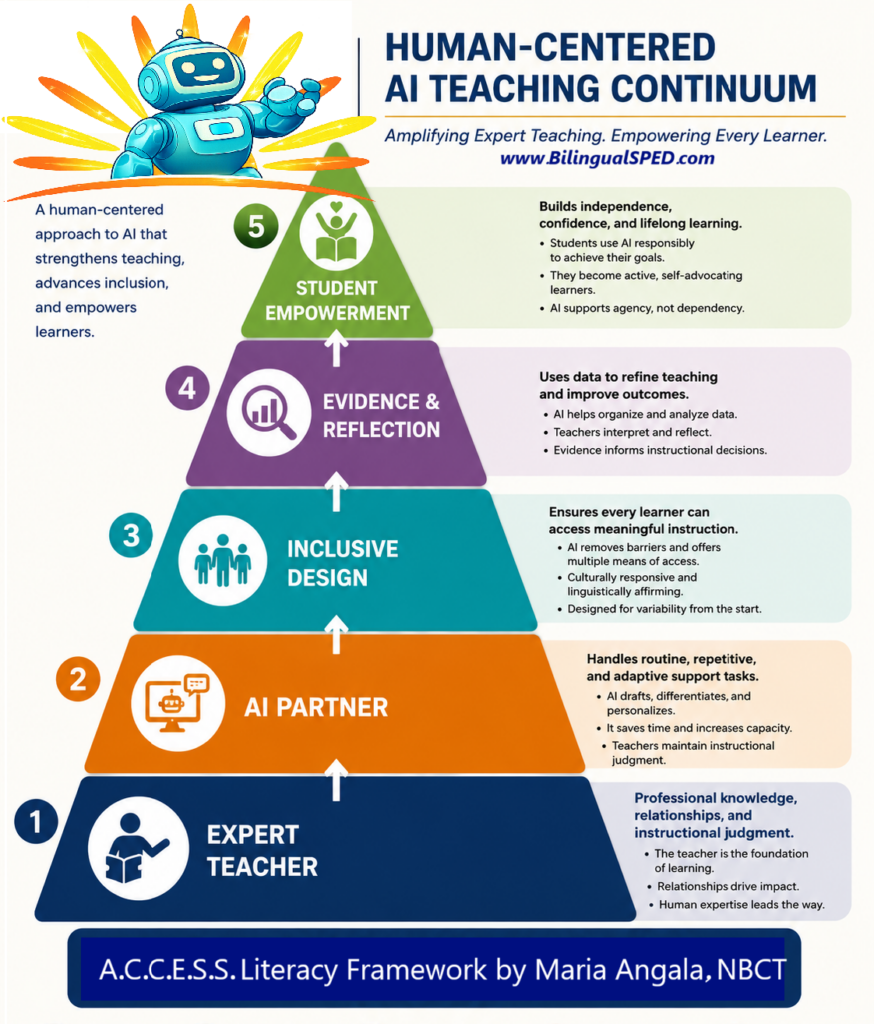
🤝 Human-Centered AI Teaching Continuum
You are the calm in their storm. Keep showing up, keep tracking the data, and keep respecting their dignity. You’ve got this.
.
Join our FUNSHINE Community to receive our latest free A.C.C.E.S.S. AI tools and other updates:
This help me understand how and know how will i teach sped students since they are the students that requires deep understanding and patience. This model help me identify what are the barriers I would face in teaching sped students
This platform gave me my Sundays back without sacrificing the quality of my instruction. Thank you so much po, Ma’am Angala! Here’s my sample I created using this AI tool:
The essential academic goal requires students to perform Apply (DOK 2: Skills & Concepts) on the target content. All generated pathways maintain this identical intellectual demand while diversifying how students receive information (Representation), engage with tasks (Engagement), and demonstrate understanding (Expression).
For multilingual learners, linguistic scaffolding provides access to disciplinary discourse without reducing cognitive expectations. For students with executive function or IEP needs, visual sequence checklists and chunked checkpoints eliminate initiation barriers.
Pathway Mode Representation (Input) Action & Expression (Output) Cognitive Demand Preserved Target Learner Accessibility Independence Fade Step
Pathway A: Text & Structured Writing Annotated source text with highlighted claim anchors and embedded glossaries. Structured 3-paragraph written analysis using paragraph frames. Preserved (Apply) General education, developing writers, students needing writing structures. Fade sentence starters to transition words only.
Pathway B: Visual & Concept Mapping Color-coded evidence flowcharts paired with chunked text sections. Annotated graphic evidence map with written or tagged justifications. Preserved (Apply) Visual learners, students with working memory needs, SLD in reading. Student constructs their own evidence map from unannotated text.
Pathway C: Oral & Socratic Discourse Source text with audio read-aloud support and collaborative partner reading. Recorded oral argument justification or structured Socratic fishbowl discussion. Preserved (Apply) Multilingual learners (WIDA L1-3), students with dysgraphia or AAC needs. Transition from peer-supported dialogue to independent oral synthesis.
Pathway D: Technology-Assisted Synthesis Digital text with text-to-speech, clickable bilingual glossaries, and video context. Digital slide deck, interactive evidence board, or recorded screen explanation. Preserved (Apply) Students with physical/motor access needs, AAC users, executive function needs. Independent selection and navigation of digital assistive tools.
🌐
WIDA Differentiated Language Pathways
Same cognitive analysis; language scaffolds adjusted across WIDA proficiency levels.
WIDA L1-2 (Entering / Emerging):
Provide visual evidence cards, bilingual glossaries, L1 discussion rehearsal, and point-and-explain sentence starters.
WIDA L3-4 (Developing / Expanding):
Provide expanded paragraph sentence frames, Tier 2 academic transition banks, and structured partner discourse routines.
WIDA L5-6 (Bridging / Reaching):
Offer advanced academic discourse prompts, nuance analysis frames, and independent justification checklists.
♿
SPED & Executive Function Pathways
Systemic accessibility accommodations embedded directly into the task architecture.
Executive Function:
Numbered step-by-step task checklist (Step 1: Identify Claim → Step 2: Extract Evidence → Step 3: Justify).
Reading Access:
Chunk text into 2-paragraph sections with stop-and-think margin checkpoints and text-to-speech option.
Written Expression:
Provide speech-to-text software access and graphic organizer planning templates prior to drafting.
🏛️
A.C.C.E.S.S. Literacy Framework Alignment
A
Activate Background
Use a 2-minute visual hook or video anchor before introducing the text.
C
Clarify Language
Pre-teach 3–4 essential Tier 2 words with visual Frayer models.
C
Chunk Tasks
Break the analysis into 3 distinct checkpoints with immediate feedback.
E
Engage with Evidence
Students highlight, tag, or physically sort evidence cards.
S
Support Scaffolds
Embed sentence starters, organizers, and peer rehearsal ongoingly.
S
Synthesize
Students demonstrate target analysis through their selected expression pathway.
⚖️
Access Support vs. Modification Analyzer
Test a proposed adaptation to determine if it maintains the learning target (Access) or changes what the student learns (Modification).