
The tool should analyze the interaction between the learner, the task, and the environment—not diagnose the student.
.
.
A.C.C.E.S.S. AI Learning Barrier Detector
“Find the barrier. Preserve the rigor. Design the access.”
📝 1. Task & Material Input
🎯 2. Context & Learner Profile
Here is a breakdown of what might make this task feel tricky and strategies you can use to show your thinking!
📊 Executive Barrier Analysis Summary
Category Severity Dashboard
Detailed Barrier Analysis & Access Strategies
🔄 Human-Centered AI Continuum & Scaffold Fade Lifecycle
Scaffolds are temporary access structures. Track progress across the lifecycle: Introduce → Model → Practice → Apply → Fade → Transfer.
🗺️ Interactive Action Map (Barrier → Strategy → Evidence)
Customize your instructional plan below. All cells are editable.
| Potential Barrier | Access Strategy | Evidence to Collect | Independence / Fade Step | Action |
|---|
⚖️ Equity Check: “Who Gets Access to Think?”
- Who gets to explain? Ensure MLs and students with IEPs have structured partner rehearsal before whole-group sharing.
- Who gets wait time? Build in a mandatory 7-second pause or written think-time after asking key questions.
- Who is positioned as a thinker? Students receiving access scaffolds must retain responsibility for analyzing textual evidence, not just completing low-level worksheets.
This A.C.C.E.S.S. AI tool investigates:
Potential task barrier: Five steps are embedded in one paragraph of directions.
Potential developing skill: Student may still be developing planning and task initiation.
Possible response: Visually sequence the five steps, model the first step, provide a checklist, and monitor initiation.
Rigor preserved: Student still completes the same writing task.
Future independence: Fade the checklist once the student consistently sequences the task independently.
This is a much more sophisticated intervention model.
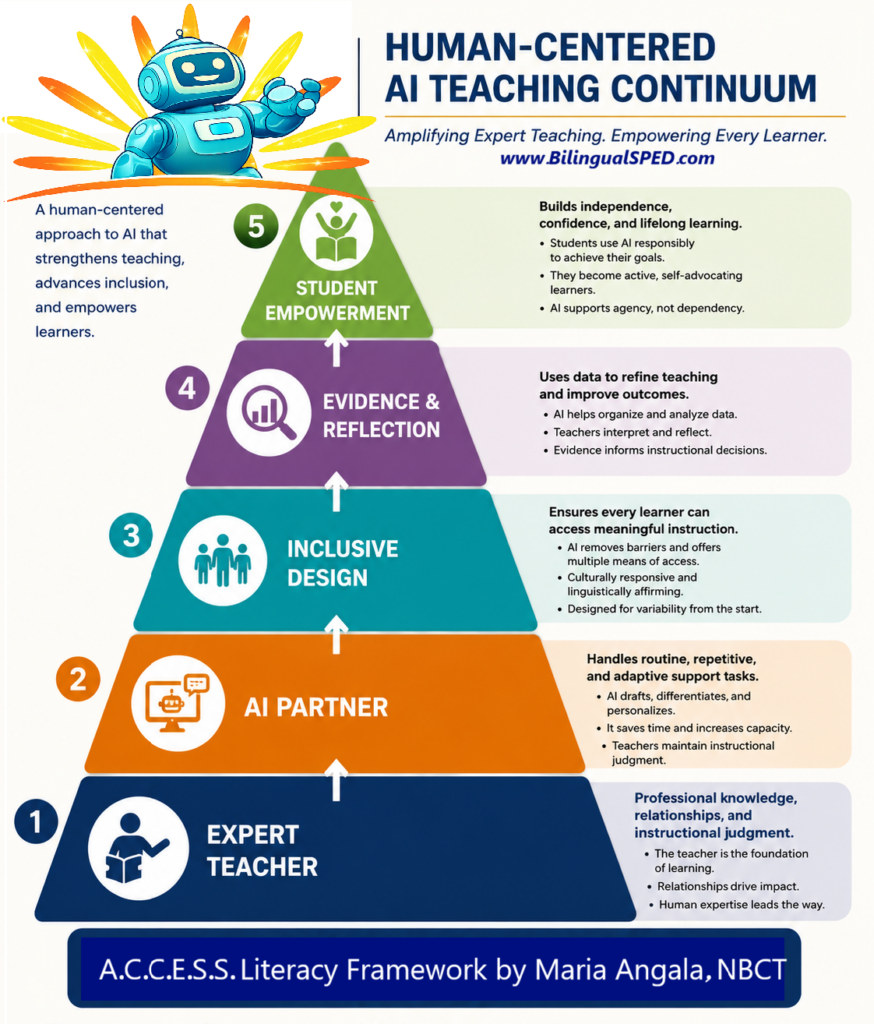
And it connects beautifully to the tools we’ve already created: Lesson Scaffold Generator → IEP Accommodation Generator → Scaffold Lifecycle Tracker → Scaffold Fade Analyzer → Scaffold Portfolio → Learning Identity Card → Learning Passport → Passport Transfer Moment.
The Barrier Detector becomes the front door of that ecosystem:
Detect the barrier → design access → scaffold → collect evidence → fade → transfer → build independence.
.
You are the calm in their storm. Keep showing up, keep tracking the data, and keep respecting their dignity. You’ve got this.
.
Join our FUNSHINE Community to receive our latest free A.C.C.E.S.S. AI tools and other updates: