This AI tool lets us measure something more meaningful than whether a response is simply “right” or “wrong.” The tool examines the complexity of thinking and explanation separately from English proficiency, so a multilingual learner can demonstrate sophisticated thinking even when their English expression is still developing.
A.C.C.E.S.S. AI Response Complexity Analyzer
“Look beyond the length of the answer. Examine the depth of the thinking.”
📌 1. Lesson Context & Expected Cognitive Target
📝 2. Student Responses (Paste Multiple Lines)
You already have strong ideas! Here are simple thinking moves to make your explanation even deeper:
⚖️ Thinking Complexity vs. Language Complexity Separation
- Demonstrates causal reasoning connecting light energy to chemical synthesis.
- Explains cause and effect relationships rather than simply recalling terms.
- Shows evidence of transfer to growth implications.
- Developing English syntax and emerging academic vocabulary.
- Uses simple sentence structures (“Sun make plant food because energy”).
- Requires academic language frames rather than cognitive simplification.
🪜 5-Level Response Complexity Continuum
📊 Categorized Response Breakdown & Analysis
| Student | Submitted Response | Thinking Level | Language Level | Inferred Evidence & Thinking Move | Next Instructional Move |
|---|
🪜 Thinking Expansion Ladder (Deeper Reasoning)
Preserves the student’s original idea while scaffolding deeper cognitive expansion:
🔍 Transparent AI Reasoning Breakdown
📄 Complete AI Response Complexity Evaluation Report
One strategic distinction with this AI tool: don’t call the five levels “low → high ability.” Call them something like Response Complexity 1–5. That protects the philosophy of our framework.
And this gives us another very strong chain in the A.C.C.E.S.S. ecosystem:
AI Error Pattern Analyzer → What kind of error is this?
AI Misconception Mapper → What might be underneath the error?
AI Response Complexity Analyzer → How deep is the student’s thinking, regardless of how sophisticated their English sounds?
Then we can connect that to AI Transfer Readiness Predictor → Can the student use that thinking somewhere new?
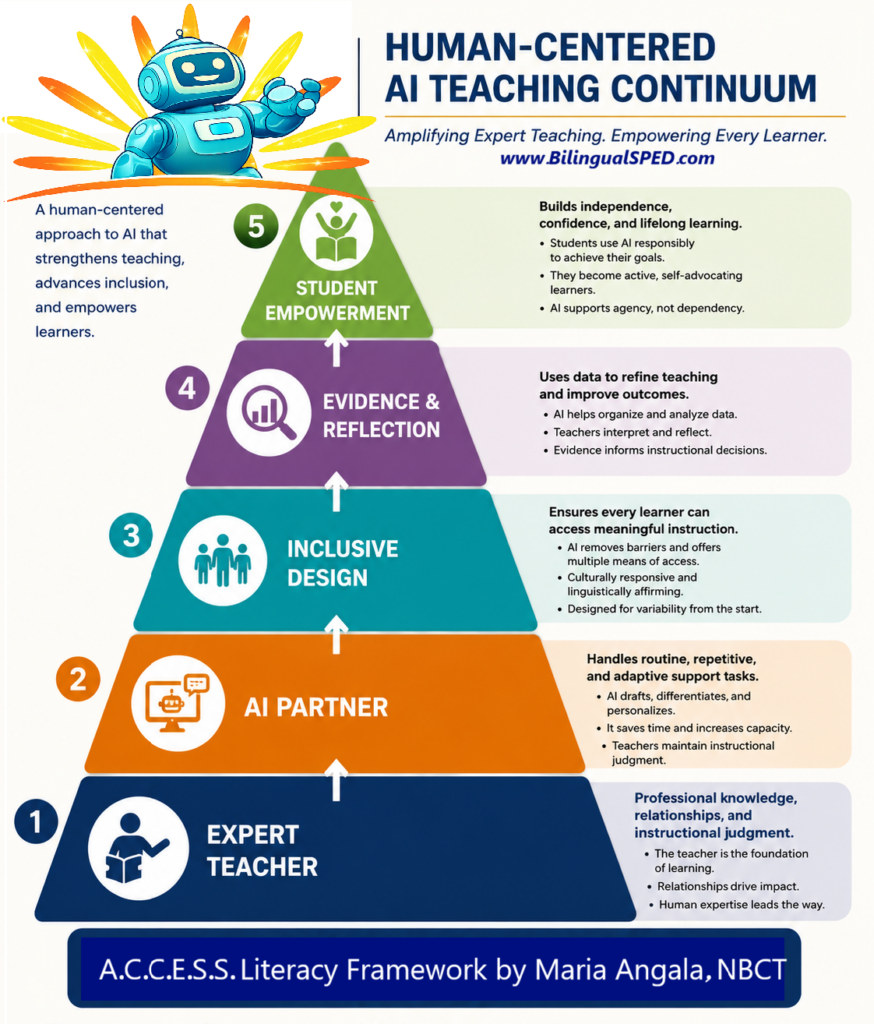
That is a much more sophisticated assessment ecosystem than simply having AI generate worksheets, rubrics, or lesson plans. It is beginning to measure the things our Human-Centered AI Teaching Continuum is actually trying to protect: access, rigor, evidence, reflection, and ultimately learner independence.
You are the calm in their storm. Keep showing up, keep tracking the data, and keep respecting their dignity. You’ve got this.
.
Join our FUNSHINE Community to receive our latest free A.C.C.E.S.S. AI tools and other updates: