
Why the A.C.C.E.S.S. Literacy Framework Image Is Built Like a Bridge — And Why That’s the Whole Point

ACCESS is a structured, scaffolded framework designed to ensure all learners can engage with grade-level literacy tasks. A – Activate Background Knowledge: Connect new learning to prior
knowledge C – Clarify Language & Vocabulary: Pre-teach and reinforce academic language C – Chunk
Complex Text & Tasks: Break tasks into manageable steps E – Engage with Evidence: Support
students in citing and explaining text evidence S – Support with Scaffolds: Use sentence frames,
visuals, and guided instruction S – Synthesize & Show Understanding: Demonstrate learning through
structured output Why ACCESS?
• Bridges the gap between the Science of Reading and classroom
practice
• Aligns with Universal Design for Learning • Designed for SPED, ELL, and struggling readers

Maintains rigor while increasing access Outcome: From access → to independence for every learner.
How My Thinking Evolved: The Behind-the-Scenes Story of Going From PLUSS to A.C.C.E.S.S.

The A.C.C.E.S.S. Literacy Framework didn’t appear fully formed one morning. It grew — slowly, messily, and honestly — out of years of PLUSS-aligned teaching that was already doing A.C.C.E.S.S. things before the acronym existed. This post tells the real story of that evolution, why naming a framework matters, and what every bilingual SPED teacher can learn from the gap between what we practice and what we call it.

It’s Time for the Philippines to Adopt the A.C.C.E.S.S. Literacy Framework — A Direct Conversation With Filipino Teachers, School Leaders, and Education Policymakers

The Philippines has some of the most dedicated teachers in the world — and one of the most persistent literacy gaps in Southeast Asia. The A.C.C.E.S.S. Literacy Framework offers a structured, repeatable, research-grounded instructional system that works in large multilingual classrooms without lowering expectations or overwhelming teachers. This post makes the case for school-wide and system-wide adoption — and shows you exactly how to start.

Big News: We’re Moving to a New Home!

Hey everyone, I need to share something exciting with you. After years of writing here on Blogspot, FUNSHINE (Digital Anthology) is moving to a brand new home! If you’ve been following along, you know I’ve always been honest about what works and what doesn’t in my special education classroom. Well, I’m about to take my … Read more

Top 10 Special Education Blog Categories and Labels

  The process of getting back to blogging is not as easy as I thought it would be. As I’ve shared in my recent blog post on January 23, 2026, my first post after 10 years of being away from blogging, I’m back at the keyboard—this time with clearer purpose and hard-earned perspective. Having this as my … Read more

How I’m using AI to Enhance my Lesson Planning

Tired of spending hours rewriting the same lesson for students at different levels? In this post, National Board Certified Teacher Maria Angala pulls back the curtain on how she uses AI as an “iteration partner” in her bilingual special education classroom. Teaching students who are navigating both IEPs and English language learning, Maria once spent evenings manually differentiating every text three ways. Now, AI handles the drafts — and she handles the decisions. She shares exactly where AI saves her time (leveling texts, generating sentence frames, simplifying vocabulary) and where it falls short (missing cultural context, overestimating reading levels, using idioms that confuse ELL students). The result? More time for one-on-one instruction, stronger lesson delivery, and a less burned-out teacher. A must-read for any SPED or ELL educator curious about AI — but wanting to stay firmly in the driver’s seat.

How to Use Making Inferences Reading Comprehension Strategy

In a standard classroom, we often tell students to “read between the lines,” but for a neurodiverse learner, those lines can feel like a solid, impenetrable wall. If the information isn’t stated explicitly, it simply doesn’t exist to them yet. As a mentor, I’ve learned that our role isn’t to ask our students to be … Read more

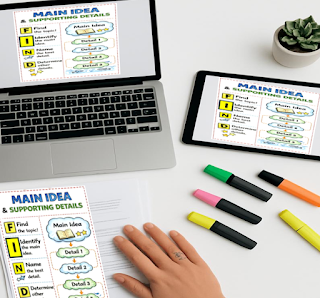
How to Use Main Idea & Details Reading Comprehension Strategy

To a student with an IEP, every sentence often carries the same weight. They might read an entire passage and, when asked for the big idea, fixate on a minor, colorful detail about a character’s shoes rather than the central message. As a mentor, I’ve learned that our most important task isn’t just to teach … Read more

Other Health Impairment (OHI) Under IDEA: What Every Special Education Teacher Needs to Know About ADHD — And Why I Take This One Personally

Other Health Impairment (OHI) is the IDEA disability category that most teachers search for and most families don’t understand — because ADHD lives here, not in its own separate box. This post breaks down what OHI means, how ADHD qualifies under it, and what real classroom support looks like for students who are misunderstood, misidentified, and often just plain exhausted from trying to keep up with a world that wasn’t designed for their brain. It’s also personal. My husband was diagnosed with ADHD in his 50s — and I’d known since college. ADHD isn’t abstract to me. It’s at my dinner table every night.

How to Use RACE/S Strategy Anchor Chart For Writing Center for ELL and SPED

This post explains how to use a RACE strategy anchor chart in a writing center to strengthen students’ constructed responses—especially for English language learners and students with special education needs. It shows how the RACE acronym (Restate, Answer, Connect, End) gives learners a clear, structured path for responding to open-ended questions by teaching them to restate the question, answer it with specific details, connect their response to evidence or broader ideas, and end with a strong conclusion. The anchor chart and printables act as visual scaffolds that make each step tangible and repeatable, helping students build confidence, organization, and text-based writing skills across content areas. Designed for literacy centers, small groups, intervention, SPED, and ELL classrooms, the strategy supports standards-aligned practice and helps students become more strategic and independent writers.