AI is reshaping how we teach multilingual learners with disabilities — but it’s not replacing the parts of our job that actually matter. Here’s an honest look at where AI helps with personalized learning, language access, and teacher workload, where it still falls flat, and how to use it without losing the relationship-first, culturally responsive teaching that makes bilingual SPED work in the first place. Written from 22+ years in the classroom, not a tech blog’s guess.
The Tuesday That Started This Whole Conversation
Picture this. You’ve got a student — let’s call the situation generic, because honestly this happens in a hundred classrooms every week — who’s an emergent bilingual, has an IEP for a specific learning disability, and needs every single worksheet chunked, visual, and available in two languages before it means anything to them. You have 25 minutes of prep between periods. You have four other students with four other profiles. And it’s Tuesday, which for some reason is always the day everything piles up.

That’s the moment AI either becomes useful or becomes one more thing you don’t have time to learn.
I’ve spent over two decades in bilingual special education, and I’ll be honest — I was skeptical of AI at first. Not because I thought it was useless, but because I’ve watched a dozen “revolutionary” ed-tech tools come and go, and most of them added work instead of removing it. This one’s different. Not because it’s magic. Because, used right, it actually gives time back to the parts of teaching that need a human in the room.
So let’s dig into what’s really changing, what’s overhyped, and how you can start using AI tomorrow without losing what makes bilingual special education work in the first place — the relationship.
What’s Actually Changing in Bilingual Special Education Classrooms?
Here’s the honest answer: AI isn’t creating new categories of support. It’s making the supports we already knew we needed faster to produce and, in some cases, more consistent.
Real-time translation tools now let you turn a science reading into five languages in the time it used to take to find one bilingual paraeducator. Adaptive tutoring systems can personalize practice aligned to IEP goals at a scale no single teacher could manage alone.Real-time translation supports multilingual learners by providing immediate translation of classroom content into multiple languages, while adaptive tutoring systems personalize practice and remediation aligned with IEP goals, offering support that goes beyond what one-on-one sessions alone could scale to. That’s not a small thing. That’s years of “I wish I had a translator on call” finally getting an answer.
And the research is starting to back this up, not just the marketing copy. A 2025 systematic review looked at AI-based interventions for students with learning disabilities across 11 studies and thousands of participants — every single one of the eleven studies reviewed reported positive outcomes, with dyslexia support being the most studied area. That’s not “AI might help someday.” That’s “AI is already helping, and we have the data.”

Quick Win: Before you build a single new resource from scratch this week, ask: has AI already made a version of this that I just need to edit? Nine times out of ten, yes.
Where AI Actually Helps (And Where I’ve Seen It Work)
1. Personalized Learning, Without the 2 a.m. Differentiation Session
You know the drill — one text, five reading levels, three languages, and accommodations layered on top for sensory needs. Used to take me an entire planning period, sometimes a whole evening. Now I draft the core lesson, run it through an AI tool, and get differentiated versions back in minutes. I still edit every single one — AI doesn’t know your student’s trauma history or their IEP nuances — but it gets me 70% of the way there instantly.
Tools worth trying:
- Diffit — generates leveled texts and comprehension questions from any topic or reading
- MagicSchool AI — built specifically for teachers, includes IEP-aligned lesson differentiation
- Google Translate — still the fastest first-draft translation tool for quick visual supports
2. Language Access That Doesn’t Depend on Who’s Available That Day
Here’s the thing nobody talks about enough: language access in special education has historically depended on staffing. If your bilingual paraeducator is out sick, your multilingual learner with a disability just lost their access for the day. AI doesn’t fix staffing shortages, but it does mean the materials — visual schedules, social stories, sensory break cards — can exist in multiple languages permanently, not just when the right adult happens to be in the building.
I’ve built visual supports in Spanish, Tagalog, and Burmese using AI translation as a first draft, then had native-speaking colleagues or families check the nuance. That second step matters — AI translation is good, not perfect, and cultural nuance is where it still stumbles.
Quick Win: Create one master set of visual supports (first/then boards, emotion check-ins, social stories for transitions) and use AI to generate multilingual versions. Do this once, reuse all year.
3. Accessibility That Scales
Classroom analytics tools can now flag which students are disengaging in real time, which used to require constant informal observation on your part.These tools track engagement and identify where students with disabilities may be struggling, flagging issues for timely intervention. For sensory accommodations especially — think noise-sensitive students, kids who need movement breaks, learners who process visual information better than auditory — AI-generated visual supports and social stories can be produced on demand instead of pieced together from whatever you can find online at 9 p.m.
4. Teacher Productivity — the One Nobody Wants to Admit They Need
I’ll say the quiet part out loud: burnout in bilingual special education is real, and a huge chunk of it comes from the sheer volume of material creation. AI drafting IEP-aligned goals, generating first drafts of progress notes, or producing parent communication in a family’s home language — that’s not cutting corners. That’s protecting your bandwidth for the actual teaching.
I built a full toolkit around exactly this — sensory accommodation cards, multilingual visual supports, and social stories ready to edit and print — because I got tired of teachers (myself included) reinventing this wheel every semester. If you want the ready-made version of everything I’m describing here, I put together a complete classroom toolkit — grab it on TpT here.
A Lesson That Actually Shows This in Action

Classroom context: A small group of upper-elementary multilingual learners, all with IEPs for specific learning disabilities, working on a science unit about ecosystems. Mixed home languages, mixed reading levels, and — this is the important part — at least one student who shuts down completely when a text feels “too hard” before they even try it.
The instructional challenge: The grade-level text was two reading levels above where most of the group could independently access it, and I needed it in three languages with visual supports for the sensory-sensitive student who does better with pictures than paragraphs.
The lesson approach: I used an AI tool to generate three leveled versions of the same ecosystem text, translated each into the students’ home languages, and paired the hardest vocabulary with simple icon-based visual supports. I also built a short social story about “what to do when reading feels hard,” because that emotional piece was honestly the bigger barrier than the content itself.
Student response: Genuinely surprised me. The student who usually shut down got through the whole passage — not because the science got easier, but because the access did. One of the multilingual learners read the passage in her home language first, then in English, and told me it “made her brain feel less tired.” Which, honestly, is the best review I’ve ever gotten on a lesson.
Teacher reflection: I’ll admit I almost skipped the social story piece because I was short on time. Glad I didn’t. In my experience, the emotional scaffolding matters just as much as the academic one — sometimes more — for kids who’ve learned that reading equals failure.
What I’d refine next time: I’d build the social story before the lesson next time, not the same morning. And I’d loop in a family member to check the translation nuance before using it live — AI got me 90% there, but that last 10% is where trust with families actually lives.
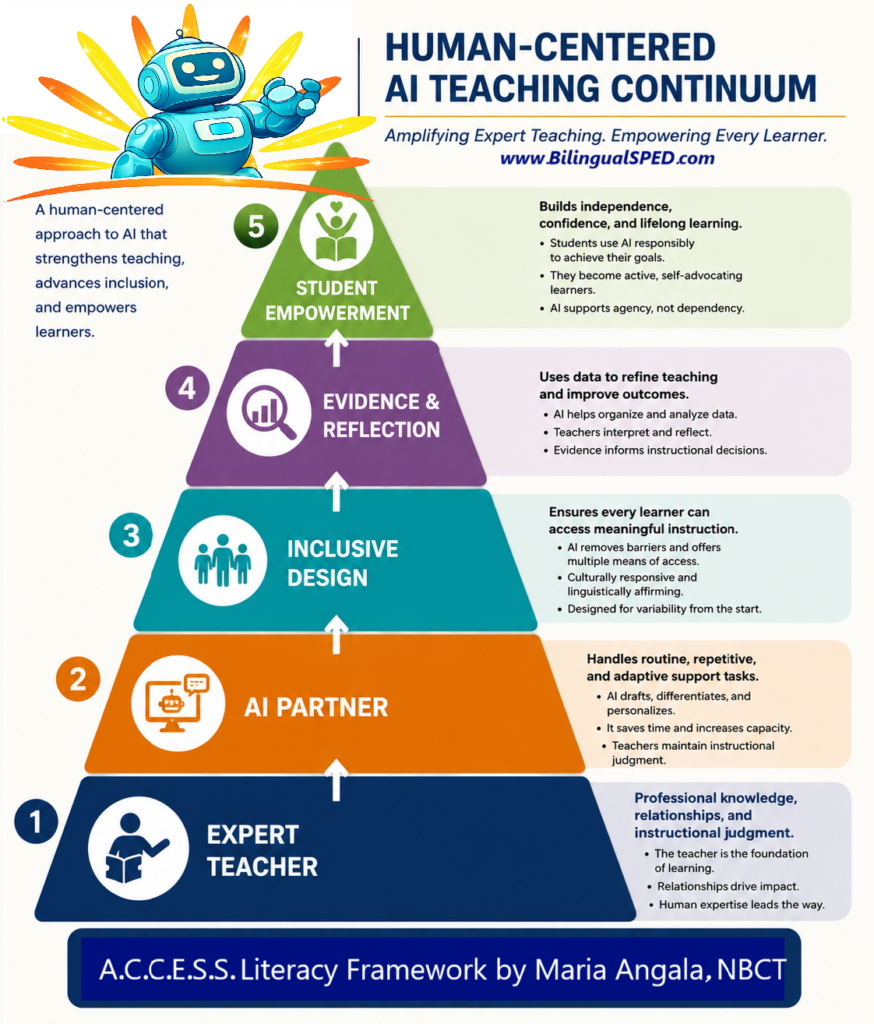
I developed a Human-Centered AI Teaching Continuum embedded within the A.C.C.E.S.S. Literacy Framework to guide educators in using AI ethically and effectively to amplify expert teaching for multilingual learners and students with disabilities.
Where AI Falls Short — And Why That’s Okay
This is the part I want new teachers to really sit with. AI can draft a social story. It cannot build the relationship that makes a social story land with a specific kid who trusts you. AI can translate a permission slip. It cannot understand why a family from a certain background might hesitate to sign anything without a phone call first.
A 2025 review of AI in inclusive education put it well — the researchers found that AI-driven adaptive learning systems, when integrated with Universal Design for Learning frameworks, significantly outperform traditional methods in personalizing educational experiences for disabled learners, but that same body of research consistently flags the same caution: technology should support human judgment, not replace it. Efficiency cannot replace empathy, full stop.Innovation cannot outpace oversight, efficiency cannot replace empathy, and access cannot depend on district wealth.
I’ve noticed the teachers who use AI well are the ones who never stopped seeing themselves as the expert in the room. AI is the intern. You’re still the teacher.
Quick Win: Before using any AI-generated material with students, run it through your “would I say this to this specific kid” filter. If it feels generic, it probably is — edit until it sounds like your voice, not a chatbot’s.
Frequently Asked Questions
Will AI replace bilingual special education teachers?
No — and the research consistently backs this up. AI tools speed up material creation and personalize practice, but the relationship-building, cultural responsiveness, and specialized instructional decision-making that define good SPED teaching still require a human who knows the student.
What’s the best AI tool to start with for bilingual special education?
Start with one thing: translated visual supports. Tools like Google Translate paired with a design tool, or purpose-built platforms like MagicSchool AI, let you produce multilingual, IEP-aligned materials without overhauling your entire workflow at once.
Is AI-generated translation accurate enough for IEP or family communication?
It’s a strong first draft, not a final product. Always have a native speaker or family member review anything going home, especially legal documents like IEPs, where nuance and tone genuinely matter.
References
- EdCircuit, “Artificial Intelligence in Special Education and Accessibility” (2025)
- Paglialunga & Melogno, “The Effectiveness of Artificial Intelligence-Based Interventions for Students with Learning Disabilities: A Systematic Review”, Brain Sciences (2025)
- Fitas, “Inclusive Education with AI: Supporting Special Needs and Tackling Language Barriers” (2025)
- Kaltura, “Combining AI and Special Education: A Comprehensive Guide” (2026)
- Marino et al., “The Future of Artificial Intelligence in Special Education”, ERIC (2022)
Where to Go From Here
AI isn’t the future of bilingual special education — it’s already here, sitting in your inbox as another tab you haven’t opened yet. The teachers who’ll thrive aren’t the ones who reject it or the ones who hand over the wheel completely. They’re the ones who treat it like a very fast, occasionally clueless assistant, and stay firmly in charge of the relationship, the culture, and the instruction.
If you want to skip the trial-and-error part I went through, the complete classroom toolkit — sensory accommodation cards, multilingual visual supports, and ready-to-use social stories — is available on TpT here. It’s everything I wish someone had handed me twenty years ago.
Want more of this — practical, honest, classroom-tested bilingual SPED strategy, not tech hype? Sign up for my email newsletter and I’ll send you the tools, templates, and real classroom stories as they come.
Reflection question: Think about one AI tool you’ve been curious about but haven’t tried yet. What’s the smallest, lowest-stakes way you could test it this week — one worksheet, one visual support, one translated note home — without it becoming one more thing on your plate?
You Might Also Like
More strategy and tools like this over at the BilingualSPED.com blog — including posts on the A.C.C.E.S.S. Literacy Framework, IEP accommodations for multilingual learners, and classroom-ready differentiation strategies.