
Here is a complete, web-based Interactive Vocabulary Builder & Scaffold Generator. It takes any target academic task or vocabulary objective and breaks it down across all 5 WIDA English Language Proficiency Levels (Beginning to Bridging), provides Formative (2-tier) and Summative (3-tier) rubric templates with emoji supports, and features multilingual self-reflection blocks across multiple languages.
.
.
A.C.C.E.S.S. Rubric Generator
Generated Rubric Package
Ready to Design Accessible Rubrics
Enter your criteria and assignment details on the left, then click “Generate Rubric” to build aligned, student-friendly, and culturally neutral assessment tools.
.
2. Standardized Templates for Classroom Use
.
A. Formative Assessment Template (Two-Tier Growth Scale)
.
Ideal for quick check-ins, daily exit tickets, and targeted skill practice.
.
| Criteria / Focus | 🌱 Level 1–2 (Emerging) | 🌟 Level 3+ (Developing & Above) |
| Concept & Content | 🖼️ Uses drawings, pointed gestures, or matched icons to show understanding. | ✏️ Explains concepts using key vocabulary and visual models. |
| Communication | 🔤 Uses 1–2 word answers or fills in sentence frames (e.g., “The _____ is _____.”). | 💬 Uses short, connected sentences (e.g., “First I did this, then I found…”). |
| Independence & Supports | 🤝 Requires visual word wall or native language / peer translation. | 💡 Uses reference tools (glossary/word bank) independently. |
.
B. Summative Assessment Template (Three-Tier WIDA-Aligned Scale)
.
Ideal for end-of-unit projects, presentations, and comprehensive tasks.
.
| Assessment Area | 🌱 Level 1: Entering (Newcomers) | 🌿 Level 2–3: Emerging / Developing | 🌳 Level 4+: Expanding |
| Message & Content | 🎯 Communicates main ideas primarily through visuals, labeled diagrams, or matched choices. | 📝 Communicates main ideas using guided templates, sentence frames, and graphic organizers. | 📚 Communicates main ideas in original multi-sentence paragraphs or structured spoken statements. |
| Academic Vocabulary | 🏷️ Identifies core key words using pictures or translated glossaries. | 📖 Uses key unit terms correctly when provided with a word bank. | 💡 Uses specialized vocabulary accurately and independently in context. |
| Linguistic Complexity | 🔤 Single words, short phrases, or copied words. (e.g., “Goal: Save money.”) | ✍️ Compound phrases and basic sentences. (e.g., “My goal is to save money for a bus pass.”) | 📄 Complex sentences with connecting words (because, however, step-by-step). |
.
3. WIDA Can-Do Alignment Quick Guide
.
When adjusting sentence complexity for your students, apply these linguistic scaffolds based on WIDA levels:
[Level 1: Entering] –> Visuals + Single Words + Native Language Supports
[Level 2-3: Emerging] –> Sentence Frames + Word Banks + Illustrated Guides
[Level 4+: Expanding] –> Sentence Starters + Graphic Organizers + Self-Editing Prompts
.
Examples of Sentence Scaffolding Across Levels
.
- Level 1 (Entering): 🖼️ “Save” / “Spend” (Match picture to word)
- Level 2–3 (Developing): 📝 “I want to save money for [ picture / word ].”
- Level 4+ (Expanding): 🌳 “I will save money because I need to buy [ word ] next month.”
.
4. Multilingual Student Self-Reflection Section
.
Include this student-facing self-assessment block at the bottom of any modified assignment or rubric:
🪞 My Reflection / Mi Autorreflexión
1. How was this work for you today? / ¿Cómo estuvo el trabajo hoy?
- 🟢 😀 Yo lo puedo hacer solo/a (I can do it by myself)
- 🟡 🙂 Necesito un poco de ayuda (I need a little help)
- 🔴 🛑 Necesito más práctica y ayuda (I need more practice & help)
2. Which tools helped you complete this task? / ¿Qué apoyos usaste?
- [ ] 🖼️ Pictures / Imágenes
- [ ] 📝 Sentence Frames / Marcos de oraciones
- [ ] 📖 Word Bank / Banco de palabras
- [ ] 👥 Partner or Teacher / Compañero o Maestro
.
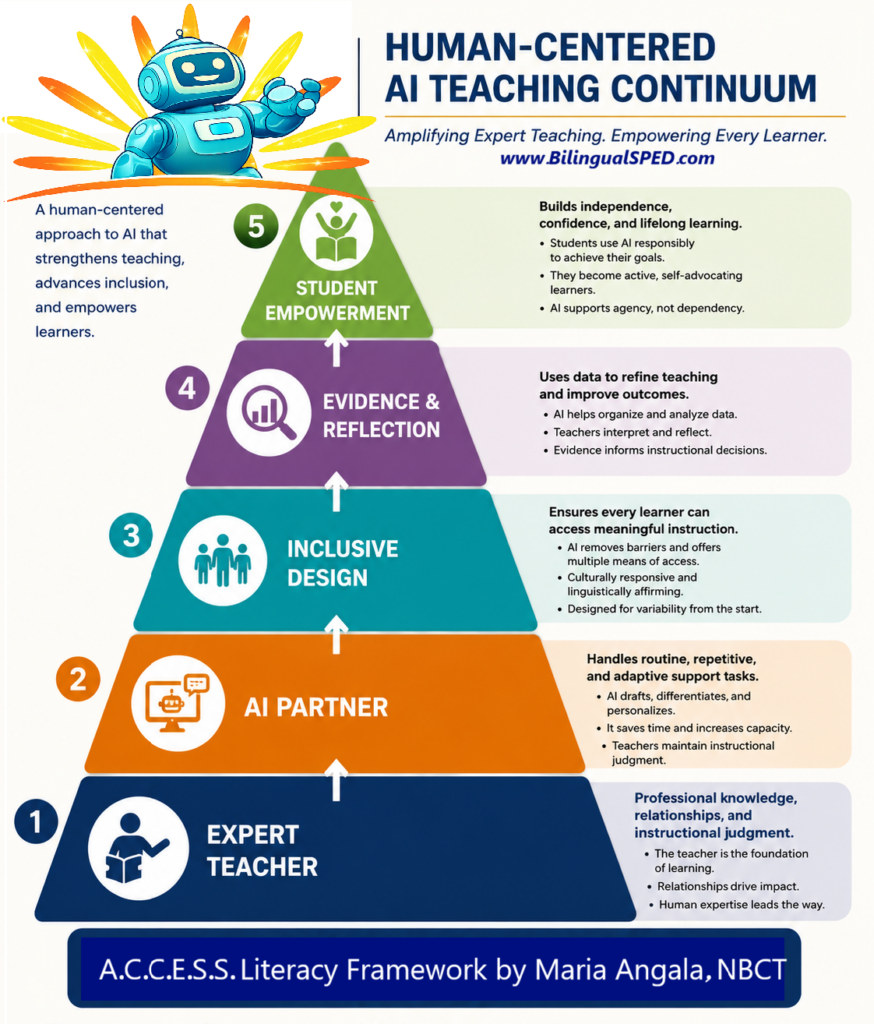
Alignment with the Human-Centered AI Teaching Continuum
.
This tool exemplifies Human-Centered AI Teaching Continuum by placing the teacher in control of instructional decisions while AI reduces the cognitive load of adapting materials.
.
- Expert Teacher: Defines the assignment, success criteria, and instructional goals.
- AI Partner: Converts academic language into proficiency-appropriate, emoji-supported rubric descriptors, generates multilingual reflections, and recommends scaffolds.
- Inclusive Design: Produces accessible rubrics tailored to WIDA proficiency levels and students’ home languages without lowering academic expectations.
- Evidence & Reflection: Includes student self-assessment, teacher notes, and progress-monitoring prompts that can inform instructional adjustments.
- Student Empowerment: Gives learners clear, understandable success criteria and opportunities to reflect in their strongest language, increasing independence and ownership of learning.
.
Integrated into the A.C.C.E.S.S. Literacy Framework, this generator becomes more than a rubric tool—it would function as an AI-assisted accessibility engine that helps ensure every multilingual learner can understand what quality work looks like while maintaining rigorous grade-level expectations.
.
You are the calm in their storm. Keep showing up, keep tracking the data, and keep respecting their dignity. You’ve got this.
.
Join our FUNSHINE Community to receive our latest free A.C.C.E.S.S. AI tools and other updates:
.