Inside the A.C.C.E.S.S. Human-Centered AI Teaching Continuum
If you’ve ever stared at a lesson plan wondering how one instructional sequence is supposed to reach a newcomer who reads no English yet, a student with a documented learning disability, and everyone in between — you’re not alone, and you’re not doing it wrong. This post walks through the A.C.C.E.S.S. Literacy Framework and its Human-Centered AI Teaching Continuum the way I’d explain it to a teacher I’m coaching one-on-one: the real problem, the actual lesson moves, what happened when I tried it, and what I’d tweak next time. No jargon. No hype. Just what’s worked across sixteen years in bilingual special education classrooms.
Okay, so let’s talk about the thing nobody quite says out loud in PD sessions: most AI-in-education advice is written for a classroom that doesn’t look like yours.
It assumes one home language. It assumes no IEP. It assumes a kid who can just… read the prompt. If you’re teaching multilingual learners or students with disabilities — or, more likely, a room full of both — that advice falls apart by 9:15 a.m.
I’ve spent over two decades teaching bilingual special education, and I built the A.C.C.E.S.S. Literacy Framework because I got tired of retrofitting other people’s “one-size-fits-all” lessons. This post is me coaching you through it like I’d coach a new teacher on my hallway — problem first, then what actually worked, then what I’d do differently. By the end you’ll have a lesson-ready sequence, and a free guide to take with you.
What Is the A.C.C.E.S.S. Literacy Framework, Exactly?
The A.C.C.E.S.S. Literacy Framework is a six-pillar instructional sequence — Activate, Clarify, Chunk, Engage, Support, Synthesize — built to make rigorous, grade-level literacy instruction reachable for multilingual learners and students receiving special education services.
It’s not a curriculum you buy and run on autopilot. It’s a sequence of decisions:
- Activate background knowledge before new content ever lands
- Clarify vocabulary so language itself isn’t the barrier
- Chunk dense text into steps a struggling reader can walk through
- Engage students actively instead of asking them to just absorb
- Support with scaffolds calibrated to the actual need
- Synthesize — analyze and respond with real evidence, same bar as everyone else
Sitting on top of all six is the Human-Centered AI Teaching Continuum — five levels mapping where AI can help, and where teacher judgment can’t be outsourced.
Want the ready-made version? I put the lesson templates, visual supports, and full reading comprehension sequence into a free A.C.C.E.S.S. Reading Comprehension Mega Bundle Guide on TpT. Free — grab it and follow along.
Why Doesn’t “Just Use AI” Work for These Students?
Here’s the anxiety underneath this whole conversation, and I think it’s a legitimate one: how do you use AI in the classroom without losing your humanity?
Look at the numbers. On the most recent National Assessment of Educational Progress, fourth-grade students with disabilities scored 40 points below peers in reading — a gap holding steady since NAEP first tracked it by disability status in 1998 (NCES, 2022). English learners showed a comparable 32-point gap. Not a “some kids need extra help” story. A systems story, unchanged for two decades.
Generic AI is built to fly the average route. The second you introduce a language barrier, or a documented disability, or — more likely, if you teach where I’ve taught — both, “average” stops meaning anything. A dashboard flagging a student as “behind” doesn’t know if that’s a language-acquisition timeline or an actual processing disability. Only a human, with real relationships and context, can tell the difference.
Quick Win 💡: Before assuming a struggling reader needs a disability referral, ask: is this a language-acquisition timeline, or a processing issue? Academic English alone can take five to seven years to develop. Confusing the two builds the wrong support for the wrong problem — sometimes for years.
Okay, So Where Do You Actually Start? (A Classroom Scenario)
Let me set a scene — a composite one, built from patterns I’ve seen across many classrooms and years, not any one student or school.
Picture a secondary reading intervention block. Roughly a third of the students are multilingual learners at different points on the language-acquisition timeline. Another third have documented learning disabilities, mostly around decoding and fluency. A handful are newcomers with interrupted schooling, encountering an American classroom for the very first time.
The assigned text? A grade-level informational passage on ecosystems. Dense. Vocabulary-heavy. Exactly the kind of text that gets quietly swapped for something “easier” in a lot of classrooms — which, in my experience, just widens the gap it was supposed to close.
The instructional challenge isn’t the content. It’s the path to the content. That’s the whole reason this framework exists.
What Does This Actually Look Like, Lesson to Lesson?
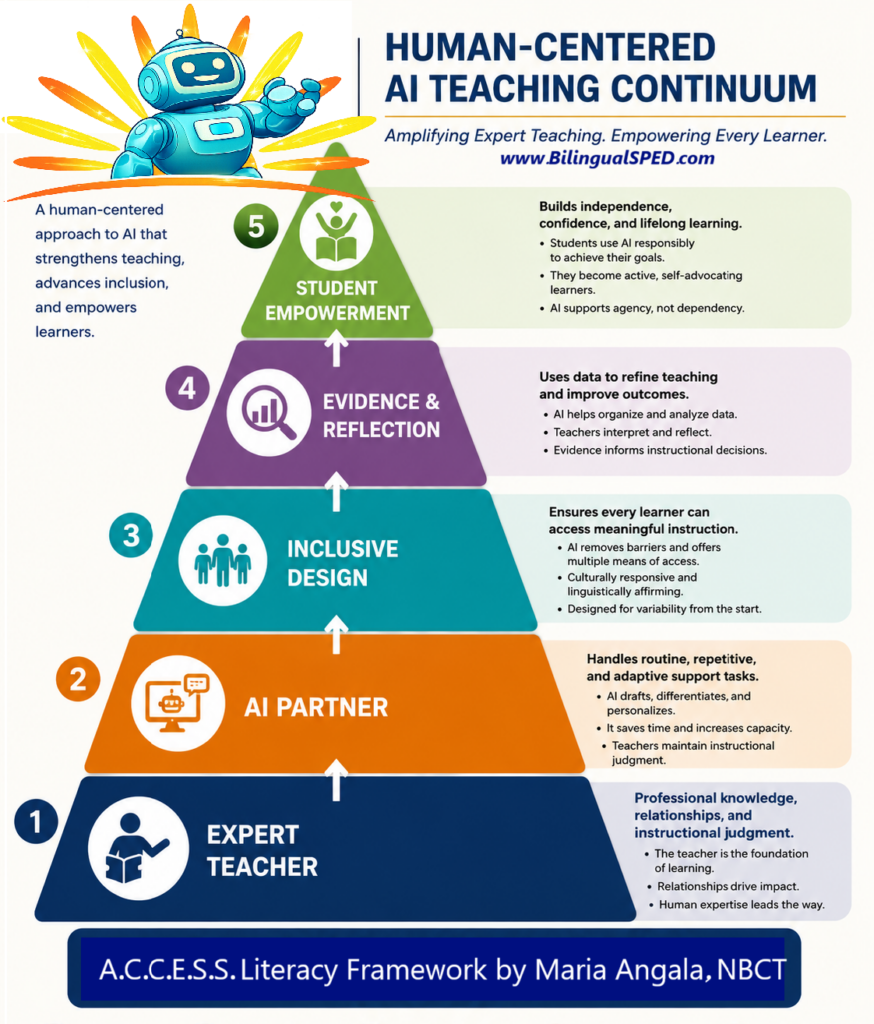
Here’s the sequence, and where AI fits at each step — because “human-centered” doesn’t mean “no AI.” It means AI is level two of the continuum, not level one.
Level 1 stays constant: Expert Teacher. Before any tool touches this lesson, the teacher’s read on the room — who’s masking a language gap as “not getting it,” who’s actually ready to be pushed — sets the plan. This never gets outsourced.
Activate + Clarify, with AI as Partner (Level 2). I’ll use AI to draft a quick background-knowledge primer and a leveled vocabulary list for the ecosystems passage, in English and in students’ home languages. That’s a first draft, though. Every translation gets checked for accuracy and cultural context before a student sees it. AI drafts. I edit. Always in that order.
Chunk + Support, with Inclusive Design (Level 3). This is where sensory accommodations and visual supports actually live. Dense text gets chunked into sections with picture-supported vocabulary cards. I build in visual supports in multiple languages — side-by-side image-and-word cards, not just translated text, because a translated paragraph alone doesn’t help a student also navigating a processing disability. Twinkl and Canva are genuinely useful for building bilingual visual sets fast, and Boardmaker is the standard for symbol-based social stories if a student needs a predictable narrative before a transition or new routine.
Engage, with real interaction. Students work in small mixed groups, using AI-drafted, teacher-reviewed sentence stems to discuss the chunked sections. This is the pillar where thoughtful AI prompts genuinely raise the ceiling — kids engaging with content instead of just receiving it.
Synthesize, with Evidence-Informed reflection (Level 4). Students respond with evidence — same expectation for everyone. Afterward, I disaggregate the data: how did multilingual learners do, versus students with IEPs, versus the group overall? That breakdown is where gaps hide if you only look at the class average.
Student Agency (Level 5) is the actual goal. Over time, I want students choosing when to use a scaffold and when to try it without one. Not a one-lesson outcome — the destination the whole sequence points toward.
By the way — this exact lesson flow, including the bilingual visual support templates and chunking guides, is basically what’s in that free A.C.C.E.S.S. Reading Comprehension Mega Bundle Guide I mentioned earlier. Built so you’re not recreating this from scratch every Sunday night.
What Actually Happened? (Student Response)
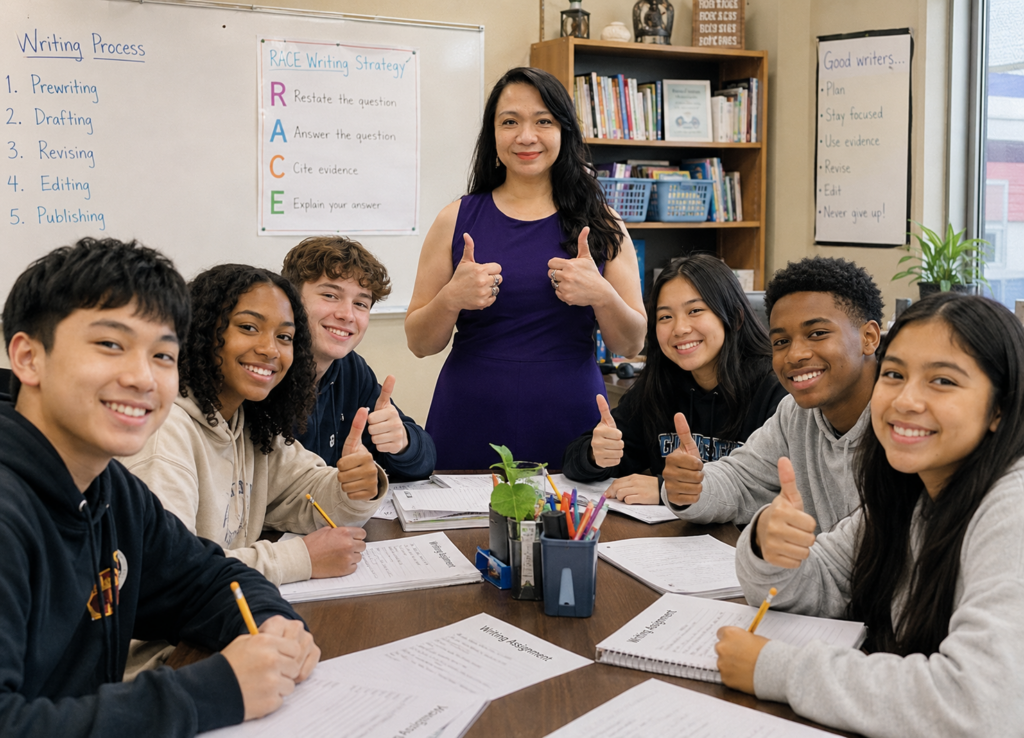
Well. Slower than I wanted, at first — chunking takes longer to plan than just assigning the passage. But the shift I noticed, consistent across years and not a one-time fluke, was who raised their hand during the Engage discussion. Students who normally sat quiet during whole-group reading, the ones I suspected were masking a language gap or genuinely disengaged, started contributing once vocabulary and background knowledge were actually in place first.
That’s not magic. That’s Activate and Clarify doing their job before Engage ever asked anything of them.
What I’d Refine Next Time
Here’s my honest reflection, teacher to teacher: I’d build home-language visual supports before the lesson, not during. AI drafts translations fast, but “fast” and “reviewed properly” aren’t the same thing. I’ve learned, more than once, that rushed AI-assisted translation review is where cultural-context errors sneak in.
I’d also disaggregate outcome data sooner. Waiting until the unit test to check whether multilingual learners and students with IEPs were both actually growing means finding the gap too late to adjust much.
Quick Win 💡: Build your bilingual visual supports and social stories a week ahead, not the night before. AI-assisted drafts still need real review time — rushing that step is where errors sneak past you.
Is There Actual Data Behind This, or Just a Good Story?
Fair question, and I’d ask it too. A few things worth knowing:
- The gaps I mentioned earlier aren’t new or shrinking fast — NAEP data shows the disability-status gap near 40 points and the English-learner gap near 32 points, holding steady for years (NCES, 2022).
- AI adoption among special education teachers is climbing fast: one national survey found 57% used AI to help develop IEPs in 2024-25, up sharply from the year before (CDT, via NPR, 2026).
- That same research is blunt about risk: fewer than half of teachers using AI professionally received any real district guidance on responsible use (CDT, 2025, via CIDDL). A little wild, given how fast adoption is moving.
- Researchers reviewing AI in IEP development keep landing on the same principle: AI output is a first draft requiring real human review, never a final product (CIDDL, 2026).
That last point isn’t just research-speak. It’s Level 2 of the continuum, word for word.
Frequently Asked Questions
Is AI safe to use with students who have IEPs? Used as a drafting tool a teacher reviews before anything reaches a student — yes, and studies show it can improve consistency in individualized planning. Used as an unreviewed, autonomous decision-maker, no. That’s what current research and legal guidance both say.
How is the A.C.C.E.S.S. Framework different from generic differentiation? Generic differentiation often means “make it easier.” A.C.C.E.S.S. doesn’t lower the bar — it changes the path to the same rigorous bar, through six instructional moves, so grade-level content stays grade-level.
Do I need special software to start? No. The sequence works with whatever tools you already have. AI and visual-support platforms help at certain steps, but the framework itself is a teaching decision, not a purchase.
One More Time, Because It’s Worth Repeating
If you’ve read this far and you’re thinking “okay, I want to try this but I don’t have a free planning period to build it from scratch” — same. That’s exactly why I put together the free A.C.C.E.S.S. Literacy Framework Reading Comprehension Mega Bundle Guide on TpT. It’s the whole sequence, ready to adapt, including the bilingual visual supports and chunking guides I described above. Free. No catch.
You Might Also Like
If this post was useful, these go deeper on specific pieces of it:
- Differentiating Between Language Acquisition and Learning Disabilities: A Teacher’s Checklist
- Why Most AI Tools Weren’t Built for Neurodivergent Learners — And How to Choose Ones That Are
- How My Thinking Evolved: The Behind-the-Scenes Story of Going From PLUSS to A.C.C.E.S.S.
- Why the A.C.C.E.S.S. Literacy Framework Image Is Built Like a Bridge — And Why That’s the Whole Point
Let’s Keep This Going
So — where does this leave you? If you’re standing in front of a room like the one I described, my honest advice is: start with one pillar. Not all six at once. Pick Chunk or Clarify for your next lesson and just see what shifts.
And if you want the full toolkit so you’re not building it solo at 9 p.m. on a Sunday, the free A.C.C.E.S.S. Reading Comprehension Mega Bundle Guide is right here on TpT — grab it, adapt it, make it yours.
I write about this stuff — real classroom problems, real instructional fixes, no fluff — pretty regularly. If that’s useful to you, sign up for my email newsletter below and I’ll send new posts, free resources, and the occasional behind-the-scenes lesson-planning fail straight to your inbox.
Reflection question for you: think of one student in your room right now who you suspect is stuck between "language gap" and "learning gap." What would change about your next lesson with them if you assumed it was the former? What if you assumed the latter?
I’d genuinely love to hear your answer — drop it in the comments, or hit reply if you’re already on the newsletter.
References:
- National Center for Education Statistics. (2022). Reading Performance — NAEP achievement gaps by disability status and English learner status. nces.ed.gov/programs/coe/indicator/cnb/reading-performance
- NPR. (2026). Special educators use AI to help them spend more time teaching. npr.org
- Center for Democracy and Technology, reported via K-12 Dive. (2025). Heightened AI use in special education brings elevated risks. k12dive.com
- CIDDL. (2026). Navigating AI in IEP Development: A Framework for Ethical Practice. ciddl.org
- CIDDL. (2026). What Every Educator Should Know About Ethics, Data, and Decision-Making When Using AI. ciddl.org