I remember sitting in an initial evaluation meeting early in my career, looking at a young girl who had just moved to the country six months prior. The data showed she was struggling with reading and followed almost no verbal directions. The team was ready to label her with a “Specific Learning Disability.” But something gave me pause. When I watched her on the playground, she was navigating complex social hierarchies in her native language with ease. Was this a disability, or was she simply in the “silent period” of language acquisition?
If you’re a new teacher, this is one of the highest-stakes puzzles you will ever solve. Misidentifying an English Language Learner (ELL) as having a disability can lead to restricted opportunities, while failing to identify a true disability can deny them the life-changing support they need.
I’m coaching you today as a peer who has navigated these muddy waters for years. We need to move beyond “gut feelings” and toward a systematic checklist. To help you track these nuances week-by-week, I always have my SPED Inclusion & Accommodations Weekly Monitoring Form clipped to my board. It’s the best way to see if a student’s struggle is consistent or if it’s tied to the linguistic demands of a specific lesson.
1. The “Double Burden” of the ELL-SPED Learner
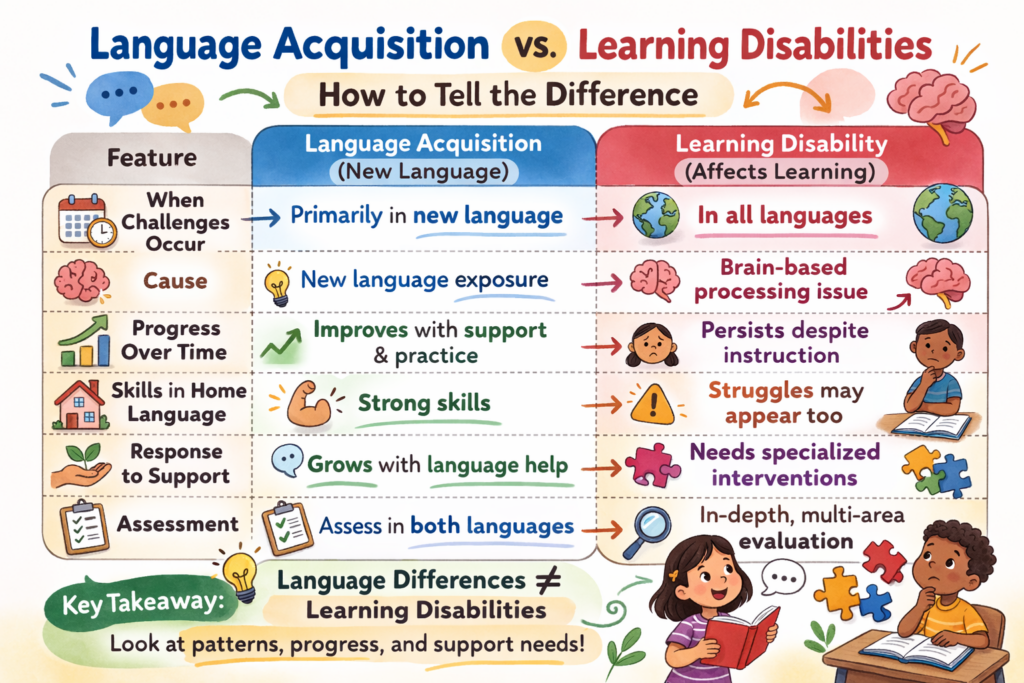
Before we dive into the checklist, we have to understand the data. Nationally, ELL students are both over-represented and under-represented in special education, depending on the district. This “seesaw” happens because it is genuinely hard to tell where language ends and disability begins.
Shared Characteristics:
- Slow processing speed (Is it cognitive, or are they translating in their head?)
- Difficulty following multi-step directions (Did they forget, or did they miss the transition words?)
- Low frustration tolerance (Are they overwhelmed by the content, or the language barrier?)
2. Your Differentiation Checklist: The “Rule Outs”
When I’m coaching a teacher through a referral, I tell them to use these “Rule Outs” first. If you can check these off, you are much closer to a true disability identification.
☐ Rule Out 1: The “Both Languages” Rule
A true learning disability exists in both the native language (L1) and English (L2).
- The Assessment: Use a Parent Interview. Ask: “Did they struggle to learn their first words in Spanish?” “Do they have trouble following directions at home in their native language?”
☐ Rule Out 2: The “Silent Period”
Is the student in their first 6–12 months of exposure? It is developmentally appropriate for ELLs to be quiet and “absorptive” during this time.
- Red Flag: If the student has been in an English-speaking environment for 3+ years and still hasn’t moved past basic social language (BICS), that’s a concern.
☐ Rule Out 3: Cultural and Environmental Factors
Has the student experienced “interrupted schooling” (SIFE)? If a student hasn’t been in school for two years, their struggle isn’t a disability—it’s a lack of opportunity.
3. Red Flags to Watch For
If you’ve ruled out the basics, start looking for these “High-Intensity” red flags. These are the indicators that usually point toward a learning disability rather than just language acquisition.
- Non-Linguistic Processing Issues: Difficulty with patterns, puzzles, or non-verbal tasks that don’t require English.
- Regression: If a student masters a skill in English one day but has completely “lost” it the next (beyond typical language fatigue).
- Significant Family History: Does a sibling or parent have a documented learning disability in their native language?
- Social-Communication Gaps: Difficulty making friends even with peers who speak their native language.
To keep a pulse on these behaviors during your 50-minute blocks, use a consistent tracking tool. I rely on the SPED Inclusion & Accommodations Weekly Monitoring Form because it allows me to note if a student is struggling across all subjects (Financial Literacy, English, and Digital Literacy) or just in the language-heavy English block.
4. Assessment Tools for the Classroom Teacher
You don’t have to wait for the school psychologist to start gathering data. Here are the tools I actually use:
- Dynamic Assessment: Instead of a “one-and-done” test, use the “Test-Teach-Retest” model. If the student can learn a new rule quickly with a little coaching, it’s likely language acquisition. If they can’t retain it despite intensive modeling, it may be a disability.
- WIDA Can Do Descriptors: Compare your student to the expected language milestones for their English proficiency level. If they are a “Level 3” learner but performing like a “Level 1” in reading, that gap is your data.
- Colorín Colorado’s ELL-SPED Resources: The absolute gold standard for finding translated checklists and research-based strategies.
5. Parent Communication: The “Partnership” Template
Parents are your best data source. When I communicate with ELL parents, I use a “Strengths-First” approach.
The Email/Letter Template:
“Hi [Parent Name], I am so impressed by how [Student] is navigating our Digital Literacy Academy! I am noticing they are having some trouble with [Specific Task, e.g., following 2-step directions]. Do you see this same struggle when you give them chores in [Native Language] at home? Your insight helps me know how to support them best!”
This “Home-School Connection” is vital. If you’re documenting this weekly on your Monitoring Form, you’ll have a clear timeline to show the IEP team if a referral becomes necessary.
6. The “Wait and Watch” vs. “Early Intervention” Debate
As your coach, I’m giving you permission to trust your gut—but verify it with data. The old “Wait to Fail” model is dead. We use MTSS (Multi-Tiered System of Supports).
- Tier 1: High-quality English instruction with lots of visuals (PLUSS framework).
- Tier 2: Small group intervention.
- Tier 3: If they still aren’t making progress relative to “true peers” (other ELLs from the same background), it’s time for a formal evaluation.
Conclusion: You are the Guardian of the Gate
Differentiating between language and disability is one of the most professional things you will do as a teacher. It requires patience, a lot of visuals, and a commitment to seeing the whole child.
Don’t let the paperwork overwhelm the person. Every time you check off a strategy on your SPED Inclusion & Accommodations Weekly Monitoring Form, you are building a case for that student’s success. You are ensuring they get exactly what they need—no more, and certainly no less.
Ready to Streamline Your Documentation?
The referral process is only as strong as the data you bring to the table.
Your Action Plan:
- Perform a “True Peer” Check: Look at another student with the same native language and time in the country. Are they progressing at the same rate?
- Start Your Paper Trail: Grab the SPED Inclusion & Accommodations Weekly Monitoring Form to track your interventions for the next four weeks.
- Join the Community:
Reflection Question: Think of one student who is currently “on your radar.” Based on the Rule-Outs above, do you think they are experiencing a language gap or a learning gap? What is one non-verbal task you could give them tomorrow to find out?