The first time I had to call a parent to discuss a significant behavioral regression, my palms were sweating so much I nearly dropped the classroom phone. I was a new teacher, and I felt like I was being summoned to the principal’s office—even though I was the one in charge. I worried they’d think I was failing their child, or worse, that I didn’t care.

Parent communication in Special Education isn’t just about relaying information; it’s about building a fortress of trust around the student.
If you are feeling that same pit in your stomach when you look at your “To-Call” list, take a deep breath. I’m coaching you today as someone who has sat through hundreds of IEP meetings and sent thousands of emails. Here is the secret: Parent communication in Special Education isn’t just about relaying information; it’s about building a fortress of trust around the student.
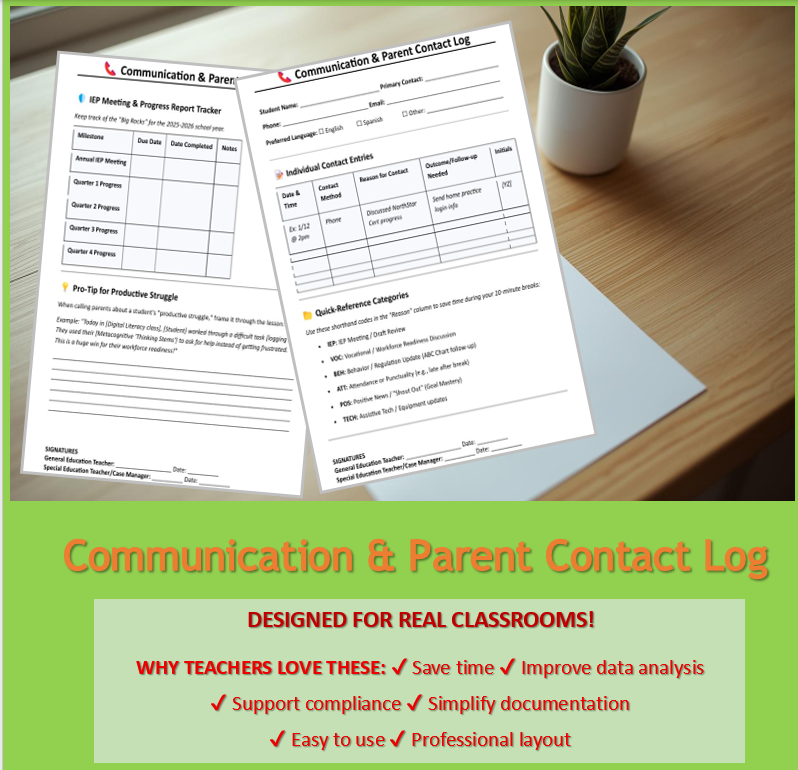
When you teach students with significant cognitive disabilities, you aren’t just their teacher; you are the eyes and ears for a family that often worries about what happens when they aren’t there. To do this well without burning out, you need a system. I personally rely on my Special Ed Parent Contact Log & IEP Milestone Tracker to keep every conversation, goal update, and vocational win organized. It’s the difference between guessing what you said in October and having the data ready for the annual review.
1. The “Trust Account” Philosophy
Think of parent communication like a bank account. You cannot make a “withdrawal” (calling about a difficult day, a bus incident, or a dip in progress) if you haven’t made enough “deposits.”
The Deposits: These are the “Good News” emails. In the whirlwind of a three-hour block of English, Financial Literacy, and Digital Literacy, it’s easy to let the small wins go unnoticed. Don’t let them.
- Did a student use their assistive technology independently for the first time? Email.
- Did they stay on task during the “Individual Work” (You Do) segment? Email.
When a parent sees your name in their inbox, you want their first thought to be, “I wonder what great thing happened today?” rather than, “Oh no, what happened now?”
2. Professionalism Meets Empathy: The Tone
We are professionals, but we are also human beings caring for someone’s “everything.” Your tone should be a blend of clinical accuracy and genuine heart.
Avoid jargon. Instead of saying, “The student demonstrated a deficit in expressive language during the whole group instruction,” try, “During our morning circle, [Student] struggled to find the words to answer a question, so we used their picture board to help them share their thoughts.”
To keep track of these nuances, I use the “Notes” section of my Special Ed Parent Contact Log. It helps me remember which parents prefer a phone call over an email and who needs me to use specific terminology that aligns with their home-based therapies.
3. The “difficult News” Sandwich
Eventually, you will have to send the “not-so-great” email. Whether it’s a lack of progress on an IEP goal or a behavioral hurdle, use the Sandwich Method:
- The Bread (Positive): Start with something the student did well that day.
- The Meat (The Issue): State the facts clearly, objectively, and without judgment.
- The Bread (The Plan): End with how you are supporting the student and a note of partnership.
4. Email Templates for Your Daily Grind
Copy, paste, and tweak these. Your time is better spent with your students than staring at a blinking cursor.
Template A: The Weekly “Wins” (The Deposit)
Subject: [Student Name]’s Great Week in Digital Literacy!
Hi [Parent Name],
I wanted to share a quick win from our Digital Literacy Academy today. [Student Name] showed incredible focus during our “Practice (We Do)” session. They were able to log into their computer using their adaptive keyboard with only one verbal prompt!
It’s wonderful to see their confidence growing with the NorthStar curriculum. Have a great weekend!
Best, [Your Name]
Template B: The Goal Update (The Milestone)
Subject: IEP Progress Update: Financial Literacy
Hi [Parent Name],
We’ve been working hard on identifying coins in our Financial Literacy block. Today, [Student Name] correctly identified the quarter 4 out of 5 times!
We are going to continue practicing this during our “Partner Work” sessions next week. I’ve logged this milestone in my tracker to ensure we have clear data for our next meeting.
Best, [Your Name]
5. Setting Boundaries (To Prevent Burnout)
You are a dedicated teacher, but you are not on call 24/7.
- Establish a “Sunset Rule”: If an email comes in after 5:00 PM, it gets answered the next morning.
- The “Monday Morning” Policy: Don’t check your inbox on Sundays. Nothing in there is so urgent that it can’t wait until you are back in your “teacher headspace.”
By using a structured Special Ed Parent Contact Log & IEP Milestone Tracker, you can actually show parents your communication policy during the first week of school. “I keep a detailed log of all our interactions to ensure your child’s needs are met. I check this log and my inbox twice a day.” It sets a professional boundary while showing you are highly organized.
6. Communicating Vocational Readiness
For our students, the goal is the workforce. When you talk to parents about vocational training, focus on stamina and independence.
Instead of saying “They worked at the school store,” say “Today, [Student] practiced a 20-minute work stamina goal. They completed their task with 90% accuracy using a visual checklist.” This shifts the conversation from “school activities” to “future employment.”
A Final Coaching Note
The parents you work with are often exhausted. They are navigating a complex system of doctors, therapists, and insurance. When you provide clear, consistent, and organized communication, you are giving them one less thing to worry about. You are proving that their child is in capable, caring hands.
Keep your logs updated. Keep your heart open. And keep your boundaries firm.
Ready to Master Your Communication?
Don’t let your parent communication become a chaotic mess of unsent drafts and missed voicemails.
Your Action Plan:
- Schedule your “Deposits”: Pick two students every Friday to send a “Positive News” email to.
- Organize your Data: Grab the Special Ed Parent Contact Log & IEP Milestone Tracker to ensure you never walk into an IEP meeting unprepared again.
- Join the Newsletter:
You’re doing the work that matters. Now, let’s make sure the parents know it too.