
Rigor is found in the depth of connection, not the length of the passage.
As a Special Education and English Learner teacher, I used this lesson with students who struggle with reading comprehension and written expression at my Washington DC school. In my role as the Digital Literacy Academy lead, I often see students who are essentially “information-blind” when they look at a complex page of text. For a student with a significant cognitive disability or an English Learner navigating a new language, a textbook page isn’t an invitation to learn; it’s an overwhelming wall of gray.
Classroom Context: The Need for Visual Literacy
In our classroom, we operate on a tight, three-hour block: 50 minutes of English, Financial Literacy, and Digital Literacy. My students are incredible individuals, but many struggle with the working memory and executive functioning required to find the “main idea” in a sea of paragraphs. We have Level 1 learners who are still developing basic decoding skills, and Level 3 learners who are preparing for the workforce but still get lost when a document lacks clear structure.
The need was clear: my students didn’t just need to read words; they needed to understand the architecture of information. They needed to master RI.6.7—integrating information presented in different media or formats.
The Instructional Challenge: A Common Mistake
The most common instructional mistake I see (and one I made myself for years) is treating text features like a scavenger hunt. We ask students to “find the caption” or “circle the heading.” While they might find the feature, they fail to understand its function. For a struggling reader, knowing that a bold word is called a “heading” doesn’t help them if they don’t realize that heading is the “umbrella” for all the ideas beneath it.
This approach fails SPED and ELL students because it stays at the identification level. It doesn’t bridge the gap to comprehension. When we teach “main idea” as a purely linguistic task, we alienate students who are still processing English syntax. They spend so much cognitive energy decoding the sentence that they have no “RAM” left to synthesize the meaning.
The Adjusted Approach: Cognitively Aligned Instruction
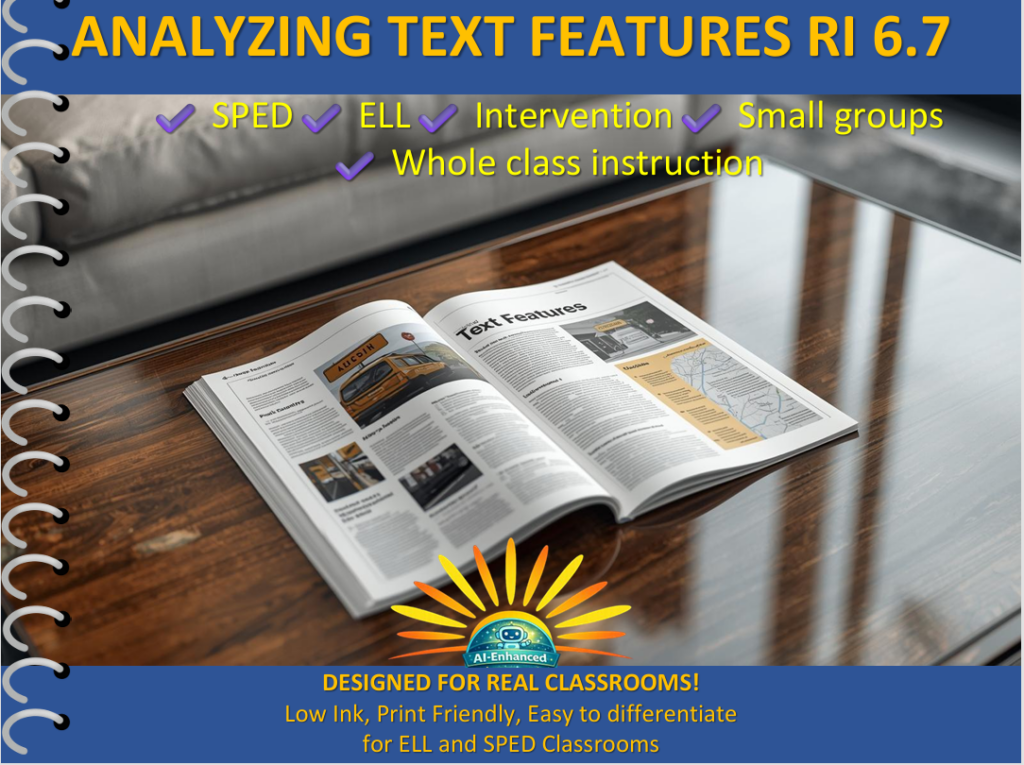
When I implemented the RI.6.7 Analyzing Text Features AI-Enhanced Visual Lesson, I shifted the focus from identification to integration. This main idea lesson for struggling readers works because it aligns with how a neurodivergent brain processes information: through visual-spatial relationships.
Following our PLUSS framework and the “I Do, We Do, You Do” model, we moved through the lesson using a task-analysis approach:
- The “I Do”: I modeled the metacognitive process of “Reading the Page Before Reading the Words.” I showed how a sidebar isn’t “extra” work—it’s a shortcut to the main idea.
- The “We Do”: We used the AI-enhanced visuals. These images are high-interest and low-readability, allowing my ELL students to grasp the main idea through visual context before they ever tackled the academic vocabulary.
- The “You Do”: Students worked on differentiated levels. Level 1 students matched visual icons to their functions, while Level 3 students explained how a specific diagram changed their understanding of the text.
Why It Works Cognitively
By using AI-enhanced visuals and structured templates, we reduce the “cognitive load.” Instead of the student’s brain being 90% occupied by decoding and 10% by comprehension, we flip it. The visual supports act as a scaffold, allowing the student to use their logic and reasoning skills—which are often much higher than their reading levels—to engage with the content. It’s a reading comprehension SPED strategy that treats the student as a thinker, not just a decoder.
Two Moments That Surprised Me
During the “Partner Work” phase, I witnessed a breakthrough with a student who typically exhibits “productive struggle” by shutting down. We were looking at a page about digital safety that used clear headings and call-out boxes. He didn’t read the whole paragraph. Instead, he pointed to the bold heading and the corresponding infographic and said, “This is the ‘boss’ of the page. It tells me the rest is about passwords.” He had internalized the hierarchy of text features—a major win for his digital literacy goals.
The second moment came from one of my ELL students. She was using the “Explain” scaffold from the lesson. English is her third language, and she often struggles with written expression. However, because the lesson broke the “main idea” into a visual formula, she wrote: “The map shows where. The text tells why. Together they tell the whole story.” That level of synthesis is exactly what the standards demand, but it was the visual bridge that let her get there.
Teacher Reflection: Refined Over Time
This is one of the lessons I refined after years of classroom use. I used to think that “more text” meant “more rigor.” Now, I know that for students with cognitive disabilities, rigor is found in the depth of connection, not the length of the passage.
The result was a classroom where the “blank page” fear was gone. Students were scanning, predicting, and summarizing based on the “clues” left by the author. Their confidence in our Digital Literacy block soared because they finally felt they had the “code” to unlock any professional document or certificate course manual they might encounter in the workforce.
What I’d Refine Next Time
Next time, I want to incorporate a “create your own” component. Once they’ve analyzed how an author uses text features to convey a main idea, I want my students to use a digital tool like Canva or PowerPoint to design their own “Visual Guide” for a workforce task (like how to clock in or follow a safety protocol). This would move them from consumers of text features to creators, further cementing the metacognitive process.
A Final Thought
If you are tired of seeing your students’ eyes glaze over when they see a non-fiction article, I cannot recommend the RI.6.7 Analyzing Text Features AI-Enhanced Visual Lesson enough. In our Washington DC school, it has transformed our approach to main idea lessons for struggling readers. It moves past the “what” and “where” and gets straight to the “why,” giving our students the tools they need to navigate a text-heavy world with independence and pride.