Speech and Language Impairment is the most common IDEA disability category, covering articulation disorders, fluency disorders like stuttering, and expressive and receptive language processing deficits. For bilingual learners, this category requires extra care — because language difference and language disorder are not the same thing, and misidentification in either direction causes real harm. This post gives you the framework to understand, identify, and support each type effectively.

Here’s something I think about a lot.
Speech and Language Impairment is the most common IDEA disability category by a wide margin — and yet classroom teachers almost universally feel underprepared to support it. We defer entirely to the SLP. We say “oh, that’s a speech thing” and mentally check out of the conversation. And then we’re surprised when a student’s reading comprehension is lagging, or when their writing doesn’t match their verbal ability, or when they shut down during discussions even though they clearly know the content.
Because here’s what nobody tells new teachers clearly enough: speech and language impairment isn’t just about how a student sounds. It’s about how they process and produce language at every level — listening, speaking, reading, writing. And that means it lives in your classroom all day, every day. Not just during pullout sessions with the SLP.
Before we dig in — if you’re building out your classroom visual supports as you read, my AI-Enhanced Anchor Charts for SPED & ELL students on TpT covers reading comprehension, writing process, and vocabulary scaffolds in bilingual formats — exactly what speech and language students need to process academic content when their language system is working harder than their peers’.
What Is Speech and Language Impairment Under IDEA — and Why Is It the Most Common Category?
Under IDEA 34 CFR §300.8(c)(11), Speech or Language Impairment means “a communication disorder such as stuttering, impaired articulation, a language impairment, or a voice impairment that adversely affects a child’s educational performance.”
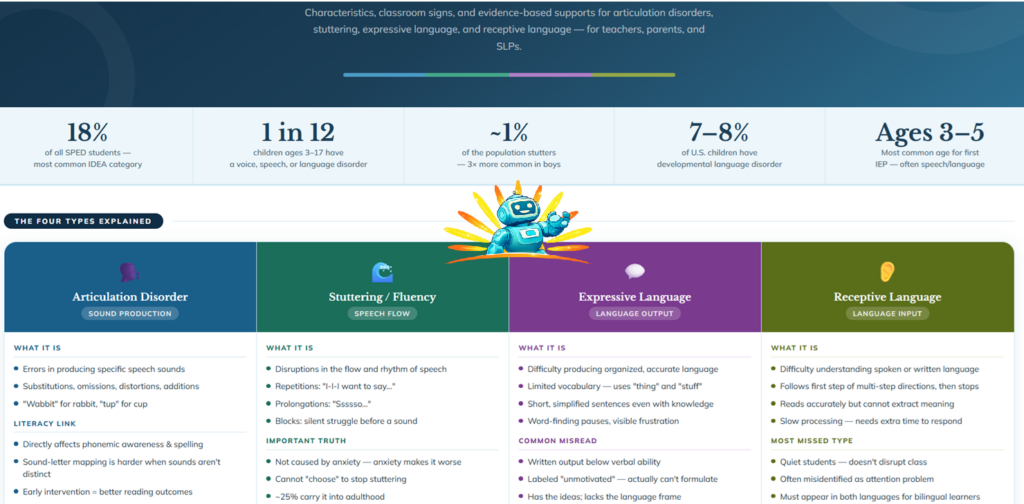
It’s the most common disability category in special education — accounting for approximately 18% of all students receiving special education services, according to the National Center for Education Statistics (2022). For children ages 3–5, it’s even more dominant — the majority of early intervention IEPs are built around speech and language services.
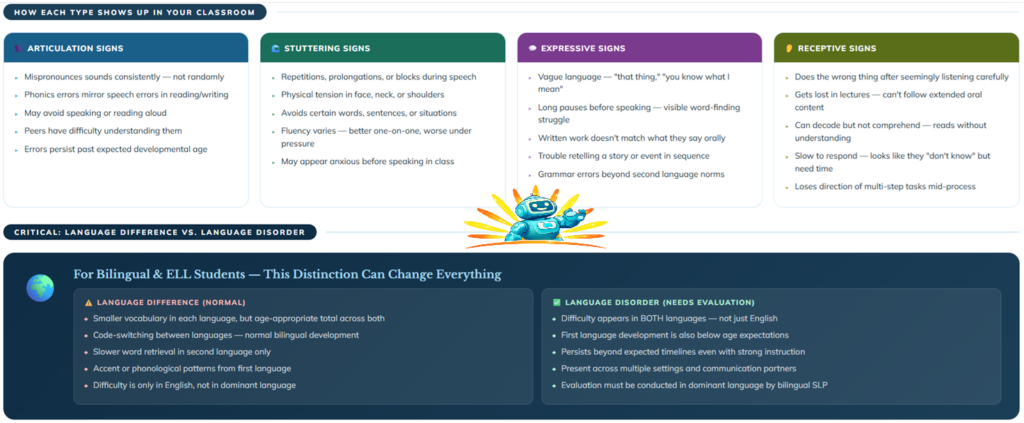
And for bilingual learners? This is where it gets genuinely complicated. According to the American Speech-Language-Hearing Association (ASHA), bilingual children develop both languages on a slightly different timeline than monolingual peers — which can look like a language disorder to an untrained eye. Mixing languages (code-switching), having a smaller vocabulary in each individual language while maintaining age-appropriate total vocabulary across both, taking longer to retrieve words — these are normal bilingual development patterns. They’re not disorders.
The disorder part is when the difficulty shows up in both languages, persists beyond expected developmental timelines, and creates functional communication challenges that impair the student’s ability to learn and interact. That distinction — between language difference and language disorder — is one of the most critical things you can carry into any conversation about a bilingual student’s speech and language evaluation.
⚡ Quick Win — The Most Important Question in Bilingual Speech EvaluationsBefore any speech and language evaluation of a bilingual student, ask: “Is the assessment being conducted in the student’s dominant language AND in English?” ASHA guidelines are clear — a valid speech-language evaluation must assess the student in both languages and interpret results within their bilingual developmental context. A monolingual English evaluation alone is insufficient and can lead to misidentification.
Articulation Disorders: When the Problem Is How Sounds Come Out
Articulation disorders are the ones most people picture when they think of “speech therapy” — the kid who says “wabbit” for “rabbit,” or who substitutes “th” for “s,” or who drops endings off words. And while articulation is genuinely the most immediately visible speech issue, it’s also the one that teachers sometimes dismiss as “cute” or “they’ll grow out of it” — which delays intervention that actually matters.
Articulation disorders involve errors in the production of specific speech sounds — substitutions (saying one sound in place of another), omissions (leaving a sound out entirely), distortions (producing a sound in an unusual way), or additions (inserting a sound where it doesn’t belong).
Here’s the thing that matters for classroom teachers: articulation disorders are not just a speech problem. They affect reading. A student who consistently confuses /f/ and /th/ in speech is also likely to confuse them in phonemic awareness tasks. A student who omits final consonants in speech is going to struggle with spelling patterns that depend on those sounds being auditorily distinct. The connection between articulation and early literacy is well-documented in the research — see ASHA’s evidence map on reading and writing — and it’s a connection teachers should understand.
What Helps in the Classroom
You’re not the SLP. You shouldn’t be doing articulation therapy. But you can:
- Model correct pronunciation naturally — not by correcting the student in front of peers, but by incorporating the correct form in your response (“Yes, the rabbit is soft, isn’t it?”)
- Use phonics instruction that makes the sound-letter connection explicit and multi-sensory — visual, auditory, and tactile at the same time
- Never call attention to mispronunciation during oral reading or class discussion — the shame response shuts down communication entirely
- Make sure your classroom anchor charts include phonics patterns with visual cues — mouth position diagrams, color-coded vowel sounds, bilingual phoneme charts
Those last two points are where my bilingual reading anchor charts come in — because they give students a visual reference for sound-letter patterns they can access independently, without having to ask for help and draw attention to their difficulty.
Stuttering: The Communication Difference That Gets the Most Misread Responses
I want to spend real time here because stuttering is handled so badly in classrooms. So consistently, so predictably badly.
Stuttering — also called fluency disorder — involves disruptions in the flow of speech: repetitions of sounds, syllables, or words; prolongations; blocks where the speaker gets stuck and sound stops entirely. About 1% of the population stutters, according to the Stuttering Foundation of America. It tends to emerge between ages 2 and 5, and while many children recover naturally, about 25% carry it into adulthood.
And the classroom responses I’ve seen — finishing sentences for the student, avoiding calling on them, having classmates laugh, a teacher visibly tensing or looking away — these are not neutral. They’re harmful. They teach a child that communication is dangerous. That being heard comes at a cost. And that cost compounds over time in ways that affect confidence, academic risk-taking, and social development.
What Actually Helps — and What Actively Hurts
What helps:
- Wait. Maintain natural eye contact and wait for the student to finish. Don’t complete their sentences. Don’t look away. Don’t change your expression. This is more powerful than any strategy you’ll read in a textbook.
- Give processing time before calling on a student — a quick “think for 30 seconds before we share” norm removes the performance anxiety of immediate response
- Create low-pressure oral participation options — written responses, partner sharing, whiteboard holds — so the student isn’t always in front of the full group
- Have a private conversation with the student about what they’d prefer — some students want to be called on, some don’t. Ask. Don’t assume.
What hurts:
- Telling them to “slow down,” “take a breath,” or “just relax” — this increases tension and shame and does nothing for fluency
- Finishing sentences for them — communicates that you don’t have time for their words
- Excusing them from oral participation entirely — removes the opportunity and signals that you expect them to fail
⚡ Quick Win — Classroom Culture Around StutteringBuild a classroom norm of patient listening for everyone — not just for the student who stutters. “In our class, we wait and we listen. We don’t finish each other’s sentences.” Model it yourself consistently. You don’t have to make it about any specific student. But you change the entire environment for the student who needs it most.
Expressive Language Impairment: When the Words Won’t Come Out Right
Expressive language impairment is a deficit in the ability to communicate thoughts, ideas, and information through language — spoken or written. The student knows what they want to say. The idea is there. But the language system doesn’t produce it the way they intend.
In my experience, expressive language impairment is the one that gets students labeled as “not trying” or “unmotivated” most often. Because they can understand what’s happening in class. They can nod, they can point, they can demonstrate comprehension non-verbally. But when you ask them to explain, or write a paragraph, or give an oral presentation — what comes out is fragmented, disorganized, or simply doesn’t reflect what’s actually in their head.
Expressive language challenges show up as:
- Limited vocabulary — using vague words like “thing” or “stuff” because the specific word won’t come
- Short, grammatically simplified sentences even when content knowledge is strong
- Word retrieval problems — long pauses, lots of “um” and “you know,” visible frustration
- Written output that’s significantly below verbal ability — not because of dysgraphia but because the language formulation system is the bottleneck
- Difficulty with narrative structure — telling a story in logical sequence, with a clear beginning, middle, end
What Works: Scaffolding Expressive Language Production
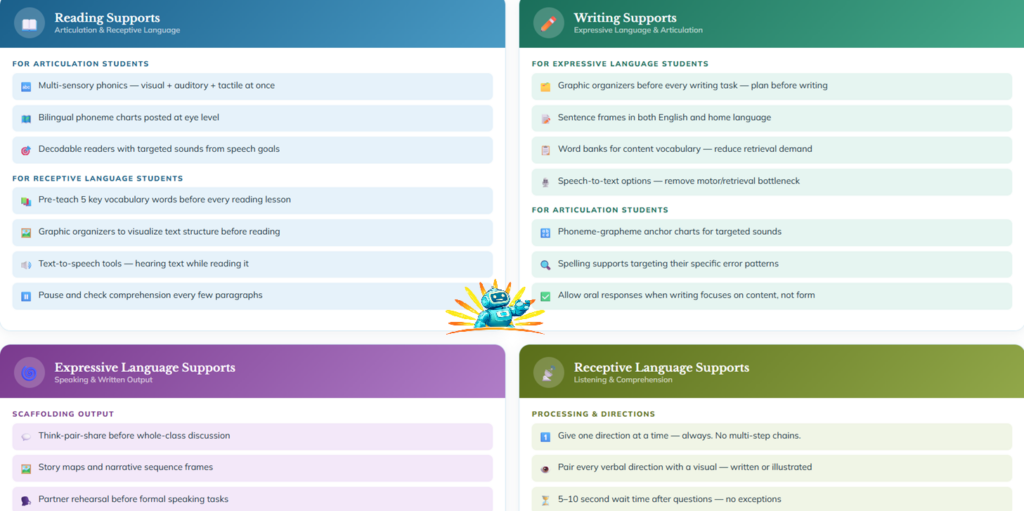
For expressive language, the goal is always to give the student a structure to hang their words on. They have the content. They need the frame.
- Sentence frames — posted visibly, in both English and the home language. “I think _____ because _____.” “First _____, then _____, finally _____.” These aren’t crutches. They’re scaffolds — and real scaffolds are removed as the student builds the underlying skill.
- Visual graphic organizers before every writing or speaking task — not as busywork, but as a genuine planning tool that externalizes what the language system is struggling to organize internally
- Word banks for content-specific vocabulary — especially for bilingual learners who have the concept but may lack the English label
- Think-pair-share before whole-class discussion — gives the student a low-stakes rehearsal before the high-stakes performance
And for writing specifically — the anchor charts I built for my SPED and ELL classroom cover the writing process in a step-by-step visual format with bilingual supports. They’re designed exactly for the student whose ideas outrun their ability to organize them on a page. Check them out: AI-Enhanced Anchor Charts for SPED & ELL.
Receptive Language Impairment: The One That Gets Missed the Longest
Honestly? Receptive language impairment is the one I wish more teachers understood deeply because it’s the silent one. The one that hides.
Receptive language impairment is a deficit in understanding language — listening comprehension, following directions, processing what’s been read or heard. The student doesn’t produce difficulty. They receive it. And because they’re not disrupting the class, nobody flags it for months. Sometimes years.
What it looks like in your classroom:
- A student who seems to understand, nods along, then does the wrong thing entirely — not because they weren’t paying attention but because they processed the directions differently
- Follows the first step of a multi-step direction and then stops — not because they forgot, but because the language system couldn’t hold all the steps simultaneously
- Reading comprehension that’s significantly below decoding ability — they can read the words accurately but can’t extract meaning from them
- Seems to “get it” during a lesson but can’t answer questions about it five minutes later
- Slow processing speed — takes significantly longer to respond to questions, often interpreted as not knowing the answer when the actual issue is processing time
For bilingual learners, receptive language impairment is particularly easy to miss because slow processing and reduced comprehension in a second language are normal features of language acquisition. The key indicator is whether the difficulty also appears in the student’s dominant language — if they’re struggling to follow directions and process language in both languages, that’s a disorder, not a difference.
🔍 Classroom Insight — Receptive vs. AttentionBefore assuming a student has attention problems, ask: “Could this be receptive language?” Students with receptive language impairment often look inattentive because they’re confused — and confusion looks the same as distraction from the outside. I’ve seen students referred for ADHD evaluations who actually had primary receptive language impairment. The intervention is completely different, and one year of the wrong support is a year lost.
Supporting Receptive Language in the Classroom
- Break directions into single steps — not “put your pencil down, close your book, turn to page 47, and read the first paragraph.” One step. Check. Next step.
- Pair verbal directions with visual cues — written on the board, on a task card, or illustrated on an anchor chart. Always. Every time. Not just for the student who needs it.
- Build in processing time — 5 to 10 seconds of wait time after a question before calling on anyone. This is research-supported and costs nothing.
- Pre-teach vocabulary before content instruction — especially for bilingual students. If the language load of a lesson is high, reduce it by front-loading the five most important words.
- Check comprehension through demonstration — “show me” rather than “tell me” when possible. A student with receptive language impairment may understand more than they can articulate.
This is exactly why I built the reading comprehension anchor charts in my SPED & ELL bundle to include visual vocabulary supports and step-by-step comprehension strategies — because receptive language students need to see the process, not just hear it once and hope it sticks.
Sensory Accommodations and Visual Supports in Multiple Languages

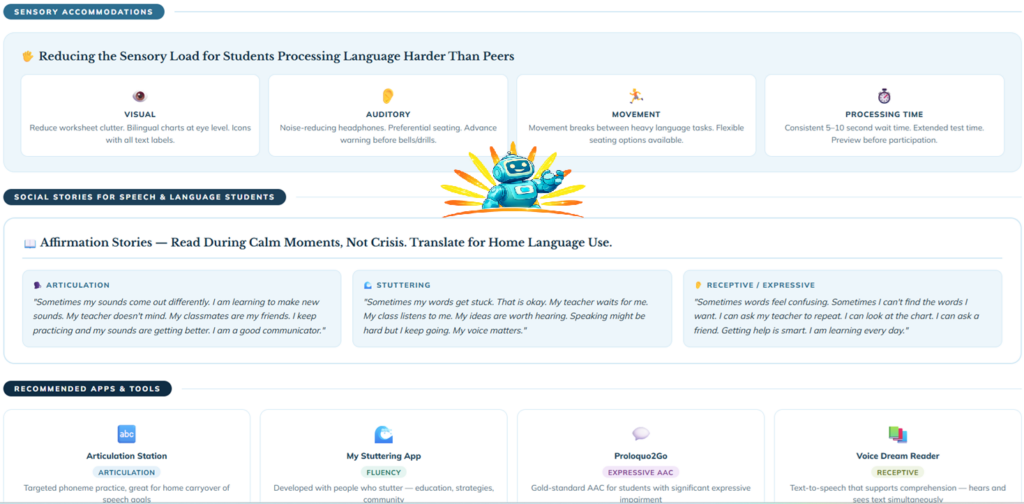
Look — for every type of speech and language impairment I’ve described, sensory accommodations matter more than most people realize. The auditory environment of a typical classroom is genuinely overwhelming for students with language processing challenges.
Think about it. Thirty kids, fluorescent lights humming, hallway noise, a teacher speaking at a normal adult pace with idiomatic language, multiple conversations happening simultaneously during group work. For a student whose language system is already working at 80% capacity just to keep up, that environment pushes them into cognitive overload before the lesson even begins.
Practical accommodations that make a real difference:
- Preferential seating — close to the teacher, away from noisy vents, windows, and high-traffic areas
- Reduced auditory distractions during independent processing — noise-canceling headphones available, not as a punishment but as a tool
- Visual schedules and routine anchors — in both English and the home language. A student with receptive language impairment relies on visual routine to compensate for what language isn’t delivering. Disrupting the visual structure without warning is genuinely destabilizing.
- Reduce the language load on written materials — simplified sentence structures on worksheets, instructions in both languages, icons alongside text
And for bilingual students specifically — a social story is one of the most underused tools for students with speech and language impairment. Here’s one I’ve adapted for a student navigating the anxiety of oral participation:
“Sometimes speaking in class feels hard. My words might come out slowly or not the way I want them to. That is okay. My teacher waits for me. My classmates wait for me. I have good ideas. My words matter. I am learning to share them, one at a time.”
Translate it. Laminate it. Put it in their communication folder. Read it together on a good day so it’s available on a hard one.
Apps That Support Speech and Language Across All Four Areas
- Articulation Station — targeted articulation practice for specific phonemes, used widely in speech therapy and suitable for home carryover
- My Stuttering App — developed with input from people who stutter, includes education, strategies, and community support for older students and adults
- Laureate Learning Systems — Early Language — receptive and expressive language development apps built on decades of speech-language research
- Proloquo2Go — robust AAC (Augmentative and Alternative Communication) app for students with significant expressive language impairment
- Vocanom — a free AAC app supporting expressive communication for students who need visual symbol support alongside or in place of speech
- Text-to-speech tools (Voice Dream, NaturalReader) — for students with receptive language impairment who process written text better when it’s read aloud
🛠️ Visual Supports That Work for Speech & Language Students
If you want the ready-made version of the bilingual anchor charts, reading comprehension scaffolds, and vocabulary visual supports I described throughout this post — I built them all in one place. Designed specifically for SPED and ELL classrooms where students need to see language, not just hear it.→ Grab the AI-Enhanced Anchor Chart Bundle on TpT
What Would I Refine? (My Honest Teacher Reflection)
I would have collaborated with the SLP earlier, more consistently, and more specifically.
For a long time, I operated on a kind of polite handoff model — the student goes to speech, comes back to my class, and I try to carry on. But the research on generalization of speech and language skills is unambiguous: skills learned in a pullout therapy setting don’t transfer to the classroom unless the classroom teacher is explicitly embedding the same strategies. The SLP works 30 minutes a week. You have the student for 360. The math is obvious.
The conversations I have with SLPs now are completely different. I ask: what specific targets are we working on this week? What language do you want me to use? What vocabulary is she practicing? What sentence structure are we reinforcing? And then I build those into my instruction, my anchor charts, my written directions, my wait time practices.
I also would have front-loaded vocabulary more intentionally for my bilingual students. Every. Single. Lesson. Not just the “important” lessons. Because for a student with receptive language impairment who is also processing in a second language, every lesson is an important lesson. Every content word that’s unfamiliar adds to a cognitive load that’s already near capacity.
And I would have used my bilingual anchor charts as wall references from week one — not pulled out during intervention, but consistently present and explicitly referenced so students built the habit of using them independently. That shift — from teacher-directed to student-initiated — is the whole goal.
3 FAQs About Speech and Language Impairment Under IDEA
❓ How do you tell the difference between a language disorder and normal second language acquisition in a bilingual student?
This is the most important question in bilingual speech-language evaluation — and the most commonly mishandled. The key indicators of a language disorder, as opposed to typical second language acquisition, are: the difficulty appears in both languages, not just English; the student’s development in their first language is also below expectations for their age; the challenges persist beyond typical acquisition timelines even with appropriate instruction and exposure; and the difficulty is present across multiple settings and communication contexts, not just in academic language. A bilingual speech-language pathologist and a culturally responsive evaluation process are essential. ASHA’s guidelines on multicultural practice provide the framework.
❓ Should a student with a speech or language impairment be in general education?
In most cases, yes — and the data supports this. The Least Restrictive Environment principle under IDEA applies fully to speech and language impairment. The majority of students with SLI receive their special education services through a combination of pullout speech therapy sessions AND push-in or consultation-based support in the general education classroom. Full removal from general education is rarely indicated for speech and language as a primary disability, and inclusion supports language development through natural social interaction and academic language exposure. The IEP team — including the SLP and parents — makes this determination based on the individual student’s needs.
❓ What’s the difference between a speech impairment and a language impairment — and does it matter for the classroom teacher?
Yes, it matters quite a bit. A speech impairment affects the production of speech sounds — articulation, fluency (stuttering), or voice quality. A language impairment affects the understanding or use of language — vocabulary, grammar, narrative, comprehension. A student can have one, the other, or both. For classroom teachers, the distinction matters because the classroom accommodations are different. A student with an articulation disorder primarily needs a shame-free communication environment and phonics support. A student with a receptive language impairment needs simplified directions, visual supports, extended processing time, and pre-taught vocabulary. Knowing which is which helps you provide targeted support instead of general “speech and language” accommodations that may not address the student’s actual area of need.
References
- U.S. Department of Education. IDEA Regulations, 34 CFR §300.8(c)(11): Speech or Language Impairment. sites.ed.gov/idea
- National Center for Education Statistics. (2022). Students with Disabilities Served Under IDEA. nces.ed.gov
- American Speech-Language-Hearing Association. Bilingual Service Delivery and Multicultural Practice. asha.org
- American Speech-Language-Hearing Association. Evidence Map: Reading and Writing. asha.org/practice/evidence-maps
- Stuttering Foundation of America. Basics of Stuttering. stutteringhelp.org
💜 Get More Real-Talk Special Education Strategies in Your Inbox
Join the BilingualSPED community — practical, research-backed tools and coaching for bilingual special educators delivered straight to you. IEP frameworks, classroom supports, freebies, and honest conversation about the work that actually matters.
📚 Get the Visual Supports Your Speech & Language Students Actually Need
Bilingual anchor charts, reading comprehension scaffolds, vocabulary visuals, and writing process supports — all in one downloadable bundle designed for SPED and ELL classrooms. Built by a bilingual special educator, for bilingual special educators.→ Grab the AI-Enhanced Anchor Chart Bundle on TpT
💬 Reflection Question
Think about a student in your classroom right now who struggles with communication — speaking, listening, reading, or writing. Based on what you read today, do you think it’s more likely a speech impairment, an expressive language challenge, or a receptive language gap? And what’s one thing you could change about how you deliver directions or visual supports this week that might shift their experience?
Drop your answer in the comments. I learn just as much from you as you do from these posts — and this community grows when we share honestly.
📌 You Might Also Like
- Specific Learning Disabilities: A Teacher’s Real Guide to Dyslexia, Dyscalculia & Dysgraphia
- Autism Spectrum Disorder (ASD): Medical Diagnosis vs. IDEA Eligibility — The Difference That Matters
- Other Health Impairment (OHI) & ADHD: What Teachers and Families Need to Know
- ELL Students in Special Education: How to Avoid Misidentification and Build Real Support
- Visual Supports and Anchor Charts That Work for SPED and ELL Classrooms