
How Linda Darling-Hammond’s Equity Mandate Inspired Me to Build the A.C.C.E.S.S. Literacy Framework for Multilingual Learners and Students With Disabilities

Linda Darling-Hammond’s equity mandate — that professional learning communities must disrupt predictable educational outcomes by race, language, and disability — is the intellectual foundation for the A.C.C.E.S.S. Literacy Framework. This post explores what that mandate means in real classrooms, how each stage of the framework removes specific barriers for multilingual learners and students with disabilities, and why high expectations without strong pathways is just a slogan.

How My Special Education and ELL Students Used This “Evaluating Point of View” Lesson And What Actually Worked

 As a Special Education and English Learner teacher, I used this lesson with students who struggle with reading comprehension and written expression at my Washington DC school. In the specialized world of the Digital Literacy Academy, my classroom serves as a bridge between foundational communication and the practical skills required for the workforce. My students … Read more

How I Tried This “St. Patrick’s Day” Differentiated Writing Lesson With My SPED Students — Here’s the Data and Student Growth

As a Special Education and English Learner teacher, I used this lesson with students who struggle with reading comprehension and written expression at my Washington DC school. In the high-stakes environment of my classroom, my days are spent navigating the intersection of cognitive disability and language acquisition. I am the lead teacher for a group … Read more

How My Special Education & ELL Students Used “Citing Textual Evidence” Lesson — And What Actually Worked

As a Special Education and English Learner teacher, I used this lesson with students who struggle with reading comprehension and written expression, and what I witnessed was a powerful shift in how they engaged with informational text. My name is Maria, and for the past 22 years as a teacher in an inner city school … Read more

How to Teach RI 6.7 Analyzing Text Features AI Enhanced Visual Lesson for SPED & ELL

I often tell new teachers that our students often miss the “signposts” that authors leave behind. These signposts—headings, captions, charts, and bold words—are not just decorations; they are the keys to the kingdom of informational text. In the 6th-grade landscape, specifically under Standard RI.6.7, we focus on integrating information presented in different media or formats. … Read more

How I Tried This Differentiated “Valentine’s Day” Reading Lesson With My SPED Students — Here’s the Data and Student Growth

As a Special Education and English Learner teacher, I used this lesson with students who struggle with reading comprehension and written expression at my Washington DC school. In the world of intensive intervention, the arrival of February often brings a specific kind of anxiety. While the rest of the building is focused on candy and … Read more

How to Use Making Inferences Reading Comprehension Strategy

In a standard classroom, we often tell students to “read between the lines,” but for a neurodiverse learner, those lines can feel like a solid, impenetrable wall. If the information isn’t stated explicitly, it simply doesn’t exist to them yet. As a mentor, I’ve learned that our role isn’t to ask our students to be … Read more

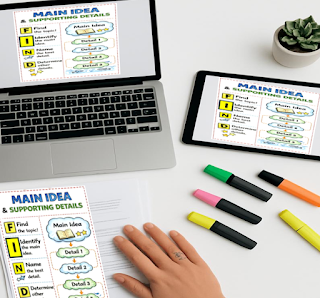
How to Use Main Idea & Details Reading Comprehension Strategy

For a neurodiverse learner, the instruction to “find the main idea” is often too vague. It feels like a guessing game where only the teacher knows the right answer. To shift this dynamic, I recently introduced the Main Idea & Supporting Details Strategy Toolkit into our literacy block.

I’ve found that students don’t need more “practice” at being wrong; they need a better framework for being right. By using visual cues and structured task-analysis steps, we take the “guesswork” out of comprehension. We aren’t just giving them a poster to look at; we are giving them a thinking framework that helps them sort “what’s important” from “what’s extra.”

Differentiating Instruction: What Actually Works (With Classroom Examples)

I remember sitting in my classroom a few years ago, staring at a stack of generic curriculum guides and then looking at my students. In one corner, I had a student who could tell you everything about the history of space travel but struggled to write a single sentence. In another, I had a student … Read more

How to Teach Analyzing Characterization & Plot RL 6.3| AI Enhanced Visual Lesson | SPED & ELL

Learn how to teach characterization and plot analysis to SPED and ELL students using an AI-enhanced visual lesson aligned to RL.6.3. This post walks bilingual special education teachers through a structured 60-minute block—Mini-Lesson, Guided Practice, and Independent Work—built around a clear 3-step strategy: Identify the Event, Observe the Reaction, and Determine the Change. Think-aloud modeling, high-contrast visual organizers, and sentence frames help neurodiverse and Tier 3 learners move beyond “what happened” to understanding how plot episodes shape a character’s growth. Includes extension activities connecting to RL.6.5, a Quick Quiz for IEP data collection, and an accommodations checklist—giving every student the tools to see themselves in the stories they read.