To a student with an IEP, every sentence often carries the same weight. They might read an entire passage and, when asked for the big idea, fixate on a minor, colorful detail about a character’s shoes rather than the central message.
As a mentor, I’ve learned that our most important task isn’t just to teach them to read the words, but to teach them how to filter the information. We have to help them find the point, not just the paragraph. In my classroom, we’ve found that the only way to make the abstract concept of a “Main Idea” manageable is to turn it into a mechanical, repeatable process.
The Power of the Thinking Framework
For a neurodiverse learner, the instruction to “find the main idea” is often too vague. It feels like a guessing game where only the teacher knows the right answer. To shift this dynamic, I recently introduced the Main Idea & Supporting Details Strategy Toolkit into our literacy block.
I’ve found that students don’t need more “practice” at being wrong; they need a better framework for being right. By using visual cues and structured task-analysis steps, we take the “guesswork” out of comprehension. We aren’t just giving them a poster to look at; we are giving them a thinking framework that helps them sort “what’s important” from “what’s extra.”
Observations from the “We Do” Phase
During our Whole Group Instruction, I watched a shift in the room’s energy. We were working on a technical passage about internet safety—a topic we prioritize in our Digital Literacy Academy to prepare our students for the modern workforce.
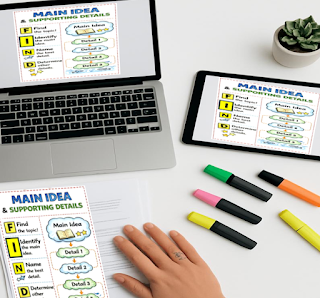
I saw a student who usually waits for a neighbor to start before picking up a pencil. Instead of hesitating, they looked up at our Main Idea strategy anchor chart. The chart uses a “tabletop” visual: the main idea is the sturdy top, and the details are the legs that hold it up. I watched the student trace the visual with their finger, then look back at the text. They weren’t overwhelmed because they had a specific job to do—find the “legs” first.
What surprised me most was the level of independence that emerged during our Partner Work. Instead of the usual “I don’t know,” I heard students debating which sentences were “key details” and which were just “extra info.” One student pointed to a sentence and said, “This doesn’t hold up the table; it’s just a decoration.” They were using the visual metaphor to organize their own thinking, moving beyond basic recall into actual evidence-based analysis.
Scaffolding for Independence and Confidence
For our ELL and Tier 3 learners, confidence is built on predictability. When a student knows that every time they see an informational text, they can use the same three steps to dismantle it, their anxiety drops.
 |
| [Image: A student-friendly anchor chart showing the “Tabletop” method for Main Idea and Supporting Details] |
In our Individual Work phase, the silence in the room felt different. It wasn’t the silence of confusion, but the silence of focus. Because the strategy is neurodiversity-aligned and low-prep, the students didn’t have to navigate a complex set of instructions. They simply followed the visual cues. I saw one student successfully identify the main idea of a workplace manual and then locate three key details to support it. The pride on their face was evident—they had found the point on their own.
Why Structure Matters for the Workforce
In our setting, we are always looking toward the horizon—preparing these students for life after the classroom. The ability to identify the most important information in a text is a foundational life skill. Whether they are reading a bank statement, a safety warning, or a supervisor’s email, they must be able to filter out the noise and find the message.
Teachers love this toolkit because it makes abstract concepts concrete. It doesn’t just help them “get through” a lesson; it builds a repeatable skill they can use all year across every subject. When students know what matters most in a text, everything else—their writing, their oral language, and their confidence—falls into place.
As you mentor your students through their reading blocks this week, watch for that moment where they stop treating every sentence like a mystery and start treating the text like a puzzle they actually know how to solve.
When you provide a visual “anchor” for an abstract concept like the Main Idea, what changes have you observed in the way your students handle the “productive struggle” of reading a text that is at the ceiling of their ability?
For me, it’s the bilingual glossaries, because they provide immediate access to meaning, reducing cognitive load during comprehension. Removing them too early can cause frustration and hinder understanding, especially with complex or unfamiliar vocabulary. For me it helps maintain learner confidence and comprehension, especially on subject areas that are in our native language. Our students here in Assumption Antique are not too familiar with the Filipino Language, so these glossaries play a vital role in our daily discussions.
Yes, Sr. Christine. You are right. Bilingual glossaries act as a critical cognitive bridge, reducing cognitive load and fostering confidence by providing immediate access to meaning, particularly for students in Antique struggling with formal Filipino. By sustaining this support until students build necessary background knowledge, these tools align with an “Equity-as-Access” model that validates home languages and prevents academic frustration.
Bilingual glossaries are hardest to remove because they provide immediate access to meaning, reducing cognitive load during comprehension. Removing them too early can cause frustration and hinder understanding, especially with complex or unfamiliar vocabulary. Our students here in Antique tend to rely heavily in translation especially on subjects areas discussed in Filipino.
Yes, Sr. Christine. You are right. Bilingual glossaries act as a critical cognitive bridge, reducing cognitive load and fostering confidence by providing immediate access to meaning, particularly for students in Antique struggling with formal Filipino. By sustaining this support until students build necessary background knowledge, these tools align with an “Equity-as-Access” model that validates home languages and prevents academic frustration.
The scaffolds I find hardest to remove are usually the Sentence starters and writing frames – Students become comfortable relying on them, especially in reading responses or writing tasks. Removing them too quickly can make students feel unsure of how to begin.
Visual cues and examples – Charts, models, and sample answers are helpful, but some students depend on copying the pattern rather than creating their own responses.
What makes it difficult to fade support over time is that students develop at different rates. Some are ready to work independently, while others still need guidance. Teachers also want to avoid frustration or failure, so we sometimes keep supports longer than necessary. Another challenge is limited time to monitor each learner closely and decide when they are truly ready for the next step.
Effective fading usually requires gradual release, observation, and trust that students can do more than they first believe.
I agree, Aember. The “Scaffolding Paradox” often occurs when tools meant to build confidence, like sentence starters and visual models, become impediments to independence, requiring a gradual “Smart Fading” approach to shift from supporting to challenging students. Strategies to phase out support include providing partial starters, offering a menu of options, and increasing the physical distance of visual aids to encourage independent thought. Effective scaffolding requires teacher observation, trust, and a gradual release of responsibility to ensure students move from dependency to confidence.
As a subject teacher in Filipino 9, the hardest scaffolds to remove are vocabulary supports, sentence starters for literary analysis, graphic organizers, and guided questioning. These are difficult to fade because Noli Me Tangere and similar texts are linguistically and conceptually challenging, so teachers rely on them to ensure comprehension and output quality. In private school settings, mixed learner ability, performance pressures, and assessment demands also encourage continued use of scaffolds. Over time, these supports become part of teaching routines, making it harder to gradually shift students toward independent analysis without risking confusion or lower performance.
You’re absolutely correct, Cherry May. The challenge of removing supports like graphic organizers and sentence starters for complex texts like Noli Me Tangere is a common dilemma, often driven by the high stakes of private education. Easing this fading process involves a gradual shift from teacher-provided tools to student-owned strategies, such as peer-generated glossaries and tiered, less-structured organizers.
The hardest scaffold to remove is constant demonstration and step-by-step guidance.
It’s difficult to fade because students still need help with coordination, confidence, and following movements, and they rely on the teacher for cues.
True, Oliver. The difficulty in removing constant demonstrations stems from students developing a dependency on visual cues, which limits their internalization of movements and creates a fear of performing independently. To foster independence and transition from mimicry to mastery, instructors can utilize strategies like verbal cues, student modeling, and gradually phasing out the “live demo” through a “we do” to “you do” approach.
The hardest scaffold to remove is constant demonstration and step-by-step guidance. It’s difficult to fade because students still need help with coordination, confidence, and following movements, and they rely on the teacher for cues.
True, Oliver. The difficulty in removing constant demonstrations stems from students developing a dependency on visual cues, which limits their internalization of movements and creates a fear of performing independently. To foster independence and transition from mimicry to mastery, instructors can utilize strategies like verbal cues, student modeling, and gradually phasing out the “live demo” through a “we do” to “you do” approach.
When I provide a visual anchor for a concept like Main Idea, I notice that students handle hard texts better.
First, they keep trying longer. Instead of giving up, they use the visual to remember what to look for: What is the text mostly about? Second, their struggle becomes more focused. They reread, look for key details, and think about which details match the main idea. Third, students become more confident. The visual gives them support, so they feel more able to solve the task on their own. Lastly, students explain their answers better because they can use the picture or chart to share their thinking.
Overall, the visual anchor does not remove the challenge—it helps students work through it in a better way.
When you provide a visual “anchor” for an abstract concept like the Main Idea, what changes have you observed in the way your students handle the “productive struggle” of reading a text that is at the ceiling of their ability?When I provide a visual anchor for a concept like Main Idea, I notice that students handle hard texts better.
First, they keep trying longer. Instead of giving up, they use the visual to remember what to look for: What is the text mostly about?
Second, their struggle becomes more focused. They reread, look for key details, and think about which details match the main idea.
Third, students become more confident. The visual gives them support, so they feel more able to solve the task on their own.
Lastly, students explain their answers better because they can use the picture or chart to share their thinking.
Overall, the visual anchor does not remove the challenge—it helps students work through it in a better way.
Precisely, Aember. Utilizing visual anchors for the main idea enhances student stamina, shifts them toward active, focused learning, and increases confidence during challenging reading tasks. These visual supports act as scaffolding, enabling students to better analyze text and explain their thinking without removing the necessary productive struggle.
Among the scaffolds that I find most difficult to remove over time are bilingual glossaries and worked examples. Since I am teaching Araling Panlipunan and Mathematics . Bilingual glossaries are particularly challenging to fade since students often depend on direct word-for-word translations instead of gradually developing the ability to determine meaning from context in the target language. Similarly, worked examples they really need examples in order to fully understood the lesson and applying them independently in new lesson. The difficulty in removing these scaffolds/support to the learner leads to confidence gap to answer without them.
Raymond, I hear you. The challenge of removing scaffolds like bilingual glossaries and worked examples stems from students developing a dependency that hinders long-term independence in content-heavy subjects. To close the confidence gap, educators should implement a “slow fade” strategy, using incomplete examples and concept clues rather than direct translations to foster self-explanation and contextual understanding.
**R – Restate the Question**
The question asks me to think about a time when I changed an activity for a learner who needed help. It asks if I used a scaffold or made the task too easy. It also asks how I could improve the activity while keeping the same goal.
**A – Answer the Question**
As a Kindergarten teacher, I learned that I made the task easier instead of giving support. I changed the skill instead of helping the child learn the same goal.
**C – Cite Evidence / Example**
For example, during a counting lesson, children were asked to count 10 objects and match them to the correct number. One child had difficulty counting all the objects. Instead of helping the child count step by step, I changed the task and asked the child to count only 3 objects.
**E – Explain Your Answer**
This was making the task easier, not scaffolding. A better way would be to keep the goal of counting 10 objects but give support. I could let the child touch each object while counting, count together first, use number cards, or group the objects into smaller sets.
This way, the child still learns to count 10 with help. I learned that scaffolding helps children learn new skills without changing the goal. Next time, I will give support so all learners can succeed.
Great use of RACE Writing strategy, Aember. This is a strong and honest application of the RACE strategy. You clearly distinguished between “modifying” (lowering the bar) and “scaffolding” (building a bridge to the bar). You didn’t just repeat the prompt; you broke down exactly what was being asked, setting a clear stage for the response. Your answer was direct and insightful. You identified the core mistake: changing the skill instead of the support. This shows high-level self-reflection. Your evidence is clear, but could be punchier. The example is perfect (counting 10 vs. 3). To make this even stronger, you could use a direct quote or a specific observation of the child’s reaction to prove the “struggle.” Your explanation is high value. This is the best part. You listed concrete scaffolding strategies (touching objects, grouping, number cards) that prove you now understand how to maintain the “high-level” goal of counting to 10. You successfully used RACE to move from a regretful reflection to an actionable teaching plan. You proved that scaffolding isn’t about doing the work for the child, but about giving them the tools to do it themselves. The transition from 10 objects to 3 was “well-intentioned inequity.” The proposed fix—using smaller sets and touch-counting—is true scaffolding.
The scaffold I find hardest to remove is graphic organizers because students rely on them to organize their thoughts before responding and I can notice that they can easily answer all of my questions. They help break down complex ideas, so without them, some students struggle to structure their answers clearly. What makes it difficult to fade this support is that learners often depend on the visual layout, in the case of my learners, they understand more it clearly if it has visual support and helps process information and sometimes they may feel lost when it is no longer provided. That is why, every time they do so, I usually involve graphic organizers especially when the topic is all about differences (ex. difference of chemical and mechanical weathering) by writing it on the board. Gradual removal, such as simplifying the organizer or asking students to create their own, is necessary but takes time to build independence.
Yes, very true Nicole. Graphic organizers are essential for structuring complex topics like chemical and mechanical weathering, but removing them requires a gradual transition from guided structure to independent thought. Strategies to fade this support include using incomplete organizers, having students draw their own sketches, or analyzing which type of organizer best fits the content.