
This is the natural companion to our AI Learning Barrier Detector. The Barrier Detector asks, “What might be getting in the way?” The Access Pathway Designer asks, “How can we create multiple pathways to the same rigorous learning target?”
That distinction is important. I designed this tool so the AI never creates a “lower” version of the objective for a student. Instead, it creates different routes to the same destination.
.
A.C.C.E.S.S. AI Access Pathway Designer
“One rigorous objective. Multiple pathways to access.”
🎯 1. Learning Destination (What Students Must Learn)
🧠 2. Cognitive Rigor & Demand
👥 3. Learner Profile in Classroom
🧩 4. Potential Access Barriers to Address
📋 Executive Access Pathway Summary
Multiple entry routes and demonstration modes leading toward the same intellectual outcome:
Primary Differentiated Access Pathways
📊 Pathway Comparison & UDL Alignment Matrix
| Pathway Mode | Representation (Input) | Action & Expression (Output) | Cognitive Demand Preserved | Target Learner Accessibility | Independence Fade Step |
|---|
🌐 WIDA Differentiated Language Pathways
Same cognitive analysis; language scaffolds adjusted across WIDA proficiency levels.
♿ SPED & Executive Function Pathways
Systemic accessibility accommodations embedded directly into the task architecture.
🏛️ A.C.C.E.S.S. Literacy Framework Alignment
⚖️ Access Support vs. Modification Analyzer
Test a proposed adaptation to determine if it maintains the learning target (Access) or changes what the student learns (Modification).
🧑🎓 Student Agency & Choice Prompts
🔄 Scaffold-to-Independence Lifecycle
⚖️ Equity Reflection: “Who Gets Access to Think?”
- Positioned as Thinkers: Multilingual learners and students with disabilities are actively evaluating author arguments—not restricted to lower-order recall tasks.
- Meaningful Communication: All students receive structured opportunities to orally rehearse complex reasoning prior to summative evaluation.
- Authentic Choice: Students select access modalities based on metacognitive awareness of their learning needs.
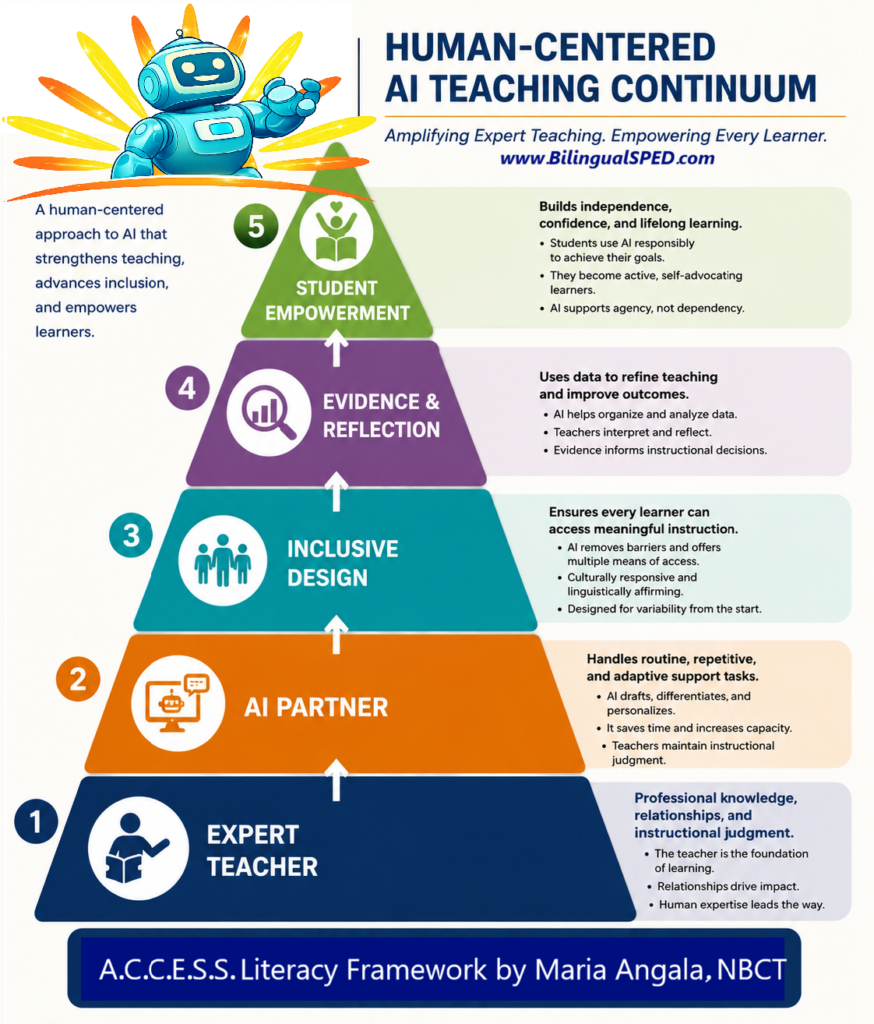
🤝 Human-Centered AI Teaching Continuum
You are the calm in their storm. Keep showing up, keep tracking the data, and keep respecting their dignity. You’ve got this.
.
Join our FUNSHINE Community to receive our latest free A.C.C.E.S.S. AI tools and other updates: