Distinguishing between typical language acquisition and a learning disability in bilingual and multilingual students is hard — but there are clear, evidence-based signals to look for. The key is assessing across both languages, tracking growth over time, and using dynamic assessment tools rather than relying on a single standardized test score. Getting this right protects students from both over- and under-identification.
The Question I Get Asked More Than Anything Else
It usually comes from a new teacher. Sometimes a veteran one. They pull me aside after a staff meeting or shoot me a quick message: “I have this student. She’s been here two years. Her English is still really low. Is this just language? Or is something else going on?”
And honestly? That question keeps me up at night too. Not because I don’t know the answer — but because I’ve seen what happens when we get it wrong in both directions.
I’ve watched bright, capable kids get labeled with a learning disability because a school team didn’t have the tools to distinguish between normal second-language development and an actual processing difference. And I’ve watched other kids — kids who genuinely needed specialized instruction — spend years sitting in the wrong intervention while adults kept saying, “Let’s give it more time. She’s still acquiring.”
Both of those scenarios? They break my heart. And they are both preventable.
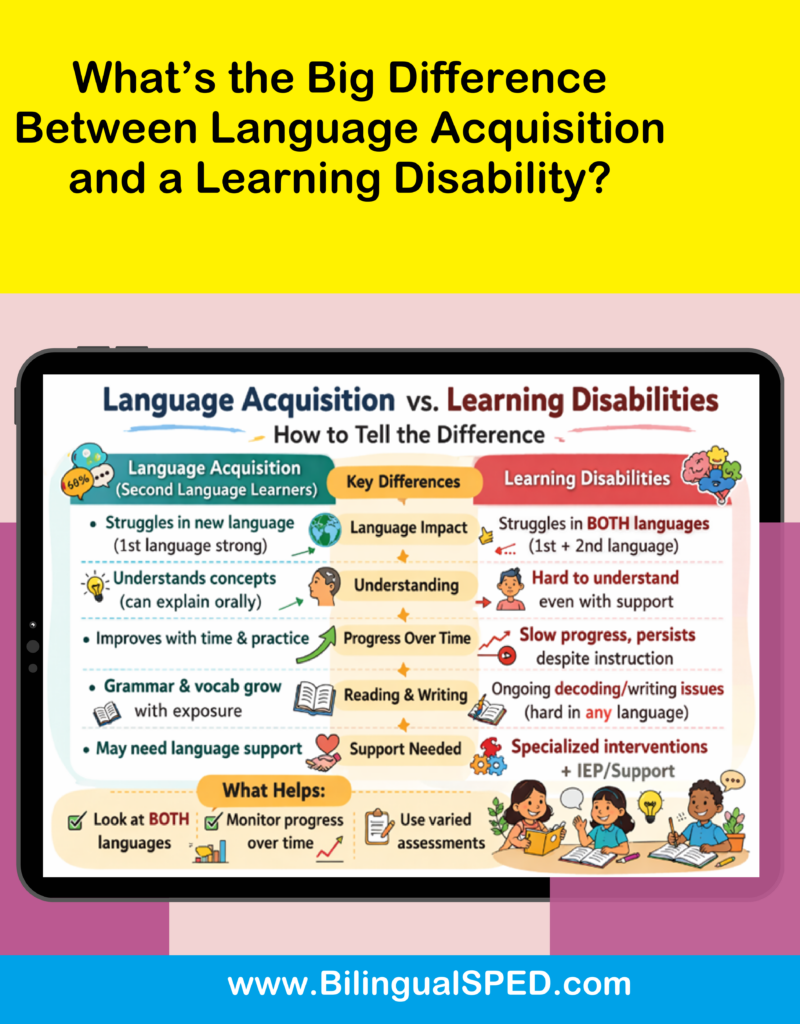
Before we go any further, I want you to know that I’ve put together a dedicated resource on my site specifically for this topic — What’s the Big Difference Between Language Acquisition and a Learning Disability? — that goes even deeper if you want to pair this post with a more structured reference tool.
Why Is This So Hard to Figure Out in the First Place?
Here’s the thing: language acquisition and learning disabilities look almost identical on the surface. Both can show up as slow reading progress. Both can sound like grammar errors in spoken English. Both can look like a student who struggles to decode unfamiliar words or loses her train of thought mid-sentence.
The difference isn’t always visible in a single snapshot. It shows up in the trajectory. In the pattern. In what happens when you actually teach the child with high-quality, targeted support.
I’ve noticed — especially in inclusive bilingual classrooms — that there’s enormous pressure to refer kids to special ed quickly, sometimes before they’ve had even a full year of solid English instruction. And I get it. Schools are overwhelmed. Caseloads are heavy. And sometimes it genuinely feels like referring a student is the fastest path to getting them more support.
But that shortcut has a cost. A big one.
| ⚡ Quick Win Before you refer any bilingual or multilingual student for a special education evaluation, ask yourself: Has this student had at least one full year of consistent, high-quality, language-rich instruction? If not, that’s your first intervention — not a referral. |
What Does Typical Language Acquisition Actually Look Like?
A child acquiring a second language is doing something genuinely extraordinary. She is simultaneously building vocabulary, learning new phonological patterns, acquiring grammar rules that may be structurally opposite to her home language, and navigating an entirely new social and academic environment.
That takes time. Real time. Research from Thomas and Collier (1997) suggests that it takes five to seven years for English learners to reach academic language proficiency — and that’s with strong instructional support. Five. To. Seven. Years.
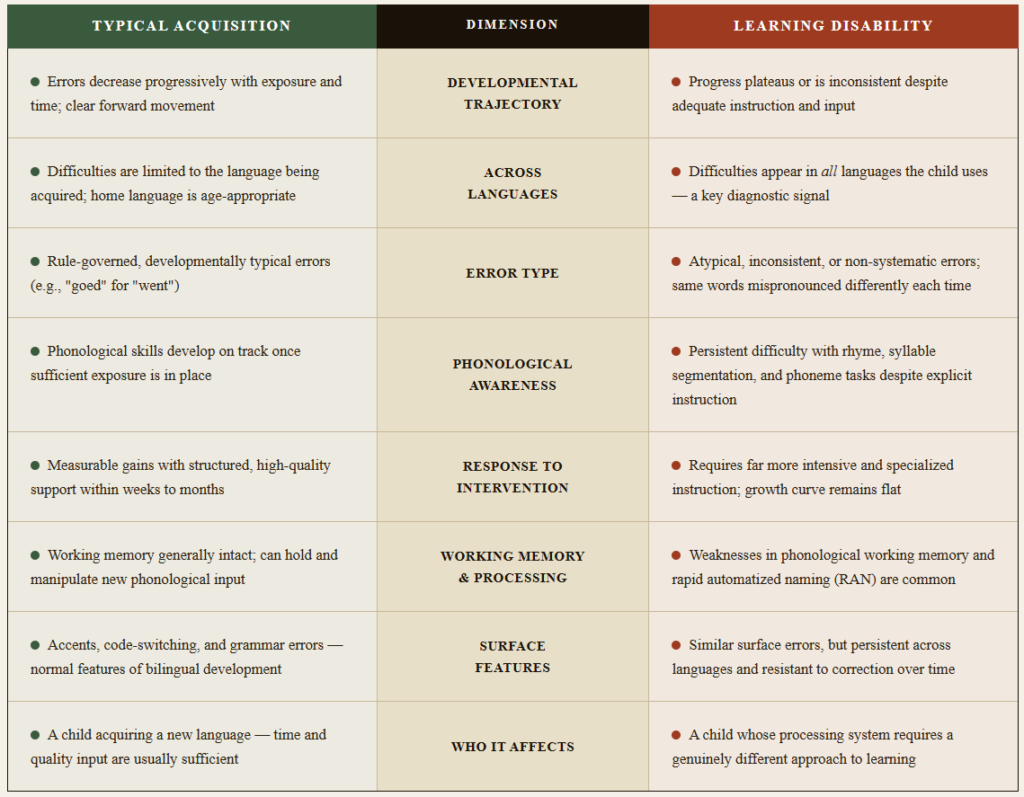
So when a student makes errors — even persistent ones — ask yourself first: are these errors developmental? Are they rule-governed? Are they the kinds of mistakes you’d expect a child at this stage of acquisition to make?
“Goed” instead of “went.” Dropped articles. Subject-verb agreement errors. These are all normal. Predictable. Expected. They are not red flags.
What IS a red flag? When those errors don’t follow a pattern. When they’re inconsistent in ways that go beyond acquisition. When a student pronounces the same familiar word differently every time, or when she can’t hold phonological information in working memory even after repeated, direct instruction in both languages.
| ⚡ Quick Win Normal acquisition errors are RULE-GOVERNED and SYSTEMATIC. If a student’s errors feel random, inconsistent, or resistant to correction even in their home language — that’s worth digging into further. |
The Most Important Signal Most Teachers Miss
I want to talk about something that doesn’t get nearly enough attention in these conversations: cross-linguistic comparison.
Here’s the most powerful question you can ask: Does this child struggle in ALL her languages, or just in English?
Because here’s the truth. A genuine language-based learning disability — like dyslexia, language processing disorder, or auditory processing difficulties — is neurological. It doesn’t discriminate by language. It shows up in Spanish and English and Mandarin and Arabic. It affects the underlying processing system, not the specific language being used.
So if a student is struggling in English but performing age-appropriately in her home language? That is strong, strong evidence for acquisition — not disability.
But if a student is struggling in both? That changes the picture significantly. And that’s when you need to start talking seriously to your school psychologist and your bilingual SLP.
This is also why assessment in both languages is non-negotiable. I’ve seen too many evaluations conducted entirely in English for students who barely speak English. That’s not an evaluation. That’s a set-up.
For families navigating this process, visual supports in multiple languages can make a tremendous difference. I’ve found tools like Boardmaker and Canva for Education invaluable for creating visual schedules, social stories, and multilingual vocabulary supports that help both during assessment preparation and daily instruction.
| ⚡ Quick Win Before referring, get a language sample in the student’s home language. Even a brief one, conducted with a bilingual paraprofessional or parent, tells you more than any English-only standardized test. |
How Phonological Awareness Changes the Conversation
Okay, this is where it gets really interesting — and where I’ve seen the most game-changing assessment moments in my career.
Phonological awareness is one of the few skills that is largely language-independent in structure. The ability to hear and manipulate sounds — to segment syllables, identify rhymes, blend phonemes — is a cognitive skill that transcends specific languages.
And here’s why that matters: you can assess it in a student’s home language without needing a translated version of an English test. Because it’s about sound structure, not vocabulary.
Research by Geva and Yaghoub Zadeh (2006) found that phonological awareness skills in a first language strongly predict literacy outcomes in a second language. Which means: if a child has weak phonological awareness in Spanish, she’s not going to just “catch up” once she acquires more English. That weakness is going to follow her.
This is one of the most powerful early screening tools we have. And yet I can’t tell you how many times I’ve sat in eligibility meetings where no one had bothered to assess phonological awareness in the home language.
Apps like Elkonin Boxes (sound boxes) tasks and Heggerty Phonemic Awareness — adapted across languages — can be powerful informal tools to gauge where a student actually is. They’re surprisingly effective even without formal norming, when used as part of a broader assessment picture.
| ⚡ Quick Win Test phonological awareness in the home language, not just English. Weak phonological skills that appear in BOTH languages are one of the strongest early indicators of a language-based learning disability. |
Response to Intervention: Your Most Diagnostic Tool
Look, I want to be real with you about something. No single test, observation, or language sample is going to give you a definitive answer. What gives you the clearest picture is time — paired with high-quality, targeted instruction — and careful tracking of a student’s response to that instruction.
This is the heart of a Response to Intervention (RTI) or Multi-Tiered System of Supports (MTSS) framework. And it works — when used well.
A student acquiring a new language will show measurable, meaningful growth when given structured, explicit language instruction. Not perfect growth. Not grade-level growth overnight. But clear upward movement.
A student with a learning disability will show a very different pattern. She might make small gains at first, then plateau. Or she’ll make gains with intensive one-on-one support but can’t generalize those skills independently. Or her progress will be wildly inconsistent — good weeks followed by significant regression.
I’ve seen this play out in my own practice. I had a student — let’s call her a third-grader, recent arrival, home language Spanish — who wasn’t making progress in our Tier 2 small group reading intervention. After six weeks of solid instruction with a trained bilingual reading specialist, most of the other ELL students in that group had made noticeable gains. She hadn’t.
That was the moment we shifted the conversation. Not to “she just needs more time” — but to “something else might be going on here, and she deserves a full evaluation.”
If you want a deeper framework for thinking through the LA vs. LD distinction — including a step-by-step decision tree — I’ve got a detailed breakdown over at bilingualsped.com that walks through the full process.
Sensory Accommodations, Visual Supports, and Social Stories: The Missing Piece
Here’s something that often gets lost in the LA vs. LD debate: regardless of which camp a student falls into, she needs support now. And two of the most accessible, high-impact tools available to bilingual educators are visual supports and social stories — especially when created in multiple languages.
Visual supports reduce cognitive and linguistic load. They allow a student to access academic content and classroom routines without having to simultaneously decode language. For students whose English is still developing, this is critical.
Social stories — short, structured narratives that explain situations, expectations, or skills in a predictable format — are particularly powerful for students with language processing challenges. When created in a student’s home language and accompanied by pictures or icons, they give students a way to rehearse situations mentally before experiencing them live.
For sensory accommodations, tools like sensory breaks, preferential seating, fidget tools, and noise-reducing headphones (like Loop Earplugs or simple foam earplugs) can make a significant difference — particularly for students whose processing differences make high-stimulation environments genuinely painful to navigate.
I’ll be honest: I used to underestimate the role of sensory supports in my bilingual SPED classroom. It wasn’t until I started really watching how my students moved through the day that I realized how much sensory overload was masking their actual cognitive capacity. Once we put the right accommodations in place? The difference was, in some cases, dramatic.
| ⚡ Quick Win Create a simple visual schedule in both English and the student’s home language. Even a three-picture sequence of the morning routine can reduce anxiety, increase predictability, and free up cognitive bandwidth for actual learning. |
The Assessment Practices That Actually Work
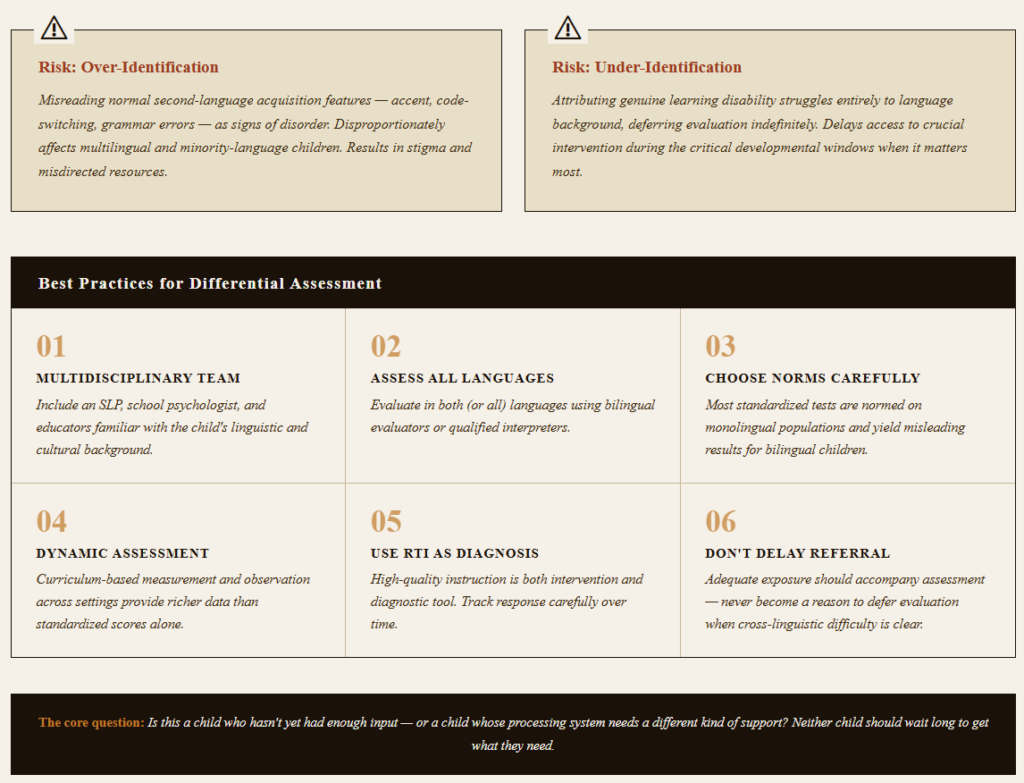
So what does best-practice assessment actually look like? I’m going to give you the real framework, not the theoretical one.
Start with a comprehensive language history. How long has this student been in the country? What language(s) were spoken in the home from birth? At what age did formal schooling begin? In what language? This context isn’t just background — it’s diagnostic information.
Use dynamic assessment rather than (or in addition to) static tests. Dynamic assessment measures a student’s ability to learn with support — not just what she knows today. It’s a much better predictor of true learning potential than a single standardized score, and it’s far less biased for students from non-dominant linguistic backgrounds.
Choose norming carefully. Most widely used standardized tests were normed on monolingual English-speaking populations. Using them with bilingual students and treating the scores as straightforward measurements of ability is, to put it plainly, a scientific error. Look for assessments that have bilingual norms — the BESA (Bilingual English Spanish Assessment) and the CELF-5 Bilingual are two strong options — or interpret scores with documented caution.
Involve the family. Parents and caregivers are your most valuable informants. They can tell you whether a child’s language development in the home language has followed a typical trajectory, whether there’s a family history of reading difficulties, and what the child’s communication looks like at home — which is often very different from what you see at school.
And please, involve your bilingual SLP. Not just as a translator, but as a clinician. Their insight into language development across both languages is irreplaceable.
| ⚡ Quick Win Use the BESA or CELF-5 Bilingual for more equitable assessment. And always, always get a parent interview — in the family’s home language — before moving toward a formal eligibility determination. |
Research References
Thomas, W.P., & Collier, V.P. (1997). School effectiveness for language minority students. National Clearinghouse for Bilingual Education.
Frequently Asked Questions
| ❓ How long should I wait before referring a bilingual student for a special education evaluation? There’s no universal number — but “wait and see” without structured intervention is never the right answer. A student who has received at least one full year of consistent, high-quality language-rich instruction and is still showing significant, cross-linguistic difficulties should be considered for evaluation. Don’t let language background become an excuse to delay support that a child genuinely needs. |
| ❓ Can a student have both language acquisition needs AND a learning disability? Absolutely — and this is more common than people realize. A student can be simultaneously acquiring English AND have an underlying processing difference like dyslexia or language processing disorder. These are not mutually exclusive. In fact, identifying a co-existing disability while supporting language acquisition requires careful, bilingual assessment and a team that understands both spaces. |
| ❓ What if my school doesn’t have a bilingual school psychologist or SLP? This is a real and painful gap in so many districts. Some practical workarounds: use trained bilingual interpreters (not untrained paraprofessionals) during assessment; consult with your district’s bilingual education coordinator; and advocate loudly for equitable assessment resources. In the meantime, gathering rich observation data, parent interviews, and language samples in the home language are all steps you can take right now. |
Here’s Your Next Step
If this post has resonated with you — if you’ve been sitting with a student in your mind this whole time, wondering which side of the line she falls on — I want you to do one thing before your next school day.
Get a language sample. Talk to the family. Look at her growth curve, not just her current level. And if you’re not sure what you’re looking at, let me help.
For a more structured resource you can actually use in team meetings, IEP conversations, and parent conferences, check out What’s the Big Difference Between Language Acquisition and a Learning Disability? on my TpT-linked resource page — it’s designed to make these conversations easier and more evidence-based.
And if you want to keep going deeper on bilingual SPED topics like this one, I’d love to have you in my community. I send out practical, research-backed strategies for bilingual special educators every week — the kind of stuff that actually helps in real classrooms, with real kids.
And one last thing — I want to leave you with something to sit with:
| 💬 Reflection Question Think about a student on your caseload or in your classroom right now who you’ve been unsure about. What do you actually know about their language development in their home language — and what would it take to find out? Drop your thoughts in the comments. I read every single one. |