Pre/post data from 14 Myanmar and SE Asia educators — and what the numbers reveal about what one well-designed 90 minutes can actually do
I want to start with a number: 50 percent.
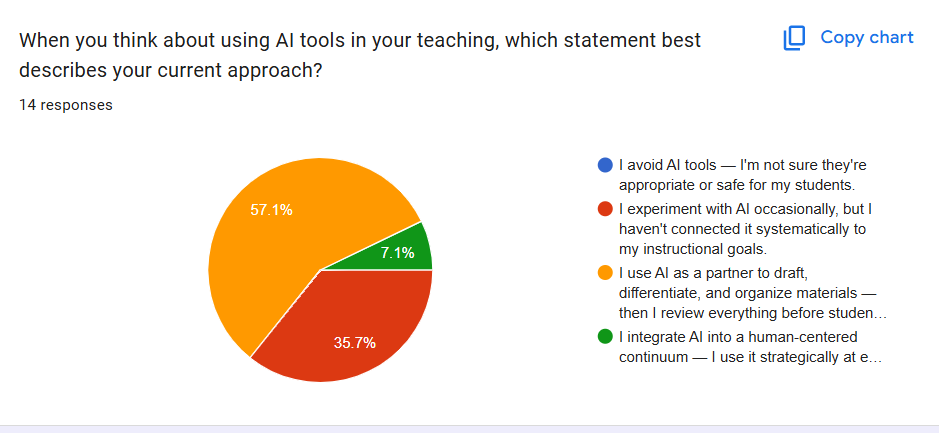
That’s how many teachers in this webinar cohort arrived describing their AI practice as experimental or avoidant — dipping into tools occasionally, without any systematic connection to their instructional goals. By the time the 90-minute webinar ended, 79 percent of those same teachers described themselves as using AI as a genuine partner or integrating it into a human-centered framework.
In 90 minutes.
I’m not sharing this to be impressive about the webinar. I’m sharing it because the shift tells us something important about what’s actually blocking teachers from using AI well — and it isn’t access to tools or even motivation. It’s the absence of a coherent framework that explains why human judgment has to stay at the center, and how AI fits inside that rather than replacing it.
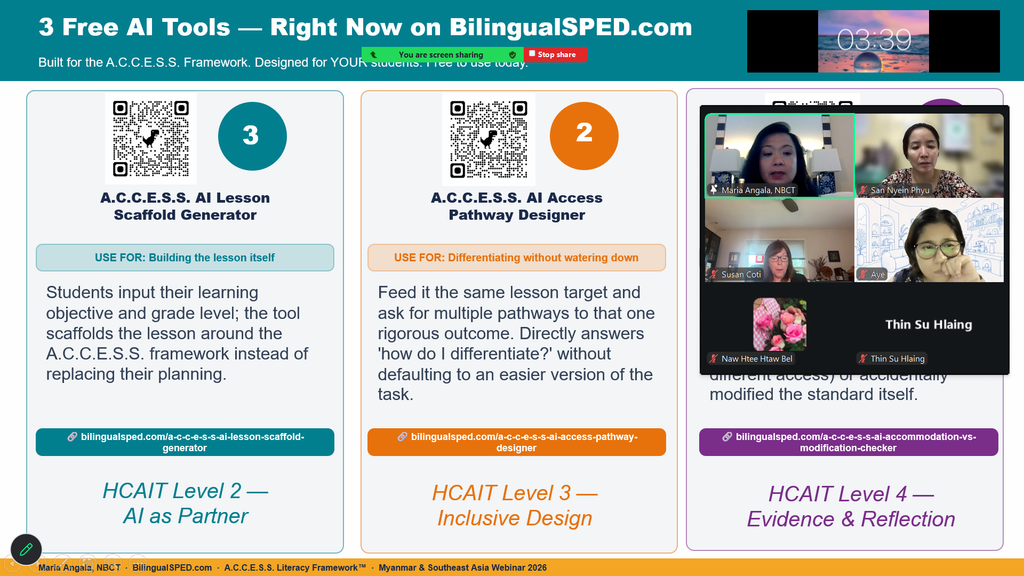
This case study documents what happened on September 26, 2026, when 14 educators from Myanmar and Southeast Asia joined a 90-minute integrated webinar: Humanizing AI for Vulnerable Students — The A.C.C.E.S.S. Framework and the Human-Centered AI Teaching Continuum. The pre/post data is specific, the teacher responses are direct, and the shift in conceptual understanding — particularly around the accommodation/modification distinction — is the most significant finding I’ve seen in a single-session webinar.
Watch the full webinar session here.
The Room Before the Webinar Began
Before I describe what changed, I need to describe what we started with — because the baseline matters for understanding what 90 minutes of coherent, targeted professional learning can and can’t do.
The cohort was small by design: 14 educators, primarily serving ELL and multilingual learners in Myanmar and across Southeast Asia, with classroom sizes that average 40+ students. Most of these teachers don’t have the luxury of small-group intervention models or specialist co-teachers. They are the intervention.
The pre-survey — administered moments before the webinar began — asked three questions on ordinal scales covering framework confidence, AI approach, and accommodation/modification understanding. Here’s what the baseline showed:
Study Parameters: Date: September 26, 2026 Format: 90-minute live webinar (6 structured segments) Cohort: 14 educators, Myanmar & Southeast Asia Survey design: Pre/post ordinal scales (3 questions each) + open-ended post reflection Matched pairs: 10 confirmed (same respondent in both surveys) Content covered: A.C.C.E.S.S. Literacy Framework (all 6 pillars) + HCAIT Continuum (5 levels) + Framework merger + 30-Day plan
Framework Confidence — The Baseline
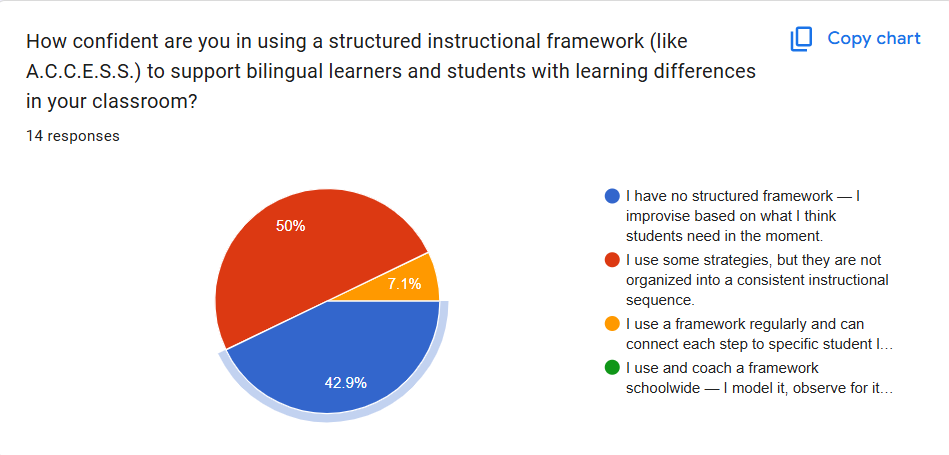
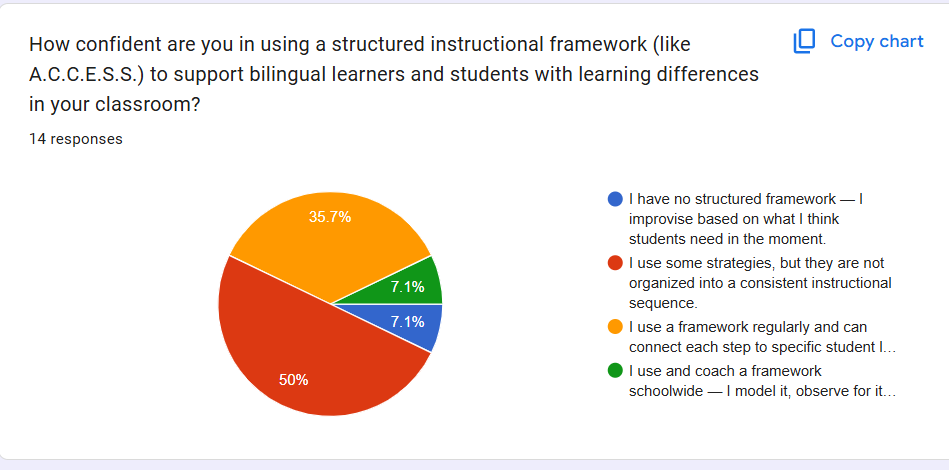
The vast majority of teachers — 10 of 14 — described themselves at Level 2: “I use some strategies, but they’re not organized into a consistent instructional sequence.” Only 2 described using a framework regularly, 1 used and coached a framework schoolwide, and 1 had no structured framework at all, improvising based on instinct.
This is a realistic picture of what teacher preparation often produces: practitioners who know pieces of good pedagogy without a coherent architecture that connects those pieces. The A.C.C.E.S.S. Framework was built precisely for this gap — not to introduce new strategies, but to give the strategies teachers already know a sequence and a purpose.
AI Approach — Where Teachers Started
Exactly half the cohort (7 of 14) described their AI approach as experimental — trying tools occasionally without systematic connection to instructional goals. Six were already using AI as a partner for drafting and differentiation with teacher review. Only one was integrating AI into a human-centered continuum strategically. Nobody was avoiding AI entirely.
The “experimenter” cluster is the most instructive. These are teachers who have encountered AI tools, found them interesting, and started using them — but without a framework for deciding when AI belongs in their instruction, what it should produce, and how to verify that the output serves their most vulnerable students rather than their average ones.
Accommodation vs. Modification — The Critical Gap
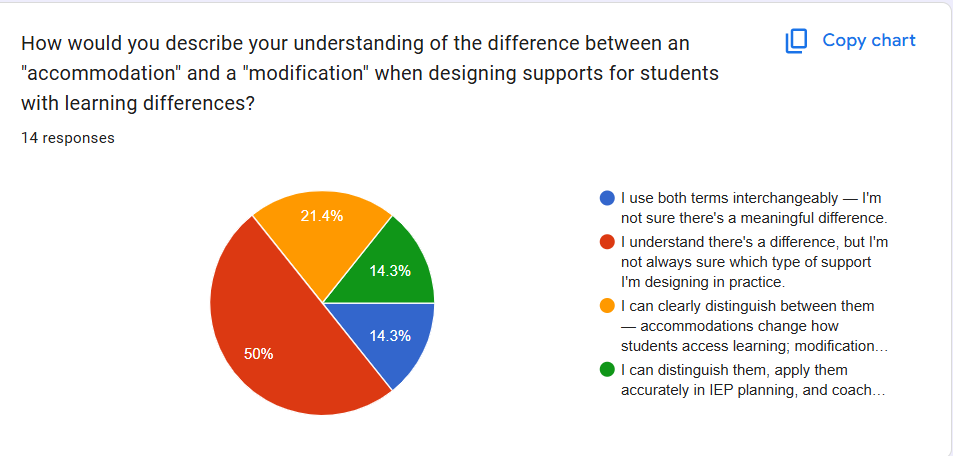
This is the finding I was least prepared for. Before the webinar, only 5 of 14 teachers (36 percent) could clearly distinguish between an accommodation and a modification. Two were using the terms interchangeably with no meaningful distinction. Seven understood there was a difference but were not always sure which type of support they were designing in practice.
For context: this distinction isn’t a technicality. It is the legal and pedagogical line between supporting a student’s access to learning and changing what that student is expected to learn. In IEP planning, getting it wrong doesn’t just produce a suboptimal lesson — it produces a legally non-compliant plan that may reduce a student’s documented learning expectations. In multilingual ELL classrooms, where misidentification of disability vs. language acquisition is already rampant, this distinction has outsized consequences.
The 90-Minute Architecture: Why the Sequence Mattered
The webinar wasn’t structured as a lecture followed by Q&A. It was built as a six-segment progression — each segment grounded in the same framework architecture I teach in my A.C.C.E.S.S. lessons. Which means the webinar itself was an A.C.C.E.S.S. lesson.
| Segment | Time | Content | A.C.C.E.S.S. Parallel |
| 1 | 0–10 min | Who We Are & Why This Matters — Teacher Sol story, the equity problem, who this framework was built for | Activate — connecting to prior knowledge |
| 2 | 10–30 min | The A.C.C.E.S.S. Framework — all 6 steps, the literacy gap, classroom application | Clarify — building the conceptual vocabulary |
| 3 | 30–55 min | The HCAIT Continuum — 5 levels, AI as partner not replacement, inclusive design | Chunk — making complexity manageable |
| 4 | 55–75 min | Merging the Two Frameworks — HCAIT as the engine inside each A.C.C.E.S.S. step | Engage — applying the learning actively |
| 5 | 75–85 min | Your 30-Day Action Plan — one step per week, starting Monday | Support — scaffolding transfer to practice |
| 6 | 85–90 min | Q&A + Closing + Certification pathway | Synthesize — consolidating and next steps |
The slide that anchored Part 2 of the webinar — the HCAIT Continuum — opened with a statement I use in every training context: “Generic AI = autopilot on the average route. Teaching diverse learners = off-road. You need a human driver who knows every bump.”
In SE Asia classrooms with 40+ students spanning multiple language backgrounds, that metaphor lands immediately. These aren’t average-route classrooms. The teachers in this cohort knew that before I said it. The framework gave them language for why their instinct to stay in the driver’s seat was right — and how AI could serve as a better co-pilot than they’d realized.
Finding 1: The AI Approach Shift Was the Headline Number
Before the webinar: 50 percent of teachers described themselves as experimenters — trying AI occasionally without systematic connection to instructional goals.
PRE-Webinar Survey
Post-Webinar Survey
Pre-Webinar Survey
Post Webinar Survey
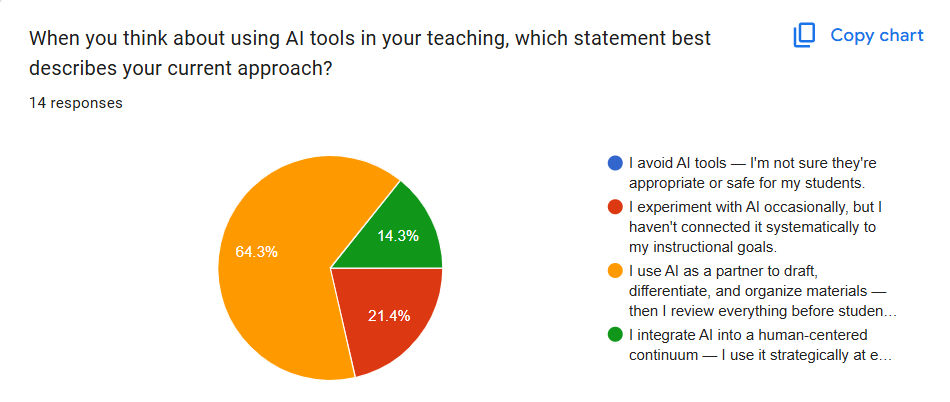
After the webinar: 79 percent described themselves as either using AI as a genuine partner (draft, differentiate, review before students see it) or integrating AI into a human-centered continuum strategically.
| AI Approach Level | Pre (n=14) | Post (n=14) | Change |
| Avoid AI tools entirely | 0 | 0 | — |
| Experiment occasionally, no systematic link | 7 (50%) | 3 (21%) | −4 ↓ |
| AI as partner — draft/differentiate, teacher reviews all | 6 (43%) | 9 (64%) | +3 ↑ |
| Full HCAIT integration — human-centered continuum | 1 (7%) | 2 (14%) | +1 ↑ |
What drove this shift? The ten matched-pair responses give us more granular data. Among respondents who moved from A2 (experimental) to A3 (partner), the post-survey change they described consistently named the same elements: identifying student needs first, using AI to generate materials, and reviewing everything before students see it. That three-step sequence is exactly Level 2 of the HCAIT Continuum — and it’s one 90-minute webinar away from being embedded in how these teachers think about their practice.
Nawhteehtawbel’s post-survey response was the most comprehensive description of what this shift looks like in practice:
| One specific change I will make is to use AI as a support tool while keeping teaching human-centered. Before using AI, I will first identify my students’ individual needs, especially students who have limited access to learning resources or feel less confident in English. Then I will use AI to create simple, level-appropriate activities, visual materials, and different learning options for them. I will still provide personal encouragement, feedback, and emotional support — so AI will support my teaching rather than replace the human connection between teacher and students. — Nawhteehtawbel, Myanmar ELL Teacher — Post-Survey, September 26, 2026 |
That response is not a recitation of what I said in the webinar. It’s a teacher translating a framework into their own context — identifying their most underserved students first, naming specific material types, and explicitly protecting the human relationship. That’s internalization, not recall.
Finding 2: The Accommodation/Modification Shift Was More Significant
If the AI shift was the headline, this was the data that surprised me most.
| Understanding Level | Pre (n=14) | Post (n=14) | Change |
| Use terms interchangeably — no meaningful difference | 2 (14%) | 0 (0%) | −2 ↓ |
| Understand there’s a difference, unsure in practice | 7 (50%) | 3 (21%) | −4 ↓ |
| Can clearly distinguish — access vs. expectation | 3 (21%) | 7 (50%) | +4 ↑ |
| Can distinguish, apply in IEP planning, coach others | 2 (14%) | 4 (29%) | +2 ↑ |
Before the webinar: 36 percent could clearly or expertly distinguish between accommodations and modifications. Two teachers were using the terms interchangeably — meaning students in their classrooms may have been receiving modifications (changed learning expectations) when the intent was accommodation (same standard, different access).
Pre-Webinar Survey
Post-Webinar Survey
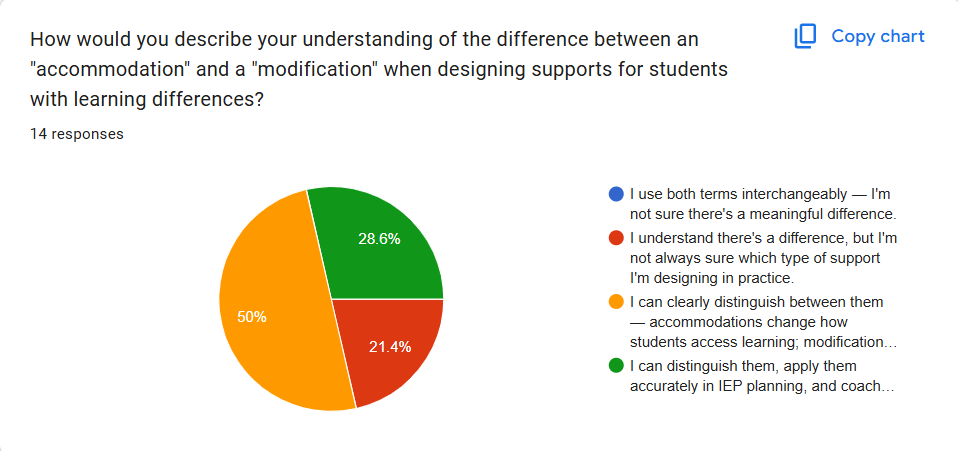
After the webinar: 79 percent could clearly or expertly distinguish the terms. The two teachers using them interchangeably both moved to at least M3 (clear conceptual distinction). And critically — 9 percent more teachers moved to the coaching level (M4), meaning they not only understood the distinction themselves but could now teach it to others.
This matters for the Myanmar context specifically. In SE Asian public school systems, formal IEP infrastructure is still emerging. Teachers are often making accommodation and modification decisions informally, without explicit training in the distinction. Getting this wrong quietly reduces learning expectations for students who are already underserved — usually by lowering the task rather than building the path.
The HCAIT Continuum’s Level 3 — Inclusive Design — directly addresses this through what the webinar slides called the “Clarify-or-Diagnose check”: is a student struggling because they’re acquiring English, or because of a learning disability? That framing landed visibly in the post-survey responses. Phoongonthant, who moved from M2 (unsure in practice) to M3 (clear distinction), described this specific change:
One specific change I will make is to use AI to create temporary, personalized scaffolds for students who need extra support, while keeping my own teaching judgment at the center. I can use AI to create simpler vocabulary explanations, sentence frames, visuals, or chunked texts for multilingual learners — but I will check and adapt them to fit my students' language and cultural context. — Phoongonthant, Myanmar Teacher — Post-Survey, September 26, 2026
Temporary scaffolds. Teacher judgment at center. Check and adapt for cultural context. That’s three HCAIT principles and two A.C.C.E.S.S. Support pillar principles in one paragraph. Written in a teacher’s own words, 90 minutes after encountering both frameworks for the first time.
Finding 3: The Specificity of What Teachers Plan to Do
The post-survey asked a single open question: describe ONE specific change you will make to your teaching practice, and explain how it will benefit your most underserved students. The range of responses — from brief to highly detailed — reveals something about where each teacher is in the HCAIT Continuum at the moment of writing.
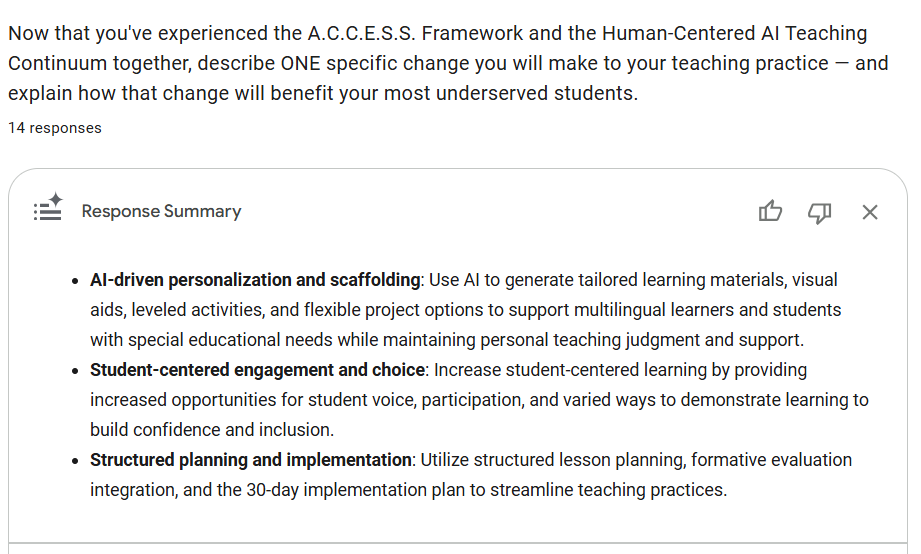
The responses cluster into four patterns:
- Student agency and choice architecture (3 teachers): Hay Mar Kyaw planned to give students more choices in activities and modalities — writing, audio, or visual projects — explicitly connecting this to underserved students feeling valued and confident. Pannei Hnin Si described AI-assisted choices letting students demonstrate learning through different modes. These responses map to HCAIT Level 5: Student Agency.
- Human-centered AI as differentiation tool (4 teachers): Multiple teachers described a sequential process: identify needs first, use AI to generate level-appropriate materials, review everything before distribution. This is HCAIT Level 2 in action — the teacher as editor-in-chief, AI as copy writer.
- Structured lesson planning for the first time (2 teachers): Sannyeinphyu described creating lesson plans and wanting to try IEP planning next. Nangayemyakyi committed to following the 30-Day implementation plan across Social Studies and English. Both represent teachers moving from improvisation (L1/L2 framework) toward structure — the foundational shift the A.C.C.E.S.S. Framework is designed to produce.
- Human connection as the non-negotiable anchor (2 teachers): Htunmaythazin’s response — “AI can’t show their problems but human can” — is the most distilled statement of HCAIT Level 1 in the entire dataset. Brief, definitive, and correct. Chit Min’s response — “A lot. I will change my teaching styles” — with Level 4 full HCAIT integration selected, suggests a teacher who already understood the framework deeply and is now naming the permission the webinar gave them.
Aye Kyaw Tint’s response deserves specific attention because it named something most post-survey responses avoid: the gap between understanding a framework and being fluent enough with the tools to implement it.
I sometimes face difficulty in applying the framework to generate forms because I am still becoming familiar with the tools and formats. As I gain confidence and fluency with these tools, I will be able to design more effective materials. This improvement will especially benefit my SEN learners, since clearer and well-structured forms will make learning tasks more accessible and supportive for them. — Aye Kyaw Tint, Teacher — Post-Survey, September 26, 2026
That honesty is actually the most accurate response in the dataset. Knowing a framework and being fluent in the tools that implement it are two different things. And the 30-Day implementation plan the webinar closed with — one week per A.C.C.E.S.S. pillar pair — was designed precisely to close that gap gradually rather than demanding fluency immediately.
🛒 CLASSROOM TOOLKIT | If you want the ready-made version of the tools used in this webinar — the 30-Day A.C.C.E.S.S. implementation planner, the HCAIT Continuum self-assessment, the accommodation vs. modification checker, and differentiated lesson templates aligned to each A.C.C.E.S.S. pillar — the complete Humanizing AI for Vulnerable Students Toolkit is available now. Grab it on TpT here → teacherspayteachers.com/store/maria-angala-nbct
Why These Two Frameworks Belong Together — The Case the Data Makes
The webinar’s title was Humanizing AI for Vulnerable Students. The claim in that title is that AI, without a human-centered framework, doesn’t automatically serve the students who need it most. It serves average students in average contexts — which is not who these 14 teachers are teaching.
The webinar slide that made this explicit showed four numbers from the room these teachers work in:
- 68% of 4th graders reading below proficiency (NAEP National Reading Report)
- 40+ average students per classroom in SE Asia
- 1 in 5 students has a language-based learning disability — most going unidentified, especially ELL students
- 75% of teachers report insufficient training in differentiated instruction for diverse learners
That last statistic is what makes the accommodation/modification finding so significant. If 75 percent of teachers feel undertrained for differentiated instruction, and 64 percent arrived at this webinar unsure about or interchangeable with the most fundamental distinction in designing supports — then the gap isn’t about effort or motivation. It’s about having a framework.
The A.C.C.E.S.S. Framework addresses the instructional architecture: how a lesson moves from activation through synthesis in a way that builds access without lowering standards. The HCAIT Continuum addresses the AI layer: how technology fits inside that architecture without displacing the teacher’s diagnostic judgment. Together, they answer the question these teachers are actually carrying into their 40-student classrooms every day.
What do I do when every student needs something different and I’m the only expert in the room?
The answer isn’t more tools. It’s a better framework for deciding which tools serve which students, checked by a teacher who knows the difference between an accommodation and a modification, between a scaffold and a shortcut, between AI as an assembly line and AI as a thoughtful co-planner.
References & Further Reading
1. Artificial Intelligence Integration in TESOL Teacher Education — TESOL Quarterly / Wiley (2025)
3. Short on Resources, Special Educators Are Using AI — The Conversation (2026)
4. Vygotsky’s Zone of Proximal Development and Scaffolding in Education — Simply Psychology (2024)
Frequently Asked Questions
Q1: How does the HCAIT Continuum work inside the A.C.C.E.S.S. Framework — aren’t they two separate things?
They’re not separate — they’re nested. The A.C.C.E.S.S. Framework provides the instructional architecture: the sequence of Activate, Clarify, Chunk, Engage, Support, and Synthesize that makes rigorous learning accessible to diverse students. The HCAIT Continuum operates as the engine inside each step, determining how AI participates at each stage and under whose judgment. For example, in the Clarify step, AI can generate bilingual vocabulary cards with visuals and sentence frames in seconds — but the teacher checks cultural accuracy, adds examples from students’ own communities, and decides which 3–5 words to actually teach. AI did the drafting; the teacher made every decision that actually matters. That’s Level 2 of the Continuum (AI as Partner) living inside A.C.C.E.S.S. Clarify. The webinar’s fourth segment was dedicated entirely to this merger — showing the A.C.C.E.S.S. step on the left, the AI tool on the right, and the human safeguard in the middle. The safeguard column never disappears.
Q2: What is the practical difference between an accommodation and a modification — and why does it matter in SE Asia classrooms?
An accommodation changes how a student accesses or demonstrates learning without changing the standard itself — think leveled texts targeting the same comprehension skill, sentence frames for the same writing task, extended time on the same test. A modification changes the actual learning standard or expectation — asking a student to identify one main idea instead of three when the standard requires three, or removing sections of a text so the comprehension demand is genuinely lower. The distinction is legally significant wherever IEP frameworks exist, and pedagogically significant everywhere else: a teacher who simplifies a task when they mean to scaffold it is lowering the ceiling for a student who was capable of reaching it. In SE Asia classrooms where ELL students are frequently misidentified or under-supported, this distinction determines whether a student receives help that builds capacity or help that quietly reduces expectation. The webinar’s pre/post data showed that 64 percent of teachers arrived unsure of or conflating this distinction — and 79 percent left with clear or expert-level understanding. That’s the shift with the highest equity stakes.
Q3: Can the A.C.C.E.S.S. Framework and HCAIT Continuum realistically be implemented in classrooms with 40+ students and limited resources?
Yes — and the SE Asia classroom context is actually where these frameworks were specifically tested in this webinar. The A.C.C.E.S.S. Framework’s Chunk pillar was explicitly designed for large classrooms: one complex reading, divided into 2–3 sections, with one guiding question per section and groups working one chunk at a time. That’s a structural differentiation strategy that doesn’t require individualized materials for every student — it requires one well-designed sequence. The HCAIT Continuum at Level 2 reduces the prep burden by letting AI generate bilingual vocabulary cards, chunked passages at two reading levels, and RACE sentence frames for different proficiency levels — with the teacher reviewing and adapting rather than creating from scratch. The webinar’s 30-Day implementation plan structures the full framework into four weeks of single-pillar focus: Activate + Clarify in week one, Chunk in week two, Engage + RACE in week three, Support + Synthesize in week four. One step at a time, starting Monday. That pace is designed for teachers who are also managing 40 students, limited prep time, and variable institutional support.
The Question the Closing Slide Left in the Room
The webinar closed with a question — not a summary, not a recap, not a list of resources. A question:
If a student truly internalizes the difference between AI as a scaffold and AI as a shortcut — how might that change their future? In college, at a job, in places where no one hands them an accommodation anymore — where they have to advocate for and direct their own support. — A.C.C.E.S.S. Literacy Framework™ Closing Reflection — Myanmar & SE Asia Webinar 2026
That question is the whole framework in one sentence. We’re not building AI users. We’re building independent learners who know how to use tools — including AI — to access their own growth rather than bypass it.
The 14 teachers in this cohort are teaching students who will graduate into a world where AI is ambient — in every job, every platform, every device. The question of whether those students use AI as a scaffold or a shortcut will be shaped, in part, by whether their teachers know the difference first.
This case study is evidence that 90 minutes of well-designed professional learning can shift that understanding significantly. It isn’t evidence that 90 minutes is sufficient. The 30-Day plan, the certification pathway, the community of practice — those are what come next.
AI with a human heart. Literacy without limits.
You Might Also Like
📖 Teaching Across Borders: What Happened When the A.C.C.E.S.S. Framework Reached Myanmar
📖 Case Study: What 113 Pre-Service Teachers Said After One HCAIT Session
📖 When 31 Teachers Examined Their Own Classrooms: A.C.C.E.S.S. Framework Case Study
📖 Why the A.C.C.E.S.S. Literacy Framework Is Built Like a Bridge
📖 Real-Time Differentiation Without the Extra Prep Hours
📖 10 Executive Functioning AI Prompts for SPED Teachers, OTs and SLPs
📬 Get the Research Before It Publishes This case study is part of an ongoing series documenting the A.C.C.E.S.S. Framework and HCAIT Continuum in classrooms across Myanmar, the Philippines, and the United States. Subscribers get the data, the tools, and the framework updates as they happen — not months later. Join thousands of SPED and ELL educators who are already building human-centered AI practice with real frameworks and real data. → Sign up at: www.bilingualsped.com
Before You Go — A Reflection Question
💬 For You: The most significant shift in this webinar's data wasn't the AI approach. It was the accommodation/modification distinction — moving from 36 percent clarity to 79 percent clarity in 90 minutes. Think about the last time you modified a task for a struggling student. Looking at it now — was it an accommodation, or did you quietly change what the student was being asked to learn? And if it was a modification: what would the accommodation version of that same task have looked like? Drop your answer in the comments below. This is the question that changes practice — and I read every response.