Handing every classroom an AI tool doesn’t automatically create equity — it just creates access, and those aren’t the same thing. This post looks at why true AI equity depends on teachers’ cultural responsiveness, instructional judgment, and expertise with multilingual learners and students with disabilities, not on which platform a district purchased. Written from 22+ years in bilingual special education, not a tech marketing deck.
The Assumption That Keeps Bugging Me
I keep hearing some version of this sentence in professional development sessions: “Once every student has access to AI, we’ll have leveled the playing field.” And every time, I want to gently raise my hand and say — no. That’s not how equity works. Never has been.
Access is the floor, not the finish line. A multilingual learner with a disability can have the exact same AI tool open on the exact same device as everyone else in the room and still be completely locked out of the actual learning, if nobody adjusted that tool for language, culture, sensory needs, or disability-specific supports. The tool doesn’t know any of that on its own. It just runs the same way for everybody unless a teacher steps in and makes it not do that.
Which is honestly the whole argument of this post. AI equity doesn’t start with technology. It starts with teachers — specifically, with our professional judgment about what a specific kid, in front of us, right now, actually needs.
So let’s dig into why this distinction matters so much, what happens when we skip it, and how you actually build equitable AI use into your classroom instead of just handing out logins.

Why Doesn’t Access Automatically Create Equity?
Here’s the research-backed version of what I described above. A qualitative study on AI and culturally responsive teaching found something worth sitting with: AI tools can genuinely support personalized learning, and students appreciated that support — but the same study found the tools frequently forgot each student’s cultural background, missing something the researchers called essential to the work. In other words, the personalization was real, but the cultural responsiveness had to come from somewhere else. It had to come from the teacher.
And the language gap is even more direct. A 2026 review on AI and the digital divide found that most AI educational tools are still built predominantly for English or a handful of major international languages, with limited accommodation for everything else. If your multilingual learners speak a language outside that narrow band, the “equity” of an AI tool can evaporate fast, unless a teacher is actively working around that limitation.
Quick Win: Before assuming an AI tool “works” for your class, test it specifically with your least-represented language or your most complex disability profile. If it falls apart there, it’s not actually equitable yet — it’s just convenient for the majority.
What Culturally Responsive AI Use Actually Looks Like
1. Multilingual Access That Goes Beyond Translation
Real language equity isn’t just running text through a translator. It’s checking whether the cultural framing of a word problem, a story, or an example even makes sense in a student’s context. I’ve noticed AI-generated content sometimes swaps in culturally specific references that mean nothing — or worse, feel alienating — to a student from a different background. That’s not a small glitch. Researchers auditing AI-generated math word problems across languages found exactly this kind of cultural mismatch happening at scale, which tells you it’s a pattern, not a one-off.
Tools like Google Translate and DeepL are strong starting points for multilingual visual supports, but the review pass — checking cultural fit, not just word accuracy — has to be human. Every time.

2. Disability-Specific Adjustment, Not Generic Personalization
AI can adapt reading level. It can generate practice problems at scale. What it can’t do on its own is know that a specific student needs sensory accommodations built into every activity, or that another student processes information best through social stories rather than direct instruction. One report from a state department of education specifically noted that speech-to-text tools help students with learning differences or physical disabilities gain independence, and that AI-powered captioning and translation tools remove real barriers for multilingual learners and students with hearing or visual differences — but that framing only holds when a teacher is deliberately pairing the right tool to the right need, not just turning a feature on for everyone.
3. Teacher Judgment as the Actual Equity Mechanism
Here’s the piece I think gets lost the most: equity isn’t a setting you toggle on inside a platform. It’s a series of small, constant decisions a teacher makes — this student needs the visual support in Spanish and in photographs, not icons; this student needs the AI-generated text simplified twice, not once; this student needs a social story before the AI tutoring session, not after. None of that is in the tool’s control panel. It’s in your head, built from watching this kid work for months.
A piece in Language Magazine put it about as clearly as I’ve seen anywhere: AI won’t replace bilingual educators, but used thoughtfully, it can support personalized, culturally affirming, linguistically inclusive education for emergent bilingual students — as long as teachers remain at the center of instruction, not the tool.
Quick Win: Keep a running list — literally a notes app is fine — of the small adjustments you make to AI-generated content for specific students. Over a semester, that list becomes your actual equity playbook, way more useful than any vendor’s marketing page.
A Lesson Where the Difference Between Access and Equity Was Obvious
Classroom context: A small group of students working through a persuasive writing unit — one multilingual learner still building English proficiency, one student with a specific learning disability who also needed sensory breaks built into any independent work.
The instructional challenge: The AI-generated writing prompts and sentence starters worked fine as a baseline, but straight out of the box they were entirely in English, text-heavy, and had zero built-in pacing for sensory regulation. Handing them over as-is would’ve technically been “AI access.” It would not have been equity.
The lesson approach: I translated the sentence starters into the student’s home language and paired them with a visual organizer instead of a wall of text. For the student needing sensory regulation, I broke the AI-generated writing task into shorter chunks with a visual break card between each one, plus a short social story about “what to do when I need a break but I’m not done yet” — something the AI tool obviously hadn’t generated on its own, because it doesn’t know that student.
Student response: The multilingual learner produced a full persuasive paragraph in her home language first, then worked with me to translate her own ideas into English — which, honestly, produced far more authentic writing than if she’d tried to think and write in English simultaneously. The student using the break card system completed the entire writing task across three shorter sessions instead of melting down thirty minutes in, which used to be the norm before I built the pacing in.
Teacher reflection: I’ll admit I almost used the AI-generated prompts as-is the first time, because they looked complete and professional on the screen. In my experience, “looks finished” and “is actually equitable for this specific kid” are two completely different things, and it’s an easy trap to conflate them when you’re short on planning time.
What I’d refine next time: I’d build a standard multilingual and sensory-adjusted version of any AI-generated writing prompt before the lesson, not during it — the same way I’d prep any other differentiated material in advance. Which is exactly why I ended up building a resource around this instead of recreating it lesson by lesson.
If you want a ready-made version of exactly this kind of adjusted material — sensory accommodations, visual supports built for multiple languages, social stories included — I created a complete classroom toolkit for this, and you can grab the AI-Supported IEP Writing Toolkit on TpT here.
What Happens When Equity Gets Skipped
This isn’t a hypothetical concern. A study of teachers across dozens of countries found real, measurable cultural bias baked into how large language models respond, meaning the “neutral” AI output your students receive may already carry assumptions that don’t reflect their background. And in special education specifically, where 2.1 million students are receiving services in just one country’s most recent school census alone according to Brazilian teacher survey data — a 58.7% increase in five years — the scale of who’s affected by these gaps is not small. It’s the whole reason this conversation matters as much as it does.
Skipping the teacher-judgment step doesn’t just create a mediocre experience. It quietly recreates the exact same access gaps AI was supposed to help close in the first place.
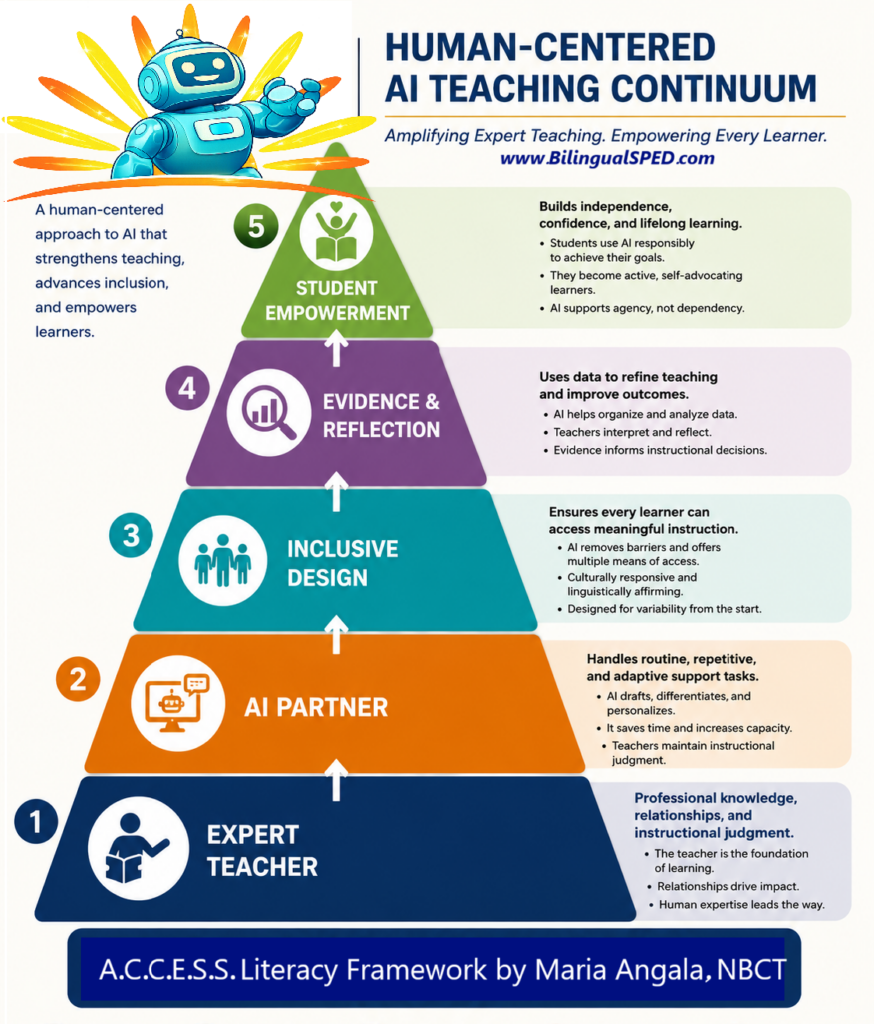
I also developed a Human-Centered AI Teaching Continuum embedded within the A.C.C.E.S.S. Literacy Framework to guide educators in using AI ethically and effectively to amplify expert teaching for multilingual learners and students with disabilities.
Quick Win: When evaluating any AI tool for equity, ask specifically: does this tool perform as well for my multilingual and disabled students as it does for the “default” student it was probably tested on? If you don’t know the answer, that’s worth finding out before you rely on it.
Frequently Asked Questions
Does giving students access to AI tools automatically improve educational equity?
No — access is necessary but not sufficient. Research shows AI tools often miss cultural context and default to major languages, meaning true equity requires teachers to actively adjust tools for language, culture, and disability-specific needs rather than assuming the technology handles this on its own.
How can teachers make AI tools more culturally responsive?
Start by checking whether AI-generated content reflects your students’ cultural context, not just their language — word problems, examples, and references can be technically translated yet still culturally mismatched. Pair AI output with your own knowledge of the student, and adjust accordingly every time.
What’s the biggest mistake schools make when trying to use AI for equity?
Treating equity as a distribution problem — handing every student the same tool — rather than a professional judgment problem. The research consistently points back to teachers as the actual mechanism that makes AI use equitable, not the platform itself.
References
- Grab, M.O., “Teaching for Equity: An Exploration of AI’s Role in Culturally Responsive Teaching in Higher Education Settings”, Innovative Higher Education (2026)
- Language Magazine, “AI as a Tool for Inclusive Bilingual Education” (2025)
- Frontiers in Computer Science, “AI and the Digital Divide in Education” (2026)
- California Department of Education, “Artificial Intelligence – Professional Learning” (2026)
- arXiv preprint, “Artificial Intelligence for All? Brazilian Teachers on Ethics, Equity, and the Everyday Challenges of AI in Education” (2025)
Where to Go From Here
AI equity was never going to come from a purchase order. It comes from teachers making hundreds of small, informed decisions about how a tool needs to bend around a specific kid, in a specific language, with a specific set of needs — instead of expecting the kid to bend around the tool. That’s not a new skill for us, honestly. It’s the same instructional judgment special educators have always brought to the table. AI just raised the stakes on using it well.
If you’d rather not rebuild these adjustments from scratch every unit, the AI-Supported IEP Writing Toolkit — built around exactly this kind of multilingual, sensory-aware, disability-specific adjustment — is available on TpT here.
Want more honest, classroom-tested thinking on making AI actually equitable for multilingual learners and students with disabilities? Sign up for my email newsletter and I’ll send new strategies straight to your inbox.
Reflection question: Think about one AI tool you’ve used recently in your classroom. Did you adjust it for a specific student’s language, culture, or disability needs — or did you use it exactly as it came? What would change if you built that adjustment in from the start next time?
You Might Also Like
More strategy and tools like this over at the BilingualSPED.com blog — including posts on the A.C.C.E.S.S. Literacy Framework, culturally responsive instruction, and equity-centered classroom practices for multilingual learners.